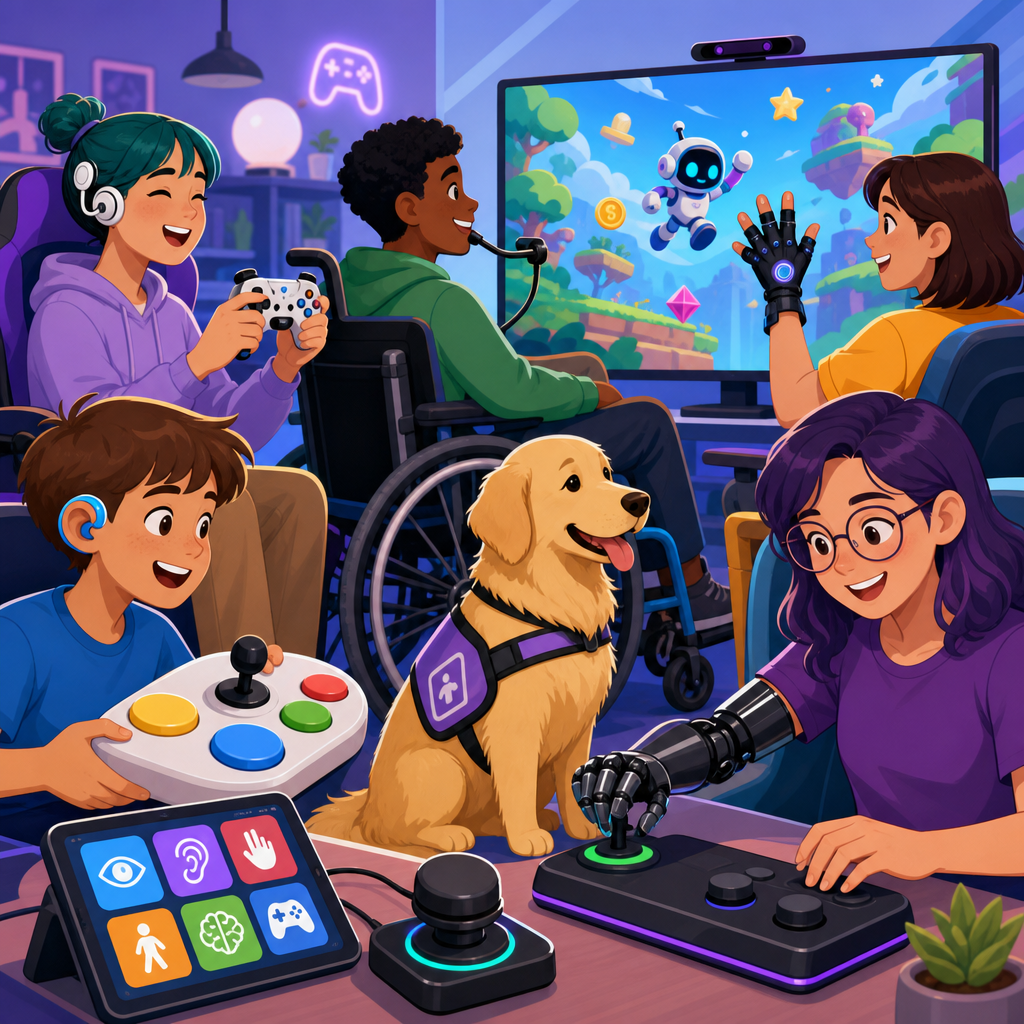
Accessible gaming technologies are advancing faster than any other area of interactive entertainment, and that momentum is reshaping how players with disabilities experience mainstream games, esports, mobile titles, and emerging platforms. In this hub article, The Latest in Accessible Gaming Technologies explores future trends and predictions in ADA developments as they apply to game design, hardware, software, and policy. Accessible gaming refers to the tools, standards, and design choices that reduce barriers for players with mobility, vision, hearing, cognitive, or speech-related disabilities. ADA developments matter here because the Americans with Disabilities Act influences how companies think about equal access, customer service, digital experiences, and public accommodations, even when gaming law itself is still evolving. After working with accessibility audits, controller remapping projects, and usability testing sessions that included disabled players, I have seen a clear pattern: accessibility stops being a niche feature the moment teams treat it as core product quality. That shift is driving the next wave of innovation.
Why does this topic matter now? Because the market, the technology, and the legal environment are converging. Major publishers now ship presets for low vision, subtitle customization, hold-to-toggle alternatives, aim assistance tuning, and single-stick adaptations. Platform holders have released accessible controllers, system-level screen readers, and speech services that reduce implementation costs for developers. At the same time, disability advocates are demanding consistency, not one-off gestures. Search trends, support tickets, and community feedback all point to the same question: what comes next in accessible gaming? The answer is broader than better menus. Future progress will include interoperable hardware, AI-assisted accessibility testing, enforceable procurement standards, stronger captioning and haptic conventions, and clearer expectations around digital inclusion. This article serves as the central guide for readers tracking updates and developments in ADA-related gaming access, helping connect product trends with the practical realities of compliance, design, and player experience.
Accessible gaming in 2025: the baseline is rising
The most important recent development is that accessibility expectations have moved from optional enhancements to baseline quality indicators. A decade ago, developers could earn praise for adding subtitles and basic remapping. Today, those features are entry-level. The current baseline includes scalable text, subtitle speaker labels, contrast controls, colorblind-safe visual design, remappable controls, toggle alternatives for repeated inputs, aim and camera adjustments, menu narration, and checkpoints that respect fatigue and dexterity limits. In my own reviews of game builds, the absence of these features now predicts poor retention among disabled players almost immediately. Studios that integrate accessibility from preproduction spend less fixing systems later, because combat, UI, onboarding, and progression mechanics are already designed to flex around different needs.
This baseline is being shaped by public examples. Games such as Forza Horizon 5, The Last of Us Part I, and God of War Ragnarök demonstrated how extensive accessibility options can coexist with commercial success and critical acclaim. Those titles normalized features like audio cues for traversal, high-contrast navigation support, puzzle assistance, and detailed subtitle controls. They also showed a practical lesson: accessibility settings should not be buried or explained with vague language. Players need labels that describe outcomes clearly. Instead of “assist mode,” strong implementations specify what changes, such as slowing game speed, extending timing windows, or reducing repeated button presses. That level of precision will define the next generation of accessible gaming standards.
Future ADA developments will influence gaming through policy, procurement, and platform rules
When people ask whether the ADA directly governs every aspect of game design, the honest answer is nuanced. The strongest near-term impact is likely to come through connected areas: digital service expectations, public accommodation debates, educational gaming environments, workplace training software, esports venues, and government procurement. Schools, libraries, universities, and public institutions increasingly buy gaming-adjacent technology for education and recreation. When those buyers require accessible interfaces and input options, developers respond. I have seen procurement questionnaires become powerful leverage points, because a single accessibility requirement in a purchasing contract can push features into a product roadmap faster than months of public requests.
Platform governance will matter just as much as formal regulation. Console storefront standards, mobile operating system requirements, and cloud gaming certification checklists can function like de facto rules. If a platform mandates subtitle support, controller remapping hooks, or compatibility with system-level assistive technologies, publishers will build to that requirement. Future ADA developments are therefore likely to shape gaming indirectly but forcefully: through vendor risk reviews, event accessibility obligations, antidiscrimination expectations in online services, and standardized accessibility disclosures. The industry is moving toward a world where saying “we did not think about disabled players until launch” is not just a design failure but a business risk.
Hardware innovation is shifting from specialized devices to interoperable ecosystems
The biggest hardware trend is interoperability. Early accessible gaming hardware often depended on custom setups assembled by players, nonprofits, and families. That ingenuity remains vital, but the market is changing. Devices like the Xbox Adaptive Controller and Sony’s Access controller established a new direction: modular hubs with large buttons, switch inputs, joystick options, and profile management. The next step is broader compatibility across consoles, PCs, mobile devices, and cloud services. Players should not have to rebuild their setup every time they switch platforms. Manufacturers understand this, and future products will increasingly support standardized ports, software profiles stored in the cloud, and companion apps that simplify calibration.
Ergonomics will also become more personalized. Expect more controllers with adjustable resistance, swappable stick heights, programmable dead zones, and mounting support for wheelchairs, desks, and bed trays. Eye tracking and head tracking will improve as camera systems become cheaper and machine vision gets better at filtering background noise and lighting changes. Sip-and-puff systems, foot pedals, and one-handed control schemes will continue to mature, but the key prediction is integration, not isolation. Accessible gaming hardware will increasingly be recognized as mainstream premium hardware. That matters because scale lowers cost, improves retail availability, and reduces the stigma that often surrounds assistive peripherals.
| Technology area | Current state | Likely next development | Player benefit |
|---|---|---|---|
| Adaptive controllers | Configurable hubs with external switches and buttons | Cross-platform profiles and simpler wireless pairing | Less setup friction across devices |
| Screen readers and menu narration | Available on some platforms and selected games | System-level APIs adopted by more engines | More consistent navigation for blind players |
| Speech recognition | Used for commands and dictation in limited contexts | Lower-latency local processing and better accent support | More reliable hands-free interaction |
| Haptics | Basic vibration cues or premium controller effects | Standardized informational haptics beyond rumble | Clearer nonvisual feedback during play |
| Cloud gaming | Accessibility depends on client and service design | Device-agnostic input mapping and remote accessibility presets | Access on lower-cost hardware |
Software accessibility will become more predictive, adaptive, and testable
Software is where the most visible gains will occur over the next few years. Expect accessibility settings to become more dynamic and context-aware. Instead of forcing players to choose every option manually, games will increasingly offer guided setup based on plain-language questions: do you want fewer repeated inputs, stronger navigation cues, reduced visual clutter, or more time for combat reactions? Better still, systems will suggest changes when they detect friction, such as repeated failed quick-time events or menu abandonment. Used responsibly, this kind of adaptive support can reduce frustration without making players feel singled out.
Another major trend is structured accessibility testing. Leading teams are already incorporating disabled players into usability studies and bug triage, but the future will involve tighter integration with QA pipelines. Engines and middleware can flag low-contrast UI, unsupported text scaling, missing captions, and inaccessible focus order before release. The closest analogy is performance testing: once teams can measure accessibility defects consistently, they can manage them. I expect more studios to adopt documented accessibility acceptance criteria tied to user stories, similar to how they track frame rate targets or crash rates. That operational change is more important than any single feature, because it makes accessibility repeatable across franchises and updates.
AI, machine learning, and generative tools will help, but only with human oversight
AI will play a real role in accessible gaming, though not in the simplistic way marketing often suggests. Automatic caption generation, speech enhancement, personalized text simplification, and real-time input remapping are all useful applications. Machine learning can also help detect patterns in telemetry that indicate accessibility barriers, such as where players abandon tutorials, fail certain mechanics at unusual rates, or disable the game after specific prompts. I have used analytics in exactly this way, and it often reveals hidden friction that standard QA misses. For example, a spike in deaths during a visual effect-heavy boss sequence may indicate not difficulty alone, but contrast, clutter, or unreadable telegraphing.
Still, AI cannot decide what accessibility means for players. Auto-generated captions may mishandle speaker changes, sound effects, or proper nouns. Visual descriptions can omit critical interactive details. Adaptive difficulty systems may help one player while undermining another player’s intended experience if controls are changed without consent. The future trend to watch is assisted implementation, not automated substitution. The best studios will use AI to accelerate testing, transcription, translation, and bug detection, while relying on disabled consultants and community testers for validation. In accessibility work, human context is never optional.
Multisensory design will define the next standard for inclusive gameplay
One of the clearest predictions for accessible gaming technologies is the move from single-channel communication to multisensory design. Important information should not be locked to sound alone, or vision alone, or rapid motor execution alone. A doorbell in a horror game can be heard, subtitled, visualized, and represented through haptic cues. Enemy direction can be indicated with spatial audio, on-screen markers, and controller feedback. Objectives can be reinforced with concise text, iconography, and narration. This is not just good accessibility; it improves usability for players in noisy rooms, on small screens, or with temporary impairments.
Haptics deserve special attention here. Most games still treat vibration as atmosphere rather than information. That is changing. Better haptic patterns can signal reload status, incoming danger direction, stamina thresholds, rhythm timing, or off-screen events. To be truly useful, these patterns must be documented, consistent, and adjustable in intensity. Similar progress is happening in audio accessibility, where features like mono audio, independent channel balancing, dynamic range controls, and customizable cue volume can make play dramatically more manageable. Future standards will reward games that communicate key mechanics redundantly across multiple channels without overwhelming the player.
Cloud, mobile, and social gaming will expand access while creating new compliance questions
Cloud gaming has major accessibility potential because it reduces dependence on expensive local hardware. A player may be able to use an older tablet, a browser, or a lightweight laptop while relying on remote processing. That can lower cost barriers and extend the life of adaptive peripherals. Mobile gaming also remains central, especially because smartphones already include mature assistive features such as VoiceOver, TalkBack, switch access, magnification, and voice control. The opportunity is obvious: if games integrate properly with operating system accessibility APIs, millions of users gain immediate support. The challenge is consistency, since many developers still bypass native patterns in pursuit of custom interfaces that break assistive technology compatibility.
Social and online features introduce another layer of ADA-related development. Voice chat moderation, text chat readability, report flows, anti-harassment systems, and identity settings all affect disabled players’ real access to gaming spaces. A perfectly accessible menu means little if a deaf player cannot coordinate with teammates, or if a player using synthetic speech is harassed in ranked play. Future developments will therefore include better live captioning, speech-to-text, text-to-speech, communication presets, and moderation tools designed with disability in mind. Inclusive gaming is not only about inputs and outputs; it is also about whether players can participate safely and fully in the community around the game.
What developers, publishers, and players should do next
The direction of travel is clear. Accessible gaming technologies are becoming more standardized, more integrated, and more visible across the full product lifecycle. ADA developments will continue to influence the industry through procurement, platform rules, public expectations, and broader digital accessibility norms. Hardware will become more interoperable, software will become easier to test, and multisensory design will replace one-size-fits-all interaction models. The studios that lead this shift will not be the ones chasing headlines with isolated features. They will be the teams that build accessibility into concept documents, design systems, quality gates, patch planning, and community support.
For publishers and developers, the practical next step is simple: treat accessibility as a release criterion, not a stretch goal. Use recognized guidance such as platform accessibility recommendations, captioning best practices, inclusive research methods, and structured testing with disabled players. For players, advocates, and buyers, keep asking better questions: Can text scale everywhere? Are controls fully remappable? Does the game support screen readers, communication aids, and low-vision play? Those questions move the market. As this hub for future trends and predictions in ADA developments grows, use it to track the policies, tools, and design patterns that will define the next era of accessible gaming.
Frequently Asked Questions
What are the most important accessible gaming technologies shaping the industry right now?
The most influential accessible gaming technologies today span hardware, software, interface design, and platform-level support. On the hardware side, adaptive controllers, modular input devices, customizable switches, eye-tracking systems, one-handed peripherals, and alternative joysticks are giving players more ways to interact with games based on their specific mobility and dexterity needs. These devices are becoming more flexible and more compatible with mainstream consoles, PCs, and mobile ecosystems, which is a major shift from the past when accessibility often depended on specialized, expensive, or hard-to-source equipment.
Software is advancing just as quickly. Modern games increasingly include remappable controls, hold-to-toggle options, stick sensitivity adjustments, subtitle customization, high-contrast modes, text-to-speech and speech-to-text tools, aim assistance, navigation assistance, and difficulty customization that supports a wider range of cognitive, sensory, and physical needs. Screen reader support and menu narration are also improving, especially in titles that are being built with accessibility in mind from early development stages instead of adding features late in production.
Another major development is the rise of operating system and platform accessibility settings that work across multiple games rather than title by title. Console accessibility dashboards, PC-level assistive integrations, and mobile accessibility APIs are helping players maintain consistent experiences across devices. The overall trend is clear: accessible gaming is no longer defined only by niche assistive tools. It is increasingly becoming a standard part of mainstream game design, product planning, and player experience strategy.
How are ADA-related developments and accessibility standards influencing game design?
ADA-related developments are influencing game design less through one single rulebook and more through a broader legal, ethical, and market expectation that digital experiences should be usable by more people. While the Americans with Disabilities Act was not originally written specifically for video games, its principles increasingly shape how developers, publishers, and platform holders think about access, usability, and inclusion. In practice, that means studios are paying closer attention to whether players can perceive information, understand systems, navigate interfaces, communicate, and complete core gameplay actions without unnecessary barriers.
This influence shows up in concrete design choices. Developers are more likely to build games with scalable UI, readable fonts, subtitle controls, colorblind-safe visual communication, alternative audio cues, simplified input options, and adjustable challenge systems. Accessibility standards from adjacent digital fields, such as web and software usability frameworks, are also informing game development pipelines. Teams are adopting accessibility checklists, internal testing protocols, and disability-inclusive user research much earlier in production.
Policy pressure matters too. As digital accessibility becomes a bigger compliance issue in education, public services, and consumer technology, game companies are preparing for a future in which accessibility is more directly tied to procurement, partnerships, storefront expectations, and reputational risk. The result is that accessible design is moving from a “nice to have” feature set toward a product requirement. For players, that translates into games that are more flexible, more customizable, and more usable across a much wider spectrum of abilities.
What future trends are likely to define the next generation of accessible gaming?
Several major trends are poised to define the next generation of accessible gaming technologies. One of the biggest is personalization through intelligent systems. Instead of offering a fixed list of accessibility settings, future games are likely to provide dynamic recommendations based on player behavior, device setup, and stated preferences. That could include automatic subtitle optimization, contextual control remapping suggestions, adaptive difficulty balancing, or interface changes that respond to visual, auditory, or motor needs in real time.
Cloud gaming and cross-device ecosystems are also likely to expand accessibility in meaningful ways. When processing is handled remotely and games can be played across phones, tablets, PCs, smart TVs, and consoles, players gain more freedom to use the device and input combination that works best for them. This could reduce hardware barriers for some users, especially when paired with accessory support and account-level accessibility profiles that carry settings from one platform to another.
Another strong trend is more inclusive development itself. Studios are increasingly consulting disabled players, hiring accessibility specialists, and integrating accessibility reviews into QA and design processes. Advances in haptics, voice interfaces, AI-assisted communication, real-time captioning, and spatial audio customization will likely create more flexible experiences across genres, including competitive multiplayer and esports. The long-term direction is not just better assistive features bolted onto games. It is a more mature design philosophy in which accessibility is treated as a core component of usability, retention, and player satisfaction from day one.
How is accessible gaming changing esports, competitive play, and online multiplayer experiences?
Accessible gaming is having a significant impact on esports and online multiplayer because these spaces have historically presented some of the toughest barriers. Competitive environments often depend on fast reactions, dense visual information, rapid communication, complex control schemes, and strict timing windows. New accessibility technologies are helping reduce those barriers by making input methods more adaptable, improving HUD readability, enabling communication alternatives, and offering more control over sensory load without undermining competitive integrity.
For example, adaptive controllers and custom peripherals allow more players to participate in competitive genres such as fighting games, shooters, sports games, and MOBAs. Interface customization can make maps, timers, objective markers, and teammate signals more legible. Speech-to-text and text-to-speech features support communication for players who are deaf, hard of hearing, nonspeaking, or unable to use standard voice chat comfortably. At the same time, developers are getting better at identifying which accessibility features are compatible with fair competition and which may need rule-specific handling in ranked or tournament environments.
The cultural side matters as well. As esports organizations, tournament hosts, and streaming platforms take accessibility more seriously, participation can expand at every level, from casual online play to amateur events to professional competition. That includes more accessible event spaces, better broadcast captioning, improved tournament setup options, and clearer policies for assistive equipment. In practical terms, accessible gaming is helping competitive play become more representative of the broader gaming audience, which strengthens communities and raises the standard for the industry as a whole.
Why does accessible gaming matter for mainstream players and the future of the industry?
Accessible gaming matters not only for players with disabilities, but for the long-term health and growth of the entire industry. Many accessibility features improve usability for everyone. Subtitles help players in noisy spaces, remappable controls benefit people using different devices or play styles, high-contrast UI supports visibility in varied lighting conditions, and adjustable difficulty can make games more welcoming without compromising depth. In other words, accessibility often overlaps with good design. When games offer more ways to interact, more people can enjoy them comfortably and consistently.
There is also a strong business case. A more accessible industry reaches a larger audience, builds stronger player loyalty, reduces friction at onboarding, and increases the lifespan of games across different demographics and ability levels. As players age, experience temporary injuries, or move between platforms and contexts, accessible options become even more valuable. What starts as disability-focused design frequently becomes mainstream user-experience innovation.
Looking ahead, accessible gaming will likely be one of the clearest indicators of product quality and platform maturity. Consumers are becoming more aware of accessibility features before they buy, critics increasingly evaluate games on inclusivity, and developers are recognizing that accessibility can no longer be separated from overall design excellence. The future of gaming is not just bigger worlds, better graphics, or faster hardware. It is a more inclusive ecosystem where more people can play, compete, create, and belong.


