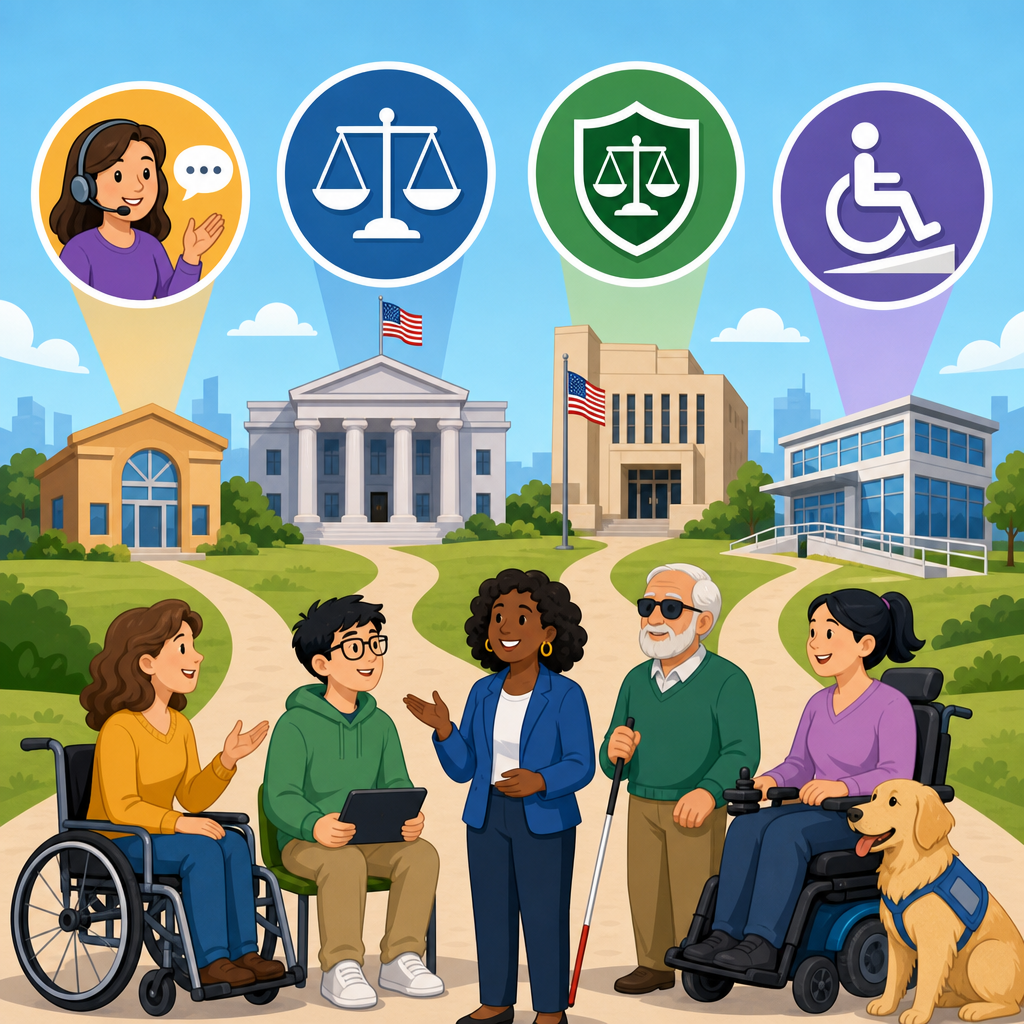
The Americans with Disabilities Act compliance landscape can look deceptively simple until you need a precise answer, file a complaint, interpret a design requirement, or decide which federal office actually has authority over your situation. Many organizations search for “ADA compliance” expecting one agency, one rulebook, and one enforcement path. In practice, four resources are repeatedly central to the work: the ADA Information Line, the Equal Employment Opportunity Commission, the Department of Justice, and the U.S. Access Board. Understanding who does what is the starting point for sound ADA compliance because it prevents delays, misdirected complaints, and costly assumptions.
ADA compliance means meeting legal obligations under the Americans with Disabilities Act and related accessibility standards so people with disabilities have equal access to employment, state and local government services, public accommodations, transportation, and communications. The ADA Information Line is an official public guidance channel. The EEOC handles employment discrimination under Title I. The DOJ enforces key provisions affecting state and local government programs and private businesses open to the public, mainly under Titles II and III. The Access Board develops accessibility guidelines, especially for the built environment, transit vehicles, information and communication technology, and medical diagnostic equipment.
This matters because compliance is rarely solved by reading one regulation in isolation. In real projects, I have seen HR teams call the DOJ with workplace accommodation questions, architects rely on nonbinding summaries instead of enforceable standards, and business owners confuse technical design guidance with litigation authority. Those mistakes waste time and increase legal exposure. A clear map of responsibilities helps employers respond to accommodation requests correctly, helps public entities evaluate program access, and helps private businesses understand physical and digital accessibility duties. This article serves as a hub for Introduction to ADA Compliance by explaining the roles, limits, and overlap of these four resources, and by showing when each one should be your first stop.
The ADA Information Line: What it is and when to use it
The ADA Information Line is the federal government’s public-facing guidance service for ADA questions. It is not a court, not an enforcement tribunal, and not a substitute for legal advice. Its value is practical: it helps callers identify which ADA title applies, what agency may handle a problem, and where to find official materials. For many organizations beginning ADA compliance work, this is the fastest way to move from confusion to a usable next step.
Use the Information Line when you need orientation. Typical questions include whether a business is covered by Title III, whether a city program must provide effective communication, where to locate the current ADA Standards for Accessible Design, or how to file a complaint. The service is especially helpful for first-time issues because ADA coverage often depends on the setting, the type of entity, and the kind of barrier involved. A restaurant asking about service animals needs different guidance than a county clerk evaluating accessible notices or a small employer facing a reasonable accommodation request.
The key limitation is authority. The Information Line gives general information, but it does not issue binding determinations and does not decide disputed facts. If your question turns on whether an accommodation is reasonable in a specific workplace, whether an alteration triggered a path-of-travel obligation, or whether a website barrier violates a settlement agreement, you usually need agency enforcement materials, counsel, or both. Think of the Information Line as a triage function within ADA compliance: useful, official, and efficient, but not the final word on contested obligations.
The EEOC: Employment discrimination and reasonable accommodation under Title I
The EEOC is the primary federal agency for ADA employment issues. If the question concerns hiring, firing, medical inquiries, disability-related harassment, reassignment, leave as accommodation, or reasonable accommodation in the workplace, the EEOC is usually the lead agency. Title I generally applies to employers with 15 or more employees, along with employment agencies, labor organizations, and joint labor-management committees.
In practice, the EEOC’s role is operational and legal. It issues regulations, technical assistance, and enforcement guidance; receives charges of discrimination; investigates claims; seeks settlement; and litigates selected cases. Its guidance on reasonable accommodation and undue hardship is foundational because many ADA compliance failures start with process mistakes rather than bad intent. I have repeatedly seen employers create risk by demanding excessive medical documentation, delaying interactive discussions, or rejecting remote work without analyzing essential functions.
A common example is an employee with multiple sclerosis requesting a modified schedule, ergonomic equipment, and occasional telework. The ADA does not require the employer to grant the exact requested accommodation automatically, but it does require an individualized assessment and an interactive process. The EEOC evaluates whether the employee is qualified, whether the accommodation would enable performance of essential functions, and whether the employer can show undue hardship based on actual disruption or cost rather than assumptions. That framework is central to workplace ADA compliance.
The EEOC also addresses pre-employment disability inquiries, post-offer medical exams, confidentiality of medical records, and qualification standards that screen out individuals with disabilities. Employers often miss that blanket “100 percent healed” return-to-work policies can violate the ADA. So can rigid attendance rules when leave or schedule flexibility may be a reasonable accommodation. For employment questions, the EEOC is the agency that matters most.
The DOJ: Public services, public accommodations, and enforcement under Titles II and III
The Department of Justice is the lead federal enforcer for many non-employment ADA issues. Under Title II, it addresses discrimination by state and local governments. Under Title III, it addresses discrimination by private entities that qualify as public accommodations, such as hotels, restaurants, retail stores, theaters, doctors’ offices, private schools, gyms, and service establishments. The DOJ also issues regulations and technical guidance that shape how ADA compliance works in daily operations.
For state and local governments, DOJ oversight reaches beyond buildings. Program access, effective communication, accessible policies, and equal participation are core obligations. A city may have an accessible new building yet still violate Title II if its emergency alerts are not accessible to deaf residents, its online forms cannot be used with screen readers, or its public meetings do not provide appropriate auxiliary aids when needed. Title II looks at the accessibility of the government’s services, programs, and activities as a whole.
For private businesses, DOJ enforcement under Title III focuses on equal access to goods and services. That includes physical barriers, communication barriers, policies, and increasingly digital access expectations. A hotel may comply with ramp and restroom requirements yet still create ADA compliance problems if reservation systems fail to identify accessible room features accurately or if staff refuse a guest with a service animal. In investigations, operational policies often matter as much as architectural features.
| Resource | Primary role | Best first use | Typical example |
|---|---|---|---|
| ADA Information Line | General guidance and referral | Identify the right ADA title or agency | Business owner asks where to file a complaint |
| EEOC | Employment enforcement under Title I | Workplace accommodation or discrimination issue | Employee denied modified schedule after medical request |
| DOJ | Titles II and III enforcement and regulations | Public service or customer access problem | Town website inaccessible for permit applications |
| Access Board | Accessibility guidelines and technical criteria | Design, construction, ICT, or equipment standards question | Architect checks clear floor space and reach ranges |
The DOJ can investigate complaints, conduct compliance reviews, negotiate settlement agreements, and file lawsuits. It may seek injunctive relief, civil penalties in Title III matters, and systemic corrective action. However, the DOJ does not replace every other agency. If the issue is employment discrimination by a covered employer, the EEOC remains the primary route. If the issue is a detailed scoping or technical design requirement, the Access Board’s guidelines and the adopted standards become crucial reference points.
The Access Board: Technical accessibility guidance and standards development
The U.S. Access Board is often the least understood of the four, yet it is indispensable in ADA compliance work involving design and technical specifications. The Board is an independent federal agency that develops accessibility guidelines and standards for the built environment, transportation vehicles, telecommunications equipment, information and communication technology, and medical diagnostic equipment. It does not function like the EEOC or DOJ as a general complaint investigator for day-to-day discrimination disputes.
Its practical importance comes from technical clarity. When architects, facility managers, procurement teams, or digital accessibility specialists need exact requirements, the Access Board’s work is where many of those requirements originate. The ADA Accessibility Guidelines informed the enforceable 2010 ADA Standards for Accessible Design adopted by the DOJ. For federal technology procurement, Section 508 standards are central, and the Access Board played the standard-setting role there as well.
Consider a hospital planning new examination rooms. Questions about transfer supports, clearances around diagnostic equipment, and accessible routes are not answered well by broad anti-discrimination principles alone. They require dimensional and performance criteria. The same is true when a transit agency evaluates boarding interfaces or when a university procurement office assesses whether software conforms to accessibility requirements. In these settings, the Access Board is the source for the technical backbone of ADA compliance.
The limitation is enforcement power. The Board creates or updates guidelines and standards, but other agencies adopt and enforce rules within their jurisdictions. That distinction matters. If you are arguing about whether a private business violated the ADA in a renovation, the enforceable standard adopted by DOJ and the facts on the ground will control. The Access Board helps explain the technical framework, but it is not the main enforcement destination for most complaints.
How these agencies fit together in real ADA compliance work
The easiest way to understand the system is to match the question to the function. If you need orientation, start with the ADA Information Line. If the issue is employment, go to the EEOC. If the issue involves government services or a business serving the public, the DOJ is usually central. If the issue turns on technical accessibility criteria for spaces, vehicles, equipment, or digital technology standards, the Access Board is a key reference.
Real cases often involve overlap. A county government employee may need a workplace accommodation, which points to EEOC, while members of the public complain about inaccessible county meetings, which points to DOJ. A retailer renovating stores may need the technical design rules reflected in Access Board guidelines, while also revising customer service policies to satisfy DOJ expectations. An IT team modernizing procurement may use Access Board-derived standards for accessibility testing, while legal and compliance staff assess broader discrimination risk under the ADA.
That is why ADA compliance works best as a coordinated function, not a siloed one. HR, legal, facilities, procurement, digital teams, and frontline operations all touch different parts of the statute. Organizations that assign ownership clearly, train managers, and document decision-making are consistently better positioned than those treating compliance as a one-time checklist. The agencies and resources discussed here are most useful when your internal process already distinguishes employment, public access, and technical standards issues.
Common mistakes and a practical starting point for organizations
The biggest mistake is asking the wrong office the wrong question. The second is assuming that one answer resolves every ADA compliance duty. Businesses commonly focus on ramps and parking while ignoring service animal policies, auxiliary aids, reservation systems, and website access. Employers often know the phrase “reasonable accommodation” but fail to run a timely interactive process or identify essential job functions accurately. Public entities sometimes renovate a flagship facility while leaving core online services inaccessible.
A practical starting point is simple. Inventory your risk by category: employment, customer or public access, facilities, digital systems, communications, and procurement. For each category, identify the governing title, the lead internal owner, and the external resource most likely to help. Keep the ADA Standards for Accessible Design available for facilities questions. Use EEOC guidance for accommodation workflows. Use DOJ materials for policy and program access questions. Use Access Board standards when technical criteria drive the answer. And use the ADA Information Line when you need to confirm where to begin.
ADA compliance is manageable when the roles are clear. The ADA Information Line points you in the right direction. The EEOC governs workplace disability discrimination and accommodation. The DOJ enforces broad access rights for government programs and businesses open to the public. The Access Board supplies the technical framework behind many accessibility requirements. Together, they form the practical map for Introduction to ADA Compliance.
If you treat this page as your hub, the next step is to go deeper on the area that matches your risk first: employment processes, public-facing policies, facility standards, or digital accessibility. Start there, assign ownership, and build a documented compliance plan that uses the right agency guidance from the outset.
Frequently Asked Questions
1. What is the difference between the ADA Information Line, the EEOC, the DOJ, and the Access Board?
These four resources all relate to the Americans with Disabilities Act, but they do very different jobs. The ADA Information Line is primarily an educational resource. It helps people understand the ADA’s requirements, points them to the right agency, and answers practical questions about how the law generally works. It does not function as a court, and it is not the main enforcement body for every ADA issue. Instead, it serves as a starting point when someone is unsure where to turn.
The Equal Employment Opportunity Commission, or EEOC, is the federal agency most closely associated with employment discrimination under the ADA. If the issue involves hiring, firing, reasonable accommodation, job application processes, medical inquiries, retaliation, or disability-related treatment in the workplace, the EEOC is often the key agency. In short, if the question is about employment rights and obligations under the ADA, the EEOC is usually the primary federal authority.
The U.S. Department of Justice, or DOJ, plays a major role in enforcing the ADA outside the employment context, especially under Title II and Title III. That includes many issues involving state and local government services, as well as public accommodations such as stores, restaurants, hotels, healthcare offices, entertainment venues, and other businesses open to the public. The DOJ also issues regulations, technical guidance, and enforcement actions that shape how the ADA is interpreted in real-world settings.
The U.S. Access Board is different from both the EEOC and the DOJ because it focuses heavily on accessibility criteria and built-environment standards. It develops accessibility guidelines and standards that inform how facilities, transit systems, technology, and other elements should be designed to be accessible. The Access Board is essential when the question is technical, such as how an accessible route should be measured, what clear floor space is required, or how design standards are structured. However, it is not usually the first stop for filing a discrimination complaint.
A useful way to think about it is this: the ADA Information Line helps explain and direct, the EEOC handles employment-related ADA enforcement, the DOJ enforces many public-sector and public-accommodation obligations, and the Access Board develops important accessibility standards and guidance. Knowing that distinction can save significant time and prevent a complaint or compliance question from going to the wrong place.
2. When should someone contact the ADA Information Line instead of filing directly with the EEOC or DOJ?
The ADA Information Line is especially useful when a person or organization needs clarity before taking a formal step. Many ADA questions begin with uncertainty: Is this an employment issue or a public accommodation issue? Does a specific fact pattern even fall under the ADA? Is a design problem governed by ADA Standards, another federal rule, or a state accessibility code? In those situations, the Information Line can be a practical first stop because it helps people sort out the category of the issue before they decide whether a formal complaint is necessary.
For example, an employer might call because it is unsure whether a requested workplace change qualifies as a reasonable accommodation. A business owner might call because customers have raised concerns about an entrance, service counter, or website. A member of the public might call because they encountered a barrier at a courthouse, restaurant, or medical office but are not sure which title of the ADA applies. In each of those situations, the ADA Information Line can often explain the general framework and direct the caller toward the agency or resource that has actual authority over the matter.
That said, the Information Line is not a substitute for a charge, complaint, lawsuit, or legal filing. If someone has an employment discrimination claim, the EEOC process often has strict timing requirements, so relying only on an informational conversation could be risky. Similarly, if the issue involves alleged violations by a public entity or a business open to the public, a person may need to review DOJ complaint procedures, state or local enforcement options, or private legal remedies. The Information Line can help orient the person, but it does not usually preserve legal deadlines.
Organizations also benefit from using the Information Line proactively. It can help compliance teams, HR departments, facilities personnel, and business owners understand basic obligations before a conflict escalates. That can be valuable when trying to avoid mistakes, particularly in areas where the ADA requires case-by-case analysis. In that sense, the Information Line is often best viewed as a front-end guidance resource rather than a back-end enforcement mechanism.
In practical terms, contact the ADA Information Line when you need help understanding the ADA, identifying the right agency, or locating technical and educational resources. Contact the EEOC or DOJ when you are ready to pursue or respond to a formal matter within their jurisdiction.
3. Does the EEOC handle all ADA complaints, or only workplace disability discrimination?
The EEOC does not handle all ADA complaints. Its role is focused primarily on workplace disability discrimination. That includes issues arising during recruitment, hiring, training, compensation, advancement, discipline, termination, and requests for reasonable accommodation. It also includes questions about disability-related medical inquiries, confidentiality of medical information, harassment based on disability, and retaliation for asserting ADA rights in the employment context.
This is a common point of confusion because many people hear “ADA enforcement” and assume the EEOC is the central agency for everything. It is not. If a person is denied access to a restaurant, hotel, retail store, doctor’s office, or other place of public accommodation, that is generally not an EEOC matter because it does not arise from employment. Likewise, if the problem concerns access to a state or local government program, public service, or municipal facility, that usually falls outside the EEOC’s primary role.
The EEOC becomes relevant when there is an employment relationship or an employment application process at issue. For example, if an applicant believes they were screened out because of disability, if an employee was denied a reasonable accommodation, or if an employer imposed improper medical documentation demands, the EEOC may be the correct federal agency. The agency investigates charges, seeks resolution in appropriate cases, and enforces federal employment discrimination laws, including the ADA.
Employers should also understand that EEOC guidance can be highly influential in shaping workplace ADA compliance. Even when a matter does not become a formal charge, EEOC regulations, technical assistance, and enforcement positions provide important direction on how employers should approach interactive process obligations, essential functions, leave-related accommodations, reassignment, and other difficult employment questions.
So the short answer is no: the EEOC is not the all-purpose ADA complaint office. It is the federal agency most closely tied to ADA employment rights and obligations. If the issue is not job-related, another agency, often the DOJ or a different regulator depending on the subject matter, may be more appropriate.
4. What does the DOJ enforce under the ADA, and how is that different from the Access Board’s role?
The DOJ enforces major portions of the ADA, particularly in areas involving state and local governments and businesses open to the public. Under Title II, the DOJ has an important role in matters involving access to government services, programs, and activities. Under Title III, it is deeply involved in issues affecting public accommodations and commercial facilities, such as physical access barriers, policies that exclude people with disabilities, ineffective communication practices, and failures to provide auxiliary aids or reasonable modifications where required by law.
That enforcement role is different from the Access Board’s role, which is more standards-focused. The Access Board develops and maintains accessibility guidelines that influence the technical design criteria used across ADA compliance work. When someone needs to know how wide a doorway should be, what turning space is required, how accessible parking should be configured, or how accessible elements must connect along a route, the Access Board’s work becomes central. Its materials are particularly important for architects, engineers, contractors, facilities managers, transit professionals, and compliance specialists.
The distinction matters because many compliance questions have both a legal side and a technical side. The legal side asks whether the ADA applies, what duties are triggered, whether an exception exists, and what enforcement path is available. The technical side asks how accessibility is measured or designed in practice. The DOJ is more closely associated with legal enforcement and interpretation of obligations under Titles II and III, while the Access Board is more closely associated with the development of accessibility criteria and design guidance.
For example, if a business wants to understand whether it must remove a barrier when doing so is readily achievable, that is an ADA compliance and legal analysis often associated with DOJ regulations and Title III principles. If the next question is exactly how the corrected feature should be designed to align with accessibility standards, Access Board resources become extremely valuable. The same pattern appears in public-sector accessibility reviews, transit accessibility planning, and facility renovations.
In short, the DOJ is an enforcement and regulatory authority for large portions of the ADA, while the Access Board is a technical standards and guidelines authority. They complement each other, but they do not perform the same function.
5. If I have an ADA compliance question about building design, renovations, or technical accessibility standards, where should I start?
If the issue is technical and design-oriented, the best starting point is often to identify the type of facility, the nature of the project, and the specific accessibility question you need answered. For building design, alterations, parking, entrances, restrooms, service counters, routes