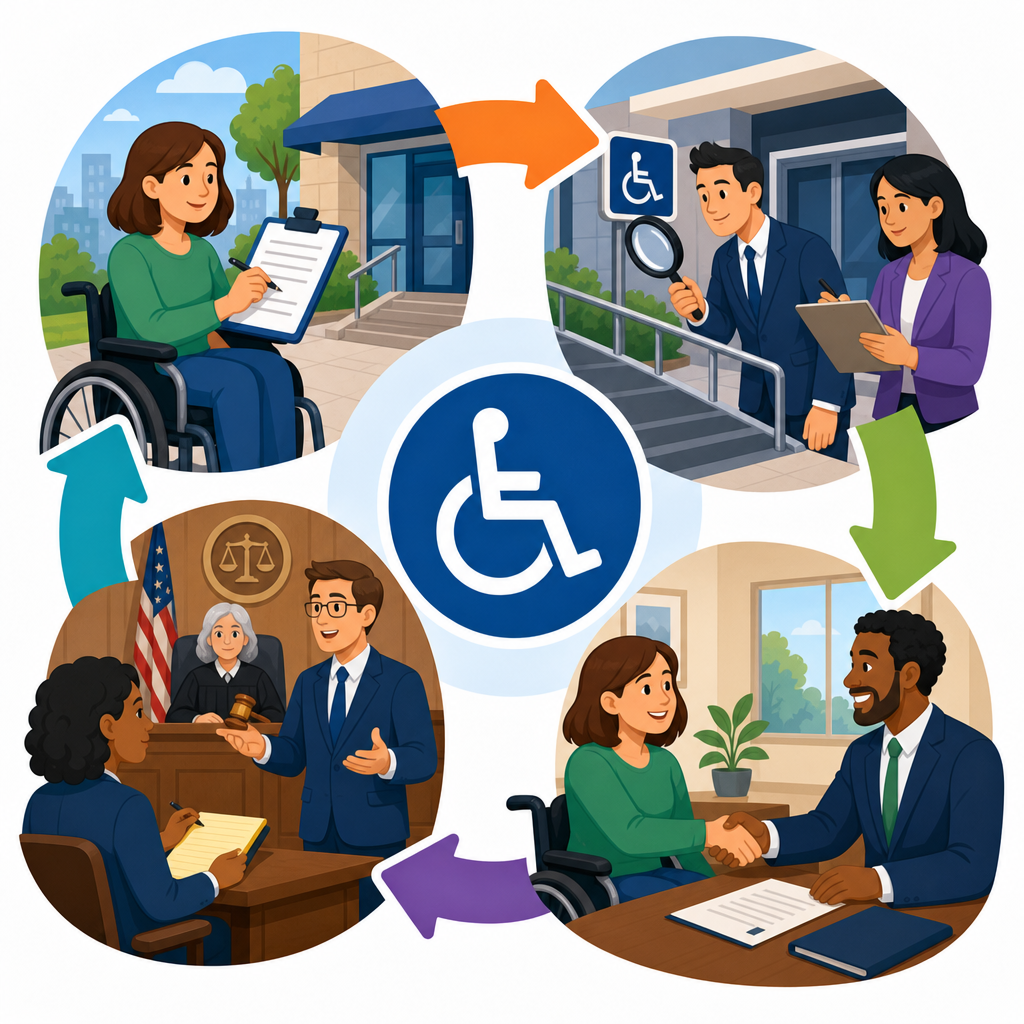
Americans with Disabilities Act compliance is often discussed as a checklist, but in practice it is a lifecycle that begins long before a lawsuit and usually ends with operational changes, monitoring, and renewed attention to accessibility. For organizations covered by the ADA, understanding how a complaint develops into an investigation, settlement, or court action is the difference between reacting defensively and managing risk responsibly. I have worked with businesses, public accommodations, schools, and service providers facing these issues, and the same pattern repeats: a barrier is identified, a person reports it, the organization decides how seriously to respond, and that decision shapes every next step.
The ADA is the federal civil rights law that prohibits disability discrimination in employment, state and local government services, public accommodations, transportation, and telecommunications. In everyday business terms, ADA compliance means giving qualified individuals with disabilities equal access to jobs, facilities, goods, services, digital content, and programs unless doing so would fundamentally alter the offering or create an undue burden. Key terms matter. A complaint is the initial allegation that rights were violated. An investigation is the fact-finding process by an agency or legal representative. A settlement is a negotiated resolution, often with corrective actions and timelines. A lawsuit is formal litigation in state or federal court when voluntary resolution fails or a plaintiff seeks judicial relief.
This topic matters because ADA issues are common, expensive, and highly visible. The Department of Justice enforces major portions of the law, the Equal Employment Opportunity Commission handles employment discrimination under Title I, and private plaintiffs can bring claims directly in many situations. Accessibility complaints also affect contracts, insurance renewals, reputation, and customer retention. A restaurant with inaccessible parking, a retailer with an unreadable online checkout flow, or a medical office without effective communication procedures may all trigger the same lifecycle. Understanding that lifecycle helps leaders prioritize prevention, preserve documentation, respond appropriately, and fix root causes instead of treating accessibility as a one-time legal project.
Introduction to ADA compliance: what organizations must actually do
ADA compliance is not a single standard applied identically to every organization. The law is divided into titles, and obligations vary by context. Title I covers employment and generally applies to employers with fifteen or more employees. Title II covers state and local governments. Title III covers private businesses that are places of public accommodation, such as hotels, restaurants, stores, health care offices, theaters, banks, gyms, and many service businesses. The Rehabilitation Act, especially Section 504 and Section 508, can also matter for entities receiving federal funds or building digital services for federal use. In real compliance work, the first question is always scope: which title applies, what facilities or platforms are covered, and what standards govern accessibility in that setting?
For the built environment, the 2010 ADA Standards for Accessible Design are the baseline most teams know best. They address parking, accessible routes, entrances, counters, restrooms, signage, seating, and dozens of other features. For digital accessibility, the ADA does not name a single technical rule in the statute, but courts, regulators, and settlement agreements commonly point to the Web Content Accessibility Guidelines, usually WCAG 2.1 Level AA, as the practical benchmark. Program access, reasonable modifications, auxiliary aids and services, and effective communication are equally important. A business may have a technically compliant doorway yet still violate the ADA if staff refuse to read forms aloud to a blind customer, decline to allow a service animal, or fail to provide captioning or interpretation when required.
The most effective compliance programs are operational, not merely legal. They include policy statements, training, an accessibility coordinator, audit schedules, remediation budgets, vendor standards, complaint intake procedures, and record retention. When I review organizations that successfully avoid escalation, they usually have a simple internal process: receive concern, log it, investigate quickly, contact the complainant, implement temporary workarounds if needed, and document corrective action. That kind of discipline reduces conflict because many ADA disputes begin with frustration rather than immediate intent to sue.
How an ADA complaint usually begins
An ADA complaint often starts informally. A customer tells a manager that the only entrance has steps. An employee requests screen reader compatible software. A patient says the intake kiosk cannot be used without vision. A website visitor emails that the appointment form is inaccessible by keyboard. These early notices matter because once the organization is on notice of a barrier, delay becomes harder to defend. A complaint may also arrive through a demand letter from counsel, a charge filed with the EEOC, a DOJ inquiry, a state civil rights agency notice, or a complaint submitted through an internal hotline.
The strongest first response is calm, prompt, and specific. Acknowledge receipt, avoid admissions before facts are known, preserve relevant records, and assign a decision maker. In employment matters, gather the job description, essential functions, accommodation history, performance records, and communications. In public accommodation matters, collect photographs, construction dates, policies, service logs, website issue reports, and vendor contracts. If the issue concerns digital access, preserve the version of the page or application in use at the time, because later fixes do not erase what existed when access was denied.
Many organizations make the mistake of arguing immediately instead of asking what barrier the person encountered and what effective solution would work. The ADA favors practical access. If a point-of-sale device cannot be reached from a wheelchair, replacing it or repositioning it may resolve the issue faster than debating technical exceptions. If a deaf patient needs effective communication for a complex consultation, a qualified interpreter may be necessary, while written notes may be inadequate. The exact obligation depends on context, but the complaint stage is where respect, speed, and documentation often prevent escalation.
What happens during an ADA investigation
An investigation tests whether the alleged barrier exists, whether the organization is covered, and whether the law required a different action. Internal investigations should mirror that structure. Start with the facts: who was affected, when, where, and by what condition or policy. Then identify the legal theory: architectural barrier, failure to accommodate, ineffective communication, discriminatory eligibility criteria, inaccessible digital service, retaliation, or policy-based exclusion. Finally, assess defenses and feasible remedies. Covered entities should not rely on assumptions. Measurements, screenshots, witness interviews, expert reviews, and policy audits are often necessary.
Agency investigations vary. The EEOC may request a position statement and supporting documents in employment cases. The DOJ may ask for policies, floor plans, training records, or website conformance information. State or local agencies may conduct interviews or site visits. In private disputes, plaintiff counsel may send preservation letters, request inspections, or retain accessibility experts. In all settings, credibility matters. Records that show prior audits, remediation efforts, and active training support a good-faith narrative. Missing records, inconsistent policies, and ignored prior complaints suggest systemic noncompliance.
Investigations also distinguish between one-off mistakes and structural barriers. A single employee’s poor response can become an organizational problem if training is absent or incentives discourage accommodation. Likewise, one inaccessible webpage may indicate a flawed procurement process if the entire platform was launched without accessibility testing. Root cause analysis is essential. In my experience, organizations that investigate deeply often discover hidden issues beyond the original complaint, which makes early comprehensive remediation more efficient than narrow patching.
Common issues, standards, and practical remedies
Most ADA matters fall into recurring categories. Facilities cases commonly involve parking slope, lack of van accessible spaces, inaccessible restroom clearances, heavy doors, sales counters that are too high, and routes blocked by merchandise. Employment matters often concern reasonable accommodations, medical inquiries, leave, reassignment, and inaccessible software. Digital cases frequently involve missing form labels, low color contrast, unlabeled buttons, keyboard traps, inaccessible PDFs, and video without captions. Communication cases involve interpreters, CART, Braille or large print materials, and policies for interacting with service animals.
| Issue | Typical standard or reference | Practical remedy |
|---|---|---|
| Parking access | 2010 ADA Standards for Accessible Design | Re-stripe spaces, correct signage, verify slopes |
| Employment accommodation | Title I, EEOC guidance | Run interactive process, assess essential functions |
| Website barriers | WCAG 2.1 Level AA | Audit templates, fix code, retest with assistive technology |
| Effective communication | Title II or Title III requirements | Provide qualified interpreters or other auxiliary aids |
| Policy exclusion | Reasonable modification rules | Revise policy and train frontline staff |
Remedies should match both the legal requirement and the user experience. A ramp that technically exists but leads to a locked side door is not meaningful access. A website accessibility statement without actual remediation is not compliance. A leave policy that says “100 percent healed” before return to work is usually a red flag because it bypasses individualized assessment. Good remediation combines physical fixes, policy revisions, training, and verification testing. Organizations should also review vendor responsibility. If a third-party booking engine, kiosk, or HR platform is inaccessible, the covered entity may still face the complaint.
Settlement: the most common resolution path
Most ADA disputes end in settlement rather than trial. Settlement is common because accessibility problems are often fixable, legal fees rise quickly, and plaintiffs usually want access more than prolonged litigation. A well-structured settlement agreement identifies the barriers at issue, the corrective actions required, the deadlines, the reporting process, and any payment terms. Payments may include attorney’s fees, damages where available under applicable law, consultant costs, and monitoring expenses. The agreement may also require policy adoption, staff training, periodic audits, or designation of an ADA coordinator.
Timing matters. Quick settlement can limit fees and operational distraction, but only if the organization understands the scope of required remediation. I have seen businesses settle one website complaint while ignoring the mobile app, PDFs, and third-party scheduler that caused the same access failure. That leads to repeat claims. Durable settlements define systems, not just isolated fixes. For example, a retailer may agree to conform customer-facing web pages to WCAG 2.1 AA, train content editors, include accessibility in procurement contracts, run quarterly scans with tools such as axe, WAVE, or Siteimprove, and complete manual testing with screen readers like NVDA or JAWS.
Confidentiality is sometimes requested, but many government settlements are public. Even private settlements should be treated as compliance roadmaps. If a business agrees to remediate restroom access within ninety days, leadership must fund the work, assign accountability, and verify completion. Failing to honor settlement terms can trigger renewed enforcement or breach claims, which are usually more expensive than the original dispute.
When an ADA complaint becomes a lawsuit
A lawsuit usually follows when the parties dispute liability, timing, scope of remediation, or damages, or when the organization simply does not respond effectively. In Title III public accommodation cases, plaintiffs often seek injunctive relief requiring barrier removal plus attorney’s fees. In employment cases, available remedies can include back pay, reinstatement, compensatory damages, punitive damages in some circumstances, and policy changes. Court procedures bring pleadings, motions, discovery, expert reports, inspections, and potentially mediation or trial. That process consumes management time and creates public records.
Litigation changes the tone. Casual statements in emails, incomplete audits, and inconsistent policies become evidence. So do maintenance logs, training records, code reviews, and prior complaints. Courts also look closely at standing, mootness, and whether barriers are readily achievable to remove in existing facilities. Digital accessibility cases may focus on whether the plaintiff personally encountered the barrier and whether the website has sufficient nexus to a physical location in certain jurisdictions, although case law continues to evolve. Because standards differ by circuit and fact pattern, defense strategy should be grounded in current precedent, not generalized internet advice.
The practical lesson is simple: lawsuits are rarely the first event. They are the consequence of unmet obligations, weak complaint handling, or unresolved negotiations. Prevention costs less than defense, and documented accessibility governance is the strongest long-term protection.
Building a compliance program that reduces complaints and strengthens implementation
The best ADA compliance program is proactive, documented, and tied to operations. Start with an accessibility policy approved by leadership. Assign responsibility to a coordinator or cross-functional team spanning legal, HR, facilities, IT, procurement, and customer experience. Conduct baseline audits of physical spaces, digital properties, and key policies. Prioritize high-impact barriers affecting core transactions such as entry, checkout, scheduling, forms, and communication. Then create a remediation plan with deadlines, budget owners, and verification steps.
Training is where implementation becomes real. Frontline staff need scripts for accommodation requests, service animal interactions, and effective communication escalation. HR needs structured interactive process training. Facilities teams need familiarity with ADA measurements and maintenance obligations, because an accessible feature that is blocked or broken can still violate the law. Developers and content teams need accessibility acceptance criteria, design system standards, and testing protocols. Procurement should require accessibility conformance reports, often in the form of a VPAT, while still validating claims through independent testing.
Finally, make complaint handling part of continuous improvement. Offer clear reporting channels, respond quickly, track trends, and revisit audits after renovations, software updates, or policy changes. Accessibility is not static. New content, new vendors, and new workflows create new barriers unless accessibility is embedded from the start. If your organization treats ADA compliance as an ongoing implementation discipline rather than a crisis response, complaints become easier to resolve, investigations become less disruptive, settlements become more manageable, and lawsuits become less likely. Review your current policies, audits, and reporting process now, then close the gaps before someone else identifies them for you.
Frequently Asked Questions
What is the typical lifecycle of an ADA complaint from the first allegation to final resolution?
The ADA complaint lifecycle usually starts well before anyone files a lawsuit. In many cases, the first sign of trouble is an internal report, a customer complaint, a demand letter from counsel, or a government inquiry pointing to a potential accessibility barrier. That barrier may involve a physical access issue, a policy or communication problem, digital accessibility concerns, or an alleged failure to provide reasonable modifications. Once the issue is raised, the organization typically needs to assess the allegation, preserve relevant records, identify who is responsible for the affected location, service, or website, and determine whether the complaint appears isolated or reflects a broader compliance gap.
From there, the matter may move into a more formal complaint or investigation stage. Depending on the facts, the complaint may be directed to a federal or state agency, handled through an administrative process, or pursued directly in court. During this stage, investigators or opposing counsel often request policies, training materials, maintenance logs, website information, prior complaints, architectural records, and evidence of corrective efforts. The organization’s response can have a major effect on the outcome. A prompt, well-documented, good-faith response often helps narrow the dispute, while delay, poor records, or inconsistent practices can make a manageable issue look systemic.
Many ADA matters resolve through negotiated remediation rather than trial. That may mean fixing barriers, revising policies, training staff, improving digital accessibility, paying fees or damages where available under applicable law, and agreeing to reporting or monitoring for a period of time. If settlement does not happen, the case can proceed into litigation, where the parties dispute facts, legal coverage, standing, scope of relief, and whether requested changes are readily achievable or otherwise required. Even then, most cases still settle before a full trial. The final phase is implementation: actually making the promised changes, documenting them, monitoring compliance, and treating accessibility as an ongoing operational responsibility rather than a one-time legal event.
How does an ADA investigation usually work, and what should an organization expect once one begins?
An ADA investigation is designed to determine whether the covered entity has violated accessibility requirements and, if so, what corrective action may be necessary. The process can vary depending on whether the matter is handled by a federal agency, a state or local civil rights office, or through private counsel developing a lawsuit. In general, the organization should expect requests for information, timelines for response, and close attention to whether the alleged problem is limited to one barrier or indicates a pattern. Investigators often look not only at the specific incident but also at policies, decision-making, maintenance practices, complaint handling, and whether leadership has made accessibility part of normal operations.
Practically speaking, an investigation often includes written requests for documents, interviews, site inspections, screenshots or testing of digital properties, and follow-up questions based on what the agency or claimant finds. For a physical location, that might involve parking, routes, entrances, counters, restrooms, seating, signage, and service practices. For a website or app, it may involve keyboard navigation, alt text, form labels, video accessibility, screen reader compatibility, and procurement or development procedures. For employment-related claims under the ADA, the investigation may focus on accommodations, medical inquiries, job descriptions, essential functions, and the interactive process.
Organizations should expect the investigation to focus heavily on credibility and consistency. If a business says it values accessibility but has no training, no written policy, no audit history, and no process for receiving complaints, that gap matters. On the other hand, if it can show that it investigated the issue promptly, brought in qualified experts, made interim changes where possible, and developed a remediation plan, that often improves the organization’s position. The goal is not just to defend against liability in the abstract; it is to show that the organization understands its obligations and is taking practical steps to meet them. That approach can influence whether the matter escalates, narrows, or resolves more efficiently.
Why do so many ADA cases settle, and what does a settlement usually require?
Many ADA cases settle because settlement is often the fastest and most predictable way to reduce risk, control cost, and achieve actual accessibility improvements. Litigation can be expensive, time-consuming, and operationally distracting, especially where the underlying barrier is real and fixable. In addition, many ADA disputes are less about dramatic factual fights and more about timing, scope, and responsibility for remediation. When both sides recognize that accessibility changes are likely coming regardless of whether the case goes to judgment, a negotiated resolution can make practical and legal sense.
A typical ADA settlement usually includes a detailed description of corrective actions. For physical spaces, that might include architectural modifications, removal of barriers, re-striping parking, changing hardware, adjusting service counters, updating signage, or improving restroom access. For digital accessibility claims, the agreement may require audits, code fixes, conformance targets, retesting, accessibility statements, staff training, and vendor management changes. For policy-based claims, settlements often require written policy revisions, reasonable modification procedures, effective communication protocols, and employee training at multiple levels of the organization.
Settlements also commonly address timing, verification, and accountability. The parties may agree on phased deadlines, expert inspections, periodic status reports, designated accessibility contacts, and a process for raising future concerns without immediately returning to court. Depending on the claims and the laws involved, a settlement may also include payment of attorney’s fees, damages, or other monetary terms. Just as important, a good settlement should be operationally realistic. If the commitments are vague, underfunded, or disconnected from how the organization actually functions, the agreement can create ongoing exposure instead of closure. The most effective settlements solve the immediate dispute and build a structure for sustained compliance afterward.
When does an ADA complaint turn into a lawsuit, and what increases the risk of litigation?
An ADA complaint can turn into a lawsuit when the issue is not resolved through informal discussions, administrative handling, or early corrective action. Sometimes a lawsuit is filed quickly, especially if the claimant believes the violation is obvious, recurring, or part of a larger pattern. In other situations, the organization has an opportunity to respond first, but the case still escalates because the response is incomplete, delayed, defensive, or unsupported by concrete remediation. Litigation risk generally increases when a business treats accessibility as a public relations problem instead of a legal and operational obligation.
Several factors tend to drive cases toward court. One is the existence of clear, visible barriers that directly interfere with access and have not been addressed despite prior notice. Another is poor documentation. If an organization cannot show what it did, when it did it, who was responsible, and what barriers remain under review, it loses the ability to demonstrate good-faith efforts. Repeated complaints, inconsistent handling across locations, inaccessible digital systems tied to core services, and failure to train frontline staff also increase exposure. In employment matters, litigation risk often grows when the employer mishandles accommodation requests, fails to engage in the interactive process, or makes unsupported decisions about medical limitations or essential job functions.
Risk also rises when leadership underestimates the scope of the issue. A complaint about one entrance may reveal broader facility problems. A website allegation may expose procurement, design, and maintenance failures across multiple platforms. A single service denial may point to policy language or staff practices that affect many people. Once the matter reaches litigation, the organization may face not only the original allegation but also broader scrutiny into its systems, history, and governance. That is why early triage matters so much. Prompt evaluation, realistic legal analysis, and visible corrective action can sometimes keep a dispute from becoming a lawsuit, or at least place the organization in a far stronger position if litigation does occur.
What should businesses and public accommodations do after a complaint, settlement, or lawsuit to prevent the next ADA issue?
The most important step after any ADA matter is to stop thinking in terms of closure alone and start thinking in terms of lifecycle management. A complaint, investigation, settlement, or lawsuit usually reveals not just one defect but a weakness in the organization’s accessibility governance. That weakness may involve ownership, budgeting, training, maintenance, design standards, vendor oversight, or complaint escalation. If the organization fixes only the exact item named in the dispute and does nothing else, the next complaint is often just a matter of time. Prevention requires converting what was learned into repeatable operational controls.
For most organizations, that means creating or strengthening a formal accessibility program. Key elements typically include a written accessibility policy, defined internal responsibility, regular audits of physical and digital assets, documented remediation plans, employee training, and a process for receiving and resolving accessibility concerns quickly. Public-facing businesses should also review customer service practices, communication methods, emergency procedures, third-party booking or ordering tools, and maintenance routines to make sure accessibility is not lost after initial improvements are made. If vendors design, build, host, or manage important systems, contracts and procurement standards should reflect accessibility expectations rather than assuming compliance will happen automatically.
Ongoing monitoring is what separates a one-time response from responsible risk management. Facilities change, websites are updated, staff turns over, and policies drift unless someone is accountable. Organizations should track remediation deadlines, keep records of completed work, test changes periodically, and revisit areas where complaints have already surfaced. It is also wise to involve qualified legal and accessibility professionals early when new projects, renovations, product launches, or service changes are planned. The