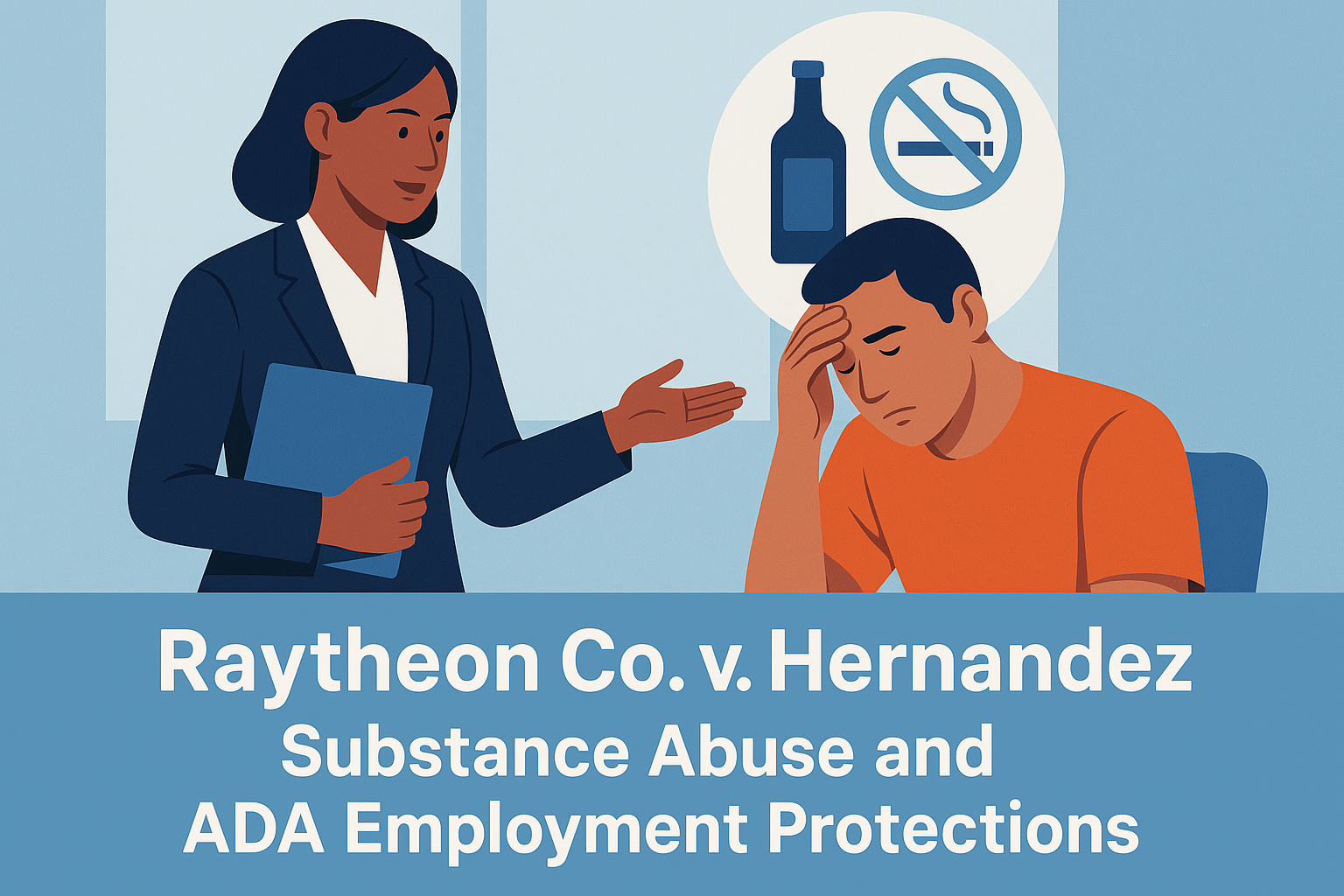
In the landmark case of Raytheon Co. v. Hernandez, the intricate interplay between substance abuse and employment protections under the Americans with Disabilities Act (ADA) took center stage. Understanding this case is vital for both employers and employees as it impacts employment practices and the rights of individuals who have battled with addiction. The ADA is a crucial piece of civil rights legislation aimed at preventing discrimination against individuals with disabilities, which includes addiction recovery. However, the extent to which the ADA protects rehabilitated drug users in employment contexts can be complex. This article explores the nuances of the case, the ruling, and the broader implications for workplace practices related to substance abuse recovery and employment rights.
The Background of Raytheon Co. v. Hernandez
The case began when Joel Hernandez, a former employee of Raytheon Company, reapplied for employment after being terminated due to failing a drug test, which had violated the company’s policies. At the time of his reapplication, Hernandez was in recovery and had not used drugs for more than two years. Raytheon, however, refused to rehire him, citing their policy against reemploying workers terminated for violation of workplace conduct rules, namely drug use in this instance. Hernandez filed a lawsuit under the ADA, claiming he was discriminated against due to his record of a disability—his prior drug addiction.
The ADA’s Definition of Disability
Under the ADA, a disability is defined as a physical or mental impairment that substantially limits one or more major life activities. Importantly, the ADA recognizes a past record of such an impairment as a disability, thus offering protections to those who have a history of drug addiction but are no longer using illegal drugs. Raytheon’s refusal to hire Hernandez seemed to collide with this ADA provision, making his case a test of how the ADA applies to individuals in recovery.
Court’s Ruling and Legal Reasoning
The central question was whether Hernandez was denied employment because of his past drug use or due to violating the company’s conduct rules. The Ninth Circuit initially ruled in favor of Hernandez, citing that drug addiction recovery qualifies as a protected disability. However, the case was taken to the Supreme Court, which provided a different perspective by focusing on motivation and policy consistency. The Supreme Court sided with Raytheon, asserting that the company’s policy of not rehiring employees dismissed for violation of workplace conduct rules was consistently applied. They concluded the motivation for non-rehire was not discrimination based on Hernandez’s disability, but rather the consistent application of a non-rehire policy, unrelated to disability discrimination standards under the ADA.
Impact on Employment Policies
The ruling underscored the importance of clear and consistently applied employment policies. Employers must ensure policies are systematic and uniformly applied to avoid any perception of discrimination. Failure to maintain consistency can lead to legal challenges. Organizations have been urged to carefully craft their policies to ensure they do not inadvertently discriminate against employees with a history of drug use who are in recovery, while also maintaining workplace safety and productivity standards.
Analysis of Consistent Application of Policies
The Raytheon case serves as a powerful example of how consistent enforcement of policies can shield employers from claims of discrimination. It illustrates that a firm, legal line drawn by policy, when uniformly applied regardless of the employee’s disability status, complies with ADA requirements. Here’s a simple breakdown of policy application based on this case:
- Policy Establishment: Employers should have clear, documented policies about workplace conduct and rehiring.
- Training and Communication: Ensure all employees and management are trained on these policies and understand ADA protections.
- Consistent Enforcement: Apply all policies uniformly, regardless of an employee’s disability history.
- Documentation: Maintain comprehensive records to support the consistent application of policies if challenged.
Lessons for Employers and Employees
For employers, Raytheon Co. v. Hernandez highlights the necessity of establishing objective criteria for employment decisions. It’s crucial to delineate clear guidelines that support objective decision-making processes. This ensures that employment decisions are based solely on objective factors such as policy violations, rather than any disability-related considerations unless directly relevant.
The case also serves as an educational benchmark for employees, particularly those with a history of substance abuse. Understanding one’s rights under the ADA emphasizes the importance of recognizing both the protections afforded and the limits of those protections in employment settings. Individuals in recovery are encouraged to clearly communicate their rehabilitation and provide documentation where necessary.
Ensuring ADA Compliance
In light of the Raytheon decision, ADA compliance is more critical than ever for employers. It involves understanding and balancing the rights of employees with disabilities, including those recovering from substance addictions, with legitimate business interests. This compliance is not a simple checkbox but rather requires ongoing assessment and adjustments to policies that affect recruitment, hiring, and employment retention strategies.
An effective compliance strategy might include:
| Compliance Strategy | Description |
|---|---|
| Policy Audit | Conduct regular audits of employment policies to ensure ADA adherence and sensitivity to those in addiction recovery. |
| Training Programs | Implement training programs for management and HR professionals to recognize and respect ADA provisions. |
| Interactive Process | Engage in an interactive process with employees who disclose a past drug addiction to understand how best to accommodate their situation. |
| Legal Consultation | Consult with legal experts familiar with ADA to ensure employment practices are compliant with current laws. |
Conclusion and Next Steps
The case of Raytheon Co. v. Hernandez underlines the complexities and the protective extent of the ADA concerning individuals who are recovering from substance abuse. The decisions in this case highlight the critical balance required between lawful employment policies and protection against discrimination. For employers, embedding compliance naturally within management practices is paramount, requiring regular reviews and possibly, legal consultations. For individuals in recovery, understanding both rights and responsibilities within the workplace is essential. It’s also beneficial to stay informed on how legal interpretations might evolve concerning ADA protections. As a next step, employers should consider auditing their rehiring policies and employee handbooks for compliance, while employees in recovery might engage in open dialogue with HR about their status and rights.
Frequently Asked Questions
1. What is the case of Raytheon Co. v. Hernandez about?
Raytheon Co. v. Hernandez is a significant U.S. Supreme Court case that highlights the intersection of substance abuse and employment protections under the Americans with Disabilities Act (ADA). The case centers on Joel Hernandez, a former employee of Raytheon Company who was denied reemployment after he had been previously terminated due to his drug addiction. Hernandez filed a lawsuit claiming that Raytheon’s refusal to rehire him constituted discrimination based on his past drug addiction, which he argued was protected under the ADA. The case examines the balance between an employer’s rights to enforce workplace policies – like a no-rehire policy – and an individual’s right to be free from discrimination due to a past disability. The decision in this case affirmed that an employer’s neutral employment policy, such as a no-rehire rule applied consistently, is not considered discriminatory under the ADA even if it adversely affects individuals with past substance abuse issues.
2. How does the Americans with Disabilities Act (ADA) relate to substance abuse?
The ADA is a pivotal law that prohibits discrimination against individuals with disabilities in various contexts, including employment. When it comes to substance abuse, the ADA offers protections for those who have completed or are participating in a drug rehabilitation program and are no longer engaging in the illegal use of drugs. This protection extends to individuals who have been successfully rehabilitated or are currently rehabilitated and not using drugs illegally anymore. However, the ADA does not protect individuals who are currently engaging in the illegal use of drugs. In the context of employment, this means that while employers cannot discriminate against someone based on a history of addiction or a rehabilitated status, they can take action against individuals who are using drugs illegally.
3. What was the Supreme Court’s decision in Raytheon Co. v. Hernandez, and what does it imply for employers?
In Raytheon Co. v. Hernandez, the Supreme Court ruled in favor of Raytheon, holding that the company’s application of its neutral no-rehire policy was not a violation of the ADA because it was enforced consistently across the board without any discriminatory intent. Importantly, the Court found that a neutral policy did not necessarily need to accommodate a person who had been previously fired for violating workplace conduct policies, such as illegal drug use. For employers, this decision underscores the importance of having clear, consistently applied policies and demonstrates that companies have the right to enforce such policies without contravening the ADA, provided there is no intentional discrimination against a person with a history of disability, like past drug addiction.
4. What implications does this case have for individuals recovering from addiction seeking employment?
For individuals recovering from addiction, the Raytheon Co. v. Hernandez case illustrates both the protections and limitations they face under the ADA in the employment context. While the ADA offers protection against discrimination due to a past addiction, this case highlights that it does not obligate employers to alter a consistently applied neutral policy (such as a no-rehire policy) for those with a past drug addiction. Recovering individuals must understand that while they have rights not to be discriminated against solely on account of past addiction, certain consequences of their actions prior to rehabilitation—such as prior termination from a position due to drug use—may legally affect their rehire status under a neutral policy. This highlights the importance of transparency and communication during the hiring process regarding a candidate’s rehabilitated status.
5. How can employers ensure they comply with the ADA when dealing with employees or applicants who have a history of substance abuse?
Employers can ensure compliance with the ADA by implementing and adhering to clear, neutral employment policies consistently across their organization. This includes understanding that while the ADA prohibits discrimination against those rehabilitated from drug addiction, it does not prevent employers from acting based on conduct or policy violations committed by employees during periods of illegal drug use. It’s essential for employers to document policies regarding substance use and ensure they are applied evenly. Employers should also engage in interactive processes to provide reasonable accommodations for employees who have completed or are undergoing rehabilitation and are not currently engaged in illegal drug use. Regular training and guidance for management and HR personnel in ADA compliance related to substance abuse issues can further help in minimizing liabilities and ensuring adherence to federal law.


