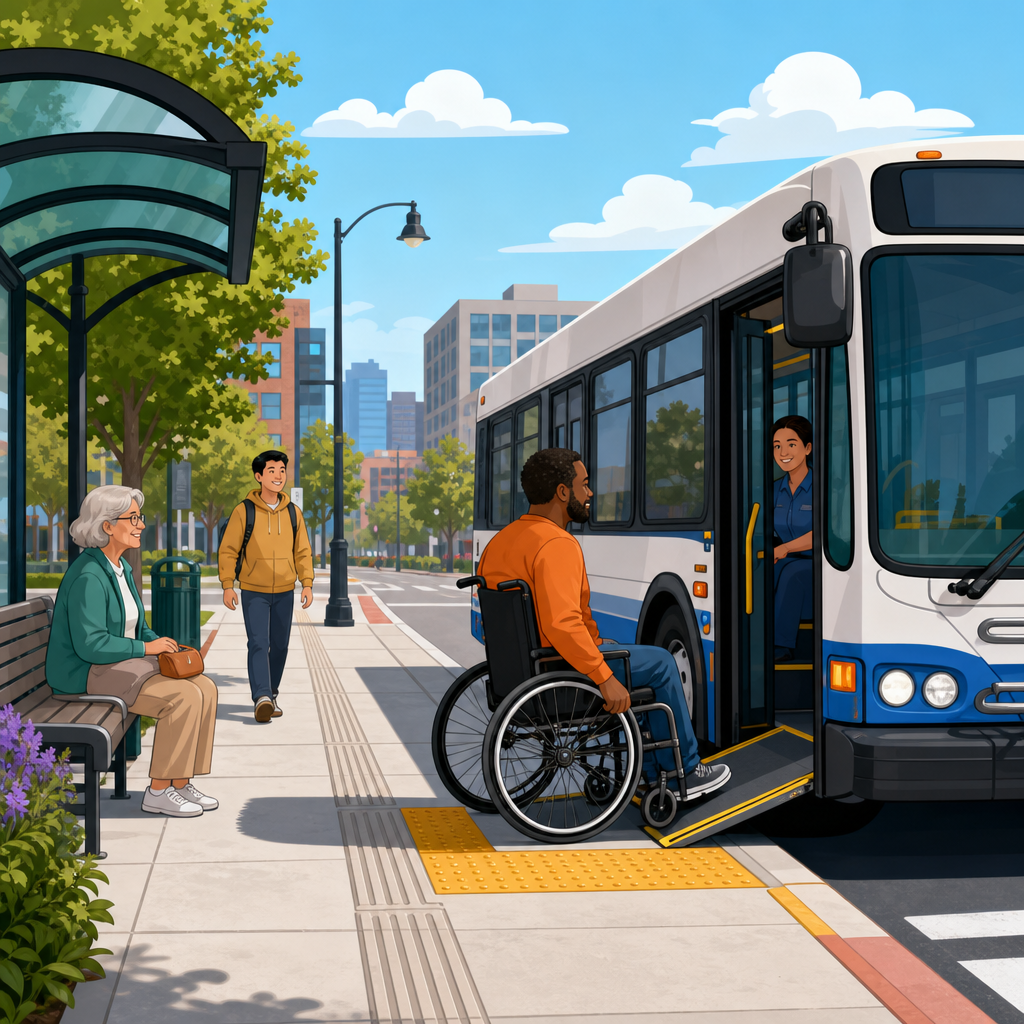
Public transit stops sit at the point where transportation policy becomes a daily public service, and PROWAG is the framework agencies need to understand to make those stops usable by everyone. In practice, transit agencies, cities, counties, and state departments of transportation share responsibility for bus stops, shelters, boarding areas, sidewalks, curb ramps, and crossings, which means accessibility failures often happen at the edges between owners. PROWAG, short for the Public Right-of-Way Accessibility Guidelines, addresses accessibility in sidewalks and street environments, including the pedestrian access routes that connect people to transit. For transportation professionals, this matters because a fixed-route system is only as accessible as the path to the stop, the waiting area, and the boarding point. I have worked on stop accessibility reviews where the bus itself had a compliant ramp and securement area, yet the rider still could not reach the stop because of broken pavement, missing curb ramps, or an inaccessible connection from the sidewalk to the pad. That gap creates legal risk, undermines service equity, and reduces ridership among older adults, disabled riders, parents with strollers, and travelers carrying bags. Agencies need a practical understanding of how stop design, maintenance, capital planning, and interagency coordination fit together. This transportation hub explains the fundamentals, identifies the most common compliance issues, and outlines what agencies should prioritize when improving public transit stops under PROWAG.
What PROWAG means for public transit stops
PROWAG establishes accessibility guidance for elements in the public right-of-way, and transit stops are directly affected because they depend on sidewalks, street crossings, curb ramps, and boarding connections. Even when transit agencies do not own the full right-of-way, they still operate a public service that must be accessible under the ADA, especially through the obligations in DOT regulations and complementary standards such as the 2010 ADA Standards for facilities. The key point is simple: accessibility at a stop is not limited to the bus shelter or sign. It includes the pedestrian access route to the stop, the dimensions and condition of the boarding and alighting area, connections across driveways, grade changes, cross slope, surface stability, and access to fare equipment or passenger amenities. Agencies should treat the stop as a node within a continuous accessible travel chain. If any link fails, the trip fails.
For bus stops, the most important concept is the boarding and alighting area. This is the space where a rider exits or enters the vehicle, deploys a ramp if needed, and positions a mobility device safely. That area must connect to the pedestrian access route, and it must provide enough clear space and a surface that supports wheelchair maneuvering. A shelter can improve comfort, but if its placement narrows the route or blocks turning space, it can create a barrier. The same is true for benches, trash receptacles, bike racks, utility poles, and advertising panels. In field audits, I have seen newly installed shelters that looked modern but left less than the necessary clear width because the site plan did not account for existing poles and guy wires. The result was an expensive retrofit that could have been avoided with an accessibility review during design.
Agencies also need to understand the relationship between PROWAG and stop types. A near-side stop before an intersection creates one set of conditions for curb ramps and crossing access. A far-side stop after the intersection may improve bus operations and visibility, yet it can increase walking distance to a marked crosswalk if connections are poorly planned. Midblock stops introduce another layer because crossing opportunities may be limited. In each case, operational decisions affect accessible use. Transportation planning should therefore pair service design with right-of-way analysis, not treat accessibility as a final checklist item after routes are set and shelters are ordered.
Core design features agencies must evaluate
Every transit stop should be reviewed through a small set of repeatable design questions. Can a pedestrian reach the stop from the surrounding network? Is there an accessible boarding and waiting area? Can a rider using a wheelchair, walker, or cane navigate around all site elements? Is there an accessible route to any provided shelter, bench, or fare machine? Can a person with low vision understand where to stand and how to cross nearby streets safely? These questions seem basic, but they expose most real-world failures.
The pedestrian access route should be continuous, firm, stable, and unobstructed. Common barriers include heaved sidewalk panels, excessive cross slope, utility cabinets placed in the clear width, and drainage grates at transition points. The boarding area needs enough usable space for ramp deployment and maneuvering. Surfaces made of loose gravel, grass, or broken asphalt usually fail this basic test, especially in wet or icy conditions. Vertical changes at the stop edge can also create hazards if they catch small front casters on wheelchairs or walkers.
Placement of amenities deserves more attention than agencies often give it. Benches should support riders who cannot stand for long periods, but the bench cannot consume the clear area needed for boarding access. Shelters should provide weather protection while preserving circulation inside and outside the structure. Transparent panels can improve security and visibility, while poor lighting can make even a geometrically compliant stop feel unsafe. Sign poles and real-time information displays should be readable, reachable when required, and located so they do not intrude into the accessible path.
| Stop element | What to verify | Common failure | Operational impact |
|---|---|---|---|
| Pedestrian access route | Continuous connection, clear width, stable surface, manageable slope | Missing sidewalk segment or obstruction at pole line | Rider cannot reach stop independently |
| Boarding and alighting area | Clear space connected to route, suitable surface, compatible with ramp deployment | Grass strip, broken pad, or utility cover in landing area | Ramp cannot deploy safely |
| Shelter and bench | Accessible route into shelter, maneuvering room, seating access | Bench blocks turning space inside shelter | Rider waits outside in weather |
| Curb ramp and crossing | Direct connection to crosswalk, detectable warnings where required | Ramp points into traffic or away from crossing | Unsafe street crossing |
| Maintenance condition | Snow clearance, debris removal, pavement repair, vegetation control | Accessible stop blocked after storm | Service becomes functionally inaccessible |
These checks should be standardized in agency design manuals and maintenance inspections. The most effective transportation programs use a stop inventory with photos, measurements, defect categories, ownership notes, and priority ratings. Tools such as ArcGIS, asset management systems, and mobile inspection platforms help staff track conditions over time rather than relying on anecdotal complaints alone.
Coordination, ownership, and legal responsibility
One of the hardest parts of public transit stop accessibility is that responsibility is rarely housed in one organization. The transit agency may own the sign and shelter, the city may own the sidewalk, the county may control drainage, and a state DOT may own the arterial roadway. Without written responsibility matrices, agencies waste time debating jurisdiction while riders face the same barrier day after day. In my experience, the most successful programs create interagency agreements that define who designs, funds, constructs, inspects, and maintains each stop element.
Transportation agencies should build those agreements around the full rider path, not isolated assets. For example, replacing a shelter without fixing the missing curb ramp nearby does not solve the access problem. Likewise, a city sidewalk program that upgrades corners but leaves an inaccessible bus pad can miss a high-value improvement opportunity. Coordinated capital planning lets agencies bundle work, reduce mobilization costs, and avoid tearing up the same location twice. Federal funding programs often reward this kind of integrated approach because it ties accessibility to safety, state of good repair, and equitable access.
Legal exposure is another reason coordination matters. ADA complaints involving transit stops often focus on barriers that were known, documented, and left unresolved because agencies disagreed about ownership. Courts and settlement agreements generally look at whether the public entity made reasonable progress, had a transition plan or barrier removal strategy, and responded appropriately when alterations occurred. Agencies should document inspections, complaint response times, maintenance actions, and project prioritization criteria. Good records do not replace compliance, but they demonstrate that the agency understands its obligations and is acting systematically rather than reactively.
Planning accessible stop improvements across a transportation network
Because few agencies can rebuild every stop at once, prioritization is essential. The strongest programs rank stops using both accessibility severity and service importance. A high-ridership stop at a hospital, community college, government center, or transfer hub should usually move ahead of a lightly used stop with similar deficiencies. Equity data also matters. Stops serving neighborhoods with higher shares of disabled residents, lower-income households, or older adults often produce outsized benefits when improved. Agencies can combine ridership, land use, complaint history, paratransit trip origins, crash data, and sidewalk gap maps to identify where investment will have the greatest effect.
Field verification is critical. Desktop reviews can identify missing sidewalks or absent curb ramps, but they rarely capture drainage problems, temporary obstructions, or the way a bus actually aligns at the curb. I recommend that agencies audit representative stops with operations staff, maintenance staff, planners, and if possible disabled riders or advisory committee members. A stop that appears accessible on a plan may fail in service because the bus cannot pull close enough to the curb, tree roots lift the pad, or a nearby driveway creates excessive cross slope in the waiting area. Those realities only emerge on site.
Phasing should separate quick fixes from capital reconstruction. Quick fixes include relocating a sign pole, trimming vegetation, repairing isolated sidewalk panels, re-striping a crosswalk approach, or replacing a bench that blocks circulation. Capital projects include adding sidewalk connections, rebuilding pads, moving utilities, constructing curb ramps, or relocating the stop entirely. Agencies that publish a tiered improvement program can show progress sooner, stretch budgets further, and build public trust. This transportation hub approach also supports internal linking across related guidance on bus stop design, sidewalk accessibility, curb ramps, detectable warnings, and ADA transition planning.
Maintenance, operations, and the rider experience
Accessibility at transit stops is not only a design issue; it is an operations issue every day of the year. Snow and ice can erase access overnight. So can storm debris, illegal parking, sidewalk dining spillover, construction fencing, or overgrown landscaping. Agencies should have maintenance standards that define response times, inspection frequency, and escalation procedures for blocked accessible stops. In northern climates, snow storage planning matters as much as snow removal. I have seen accessible pads built correctly and then rendered useless because plowed snow was piled exactly where a lift or ramp needed to deploy.
Operations staff also need training. Bus operators should know how stop conditions affect ramp deployment and when to report defects. Customer service teams should be able to categorize accessibility complaints precisely rather than entering vague notes like bad stop. Maintenance crews should understand that a one-inch lip, a loose paver, or a sign shifted into the clear width can be a serious barrier. When agencies connect these reports to a stop asset database, recurring defects become visible and funding requests become much easier to justify.
The rider experience should remain the test of whether the program works. An accessible stop allows a rider to approach, wait, obtain information, board, and continue the trip with dignity and predictability. That includes wayfinding, lighting, sight lines, weather protection, and personal security alongside technical compliance. A stop can meet dimensional criteria and still perform poorly if riders must wait in mud beside a shelter or cross five lanes without sufficient crossing time. Agencies should pair standards compliance with user observation, complaint review, and post-project evaluation.
Public transit stops and PROWAG belong at the center of transportation accessibility planning because they determine whether many riders can use fixed-route service at all. Agencies need to think beyond the sign or shelter and evaluate the entire chain of access: sidewalk connection, curb ramp, crossing, boarding area, amenities, maintenance, and operations. They also need clear ownership agreements, reliable inventories, and a prioritization method that reflects ridership, equity, and severity of barriers. The most effective transportation programs do not wait for complaints to reveal problems. They inspect systematically, coordinate across departments, and bundle accessibility upgrades into routine capital work whenever streets, sidewalks, or stops are altered.
As the hub page for transportation guidance, this article sets the baseline for more detailed topics such as bus stop boarding areas, curb ramp design, shelter placement, detectable warnings, sidewalk maintenance, and ADA transition planning. The main benefit of understanding PROWAG at transit stops is straightforward: agencies can deliver service that more people can actually reach and use, while reducing avoidable legal and operational risk. Review your stop inventory, map your barriers, and start with the stops where accessible improvements will change the most trips.
Frequently Asked Questions
What is PROWAG, and why does it matter for public transit stops?
PROWAG stands for the Public Right-of-Way Accessibility Guidelines. It provides the technical accessibility framework agencies use to evaluate and improve pedestrian features located in the public right-of-way, including sidewalks, curb ramps, crossings, pedestrian access routes, and key transit stop elements. For public transit stops, PROWAG matters because the usability of a stop depends on much more than the sign or shelter itself. A stop may technically exist, but if riders cannot reach it safely from the sidewalk, navigate the curb ramp, cross the street, or board from a stable and accessible area, then the stop is not functionally serving the public.
For transit agencies, cities, counties, and state departments of transportation, PROWAG is especially important because transit stops sit at the intersection of multiple systems and multiple owners. One entity may control the roadway, another the sidewalk, another the shelter, and another the bus operations. That fragmented responsibility is often where accessibility breaks down. PROWAG gives agencies a common set of expectations for how the right-of-way should support pedestrian access, including access to transit. In practical terms, it helps agencies move beyond isolated compliance decisions and toward a connected, usable path of travel for people with disabilities, older adults, parents with strollers, and anyone navigating the built environment on foot or with mobility devices.
Which parts of a transit stop are typically covered by accessibility planning under PROWAG?
Accessibility planning for a transit stop should be understood as a corridor and connection issue, not just a pad or a shelter issue. Under a PROWAG-informed approach, agencies need to consider the full sequence of use: how a person gets to the stop, how they wait there, and how they board or alight. That usually includes the pedestrian access route leading to the stop, sidewalk width and condition, vertical changes in level, driveway crossings, curb ramps, detectable warnings where required, street crossings near the stop, boarding and alighting areas, connections to shelters, benches, and transit information, and the relationship between the stop and adjacent site features such as utility poles, landscaping, or drainage structures.
In many locations, the biggest accessibility barrier is not the bus stop sign itself but the surrounding context. A perfectly installed shelter does not solve a missing curb ramp. A compliant boarding area does not help if there is no continuous accessible sidewalk connection. Likewise, a stop may fail in practice if riders must wait in grass, gravel, or a narrow pinch point blocked by street furniture. Agencies should therefore inventory all physical elements that affect a rider’s path of travel and usability. The key question is whether a person with a disability can independently and safely approach, enter, wait at, and depart from the stop using the public right-of-way as it actually exists.
Who is responsible for making transit stops accessible when multiple agencies or property owners are involved?
Shared responsibility is one of the most common and difficult issues in transit stop accessibility. In many communities, the transit agency operates service and installs the stop marker, the city maintains the sidewalk, the county controls drainage or adjacent roads, the state DOT owns the arterial, and a private property owner may influence access through frontage conditions. Because of that patchwork, accessibility failures often occur at ownership boundaries, with each party addressing only its own asset while the overall stop remains unusable. From a public-facing perspective, however, riders experience the stop as one connected facility, not a collection of separate jurisdictions.
Agencies should not rely on informal assumptions about who handles what. Instead, they should develop written agreements, maintenance responsibilities, design standards, and coordination procedures that clearly assign duties for stop pads, shelters, sidewalks, curb ramps, crossings, snow removal, vegetation management, and temporary construction impacts. Even where one entity does not own every feature, it still benefits from identifying barriers, documenting deficiencies, coordinating remedies, and escalating unresolved issues. The strongest programs use interagency memoranda, permit review processes, capital project checklists, and shared inventories so that accessibility is addressed systematically rather than reactively. The goal is not simply to assign blame for barriers, but to ensure that no critical link in the accessible path of travel is overlooked.
How should agencies prioritize transit stop accessibility improvements if they cannot fix every stop at once?
Most agencies face budget, staffing, and right-of-way constraints, so prioritization is essential. The most effective approach is to combine accessibility risk, rider impact, and implementation opportunity. High-priority locations often include stops with high ridership, stops serving hospitals, schools, government centers, senior housing, and transfer hubs, and stops where barriers prevent basic access to service, such as missing sidewalks, inaccessible boarding areas, or absent curb ramps. Agencies should also pay close attention to locations with known complaints, Title II transition plan relevance, ADA paratransit interactions, safety concerns, and recurring maintenance issues that degrade accessibility over time.
At the same time, agencies should integrate accessibility improvements into routine capital planning, resurfacing, sidewalk projects, signal upgrades, stop consolidation efforts, and shelter replacement programs. That is often the most realistic way to make broad progress. A strong prioritization framework typically includes a stop inventory, condition scoring, documented barrier types, ownership information, photographs, and a method for ranking improvements by severity, usage, equity considerations, and coordination feasibility. Importantly, agencies should not focus only on locations that are easiest to fix. The highest-value improvements are often the ones that restore a complete accessible connection from the surrounding pedestrian network to the transit vehicle. Clear criteria, public transparency, and periodic reassessment help agencies demonstrate that they are making measurable progress rather than addressing stops in an ad hoc manner.
What are the most common mistakes agencies make when applying PROWAG principles to transit stops?
One of the most common mistakes is treating the transit stop as an isolated object instead of part of an accessible route. Agencies may install a shelter or replace a sign and consider the work complete, even though the stop remains inaccessible because the sidewalk is broken, the curb ramp is missing, the boarding area is obstructed, or the nearest crossing is unusable. Another frequent mistake is assuming that ownership limits responsibility for coordination. While legal ownership matters, accessibility planning fails when agencies ignore conditions just beyond their direct asset line. Riders do not distinguish between transit, roadway, and sidewalk owners when they encounter a barrier.
Other common problems include using inconsistent design standards, overlooking maintenance as an accessibility issue, and failing to account for real-world obstructions such as poles, utility boxes, overgrown vegetation, parked vehicles, drainage issues, or construction detours. Agencies also run into trouble when they document stops too narrowly, without capturing the actual path of travel and nearby crossing conditions. Finally, some programs emphasize new installations while allowing existing stops to remain inaccessible for years without a clear transition strategy. The best way to avoid these mistakes is to evaluate stops from the rider’s perspective, use a corridor-based accessibility review, coordinate across departments and jurisdictions, and build accessibility requirements into planning, design, construction, maintenance, and replacement cycles from the beginning.