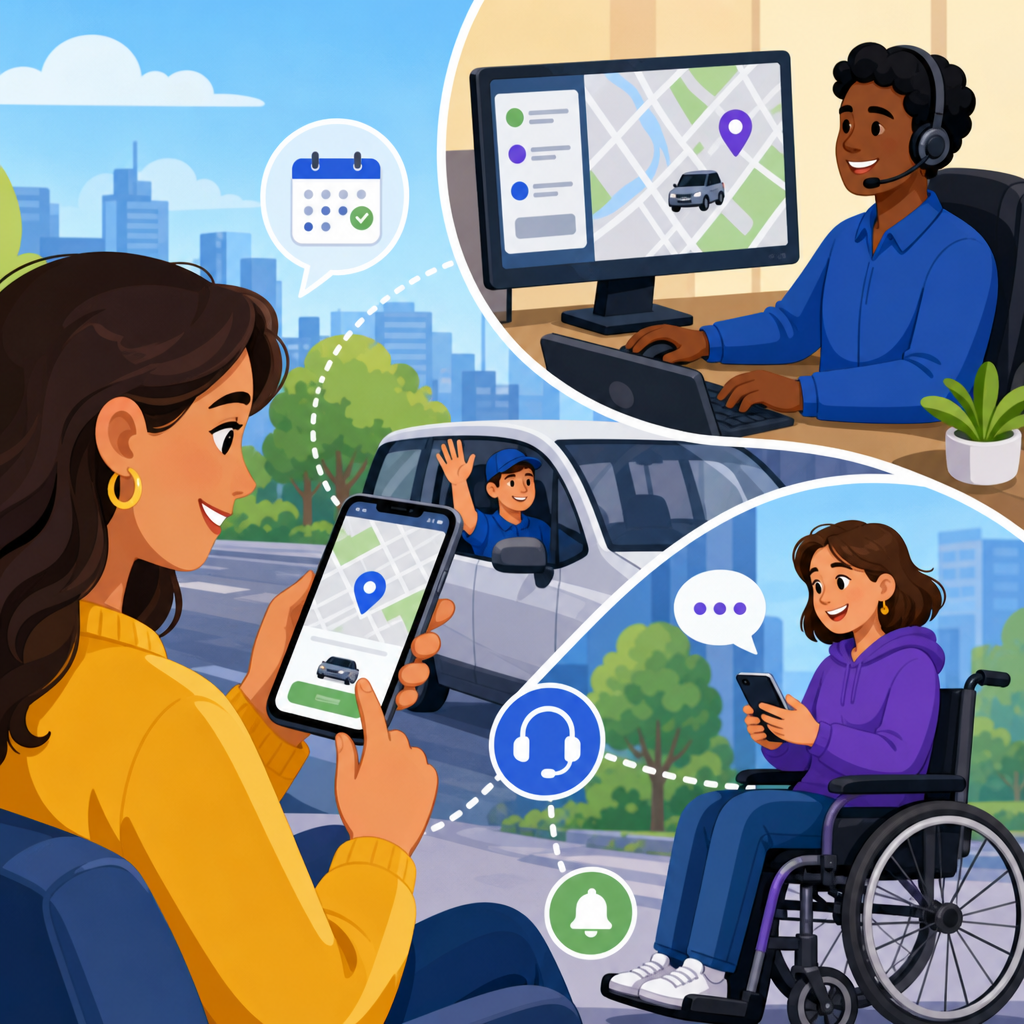
Accessible booking, dispatch, and rider communication systems are the operational backbone of inclusive transportation, turning a trip request into a safe, understandable, and completed journey for people with varied mobility, sensory, cognitive, and language needs. In transportation, accessibility means more than adding a wheelchair icon to a booking form. It includes digital accessibility for websites and apps, operational accessibility in call centers and dispatch workflows, vehicle and stop information that riders can perceive and understand, and communication methods that work before, during, and after the trip. A booking system is the interface where riders request service, manage eligibility, confirm pickup details, and receive updates. Dispatch is the engine that assigns trips, schedules vehicles, balances capacity, and responds to disruptions. Rider communication systems include SMS alerts, automated voice calls, email notices, in-app messages, live agent support, driver tablets, and onboard announcements.
This topic matters because transportation access directly affects employment, health care, education, and civic participation. In my work reviewing transit and demand-response platforms, the biggest failures rarely start on the vehicle. They start when a rider cannot complete a reservation with a screen reader, cannot understand pickup windows, or misses a cancellation notice that was sent only by text. Public transit agencies, paratransit providers, microtransit operators, non-emergency medical transportation companies, and private shuttle networks all face the same core challenge: every trip depends on accurate information moving between riders, agents, drivers, and software systems. When those systems are not accessible, the result is missed rides, costly no-shows, unsafe transfers, and preventable complaints. When they are designed well, agencies improve service reliability, reduce call volume, support regulatory compliance, and serve more riders with the same fleet.
For transportation leaders building an industry-specific accessibility strategy, this hub explains the essential components of accessible booking, dispatch, and rider communication systems, the standards that shape them, the common design errors to avoid, and the practical priorities for procurement, implementation, and continuous improvement.
What accessible transportation systems include
An accessible transportation technology stack usually spans several connected products rather than one monolithic platform. The rider-facing layer includes websites, mobile apps, interactive voice response systems, kiosks, and agent-assisted booking tools. The operations layer includes computer-aided dispatch, scheduling engines, driver manifests, GPS and automatic vehicle location feeds, incident management tools, and reporting dashboards. The communication layer ties them together through confirmations, reminders, estimated arrival notices, service alerts, proof-of-pickup records, and post-trip feedback. In transportation, accessibility must be treated as an end-to-end service property. A compliant website does not solve the problem if dispatch notes cannot capture mobility device dimensions, or if driver tablets truncate instructions needed for a blind rider’s pickup location.
Across fixed-route, paratransit, dial-a-ride, and microtransit models, riders need several things consistently: a simple way to request service, clear eligibility or fare information, confirmation that the trip exists, understandable pickup expectations, real-time updates when conditions change, and a reliable method to reach a human when automation fails. For deaf or hard-of-hearing riders, voice-only notifications are insufficient. For blind or low-vision riders, unlabeled buttons, inaccessible maps, and image-based schedules block trip management. For riders with cognitive disabilities, unclear time windows and complex cancellation rules create avoidable confusion. For riders with limited English proficiency, safety-critical messages sent only in English create risk. Good systems accommodate all of these realities by design, not as afterthoughts.
Transportation organizations also need accessible internal workflows. Reservation agents must be able to enter accommodations accurately. Dispatchers need structured fields for pickup landmarks, escort requirements, service animal information, and transfer dependencies. Drivers need concise, readable instructions presented safely on mounted devices. Supervisors need audit trails showing when notices were sent and whether riders acknowledged them. These requirements are operational, not cosmetic, because they directly affect on-time performance, service equity, complaint resolution, and risk management.
Standards, regulations, and procurement requirements
Transportation accessibility is shaped by overlapping legal and technical requirements. In the United States, the Americans with Disabilities Act sets the baseline for nondiscrimination in public services and transportation, including complementary paratransit obligations for many transit agencies. Section 504 of the Rehabilitation Act applies to recipients of federal funding. Section 508 influences information and communication technology procured by federal agencies and is often referenced in public-sector purchasing. For digital products, the most widely used technical benchmark is WCAG 2.1 Level AA, and many organizations now evaluate against WCAG 2.2 as products evolve. European operators commonly map to EN 301 549 for ICT accessibility. None of these standards should be treated as a checkbox exercise. In transportation, legal compliance and service usability are connected but not identical; a technically conforming interface can still fail riders in live operations.
Procurement is where many accessibility outcomes are won or lost. Agencies should require vendors to provide a current accessibility conformance report, preferably using the VPAT format, but they should never accept vendor claims without testing. I have seen proposals promise screen reader compatibility while basic date pickers were unusable and trip status updates were not announced to assistive technologies. Strong procurement language asks for keyboard operability, screen reader support, color contrast, captioning, error identification, alternative notification channels, accessible PDFs where relevant, and documented remediation timelines. It also requires accessibility in native mobile apps, not only web portals, plus interoperability with call center systems and translation workflows.
Contracts should specify service-level expectations tied to accessibility. Examples include maximum time to remediate critical accessibility defects, support for relay calls, availability of multilingual notification templates, and accessible alternatives when real-time maps fail. Agencies should also request usability testing with disabled riders before launch and after major releases. That step catches operational barriers technical audits miss, such as driver-arrival messages that say “your ride is here” without identifying vehicle color, location, or boarding side.
Designing accessible booking flows for every rider
The booking flow is the front door to transportation service, so it must work for first-time users, frequent riders, family caregivers, and agency staff booking on a rider’s behalf. The best systems present one task per step, use plain language, preserve entered data, and make every control available by keyboard. Riders should be able to book one-way, round-trip, subscription, and return trips without re-entering repetitive details. Forms should label required fields clearly, identify errors next to the field in text, and avoid timeout behavior that erases progress. Date and time selection must support manual entry as well as picker widgets because many custom calendars are difficult with assistive technology.
Accessible booking also depends on transportation-specific data design. Pickup and drop-off fields should support landmarks, building entrances, gate codes, unit numbers, and notes about safe meeting points. The system should capture whether the rider uses a wheelchair, scooter, walker, oxygen, or a service animal, and whether a personal care attendant or companion is traveling. These are not edge cases. They affect vehicle assignment, dwell time, securement capacity, and route planning. If the system buries these needs in free-text comments, dispatch accuracy drops and drivers receive inconsistent information.
Identity and eligibility workflows need the same attention. Paratransit riders may need to verify certification status, book within service areas, and understand fare rules linked to ADA eligibility categories. Non-emergency medical transportation users may need to confirm payer authorization, appointment times, and will-call return policies. Accessible systems explain these rules in plain terms before checkout, not inside policy PDFs. They also offer multiple login and verification methods. One-time passcodes sent only by SMS can exclude riders who use landlines, shared devices, or assistive communication setups. Email, voice, authenticator apps, and agent verification should be available based on risk level.
Dispatch and scheduling that preserve accessibility in operations
Dispatch systems determine whether accessibility commitments survive contact with real-world constraints. Scheduling engines must account for vehicle lift availability, securement positions, rider loading time, transfer protection, and driver training qualifications. If optimization is tuned only for efficiency, the software may stack trips in ways that create unworkable boarding sequences or excessive ride times for passengers needing additional assistance. In practice, accessibility settings belong inside scheduling logic, not in side notes. Parameters such as maximum ride time, early arrival tolerance, no-step vehicle requirements, and escort rules must be machine-readable so the dispatcher is not forced to remember them manually during peak demand.
Real-time dispatch also needs accessible exception handling. Late vehicle, no-show, address mismatch, weather disruption, and hospital will-call returns are common scenarios. A strong platform lets dispatchers contact riders through their preferred channels, log every attempt, and escalate to a live agent quickly. It should support message templates that can be translated, read aloud clearly by text-to-speech, and shortened for SMS without losing meaning. Driver-facing applications must show critical rider notes prominently but safely, with large touch targets, high contrast, and minimal cognitive load. If a driver must drill through five screens to find the instruction “rear entrance only,” the design has already failed.
| System area | Accessibility requirement | Operational benefit |
|---|---|---|
| Booking form | Keyboard support, clear labels, text error messages | Higher completion rates, fewer abandoned reservations |
| Trip data | Structured fields for mobility aids and attendants | More accurate vehicle assignment and manifests |
| Dispatch logic | Rules for lift vehicles, ride time, and transfer protection | Fewer service failures and safer trip execution |
| Notifications | SMS, voice, email, app, and agent fallback | Lower no-show rates and better rider awareness |
| Driver tablet | Readable instructions, high contrast, simple workflow | Faster boarding and fewer missed special instructions |
Providers using tools such as Trapeze, Ecolane, Routematch, Spare, RideCo, Via, or custom CAD/AVL stacks should evaluate whether accessibility attributes survive every handoff between modules. In many deployments, reservation data enters correctly but is lost when exported to a driver manifest or third-party messaging tool. End-to-end testing with real trips is essential because integrations, not core software, often create the most serious barriers.
Rider communication before, during, and after the trip
Accessible rider communication answers three questions at all times: Did my trip book successfully, what is happening now, and what should I do next? Every transportation provider should send confirmations immediately with date, pickup location, drop-off location, service type, fare if applicable, and a clear cancellation method. Reminder notices should state the pickup window in plain language, not only a single time stamp that can mislead paratransit riders. Arrival alerts should identify the vehicle in a way riders can use, such as vehicle number, make, color, or curb position. A message that says “driver has arrived” is often useless at a hospital entrance with multiple vans present.
Multichannel delivery is mandatory. SMS works well for many riders, but some need automated voice calls, email, app push notifications, TTY-compatible support, or direct agent outreach. Communication preferences should be rider-controlled and stored in the profile, with overrides for urgent incidents. Message content must be concise, readable, and localized into the languages riders actually use. For blind riders, links should be descriptive and not rely on map visuals alone. For deaf riders, video relay or chat support can be more effective than callback promises. For riders with cognitive disabilities, repeat the next action clearly: “Your pickup window is 2:00 to 2:30 PM. Please be at the front lobby by 1:55 PM.”
After the trip, accessible systems continue to matter. Receipts, missed-trip determinations, complaint forms, and appeal processes should all be available digitally and through staffed channels. Agencies that analyze communication outcomes often find measurable gains: fewer “where is my ride” calls, fewer preventable no-shows, and faster dispute resolution because every notice is logged. Those gains improve both customer experience and cost control.
Implementation, testing, and continuous improvement
Successful transportation teams treat accessibility as a product and operations discipline, not a one-time remediation project. Start with a service blueprint that maps each rider touchpoint from trip discovery to post-trip feedback. Then test each touchpoint with keyboard-only navigation, screen readers such as NVDA, JAWS, and VoiceOver, zoom up to 200 percent, color contrast analyzers, caption checks, and live call center scenarios. Include native app testing on iOS and Android, because mobile accessibility issues often differ from web issues. Measure task completion, time on task, error rate, and support escalation, not just conformance findings.
Governance matters just as much as testing. Assign ownership across digital product, operations, vendor management, and customer service. Build accessibility requirements into design systems, content standards, release gates, and QA scripts. Train reservation agents and dispatchers on disability etiquette and structured data entry so accessible tools are used correctly. Review complaints for systemic patterns rather than isolated incidents. If riders repeatedly miss pickup notices at a certain hospital campus, the problem may be message wording, geofencing accuracy, or pickup landmark data quality rather than rider behavior.
As a hub for transportation guidance, this topic connects naturally to deeper articles on paratransit software, microtransit app design, accessible driver interfaces, multilingual service alerts, call center accessibility, and vendor procurement checklists. Teams that improve these systems usually see the same result: clearer information, more dependable operations, and transportation service that more people can actually use. Audit your current booking flow, dispatch rules, and communication channels, then prioritize the barriers that stop riders from completing trips today.
Frequently Asked Questions
What makes a booking system truly accessible in transportation?
A truly accessible booking system supports people with a wide range of mobility, sensory, cognitive, speech, and language needs from the very first interaction. That means accessibility must be built into every booking channel, including websites, mobile apps, kiosks, and phone-based reservations. For digital tools, this includes compatibility with screen readers, keyboard navigation, clear heading structures, high color contrast, resizable text, descriptive form labels, and error messages that are easy to understand and correct. For riders with cognitive or language-related needs, simple wording, logical page flows, plain-language instructions, multilingual support, and visual confirmation steps can make the difference between a successful booking and a failed one.
Accessible booking also means collecting the right trip information without creating unnecessary barriers. Riders should be able to specify mobility aids, service animals, boarding assistance needs, communication preferences, pickup landmarks, and other accommodation details in a respectful and structured way. The system should remember saved preferences when appropriate so riders do not have to repeat sensitive or essential information on every trip. Equally important, the booking process should confirm that these details are actually transmitted to dispatchers and drivers, rather than being stored in a field no one uses operationally.
In practice, an accessible booking system is not defined by a single feature. It is defined by whether riders can independently request, confirm, manage, and understand their trip with confidence. If a rider can complete the process without guessing, relying on workarounds, or making multiple follow-up calls to clarify basic details, the system is moving toward real accessibility rather than performative compliance.
How do dispatch systems support accessible transportation beyond basic scheduling?
Dispatch systems are the operational engine that turns a trip request into an actual ride, and their role in accessibility is often underestimated. A strong accessible dispatch platform does much more than assign vehicles and optimize routes. It incorporates rider accommodations into trip logic, ensures the correct vehicle type is sent, flags boarding or transfer assistance needs, and helps dispatch staff communicate clearly with operators in real time. If a rider requires a wheelchair-accessible vehicle, extra dwell time, curb-to-curb assistance, or a specific pickup approach, the dispatch system must surface that information prominently and consistently throughout the workflow.
Accessibility in dispatch also depends on usability for staff. Dispatchers often work in fast-paced environments where missed details can directly affect rider safety and trip success. Systems should present rider needs clearly, avoid cluttered interfaces, reduce manual re-entry, and support standardized notes rather than relying on free-text fields alone. Alerts for missed accommodations, duplicate bookings, inaccessible vehicle assignments, or changes in rider status can prevent service failures before they happen. Integrations with booking platforms, driver tablets, AVL systems, and customer communication tools are especially important because accessibility often breaks down when information is fragmented across disconnected systems.
Another key function of accessible dispatch is resilience during disruptions. Delays, vehicle substitutions, missed pickups, road closures, and driver changes are challenging for any rider, but they can be especially disruptive for people with disabilities. A dispatch system that allows rapid reassignment, timely communication, accommodation-aware decision-making, and service recovery protocols helps maintain dignity and trust. In other words, dispatch accessibility is not just about efficiency. It is about reliably operationalizing rider needs in real-world conditions.
Why is rider communication such an important part of accessibility?
Rider communication is essential because transportation accessibility depends not only on getting the logistics right, but also on making sure the rider understands what is happening before, during, and after the trip. Many service failures occur not because a ride was never scheduled, but because the rider did not receive a message in a usable format, could not identify the vehicle, did not understand a delay notice, or had no clear way to ask for help. Accessible communication systems reduce uncertainty and give riders the information they need in formats they can actually use.
Effective accessible communication is multimodal. Riders should be able to receive confirmations, reminders, arrival alerts, delay notices, and post-trip updates through channels such as voice calls, SMS, email, app notifications, and in some cases TTY or relay-supported communication. Messages should be concise, time-sensitive, and written in plain language. They should avoid jargon, unexplained abbreviations, or vague phrases like “vehicle nearby” when more specific information is possible. For riders who are blind or have low vision, compatibility with screen readers and audio alerts matters. For riders who are deaf or hard of hearing, text-based updates and visual indicators are critical. For riders with cognitive disabilities, clear step-by-step messages and predictable notification patterns can improve independence and reduce stress.
Communication must also flow both ways. Riders need practical ways to confirm details, report a problem, ask for assistance, notify the provider of a change, or connect with a live agent when automated messages are insufficient. The best systems treat communication as a core service layer, not an afterthought. When communication is accessible, riders are more likely to feel confident, informed, and safe throughout the journey.
What features should transportation providers prioritize when designing inclusive rider experiences?
Transportation providers should prioritize features that remove friction across the full rider journey, not just at the booking screen. At a minimum, inclusive rider experience design should include accessible trip search and reservation tools, accommodation capture, fare transparency, multiple contact methods, real-time trip status visibility, and reliable post-booking support. Providers should also make it easy for riders to save frequent destinations, store mobility and communication preferences, and review trip details in a format that is readable and easy to revisit later. Consistency matters: the same trip details should appear across the website, app, call center, dispatch console, and driver interface.
Providers should also think carefully about vehicle and stop interactions. A rider experience is only truly inclusive if the digital and operational layers connect to the physical journey. Features such as precise pickup instructions, landmark-based wayfinding, vehicle identification details, operator notes, and boarding assistance alerts can significantly improve the experience for riders with mobility, sensory, or cognitive disabilities. If a system tells a rider a trip is booked but fails to communicate where the driver will actually stop, whether assistance is available, or how to identify the correct vehicle, the experience is incomplete.
Another high-value priority is flexibility. Not every rider wants or can use the same channel in the same way every time. Some may prefer self-service apps, while others need a trained call center agent. Some may want text alerts, while others need voice outreach. Inclusive systems let riders choose the method that works best for them without penalizing them for that choice. Finally, providers should prioritize testing with real users with disabilities. Accessibility is not fully achieved through standards checklists alone; it improves when systems are evaluated by the people who rely on them.
How can transportation organizations measure whether their booking, dispatch, and communication systems are actually accessible?
Transportation organizations should measure accessibility using both technical compliance indicators and real-world service outcomes. Compliance testing is an important starting point. Websites and apps can be evaluated against recognized digital accessibility standards, and internal tools can be reviewed for usability, keyboard access, screen-reader support, and clarity of workflows. But accessibility cannot be judged only by whether software passes an audit. Organizations also need to examine whether riders with disabilities can complete bookings successfully, receive accommodations reliably, understand communications, and finish trips without preventable breakdowns.
Useful performance metrics may include booking completion rates by channel, call abandonment rates, accommodation fulfillment rates, missed pickup rates, complaint categories, trip denials due to equipment mismatch, and time-to-resolution for service issues. Communication-specific metrics such as message delivery success, rider response rates, and escalation frequency can reveal whether alerts are being received and understood. Staff-side metrics matter too. If dispatchers frequently override assignments, re-enter accommodation details manually, or call drivers to relay information already entered into the system, that usually points to a design or integration gap affecting accessibility.
The most valuable measurement approach combines data with direct rider feedback. Surveys, usability sessions, accessibility audits, complaint reviews, and advisory groups that include disabled riders can surface issues that dashboards alone will miss. Organizations should treat accessibility as an ongoing operational discipline, not a one-time project. Systems change, service patterns evolve, and rider needs vary, so continuous monitoring and improvement are essential. When measurement focuses on actual rider outcomes, organizations can move beyond checking boxes and start building transportation services that are genuinely inclusive.