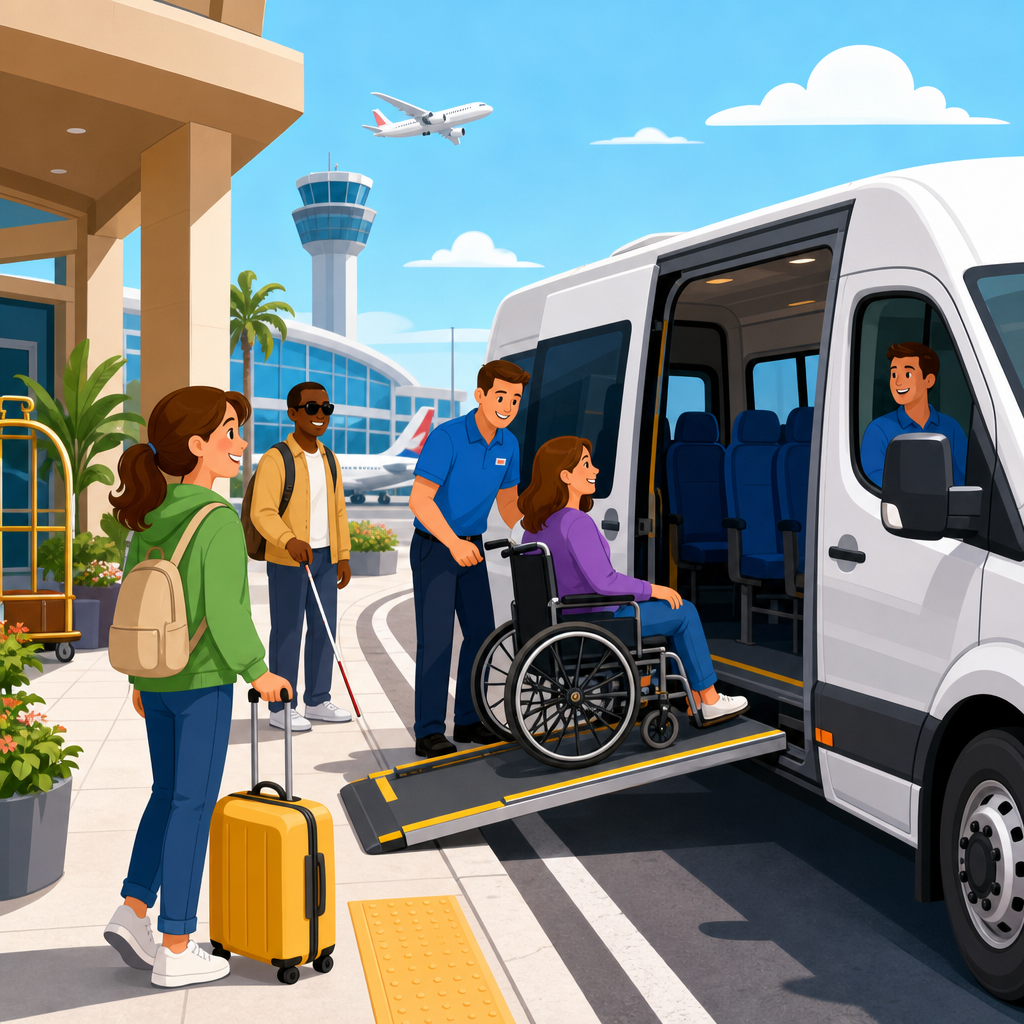
Airport and hotel shuttle accessibility basics determine whether travel feels manageable or exhausting for people with disabilities, older adults, families with strollers, and anyone carrying bulky luggage. In transportation planning, accessibility means more than having a ramp on one vehicle. It includes the full trip chain: booking, pickup, boarding, securement, communication, travel time, drop-off, and problem resolution when something goes wrong. A shuttle can technically exist and still be unusable if a rider cannot confirm wheelchair space, hear the driver, read the signage, or reach the pickup zone safely. That gap is where many trips fail.
I have worked with hotel teams, airport operators, and ground transportation vendors on service design and complaint reduction, and the same pattern appears repeatedly: most failures come from process, not intent. Drivers may want to help but lack training on mobility devices. Hotels may advertise accessible shuttle service without understanding lift capacity, boarding clearance, or securement requirements. Airports often have complex curb zones, temporary construction, and multiple terminals that confuse first-time riders. Because shuttles connect lodging and aviation, they sit at a critical point in the traveler journey. If that link breaks, the entire trip can become late, unsafe, or humiliating.
This article explains airport and hotel shuttle accessibility basics as a transportation hub guide. It covers the equipment, policies, staffing, and rider information that make service genuinely usable. It also clarifies how accessibility differs for wheelchair users, people who are blind or low vision, deaf or hard of hearing travelers, neurodivergent passengers, and people with limited stamina. Throughout, the practical standard is simple: an accessible shuttle service lets a traveler book, locate, board, ride, and exit with dignity and reasonable independence. That standard matters for legal compliance, customer satisfaction, reputation, and operational reliability across the broader transportation sector.
What Accessible Shuttle Service Includes
Accessible shuttle service begins before the vehicle arrives. Riders need accurate information on whether the shuttle is lift-equipped or ramp-equipped, how many mobility devices it can accommodate, whether advance notice is required, where pickup occurs at each terminal, and what assistance a driver can provide. At hotels, front desk staff should know the answer immediately rather than saying, “I think it’s wheelchair accessible.” At airports, signage and wayfinding should direct travelers to the correct commercial vehicle area, not simply to ground transportation in general.
Vehicle accessibility has several layers. A low-floor van with a fold-out ramp may work well for many manual wheelchair users, but the slope can still be too steep if curb height is inconsistent. A cutaway shuttle bus with a lift offers better flexibility, yet boarding takes longer and requires more driver skill. Inside the vehicle, securement systems, aisle width, grab rails, priority seating, step edges, and contrast markings all affect usability. For ambulatory passengers with balance limitations, a high first step can be just as exclusionary as a missing ramp.
Communication accessibility is equally important. Drivers should announce the route, destination hotel, and major stops clearly. Printed instructions should use plain language, large type, and high contrast. Digital booking confirmations should include pickup photos or maps when possible. In my experience, adding one annotated curbside image to a confirmation email reduces missed pickups dramatically, especially at large airports with multiple islands, baggage levels, and terminal doors. Good accessibility is not one feature; it is a coordinated service design.
Key Vehicle Features, Standards, and Operating Requirements
For transportation managers, the core question is what equipment and procedures a compliant, usable shuttle should have. In the United States, shuttle operators commonly look to the Americans with Disabilities Act for vehicle and service expectations, while airports and hotels may also follow local building codes, state disability laws, and company brand standards. Practical accessibility requires boarding equipment that matches the service pattern. Frequent hotel loops with many bags often benefit from low-floor configurations, while mixed-demand airport contracts may require lift-equipped vehicles capable of handling larger power chairs.
Securement and capacity details matter. Many modern power wheelchairs weigh well over 300 pounds before the rider is added, and some exceed the limits of older lifts or tie-down systems. Drivers need to know platform weight ratings, occupied mobility device securement procedures, and when a device can be transported occupied versus stowed separately. They also need training on scooters, which can be unstable if improperly secured. A shuttle advertised as accessible should not improvise with bungee cords, luggage straps, or unsafe positioning.
| Accessibility element | Why it matters | Operational example |
|---|---|---|
| Ramp or lift | Enables boarding for wheelchair users and some travelers with walkers | Driver deploys lift at hotel entrance with enough side clearance for turning |
| Securement system | Prevents movement during braking or turns | Four-point tie-down and occupant restraint used on a power chair |
| Priority seating | Supports riders who cannot manage standard seating easily | Front seats reserved for passengers using canes or with limited stamina |
| Audio and visual information | Helps riders identify the correct shuttle and stop | Destination sign plus driver verbal announcement at terminal pickup |
| Driver assistance training | Turns equipment into a usable service | Driver knows safe push technique, securement angles, and respectful communication |
Maintenance is the hidden backbone of accessibility. A lift that fails twice a month is not a minor inconvenience; it is a recurring service denial. Operators should inspect lifts, ramps, kneeling systems, restraint belts, and door sensors daily, with defects logged before dispatch. The best programs track mean distance between failures and analyze road calls by vehicle type, route, and driver. Accessibility performance is measurable, and serious transportation providers treat it like safety, not hospitality.
Booking, Dispatch, and Pickup Coordination
Many accessibility problems originate in reservation and dispatch workflows. If a hotel booking engine or phone agent cannot record that a guest uses a wheelchair, dispatch may send a standard van with no boarding device. If an airport-area hotel contracts overflow trips to third-party operators without sharing accessibility notes, the rider gets stranded despite having confirmed service. Reliable shuttle accessibility basics therefore include data handling: reservation fields for mobility device type, service animal presence, transfer needs, and communication preferences must be visible to dispatch and drivers in real time.
Advance notice policies require nuance. Some operators ask for twenty-four hours of notice for accessible service, but that can be unrealistic for delayed flights, rebookings, and weather disruptions. A stronger model is to keep at least one accessible vehicle in the active rotation during core airport service hours and use notice only for unusual circumstances, such as oversized power chairs or group movements. This approach reduces the common complaint that “accessible service is available, but not when you actually need it.”
Pickup coordination at airports should be specific down to the door number, level, and island. “Outside baggage claim” is inadequate at most major airports. Better instructions say, for example, “Terminal B, lower level, door 4, commercial shuttle island 2, blue sign.” For blind or low vision travelers, staff should be prepared to stay on the phone until contact is made. For deaf travelers, text-enabled dispatch and visual vehicle identification are essential. In one program I reviewed, simply enabling SMS updates with vehicle description and plate number cut failed contacts significantly because riders no longer had to rely on overheard announcements.
Serving Different Disability and Mobility Needs Well
Accessible transportation is not one-size-fits-all. Wheelchair users need reliable boarding and securement, but many other riders also depend on specific service design. Travelers with walkers may need extra dwell time and a stable handhold. Passengers with low vision benefit from consistent driver introductions, verbal stop calls, and uncluttered boarding areas. Deaf or hard of hearing riders may miss shouted curbside instructions, so drivers should use destination signs, gestures, and text where feasible. Neurodivergent travelers may need predictable wait times, clear instructions, and reduced sensory overload during boarding.
Service animals deserve specific mention because confusion remains common. A legitimate service animal is not a pet and should not be refused because of breed, size, or hotel preference. Drivers should know that allergies or fear of dogs do not justify denial of service. At the same time, operators can set reasonable behavior expectations, such as keeping aisles clear and avoiding unsafe placement near lift mechanisms. Training should cover respectful language and the limited questions permitted when the need for a service animal is not obvious.
Temporary disabilities and age-related mobility changes also shape demand. Airport hotel shuttles routinely carry passengers recovering from surgery, travelers using crutches after injuries, and older adults who cannot climb steep steps with luggage. When providers focus only on wheelchair compliance, they miss a large share of actual accessibility needs. A better transportation mindset treats step height, seat stability, handrails, lighting, and boarding pace as universal design issues that improve the service for nearly everyone.
Staff Training, Customer Service, and Safety Practices
Training is where policy becomes real. Front desk teams should know how to describe shuttle accessibility accurately, record requests, and escalate problems without debate. Dispatchers should understand capacity, backup plans, and how to prioritize stranded accessible passengers when flight banks create surges. Drivers need hands-on instruction, not just a manual. That includes lift deployment, wheelchair securement, guiding techniques for blind passengers, communication etiquette, and what assistance is appropriate versus intrusive. In audits I have conducted, the biggest service quality difference came from recurrent practical drills every quarter, not annual slide presentations.
Language matters. Staff should address the traveler directly, not a companion, and should ask before touching a wheelchair, walker, or service animal. Clear, respectful phrases work best: “Would you like boarding assistance?” is better than “Can you manage?” Drivers should also explain delays honestly. If a lift cycle will take three minutes or luggage loading must pause to create securement space, saying so reduces stress and prevents misunderstandings with other passengers.
Safety procedures must balance urgency with dignity. During curbside operations, accessible boarding often takes longer, and impatient traffic behind the shuttle can pressure drivers to rush. Supervisors should support drivers in taking the time required to deploy equipment properly, check tie-down angles, and confirm brakes or power settings on mobility devices. Incident reporting should capture near misses, not only injuries, because recurring problems such as slippery curb plates, poor nighttime lighting, or confusing curb assignments usually appear in smaller events before a serious accident occurs.
Common Failures, Accountability, and How to Choose Better Providers
The most common airport and hotel shuttle accessibility failures are predictable: inaccessible backup vehicles, broken lifts, vague pickup instructions, untrained drivers, and inaccessible complaint channels. Another recurring issue is overpromising. A hotel website may state “free accessible airport shuttle,” but the actual operator may require long notice, run limited hours, or accommodate only one mobility device at a time. Transparency is better than marketing language. Travelers can plan around limits when they are stated clearly; they cannot plan around ambiguity.
Hotels and airports selecting transportation vendors should evaluate accessibility in procurement, not after complaints arrive. That means reviewing fleet composition, preventive maintenance records, training logs, dispatch software fields, and service recovery procedures. Ask for proof that accessible trips are tracked separately and that denials, missed pickups, and equipment failures are analyzed. Mystery-shop the service with real scenarios, including a power wheelchair user arriving after a delayed evening flight. If the vendor cannot explain the backup plan confidently, the program is not ready.
Travelers can also protect themselves by asking targeted questions: Is the shuttle lift- or ramp-equipped? What is the pickup location at my terminal? Do you require advance notice? Can you accommodate a power wheelchair or scooter? Are text updates available? Those questions reveal quickly whether a provider has mature accessible transportation processes or is guessing. For hotels building an industry-specific transportation program, the priority is clear: treat airport and hotel shuttle accessibility basics as operational essentials, not optional amenities. Audit the full trip chain, train staff repeatedly, maintain the equipment rigorously, and publish precise pickup information. When those pieces are in place, accessible shuttle service becomes dependable, safer, and far more useful for every traveler.
Frequently Asked Questions
What does accessibility really mean for an airport or hotel shuttle?
Accessibility for an airport or hotel shuttle means the entire trip can be used safely, reliably, and with reasonable dignity by people with different mobility, sensory, cognitive, and communication needs. It is not limited to whether one vehicle has a ramp or lift. True accessibility covers the full travel chain: how a rider learns about the service, how they make a reservation, whether pickup instructions are understandable, whether the vehicle arrives as promised, how easy boarding is, whether mobility devices can be safely accommodated, how the driver communicates, how long the trip takes, and what happens if there is a delay, missed pickup, or equipment problem.
In practical terms, an accessible shuttle should provide clear information in advance about step height, lift or ramp availability, wheelchair securement, seat layout, luggage handling, service animal policies, and whether the route is shared or direct. It should also support passengers who may not use wheelchairs but still need accessible service, including older adults, travelers with limited stamina, families with strollers, and people carrying medical equipment or bulky bags. Good accessibility reduces uncertainty. It helps riders know what to expect and gives them a realistic way to complete the trip without depending on luck or special favors.
A shuttle can technically be offered and still be functionally inaccessible. For example, if booking staff cannot confirm whether a wheelchair will fit, if the pickup area has no curb cuts, if the driver is not trained to operate securement systems, or if passengers are left without assistance after a missed connection, the service may fail the people who need it most. That is why accessibility should be understood as a service standard, not a single vehicle feature.
What features should travelers look for before booking an airport or hotel shuttle?
Before booking, travelers should look for specific, verifiable details rather than general claims like “accessible” or “ADA friendly.” A useful starting point is whether the company clearly explains its accessibility options on its website or reservation page. Important details include whether vehicles have ramps or lifts, the maximum wheelchair dimensions and weight allowed, whether power wheelchairs and scooters are accepted, how mobility devices are secured, and whether the driver is trained to assist with boarding and securement. If these details are missing, that is a sign the service may not be prepared to meet varied access needs consistently.
Travelers should also confirm how pickup works. Ask whether pickups happen at the curb, at a designated shuttle island, inside a parking structure, or at a remote lot that requires an additional transfer. A service may have an accessible vehicle but still be difficult to use if the pickup point requires a long walk, multiple level changes, or confusing wayfinding. For hotel shuttles, it also helps to ask whether the hotel entrance, loading area, and path from the lobby to the shuttle stop are step-free and easy to navigate with a wheelchair, walker, stroller, or luggage cart.
Communication features matter as much as physical equipment. Travelers should check whether they can request accommodations during booking, whether customer service can answer accessibility questions knowledgeably, whether ride updates are sent by text or phone, and whether drivers can identify themselves clearly upon arrival. If someone is deaf, hard of hearing, blind, low vision, or has cognitive processing needs, clear instructions and predictable communication can make the difference between a workable trip and a missed ride.
Finally, ask about contingency planning. If the accessible vehicle is unavailable, does the company have a backup process? If a flight is delayed, can the pickup be adjusted? If luggage, a stroller, or a mobility device requires extra time, is that accommodated without penalty? The strongest shuttle services do not just advertise features; they can explain exactly how they handle real travel conditions.
How can travelers tell whether a shuttle service is genuinely reliable for wheelchair users and other passengers with mobility needs?
Reliability comes from consistency, not just equipment. A genuinely reliable shuttle service should be able to describe its procedures confidently and without hesitation. For wheelchair users, that means staff can explain whether the vehicle uses a ramp or lift, what the boarding process looks like, how wheelchair securement is handled, whether tie-down positions are available, and whether the rider can remain in their wheelchair during travel if needed. If answers are vague, contradictory, or dependent on “seeing what vehicle shows up,” the service may not be dependable.
Another strong indicator is whether the company plans for time realistically. Accessible boarding often takes longer than standard curbside loading, especially when securement, luggage handling, or crowded airport traffic are involved. Reliable operators build this into scheduling rather than treating it as a disruption. They also train drivers to stop at safe loading areas, deploy equipment properly, communicate directly with the passenger, and avoid rushing the process. A respectful, unrushed boarding experience usually reflects a more mature and organized service model.
Reviews and direct questions can also help. Look for comments that mention on-time pickup, competent driver assistance, safe wheelchair handling, and good communication during delays. General five-star ratings are less useful than detailed descriptions from travelers with similar needs. It is also worth asking whether the provider serves accessible trips regularly or only occasionally. Services that handle these requests often are usually better at solving common issues, from oversized mobility devices to airport pickup confusion.
For travelers with canes, walkers, limited balance, recent injuries, or difficulty climbing steps, reliability also includes stable entry, handholds, enough time to sit before the vehicle moves, and drivers who do not assume everyone boards the same way. In other words, reliable accessibility is not only about legal compliance. It is about whether the service can deliver a safe, repeatable, low-stress trip for the passenger who actually needs it.
What common accessibility problems happen with airport and hotel shuttles, and how can travelers prepare for them?
Some of the most common problems are incomplete booking information, inaccessible pickup locations, long waits, drivers who were not informed about an accommodation request, and vehicles that technically have equipment but are not ready to use it efficiently. Travelers may also run into practical issues such as overcrowded luggage compartments, narrow aisles, unclear signage at airport terminals, or shuttle routes that include multiple stops and significantly extend travel time. These issues can be especially difficult after a long flight, during bad weather, or when traveling with children, medical supplies, or fatigue-related disabilities.
Preparation starts with documentation and confirmation. Travelers should save reservation details, accommodation requests, confirmation emails, and the direct phone number for dispatch or the hotel front desk. If possible, it is wise to reconfirm accessibility needs shortly before travel, especially for airport pickups that depend on arrival times. Asking for exact pickup instructions can prevent confusion later. For example, knowing the terminal door number, island letter, or hotel loading zone location can reduce stress and missed connections.
It also helps to build in extra time and a backup plan. If a traveler has a strict medical schedule, a tight meeting, or a cruise departure, relying on a single uncertain shuttle can be risky. In some cases, arranging an alternate accessible taxi, paratransit option, rideshare with accessibility features, or private transfer may be worthwhile as a contingency. This is not because shuttle service is always unreliable, but because the consequences of one failure can be much higher for travelers who cannot easily switch to another mode on short notice.
If a problem does occur, specific communication is important. Instead of saying “the shuttle is not accessible,” it is usually more effective to state the exact issue: the lift is inoperable, the curb lacks a safe ramped path, the driver cannot secure a power chair, or no one can identify the pickup point. Clear details give dispatch or hotel staff a better chance to fix the problem quickly. Good services have escalation procedures. Weak services rely on improvisation. That difference often becomes visible only when something goes wrong.
Why does shuttle accessibility matter even for travelers who do not identify as disabled?
Shuttle accessibility matters broadly because travel needs are not fixed, and many passengers benefit from accessible design even if they do not describe themselves as disabled. Older adults may have reduced balance or endurance. Parents may be managing strollers, diaper bags, and tired children. Travelers may be carrying sports equipment, instruments, or large suitcases. Someone recovering from surgery, dealing with back pain, or traveling with a temporary injury may suddenly need step-free boarding, extra time, or a shorter walk from pickup to destination. Accessible shuttle service creates flexibility for real-world travel, not just a narrow category of users.
There is also a major predictability benefit. Features such as low-step or ramped entry, clearer signage, better lighting, more organized pickup instructions, safer loading areas, and better-trained drivers improve the trip for nearly everyone. They reduce confusion, speed up boarding, lower the risk of falls or missed pickups, and make shared transportation less stressful. In that sense, accessibility is closely tied to service quality. The systems that help a wheelchair user complete a trip smoothly often help all riders have a better experience.
From a planning perspective, accessibility also supports inclusion and operational resilience. Hotels, airports, and shuttle operators serve a wide mix of customers with changing abilities and circumstances. When the shuttle system is built around only the easiest passengers to move, many people are left to struggle, ask for exceptions, or avoid the service entirely. When accessibility is built into booking, communication, boarding, securement