Safety standards can protect workers, customers, and the public, but they can also become a convenient excuse for excluding disabled people when the law requires a more careful, evidence-based approach. In ADA rights disputes, that distinction matters because employers, businesses, schools, landlords, and licensing bodies often justify a refusal by saying a rule is about safety rather than discrimination. I have worked through these questions in policy reviews, accommodation disputes, and accessibility audits, and the pattern is consistent: legitimate safety standards are grounded in actual risk, current evidence, and individualized assessment, while unfairly exclusionary standards rely on assumptions, outdated rules, or blanket bans. This article serves as a hub for advanced topics in ADA rights by explaining how safety standards are evaluated, when direct threat and business necessity defenses apply, how courts and agencies analyze medical and functional evidence, and where readers should look next across related rights and protections issues.
What makes a safety standard legitimate under ADA rules
A legitimate safety standard under the Americans with Disabilities Act is job-related or service-related, consistent with business necessity, and tied to a real risk that cannot be reduced through reasonable modification or accommodation. The central legal idea is simple: the standard must measure the ability to perform safely, not the presence of a diagnosis, disability label, assistive device, or medical history. In employment cases, Title I of the ADA permits qualification standards that screen out individuals with disabilities only if the standard is job-related and consistent with business necessity, and if performance cannot be accomplished with reasonable accommodation. In public accommodations and government services, safety restrictions must rest on an actual risk analysis rather than speculation.
That means decision-makers need evidence. A hospital can require sterile technique for surgical staff. A transit operator can require the ability to respond to emergency signals. A chemistry lab can require compliance with hazardous materials protocols. Those standards are legitimate because they identify concrete essential functions or safety procedures. By contrast, a rule that bars all people with seizure disorders from working near machinery, regardless of seizure control, treatment history, physician input, or available safeguards, is usually defective because it substitutes a category exclusion for individualized assessment. The ADA does not require organizations to ignore danger, but it does require them to distinguish between documented risk and generalized fear.
This issue matters well beyond hiring. Professional licensing boards, housing providers, colleges, event venues, recreation providers, and healthcare systems all use safety language. Readers exploring advanced ADA rights should also look at related subtopics such as medical documentation limits, essential functions analysis, interactive process failures, inaccessible emergency planning, effective communication duties, and retaliation after accommodation requests. Safety standards frequently intersect with all of them.
How the direct threat standard separates real risk from stereotype
The most important advanced concept is direct threat. Under ADA doctrine, a direct threat is a significant risk of substantial harm to the health or safety of the individual or others that cannot be eliminated or reduced by reasonable accommodation. This is not a vague concern or a worst-case scenario. It is a structured analysis that considers duration of the risk, nature and severity of potential harm, likelihood that harm will occur, and imminence of the harm. Courts and enforcement agencies expect an individualized assessment based on current medical knowledge or the best available objective evidence.
In practice, this standard blocks lazy decision-making. I have seen organizations invoke safety after learning that an applicant uses insulin, has PTSD, uses a wheelchair, or has a history of depression. None of those facts alone establishes direct threat. The lawful question is narrower: what specific task creates what specific risk, how probable is the harm, and what accommodation could reduce it? If an employee with diabetes works in a warehouse, the analysis should focus on schedule stability, break access, glucose monitoring, and emergency response procedures. If those measures allow safe performance, exclusion is hard to defend. If a commercial driver has uncontrolled loss-of-consciousness episodes despite treatment, the evidence may support restrictions for that role. The difference is individualized proof.
Direct threat also applies in customer-facing settings. A fitness center cannot exclude a member with cerebral palsy because staff assume equipment use might be unsafe. It can, however, enforce neutral machine-use rules if they are genuinely necessary and applied equally, while also considering modifications such as orientation assistance or alternate equipment. The ADA rejects stereotype-driven safety judgments even when those judgments are framed as caution.
When qualification standards and business necessity are valid
Many disputes turn on qualification standards. These are the education, skill, licensing, medical, vision, hearing, lifting, attendance, or conduct requirements an organization says are necessary. Some are valid. Some are overbroad. The strongest standards are tightly tied to essential functions and backed by task analysis. For example, a police department may require officers to make rapid situational judgments, use force within policy, communicate clearly under stress, and meet validated physical benchmarks linked to field duties. A standard is much weaker if it is inherited from tradition, copied from another employer, or left unchanged despite technology and changed job design.
Business necessity is not a magic phrase. Employers must explain why the standard predicts safe and effective performance. They should be able to identify the essential function, the hazard, the operational context, and the reason less exclusionary measures would not work. I have found that organizations with the best records maintain written job analyses, incident reports, ergonomic reviews, and accommodation histories. They can show why a requirement exists. Organizations with poor records often rely on supervisor instinct, generalized insurance concerns, or “we have always done it this way,” which rarely survives careful review.
Medical standards deserve special scrutiny. Blanket exclusions tied to psychiatric history, opioid use disorder treatment, HIV status, monocular vision, or mobility impairments often fail because they use diagnosis as a proxy for capacity. A lawful standard measures function. Can the person climb ladders safely with or without equipment? Can they perceive alarms through visual, auditory, or tactile means? Can they complete sterile preparation with modified tools? Those are ADA questions. A diagnosis-only screen is usually a red flag.
Common settings where safety standards exclude unfairly
Unfair exclusion appears in recurring patterns. Hiring is the most visible one, especially after conditional job offers when employers order broad medical exams and then revoke offers based on generalized restrictions. Licensing is another. Nursing, teaching, transportation, security, and childcare applicants may be denied because a board equates a mental health history or mobility limitation with unfitness, even when the applicant has years of safe performance. Housing providers sometimes invoke emergency evacuation or insurance concerns to deny reasonable accommodations or assistance animals. Universities may remove students from clinical placements or field programs because administrators fear liability instead of conducting an individualized review.
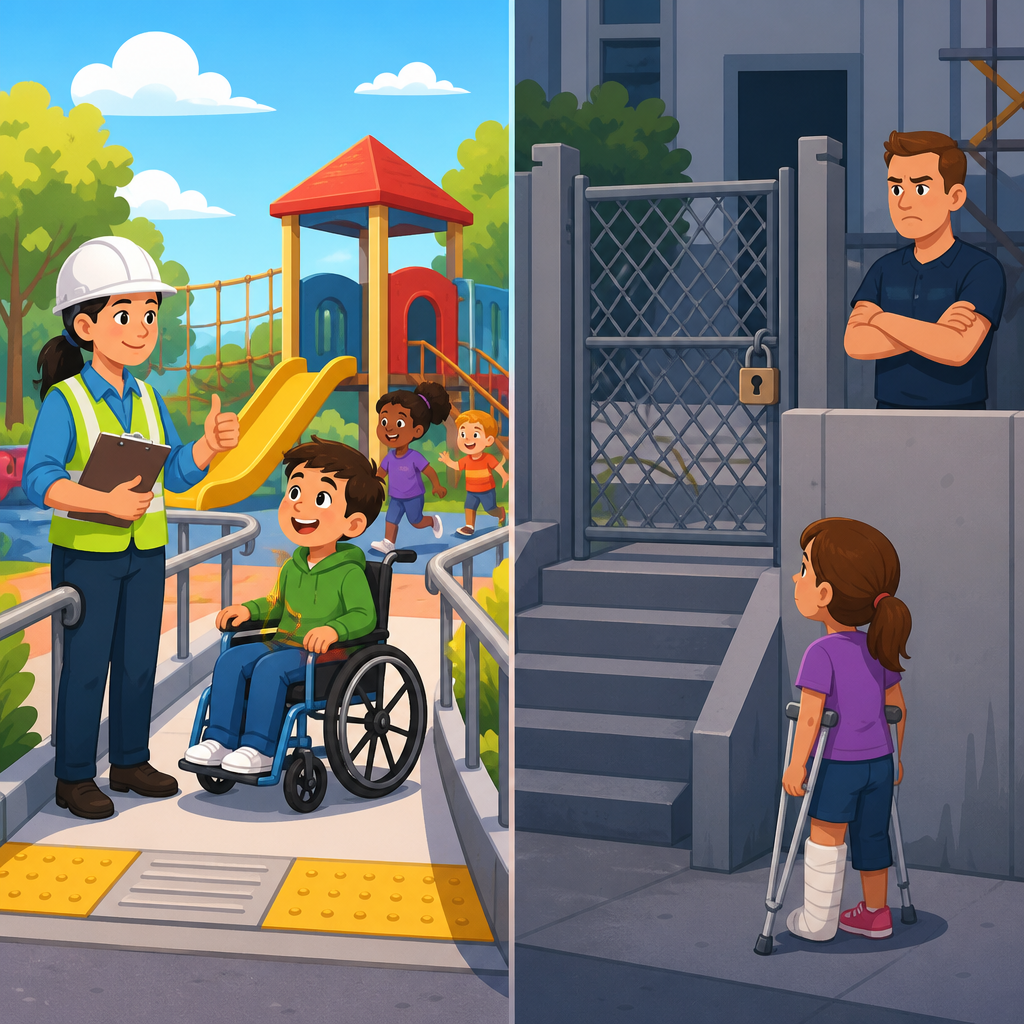
The same problems arise in public accommodations. Hotels, restaurants, theaters, gyms, and recreation sites sometimes refuse entry or participation because staff think a disabled guest will pose a danger to self or others. The legal weakness is usually the same: no objective evidence, no individualized assessment, and no consideration of modifications. During accessibility reviews, I have repeatedly seen emergency planning used as a justification for exclusion when the better response was better planning: evacuation chairs, visual alarms, staff drills, refuge procedures, or communication protocols.
| Setting | Potentially Legitimate Standard | Potentially Unfair Exclusion |
|---|---|---|
| Manufacturing job | Ability to follow lockout/tagout procedures | Automatic rejection of all applicants with epilepsy |
| Hospital clinical role | Compliance with infection-control protocol | Ban on workers with mobility impairments without task analysis |
| University lab course | Use of protective equipment and emergency response steps | Removal of a student based on anxiety diagnosis alone |
| Gym or recreation site | Neutral rules for equipment operation | Refusal of access based on staff assumptions about disability |
How to test whether a rule is defensible
A defensible rule answers five questions clearly. First, what exact harm is being prevented? Second, what evidence shows the risk is significant rather than remote? Third, does the rule measure actual ability instead of diagnosis or status? Fourth, what accommodations or modifications were considered? Fifth, is the rule applied consistently across disabled and nondisabled people who present the same risk? If an organization cannot answer those questions, the safety rationale is probably weak.
Documentation matters. Employers should have current job descriptions, essential function analyses, and records showing why a standard exists. Public-facing businesses should have written policies for individualized assessment and staff training on modifications. Schools and licensing bodies should document how they weighed technical standards, professional competencies, and accommodation options. Objective inputs can include OSHA guidance, CDC infection-control standards, NFPA life-safety codes, validated physical demand studies, treating clinician reports, and independent occupational assessments. But none of these sources should be used mechanically. Standards and medical guidance are tools for analysis, not substitutes for analysis.
Consistency matters too. If a company claims lifting fifty pounds is critical for safety, but the task is routinely reassigned or aided by carts and team lifts, that inconsistency undermines the standard. If a school excludes a student with a psychiatric disability from a clinical program for perceived volatility but tolerates comparable conduct from others through coaching or supervision, discriminatory enforcement becomes easier to prove. Uneven application often reveals that “safety” is masking discomfort.
Reasonable accommodation is part of the safety analysis, not an afterthought
One of the most common ADA errors is treating safety review as complete before accommodation is discussed. The law requires the opposite sequence. Decision-makers must ask whether a reasonable accommodation would reduce the risk to an acceptable level while preserving essential functions. That can include schedule changes, reassignment of marginal tasks, modified equipment, interpreters, visual alert systems, remote monitoring tools, anti-fatigue supports, policy adjustments, temporary restrictions during treatment, or additional training. In many cases, the accommodation is what makes the safety standard legitimate because it allows the standard to remain focused on the essential outcome rather than excluding a class of people.
Examples are concrete. A deaf employee in a manufacturing setting may safely perform if machine alarms are integrated with strobes or haptic alerts. A nurse with a back impairment may meet patient-handling requirements with lift-assist devices and team-transfer protocols. An employee returning after a psychiatric hospitalization may perform safely with a modified schedule, clear escalation procedures, and periodic check-ins rather than a forced unpaid leave. A tenant with a mobility disability may remain housed safely if an evacuation plan includes relocation assistance and first-responder notification instead of lease termination.
Accommodation has limits. The ADA does not require elimination of essential functions, creation of substantial new risks, or adoption of measures that impose undue hardship. But organizations must be able to show that they considered workable options in good faith. Skipping that step is one of the clearest indicators that exclusion was unfair.
Advanced issues in litigation, enforcement, and policy design
At the advanced level, safety disputes often turn on who framed the evidence better. Timing matters. A decision based on stale restrictions, incomplete medical records, or assumptions formed before the interactive process is vulnerable. So is a policy that reserves discretion to exclude but offers no criteria. Plaintiffs often strengthen cases by comparing policy language to actual tasks, showing successful past performance, identifying inconsistencies in enforcement, and presenting expert opinions on accommodation feasibility. Defendants are strongest when they can tie a standard to validated task demands, incident patterns, and documented efforts to explore alternatives.
There are also important overlaps with other rights and protections topics in this hub. Confidentiality rules limit how medical information gathered during safety reviews may be stored and shared. Retaliation rules protect people who challenge exclusionary standards or request accommodation. Web accessibility and effective communication duties matter when safety instructions, emergency alerts, or training modules are inaccessible. Housing law, rehabilitation law, air travel rules, and state disability statutes may create parallel protections or slightly different standards. Readers building a deeper ADA strategy should treat safety disputes as cross-cutting issues, not isolated events.
Good policy design reduces conflict before lawyers become involved. The best organizations define essential functions carefully, use current evidence, train managers not to improvise medical judgments, and build accommodation review into every safety decision. They audit disqualification criteria, technical standards, and emergency procedures for hidden barriers. They also ask a practical question that too many institutions ignore: is this rule preventing harm, or is it preventing participation? That question often exposes whether a standard is legitimate or exclusionary.
Safety standards are legitimate when they address real, significant risks through current evidence, individualized assessment, and serious consideration of reasonable accommodation. They exclude unfairly when they rely on stereotypes, broad diagnosis-based bans, stale criteria, or inconsistent enforcement. For anyone navigating advanced ADA rights, this is a core principle: the law protects safety, but it does not permit safety to become shorthand for exclusion. Across employment, licensing, education, housing, healthcare, and public access, the decisive issues are specificity, proof, and whether modifications could make equal participation safe. Use this hub as a starting point for the broader rights and protections landscape, then review the connected topics on direct threat, business necessity, essential functions, medical inquiries, technical standards, emergency planning, and retaliation. If you are evaluating a policy now, start by asking for the evidence behind the rule and whether a workable accommodation was fully considered.
Frequently Asked Questions
1. When is a safety standard considered legitimate under disability rights law?
A safety standard is generally legitimate when it addresses a real risk, is grounded in objective evidence, and is applied in a way that is actually necessary for the activity, job, housing situation, educational program, or license at issue. Under the ADA and related disability rights principles, decision-makers do not get to rely on vague fears, stereotypes, or blanket assumptions about what disabled people can or cannot do. A rule is far more likely to be defensible when it is based on current medical knowledge, reliable data, industry-specific facts, or a careful individualized assessment of the person’s actual abilities and the actual conditions involved.
That means the central question is not whether “safety” sounds important in the abstract. It is whether the specific standard truly responds to a significant risk that cannot be reduced through reasonable modifications, accommodations, policies, equipment, training, or other practical measures. A legitimate standard should also be consistently enforced. If an employer, school, landlord, business, or licensing body invokes a safety rule only when a disabled person requests access, but overlooks similar risks in other contexts, that inconsistency may suggest the rule is being used selectively rather than neutrally.
In practice, legitimate safety standards are usually tailored, documented, and connected to actual essential requirements. They explain what the risk is, why it matters, how it was evaluated, and why less restrictive alternatives would not work. The more generalized, speculative, or exaggerated the justification, the more likely it is that “safety” is functioning as a cover for exclusion rather than a lawful reasoned standard.
2. What are common signs that a safety rule may be excluding disabled people unfairly?
One of the clearest warning signs is the use of broad categorical language, such as “we never allow people with that condition,” “it is too much of a liability,” or “for safety reasons, you cannot participate.” Those statements often reveal that no individualized review has taken place. Disability law generally requires more than a reflexive no. It requires a serious look at the person, the setting, the actual tasks involved, and whether accommodations would reduce or eliminate the concern.
Another red flag is the absence of evidence. If the decision-maker cannot point to any current data, professional guidance, incident history, functional assessment, or concrete reason why the individual poses a significant risk, the safety explanation may be weak. The same is true when the rule seems overinclusive. For example, a policy that bars all people with mobility, psychiatric, neurological, or sensory disabilities from a role or service without distinction is often too blunt to be justified.
Unfair exclusion also becomes more likely when alternatives were never explored. If someone requested an accommodation and the response skipped directly to denial without discussing modified procedures, assistive technology, scheduling changes, support staff, policy adjustments, or task restructuring, that failure can matter. So can inconsistent treatment. If non-disabled people are allowed to proceed despite comparable or greater risks, but disabled people are blocked immediately in the name of safety, that discrepancy may show the rule is not being applied fairly. In short, unfair exclusion often looks like assumption instead of analysis, certainty without evidence, and denial without problem-solving.
3. Does the ADA require an individualized assessment before denying access based on safety concerns?
In many ADA contexts, yes. An individualized assessment is often a critical part of determining whether a claimed safety concern is lawful. The purpose is to move the decision away from stereotypes and toward facts. Instead of asking what people with a diagnosis are supposedly like, the law pushes decision-makers to ask what this particular person can do, what the actual environment is, what the relevant risks are, and whether reasonable accommodations could address those risks.
This assessment should be based on objective evidence and current information, not outdated assumptions or speculative worst-case scenarios. Relevant factors can include the nature of the risk, how severe the potential harm would be, how likely it is to occur, and whether reasonable modifications would reduce the risk to an acceptable level. In employment cases, this often overlaps with questions about essential job functions, workplace conditions, and available accommodations. In public accommodations, education, housing, and licensing matters, the same basic principle applies: the decision should be individualized, evidence-based, and tied to the real circumstances rather than to generalized discomfort or paternalism.
An individualized assessment does not guarantee that every request must be granted. Sometimes a genuine direct threat or unavoidable hazard exists. But the legal and practical significance of the assessment is that it disciplines the process. It requires a decision-maker to show their work. If there was no real review, no dialogue, no exploration of adjustments, and no factual basis for concluding that the person could not participate safely, that gap can become a major issue in an ADA dispute.
4. How do reasonable accommodations affect whether a safety-based exclusion is lawful?
Reasonable accommodations are often the turning point. A safety concern that seems serious at first may become manageable once appropriate modifications are considered. That is why the legal question is rarely just whether some risk exists. Nearly every job, building, program, or public setting involves some level of risk. The more important question is whether the risk can be reduced sufficiently through reasonable accommodation without fundamentally altering the nature of the activity or creating an undue burden.
Examples vary by context. In employment, accommodations might include reassignment of marginal tasks, adaptive equipment, modified methods of communication, schedule adjustments, extra training time, remote components, or changes in how a function is performed. In schools, accommodations may involve support services, policy adjustments, accessible transportation, crisis planning, or communication supports. In housing, they may include modified policies, structural changes, or assistance-related exceptions. In licensing and testing, they may include extra time, alternative formats, auxiliary aids, or adjusted procedures. The key point is that a lawful safety analysis cannot stop before these options are seriously considered.
If a decision-maker dismisses accommodations out of hand, claims they would not work without evaluating them, or refuses to engage in an interactive process, the exclusion becomes harder to defend. On the other hand, if accommodations were explored carefully and documented, and the evidence still showed a significant risk that could not be mitigated, the safety rationale may be more credible. In many disputes, the real issue is not whether safety matters, but whether the institution made a genuine effort to make access safe rather than using safety as a reason to avoid access altogether.
5. What should someone do if an employer, business, school, landlord, or licensing body says a refusal is “for safety reasons”?
The first step is to ask for specifics. A person facing exclusion should try to find out exactly what safety concern is being identified, what rule or policy is being relied on, what evidence supports it, and whether an individualized assessment was conducted. It is also important to ask whether accommodations or modifications were considered and, if so, why they were rejected. Vague references to liability, insurance, discomfort, or “best practices” are usually not enough by themselves. Clear explanations matter, and getting them in writing can be very helpful.
Documentation is critical. Keep copies of emails, letters, policy language, accommodation requests, medical or professional support where appropriate, and notes about conversations. If the decision-maker made broad statements about your disability rather than your actual situation, record that. If similarly situated non-disabled people are treated differently, note that as well. These details often reveal whether the refusal was truly evidence-based or whether the safety explanation was inconsistent, exaggerated, or pretextual.
From there, it may make sense to propose concrete accommodations, request reconsideration, use an internal appeal process, or consult an attorney, advocate, disability rights organization, or relevant agency. The right forum depends on the setting. Employment matters may involve the EEOC or state fair employment agencies. Housing disputes may implicate HUD or state housing agencies. School and public access issues may involve the Department of Justice, the Department of Education, state civil rights bodies, or private legal action. In many cases, the strongest response is a calm, well-documented request that shifts the conversation from labels and fear to evidence, individualized review, and workable solutions. That is often where the distinction between legitimate safety standards and unfair exclusion becomes clearest.