Designing an accessible kitchenette under the ADA means creating a compact food preparation area that people with mobility, reach, vision, and dexterity limitations can use safely and independently. In practice, that requires more than lowering one counter or adding clear floor space. A compliant kitchenette must coordinate approach clearances, turning space, accessible routes, operable parts, sinks, storage, appliances, and the technical criteria that apply to drinking fountains, dining surfaces, and other special elements addressed in Chapter 8 of the 2010 ADA Standards for Accessible Design. I have reviewed and applied these provisions on renovation scopes where a seemingly minor break area became the most complex room in the plan set because every inch affected usability. That is why this topic matters: kitchenettes appear in offices, schools, multifamily common areas, hospitality spaces, clinics, and community rooms, and they often serve as the daily point where accessibility either supports independence or quietly blocks it.
For this article, a kitchenette is a small kitchen or break area with limited cooking and preparation functions, not a full commercial kitchen. Under the ADA Standards, the primary technical rules come from Section 804, but good design also depends on Chapter 3 clearances, Chapter 4 accessible routes, Section 212 and 606 for sinks, Section 308 for reach ranges, Section 309 for operable parts, and related Chapter 8 provisions for special rooms and elements such as dining and work surfaces, dressing areas, medical care spaces, saunas, and transportation facilities. As a hub article within ADA Accessibility Standards, this page explains how kitchenette requirements fit within the broader Chapter 8 framework so planners can scope the room correctly, identify where additional provisions apply, and avoid common errors before documents reach permit review, procurement, or field installation.
What Chapter 8 Covers and Why Kitchenettes Need a Whole-Room Approach
Chapter 8 addresses special rooms, spaces, and elements that demand more tailored criteria than a general circulation path or door opening. It includes wheelchair spaces in assembly areas, dressing and fitting rooms, medical care and long-term care facilities, transient lodging kitchens and kitchenettes, transportation facilities, judicial spaces, detention facilities, saunas and steam rooms, and special elements such as dining surfaces and work surfaces. The key lesson for kitchenette design is that no room exists in isolation. A compliant break area still fails if the route to it includes a narrow turn, if the dining counter has no accessible portion, or if the sink knee clearance is blocked by a disposal and hot-water pipes without protection.
When I audit small amenity spaces, the most frequent mistake is treating the kitchenette as millwork instead of as a system of user tasks. A person must enter, turn, approach the sink, place items on a work surface, open a refrigerator or microwave, reach controls, and retreat without backing through a conflict point. Each task relies on another standard. That is why Section 804 should be read together with Sections 305, 306, 308, 309, and 606. If the room serves residents or guests, transient lodging scoping can also affect whether a full kitchen or kitchenette must be accessible in a certain number of units. As a hub page for Chapter 8, this article helps connect those rules so design teams can move from isolated dimensions to actual functional access.
Core ADA Requirements for an Accessible Kitchenette
An accessible kitchenette must provide an accessible route into the space, clear floor space positioned for a forward or parallel approach where required, and enough maneuvering area for a wheelchair user to operate the room independently. In most cases, a 60-inch turning circle or T-shaped turning space under Section 304 is the baseline starting point, though layouts can satisfy the standard through equivalent turning geometry rather than an empty circle drawn in the center. Section 804 requires at least one 30-inch by 48-inch clear floor space complying with Section 305 positioned for a parallel approach to appliances or a forward approach where knee and toe clearance is provided. The exact arrangement depends on the element being served.
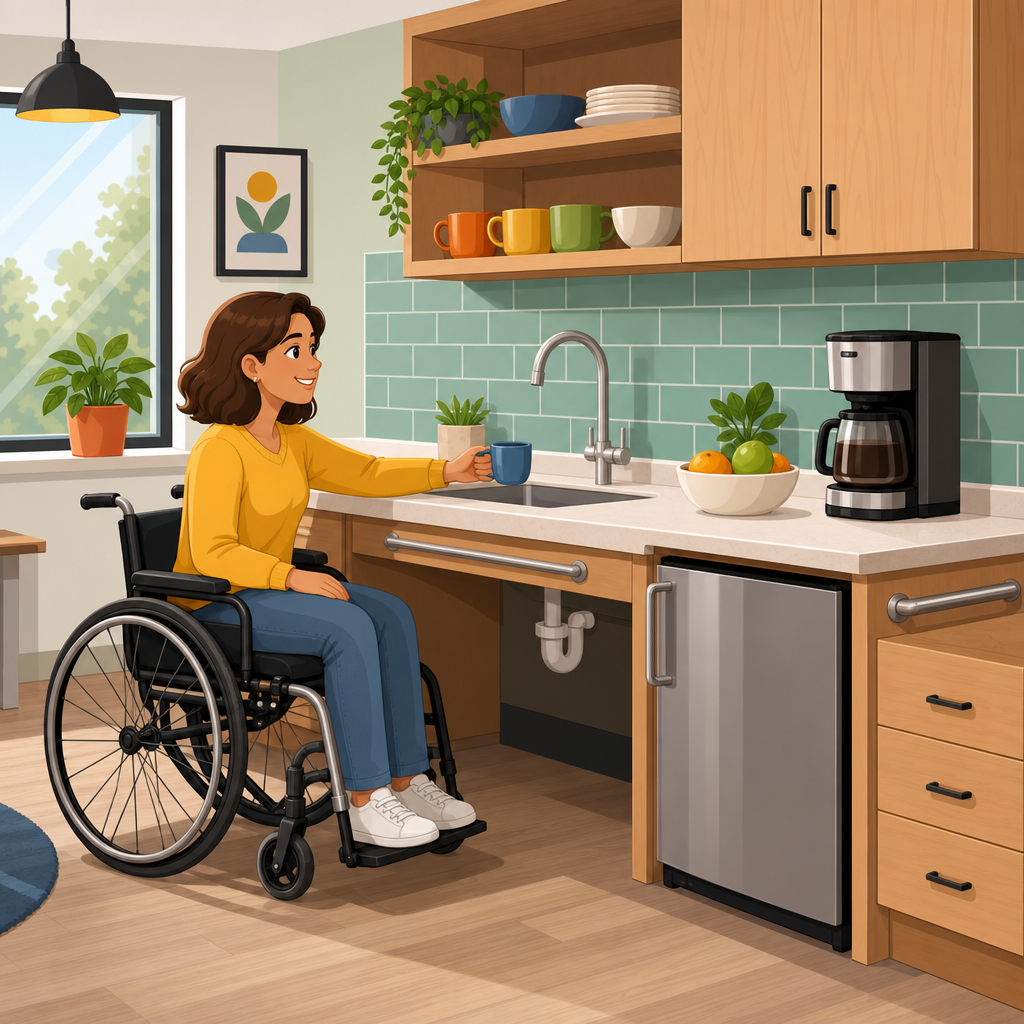
The sink is often the anchor of compliance. An accessible sink under Section 606 needs knee clearance at least 27 inches high, 30 inches wide, and 11 to 25 inches deep depending on height, toe clearance, insulated or otherwise protected pipes, and faucets operable with one hand without tight grasping, pinching, or twisting of the wrist. Operable force generally cannot exceed 5 pounds under Section 309. Countertops and work surfaces associated with the kitchenette should include an accessible work surface with a top 34 inches maximum above the finish floor when the surface is required to be accessible. In employee break rooms, that usually means making the key functions usable even when not every linear foot of counter is lowered.
Appliances create the next layer of detail. A microwave placed above a base cabinet at 54 inches may satisfy a manufacturer image but not ADA reach ranges. If the user cannot safely place and remove heated items, the kitchenette is not functionally accessible. Refrigerators need approach space that accounts for door swing and shelf access. Cooktops, where provided, should have controls at the front or side and avoid forcing users to reach across active burners. Dishwashers need careful door clearance analysis so an open door does not consume the only approach space. In renovation projects, these conflicts are where accessibility is won or lost.
Clearances, Reach Ranges, and Operable Parts That Commonly Cause Violations
Most failed kitchenettes are not failed by one dramatic error. They are failed by layered small misses. Reach range limits under Section 308 generally allow unobstructed forward reach up to 48 inches maximum and side reach with its own conditions, but those numbers change when an obstruction such as a countertop depth is introduced. Designers often mount upper cabinets or microwave controls within a nominal reach range without accounting for the required clear floor space or the depth of the obstruction in front of the user. The result is a technically mounted but practically unusable element.
Toe and knee clearance are also misread. A 34-inch high counter alone does not create an accessible work surface if base cabinets, a water heater, or a full-height panel block the forward approach. At sinks, exposed sharp edges or uninsulated hot-water lines are another routine field issue. I have seen otherwise well-designed office kitchenettes require change orders because a sink base support rail dropped below the knee clearance envelope after fabrication. That is avoidable if accessibility dimensions are drawn directly into millwork details rather than left to contractor interpretation.
Door hardware and appliance hardware matter as much as countertops. Pulls that require pinching, latches with high operating force, or touch controls with no tactile feedback can make an accessible-looking room difficult to use. Where a refrigerator is recessed into an alcove, verify the user can position a wheelchair, open the door, and reach commonly used shelves. ADA compliance is not simply whether a wheelchair can enter the room; it is whether the person can complete the intended tasks within the room with reasonable independence and safety.
| Element | Common design target | Frequent mistake | Better practice |
|---|---|---|---|
| Sink | 34-inch max rim or counter, knee and toe clearance, protected pipes | Decorative apron or disposal blocks knees | Detail clearances in cabinet shop drawings |
| Work surface | 34-inch max top with clear floor space | Lowered counter but no forward approach | Leave removable base cabinet or open knee space |
| Microwave | Within accessible reach and safe transfer height | Mounted over counter or refrigerator too high | Place on shelf or base cabinet with side approach review |
| Refrigerator | Approach space that works with door swing | Door opens into narrow corner | Model user position and shelf reach before specifying |
| Storage | Accessible storage within reach range where required | All usable shelves in upper cabinets | Provide lower drawers and pull-out shelves |
Appliances, Storage, and Usability in Real Projects
Accessible kitchenette design becomes clearer when tied to actual user tasks. In a corporate training center I worked on, the original plan showed a sink, undercounter refrigerator, microwave above, and full-height pantry cabinet in a niche only 7 feet wide. On paper, every item fit. In use, the refrigerator door blocked the turning area, the microwave height exceeded a practical safe reach, and the pantry offered no accessible storage. We revised the layout by moving the microwave to a counter-height shelf, switching to drawer storage, widening the niche opening, and using a shallower pantry with pull-out trays. The revised room not only aligned with ADA intent but was easier for every employee to use.
Storage is often overlooked because not every cabinet must be accessible, but enough storage should be usable to support the function of the room. Frequently used items such as cups, coffee supplies, snacks, or utensils should not all be placed in upper cabinets. Drawers, roll-out shelves, and D-shaped pulls improve usability for people with limited grip strength as well as wheelchair users. Specifying touch-latch cabinets can create problems when opening force is inconsistent or when the user needs one hand for balance or carrying an item. Simple hardware with low operating force is usually the better solution.
For appliances, manufacturer cut sheets are necessary but not sufficient. Review door swing, control location, and installation height. A side-hinged wall oven may be workable in a larger kitchen, yet in a kitchenette it can consume the only clear floor space. Beverage coolers with deep lower shelves can be hard to access even when the handle is compliant. Induction cooktops can reduce burn risk, but they still require accessible controls and adjacent landing space. When selecting products, ask not only “Is this appliance available?” but “Can a seated user approach, operate, and recover safely?” That question consistently leads to better specifications.
How Kitchenettes Interact With Other Chapter 8 Spaces and Elements
Because this page is the hub for Chapter 8 special rooms, it is important to place kitchenettes within the larger family of requirements. Dining surfaces under Section 902 require clear floor space and a surface height between 28 and 34 inches above the finish floor. If a kitchenette opens into a café area or break room with bar-height counters only, the overall amenity may still fail accessibility even if the sink itself is compliant. Work surfaces under Section 902 follow similar logic. A community room kitchenette should connect to accessible seating and usable tables, not end at the cabinet line.
Transient lodging is another key overlap. In hotels, extended-stay rooms, and similar facilities, the required number of accessible units may need kitchens or kitchenettes that comply with Section 804 as part of the guest room. Medical care and long-term care environments bring additional considerations, including patient mobility, staff assistance, and clearances for equipment, though the base technical criteria still matter. In educational or civic settings, an employee-only break area may have different scoping than a public self-service pantry, yet usability remains a practical expectation and often aligns with broader civil rights obligations.
Other Chapter 8 provisions illustrate the same design principle: accessibility follows the user journey. Dressing rooms require turning space and benches where the activity occurs. Saunas and steam rooms require accessible turning and bench access within the room. Judicial and detention spaces address where participants must sit, stand, or communicate. Kitchenettes are no different. The standard is organized by room type, but successful design always starts with the sequence of actions a person must complete. That mindset is what allows teams to coordinate details across the entire Chapter 8 subtopic instead of chasing isolated dimensions late in the project.
Documentation, Field Verification, and Common Plan Review Questions
Permit reviewers and accessibility consultants usually ask the same practical questions about kitchenettes. Where is the turning space? Which counter or work surface is accessible? How is knee clearance maintained after plumbing, supports, and accessories are installed? Are the appliance controls within reach range? Does the refrigerator or dishwasher door obstruct the only clear floor space? Those questions should be answered directly on the drawings. I recommend dimensioning the accessible route, clear floor spaces, turning geometry, counter heights, sink clearances, and reach-critical controls on enlarged plans and millwork elevations rather than relying on a generic accessibility note.
Field verification matters because the room can drift out of compliance during construction. Countertops may be shimmed above the specified height. A pipe wrap may be omitted. An outlet, paper towel dispenser, or fire extinguisher cabinet may intrude into the required approach space. Appliance substitutions are especially risky; a replacement microwave with a different control panel height can undo a compliant layout. During punch walks, measure the finished conditions that affect use, not just rough openings. Sit in front of the sink clearance if possible, open each appliance door fully, and confirm that the accessible route remains usable with the room in its normal operating condition.
As you build out your ADA Accessibility Standards content, use this chapter hub as the starting point for deeper pages on transient lodging kitchens, dining and work surfaces, medical care spaces, dressing rooms, and transportation facilities. The central takeaway is simple: an accessible kitchenette under the ADA is a coordinated room, not a single compliant component. Start with user tasks, apply Section 804 together with the clearance, reach, and operability rules that support it, and verify the final installation in the field. That approach reduces redesign, improves independence, and produces spaces that work in everyday use. If you are planning, renovating, or auditing a kitchenette, review the layout now and correct conflicts before they become built barriers.
Frequently Asked Questions
1. What makes a kitchenette ADA accessible, and is lowering one counter enough?
No. An ADA-accessible kitchenette is not created by lowering a single countertop alone. Accessibility depends on how the entire space works together for someone using a wheelchair, scooter, walker, or with limited reach, vision, or hand strength. That means the kitchenette must provide an accessible route into and through the space, adequate turning room, clear floor space at key features, reachable controls and storage, and usable appliances and fixtures. If one feature is technically compliant but blocked by poor layout, the kitchenette may still fail to function accessibly in real use.
In practical terms, designers need to think about approach and use at every element. A person should be able to enter the kitchenette, turn or reposition as needed, approach the sink or work surface, operate faucets and controls without tight grasping or twisting, and use appliances safely. Knee and toe clearance may be needed under certain counters or sinks. Clear floor space must be positioned to allow either forward or parallel approach, depending on the feature. Operable parts such as switches, outlets, appliance controls, and dispensers must be within accessible reach ranges and usable with one hand.
An accessible kitchenette also has to account for circulation between elements. Even if the sink, microwave, and refrigerator are individually compliant, the route connecting them must still be usable. This is especially important in compact layouts, where door swings, appliance doors, and cabinetry can easily interfere with required maneuvering space. Good ADA design is coordinated design: counter height, sink access, storage strategy, appliance selection, dining or work surfaces, and floor clearances all need to support independent use rather than simply checking one visible box.
2. How much floor space and maneuvering room does an ADA-compliant kitchenette need?
The kitchenette needs enough open floor area for a person with a mobility device to enter, position, and turn to use the different components. One of the most important planning concepts is turning space. In many cases, this means providing room for a wheelchair user to make a 180-degree turn, often thought of as a circular turning area or a T-shaped turning space. In a compact kitchenette, this requirement can drive the entire layout because base cabinets, islands, appliance projections, and door swings can quickly reduce usable maneuvering area.
Clear floor space is also required at individual elements such as sinks, work surfaces, and appliances. This clear space cannot simply exist somewhere else in the room; it must be properly located so the user can actually approach and operate the element. Depending on the feature, the approach may be forward or parallel. A sink or work surface may need knee and toe clearance for forward approach, while some storage or controls may be usable from a side position. The important point is that the floor space must connect to the accessible route and not be obstructed by open appliance doors, trash pullouts, or protruding cabinet hardware.
Designers should also evaluate circulation width between opposing counters or between a counter and an appliance wall. A technically legal route can still feel cramped and become unusable if the user cannot open a refrigerator door and still maneuver, or if a microwave is mounted where the user must back into a tight corner to reach it. In real-world ADA kitchenette planning, successful layouts often reserve generous open floor area at the central work zone and avoid unnecessary projections. If dining surfaces or drinking fountains are part of the kitchenette area, they must be integrated so they do not steal required maneuvering clearances from food preparation functions.
3. What are the ADA requirements for accessible sinks, countertops, and work surfaces in a kitchenette?
Accessible sinks and work surfaces need to be usable from a seated or standing position without creating safety hazards or awkward reach conditions. In many accessible kitchenette designs, at least one sink and one work surface are provided with appropriate height and with knee and toe clearance below for forward approach by a wheelchair user. The area under the sink must be carefully detailed because exposed pipes and sharp surfaces can create burn or abrasion hazards. Protective panels or insulation may be necessary so the user can pull under the sink safely.
Faucets and controls must also be operable with limited dexterity. Lever-operated, touch, or otherwise easily activated controls are generally preferred because they do not require tight grasping, pinching, or twisting of the wrist. The sink should be shallow enough and positioned so a user can reach into it without excessive strain. Counter and work surface placement should support common tasks such as rinsing produce, preparing food, setting down hot items, and using small appliances. A lowered counter that lacks usable approach clearance or is too far from the sink and refrigerator may technically seem accessible but function poorly.
Work surfaces are especially important in a kitchenette because compact spaces often combine preparation, serving, and occasional dining into one area. If a dining or eating surface is included, it may have its own technical criteria for height, clearance, and approach. Designers should avoid placing accessible work areas where upper cabinets, deep shelving, or protruding microwaves reduce usability. The best accessible kitchenette work zones are simple, open, and connected: an accessible sink, adjacent landing or prep surface, reachable storage for basic items, and appliance access all arranged so the user can complete tasks independently and safely.
4. How should appliances, storage, and controls be designed for ADA accessibility in a kitchenette?
Appliances, storage, and controls should be selected and positioned so they can be reached and operated by people with limited mobility, reach, or hand strength. This often means prioritizing side-opening or drawer-style appliances where appropriate, placing controls within accessible reach ranges, and ensuring clear floor space at each unit. Refrigerators, microwaves, cooktops, dishwashers, and compact ovens can all present accessibility challenges if mounted too high, set too far back, or installed where door swings block maneuvering space.
For storage, the key issue is usable reach. Traditional upper cabinets can be difficult or impossible for many users, especially in a kitchenette where counters are deeper and circulation space is tight. A better strategy is to place frequently used items in lower drawers, pull-out shelves, or other accessible storage systems. Storage that requires stretching above shoulder height or bending deeply into a corner undermines independence. Designers should think carefully about what must be within easy reach every day: cups, plates, utensils, cleaning supplies, and food items. Accessible design is not just about whether a cabinet exists, but whether the intended user can actually get to its contents safely.
Controls and operable parts include much more than appliance buttons. Light switches, electrical receptacles, exhaust controls, garbage disposal switches, water dispensers, and any built-in device controls should be located within accessible ranges and should not require fine motor precision. In addition, visual clarity matters. Controls that are clearly labeled, easy to distinguish, and intuitive to use improve accessibility for people with low vision or cognitive limitations. In a well-designed ADA kitchenette, appliances and controls are coordinated with the layout so the user does not have to reach across hot surfaces, navigate around open doors, or use excessive force to complete routine tasks.
5. Do ADA kitchenette rules also apply to features like dining surfaces and drinking fountains?
Yes, if those elements are part of the kitchenette or the immediately related amenity area, they may be subject to their own ADA technical requirements in addition to the kitchenette criteria. This is an area where many designs fall short. A project team may carefully address the sink and counters but overlook a built-in eating ledge that is too high, lacks knee clearance, or is blocked by fixed seating. Similarly, if a drinking fountain is included nearby as part of the shared convenience area, it must comply with the applicable ADA rules for accessible use, including approach, operable parts, and clearances.
Dining and transaction-style surfaces should be evaluated for height, usable approach, and sufficient clear floor space. If the kitchenette is intended to serve employees, residents, guests, students, or patients, the eating or serving surface should be designed so a person using a wheelchair can pull up and use it comfortably. That may mean providing a portion of the surface at an accessible height with proper knee and toe clearance and ensuring that circulation around chairs, tables, or fixed millwork does not compromise the accessible route.
For drinking fountains or bottle-filling stations associated with the kitchenette zone, compliance involves more than simply mounting the unit at a lower height. Designers must review the applicable technical requirements for spout location, controls, clear floor space, and cane-detectable conditions where relevant. The broader lesson is that an ADA-compliant kitchenette should be treated as a connected system of user experiences, not just a sink-and-counter package. If the space includes food prep, storage, informal dining, hydration, or shared-use amenities, each feature must be reviewed on its own technical terms and coordinated so the full environment remains usable, safe, and independent for people with disabilities.