ADA rules for dressing rooms, fitting rooms, and locker rooms determine how people with disabilities enter, use, and move through some of the most private and functionally complex spaces in a building. In practice, these requirements come from Chapter 8 of the 2010 ADA Standards for Accessible Design, which covers special rooms, spaces, and elements, including dressing, fitting, and locker rooms, medical care and long-term care facilities, transient lodging guest rooms, detention and correctional facilities, judicial facilities, and residential dwelling units. When I review renovation drawings or walk retail, fitness, hospitality, and healthcare sites, Chapter 8 is where many owners discover that accessibility is not limited to ramps, doors, and toilets. These rooms involve turning space, clear floor space, benches, coat hooks, mirrors, shelves, and routes that must work together. Because users may be undressing, transferring, or storing personal items, small dimensional mistakes create real barriers quickly. A bench mounted too close to a wall, a locker latch set too high, or a route narrowed by decorative millwork can make a nominally compliant room unusable. That is why understanding ADA rules for dressing rooms, fitting rooms, and locker rooms matters for architects, contractors, facility managers, retailers, schools, gyms, and hospitality operators. It also matters because Chapter 8 works as a hub within ADA Accessibility Standards: once you understand how this chapter handles special-use spaces, it becomes easier to interpret the related technical requirements in Chapters 2 through 6 and apply them consistently across a project.
What Chapter 8 covers and how it connects to dressing, fitting, and locker rooms
Chapter 8 is the special-conditions chapter of the ADA Standards. Instead of restating every technical requirement, it tells you when a certain room type must comply and then points you back to the scoping and technical provisions elsewhere in the standards. For dressing, fitting, and locker rooms, the key starting point is Section 803. That section addresses where accessible rooms are required, how many must be provided, and what features are mandatory inside the room. In plain terms, if a facility provides dressing rooms or fitting rooms for use by the public or by employees as part of the program or service, at least five percent, but no fewer than one, must be accessible in each cluster. A cluster means a group of rooms serving the same use area, such as a bank of fitting rooms in one department or locker rooms adjacent to a specific pool, gymnasium, or team area.
That cluster concept is often missed. I have seen retailers count one accessible fitting room in a flagship store as sufficient for every sales floor, even though the rooms were distributed by department. That approach fails because users need an accessible option where the service is actually offered. The same issue appears in recreation centers with multiple locker room groupings: family changing near the pool, team rooms by the courts, and general locker rooms by the fitness area may each need accessible provision. Chapter 8 therefore operates as a hub article topic because it teaches a broader compliance habit: identify the specific room type, determine scoping in Chapter 8, then verify route, maneuvering clearance, operable parts, and reach ranges under the technical chapters.
Accessible dressing and fitting rooms: dimensions, turning space, and doors
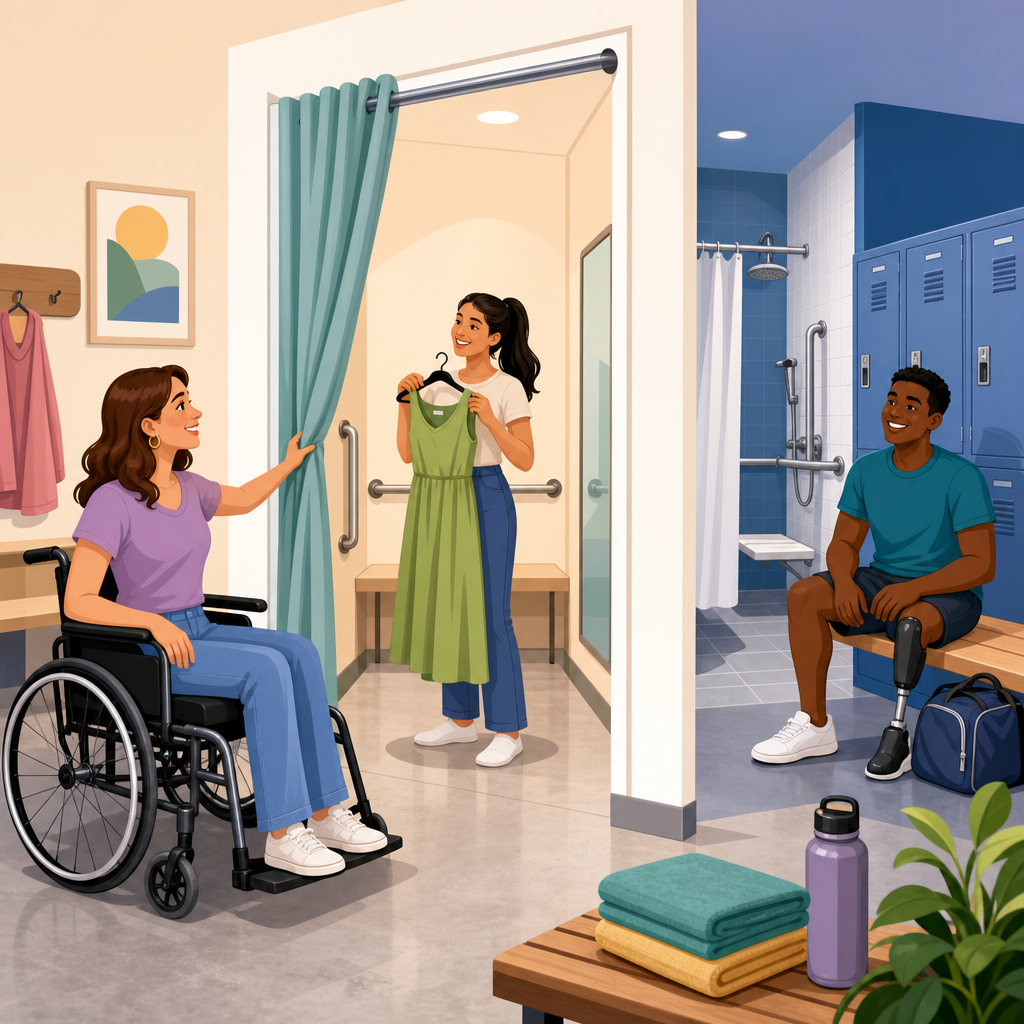
An accessible dressing room or fitting room must provide a clear floor or ground space and either a turning space or a T-shaped turning space so a wheelchair user can enter, close the door or curtain, maneuver, and use the room independently. The standards permit either a 60-inch diameter turning circle or a compliant T-turn. In the field, I usually advise teams to plan for the full circle because merchandising, wall protection, and bench projections can erode usable area after construction. Doors cannot swing into the required clear floor space for fixtures and benches in a way that blocks use, and hardware must be operable without tight grasping, pinching, or twisting of the wrist. If curtains are used instead of doors, the opening still must provide an accessible route and enough space for approach and transfer.
Section 803 also requires a bench in an accessible dressing room. The bench must be fixed to the wall or floor, 24 inches minimum in length, and 20 to 24 inches deep. Its top must be 17 to 19 inches above the finish floor. The bench needs clear floor space positioned for either a parallel or perpendicular transfer, depending on room configuration, and the supporting wall and seat must be capable of structural stability. Coat hooks and shelves are also regulated because people need places to hang clothing and set down personal items while changing. At least one hook and one shelf in the accessible room must be within the ADA reach range, typically 48 inches maximum above the floor for an unobstructed forward or side reach, though lower placement is usually more usable.
Mirrors are another common issue. If a mirror is provided in an accessible dressing room, the bottom edge of the reflecting surface can be no more than 40 inches above the floor. Retail chains often standardize full-length mirrors mounted too high because of trim details or anti-tip backing. The result is a room that technically exists but does not fully serve seated users. Good design resolves this early by specifying mirror locations during fixture coordination rather than after millwork installation. In existing facilities, relocating a mirror and lowering one shelf or hook may be straightforward, but enlarging the room for turning space is not, which is why layout decisions in schematic design carry the greatest compliance value.
Locker rooms: routes, lockers, benches, and showers
ADA rules for locker rooms extend beyond the room itself. The accessible route has to connect entrances, lockers, changing areas, benches, toilet rooms, and showers where those elements are provided. In schools, gyms, and health clubs, that route is frequently compromised by bench islands, freestanding hair dryer stations, or laundry carts stored in circulation aisles. The standards require enough clear width for movement and enough maneuvering space at doors and turning points. Accessible lockers must have operable parts within reach range and hardware that does not require tight grasping or twisting. If only some lockers are accessible, they should be integrated into the same room rather than segregated to a back corridor or staff office.
Benches in locker rooms follow technical rules similar to those in dressing rooms, but the design context is broader because benches often occur in runs. Where benches are provided, at least one of each type in each cluster serving accessible elements should comply. The compliant bench needs back support if it is not mounted to a wall and must provide a stable transfer surface. Adjacent clear floor space is critical. I have reviewed athletic facilities where benches met height and depth requirements on paper but were set between locker doors and columns, leaving no realistic transfer area. That is a field example of why dimensional compliance alone is not enough; the room has to function as a sequence.
When showers are part of the locker room, Chapter 8 does not replace shower technical requirements; it points you to them. Transfer showers, roll-in showers, shower seats, grab bars, controls, and handheld sprays each have detailed standards. The same is true for toilet and bathing rooms connected to locker areas. In natatoriums and fitness centers, accessible routes also intersect with pool access requirements, turning a locker room into a coordination point for multiple standards sections. The safest approach is to treat the locker room as a network of linked accessible components rather than a single room label on a plan.
Common compliance mistakes in retail, schools, gyms, and hospitality
The most frequent mistake in retail fitting rooms is undercounting accessible rooms. Five percent, but no fewer than one, applies by cluster, not by entire property. Another routine error is providing an “accessible” room that doubles as storage. Rolling racks, package hold bins, and spare seating often end up inside the largest fitting room because staff see extra square footage. That immediately defeats the required clear floor space. In schools and universities, team locker rooms sometimes receive less attention than public or spectator areas, yet program access applies to athletes and students with disabilities too. In hospitality, spa and changing rooms are often designed with premium finishes but insufficient maneuvering clearance because decorative casework is prioritized over circulation.
On renovation projects, the biggest trap is assuming that if plumbing fixtures are untouched, the changing areas do not need review. Alterations that affect usability can trigger obligations to improve path of travel and related features. Another trap is relying only on generic manufacturer “ADA compliant” labels for benches, lockers, mirrors, and hooks. The product may meet one technical criterion, such as seat height, while the installed configuration still fails due to reach range, protrusion, or transfer clearance. I have found that mockups and field measurements before final sign-off save significant rework, especially in branded retail chains where one flawed prototype can be replicated across dozens of stores.
| Area | Frequent mistake | Why it fails | Better practice |
|---|---|---|---|
| Retail fitting rooms | Counting one accessible room for the whole store | Accessible rooms are required by cluster | Evaluate each department or fitting room bank separately |
| School locker rooms | Bench installed without transfer clearance | Users cannot safely transfer from mobility devices | Coordinate bench location with locker swing and aisle width |
| Gyms and clubs | Accessible lockers placed in remote overflow area | Equivalent convenience and integration are lost | Disperse compliant lockers within the primary room |
| Hotels and spas | Decorative millwork reducing turning radius | Required maneuvering space is obstructed | Protect the turning space on finish and millwork drawings |
How Chapter 8 interacts with other special rooms and spaces
Because this article serves as a hub for Chapter 8: Special Rooms, Spaces, and Elements, it is important to place dressing rooms and locker rooms in the larger framework. Chapter 8 also addresses medical care and long-term care facilities, where patient bedrooms, toilet rooms, and bathing rooms have specialized accessibility rules reflecting patient mobility levels and staff assistance. It addresses transient lodging, where guest room dispersion, communication features, and mobility features shape how accessible accommodations are provided. It addresses detention and correctional facilities, judicial facilities, and residential dwelling units, each with unique scoping tied to the use of the space. The pattern is consistent across all of them: Chapter 8 identifies what is required for a special occupancy and then relies on the technical chapters for exact dimensions and features.
That structure is useful when you manage a mixed-use property. A resort may combine hotel guest rooms, spa locker rooms, pool changing rooms, and employee dressing areas. A university may include dormitory units, athletics locker rooms, healthcare clinics, and courtroom-style hearing rooms. Instead of treating each as an isolated compliance puzzle, use Chapter 8 as the map. Start with the room type, identify the scoping trigger, count required accessible spaces by cluster or total as applicable, then verify all technical elements. This method reduces omissions during design and gives facility teams a clearer audit checklist during operations.
Design, construction, and operations best practices
Effective compliance starts before construction documents. During programming, identify every location where users change clothes, store belongings, or prepare for activities. During schematic design, reserve the larger footprints accessible rooms need; trying to “find” turning space later usually forces compromises. In design development, coordinate doors, benches, lockers, mirrors, hooks, and shelves as a single accessibility package. During construction, verify rough framing and backing for benches and accessories before finishes go in. After opening, train staff not to use accessible rooms for storage, not to move benches into clear spaces, and not to replace compliant hardware with decorative but noncompliant alternatives.
For audits, I rely on tape-measure basics and repeatable checklists. Measure bench height, depth, and length. Confirm turning space free of obstructions. Check mirror mounting height, hook and shelf reach range, door maneuvering clearance, and locker hardware operation. Review maintenance practices because accessibility failures often emerge after turnover, not at inspection. A broken closer, a swollen door, or relocated seating can turn a compliant room into a barrier. The core benefit of getting ADA rules for dressing rooms, fitting rooms, and locker rooms right is practical usability: people can shop, participate, travel, exercise, and work with dignity and independence. Use Chapter 8 as your guide, review each room cluster carefully, and audit these spaces regularly so accessibility remains built into daily operations.
Frequently Asked Questions
What ADA standards apply to dressing rooms, fitting rooms, and locker rooms?
The primary requirements come from Chapter 8 of the 2010 ADA Standards for Accessible Design, which addresses special rooms, spaces, and elements, including dressing rooms, fitting rooms, and locker rooms. These spaces must also comply with relevant provisions found elsewhere in the standards, such as accessible routes, maneuvering clearances, doors, turning space, reach ranges, benches, and operable parts. In other words, compliance is not limited to one isolated section. A dressing room may need to satisfy requirements for the room itself, the route leading to it, the door hardware, any built-in bench, coat hooks, shelves, lockers, and the clear floor space needed for wheelchair users to enter and use the room independently.
In practical terms, the ADA expects these rooms to be accessible as part of the overall path of travel and usable by people with mobility disabilities. If a facility provides dressing, fitting, or locker rooms for the public or for building occupants, a required number of those rooms must be accessible. The exact scoping can depend on how many rooms are provided and whether they are clustered in one area or dispersed throughout a facility. Designers and owners should also remember that state and local accessibility codes may impose additional or more specific requirements. The safest approach is to treat ADA compliance as a coordinated design issue rather than a checklist item limited to one room type.
How many accessible dressing rooms or fitting rooms are required under the ADA?
The ADA generally requires at least 5 percent of dressing rooms, fitting rooms, and locker rooms in each cluster to be accessible, but never fewer than one accessible room where such rooms are provided. That means if a store, gym, school, or similar facility has a group of fitting or dressing rooms in one location, at least one must usually be designed to meet accessibility requirements. If rooms are dispersed in different locations or serve different functions, accessibility should be considered in each cluster rather than assuming one compliant room somewhere in the building is enough.
This is an important point because accessibility is about equivalent use, not just technical presence. For example, if a retail store has fitting rooms on multiple floors, or separate fitting room clusters in different departments, users with disabilities should not be forced to travel to a remote area to find the only accessible option. Similarly, in locker room settings, if the facility offers distinct locker or changing spaces associated with different amenities, the accessible rooms should be integrated into those same service areas whenever required. The goal is to provide access that is practical, dignified, and comparable to what other users receive.
Because layout and use patterns vary widely, owners should confirm the room count, clustering, and applicable scoping during design and before renovations. A very common mistake is to count only the room itself while overlooking whether the accessible route, door swing, bench placement, or turning area actually allows the room to function as intended. A room may be labeled accessible on paper yet still fail in real-world use if the dimensions and clearances are not properly coordinated.
What features make a dressing room, fitting room, or locker room ADA compliant?
An ADA-compliant room must be usable by a person with a disability from entry through actual use. That starts with an accessible route connecting the room to the rest of the facility. The entrance must provide adequate maneuvering clearance, and the door must have accessible hardware that can be operated without tight grasping, pinching, or twisting of the wrist. Once inside, the room must include sufficient clear floor space and turning space so a wheelchair user can enter, reposition, and use the room without obstruction.
Where a bench is required in an accessible dressing room or fitting room, the bench must meet applicable ADA criteria for size, location, and support. Benches typically must be fixed or otherwise compliant in a way that supports transfer and stable use. Clear floor space must be positioned properly alongside the bench to allow transfer from a wheelchair. If shelves, hooks, mirrors, or other accessories are provided, they must be within accessible reach ranges and mounted at heights that can be used by people with disabilities. Locker rooms may also require accessible lockers, seating, and accessible routes to related elements such as showers, toilets, and lavatories when those features are part of the same facility.
The larger compliance issue is usability as a whole. A room can have a compliant bench and still be inaccessible if the door swing blocks the turning space. A coat hook can be mounted at the wrong height and make the room less functional, even if the room dimensions are correct. In locker rooms, narrow aisles between lockers, inaccessible latch hardware, and benches placed too close together are frequent problems. ADA compliance depends on all these elements working together so the room is not merely technically present but truly usable by people with a range of disabilities.
Do locker rooms have different ADA considerations than retail fitting rooms?
Yes. While locker rooms and retail fitting rooms share certain core ADA requirements, locker rooms often involve a broader set of accessibility issues because they are usually part of more complex environments. A retail fitting room is typically a relatively simple enclosed space for trying on clothing. A locker room, by contrast, may include lockers, benches, showers, toilet rooms, sinks, grooming areas, changing areas, and circulation aisles used by many people at once. That means accessibility must be evaluated not only at the room level but also across the entire sequence of use.
For example, an accessible locker room should allow a person with a disability to enter the space, move through the aisles, access required amenities, use lockers or storage where provided, and reach connected bathing or toilet facilities when those are part of the same program. If the locker room includes saunas, steam rooms, or other related amenities, those may trigger additional ADA considerations as well. The location and usability of benches become especially important in locker rooms, since they are often essential for changing and transferring. Locker hardware, shelf heights, and routes between key features all matter.
Privacy and independence are also major considerations. In both fitting rooms and locker rooms, the ADA supports integrated access rather than segregated accommodations whenever possible. Users with disabilities should be able to use rooms that are part of the same general experience as everyone else. In practice, that means owners should avoid placing the only accessible changing space in a remote staff area or behind a service corridor. Accessibility works best when it is built directly into the normal user experience of the room type being provided.
What are the most common ADA compliance mistakes in dressing rooms, fitting rooms, and locker rooms?
One of the most common mistakes is assuming that a slightly larger room is automatically accessible. Size alone does not create compliance. The room must have proper turning space, door maneuvering clearance, and a usable layout that allows a wheelchair user to approach and use the bench, hooks, shelves, mirror, and other elements. If the door swing cuts into the required clearances, or if a bench is installed in the wrong location, the room may fail even if it appears spacious.
Another frequent issue is inaccessible accessories. Hooks mounted too high, shelves that cannot be reached, mirrors that do not serve seated users, and locker hardware that requires tight grasping are all recurring problems. In locker rooms, designers also often underestimate circulation space between benches and lockers, making it difficult or impossible for wheelchair users to move through the area. Renovation projects are especially vulnerable to these errors because existing walls and plumbing layouts can tempt teams to compromise on clearances.
A third major mistake is treating accessibility as a single-room obligation instead of a system. An accessible fitting room is not truly accessible if the route to it includes stairs, heavy doors, or narrow passages. An accessible locker room bench does not solve the problem if the showers or toilets connected to that locker room are inaccessible. The best way to avoid violations is to review the entire path of use, from arrival at the facility to entry, changing, storage, and exit. Early coordination among architects, contractors, owners, and accessibility consultants can prevent expensive fixes later and help ensure the finished space works for real users, not just on a drawing.