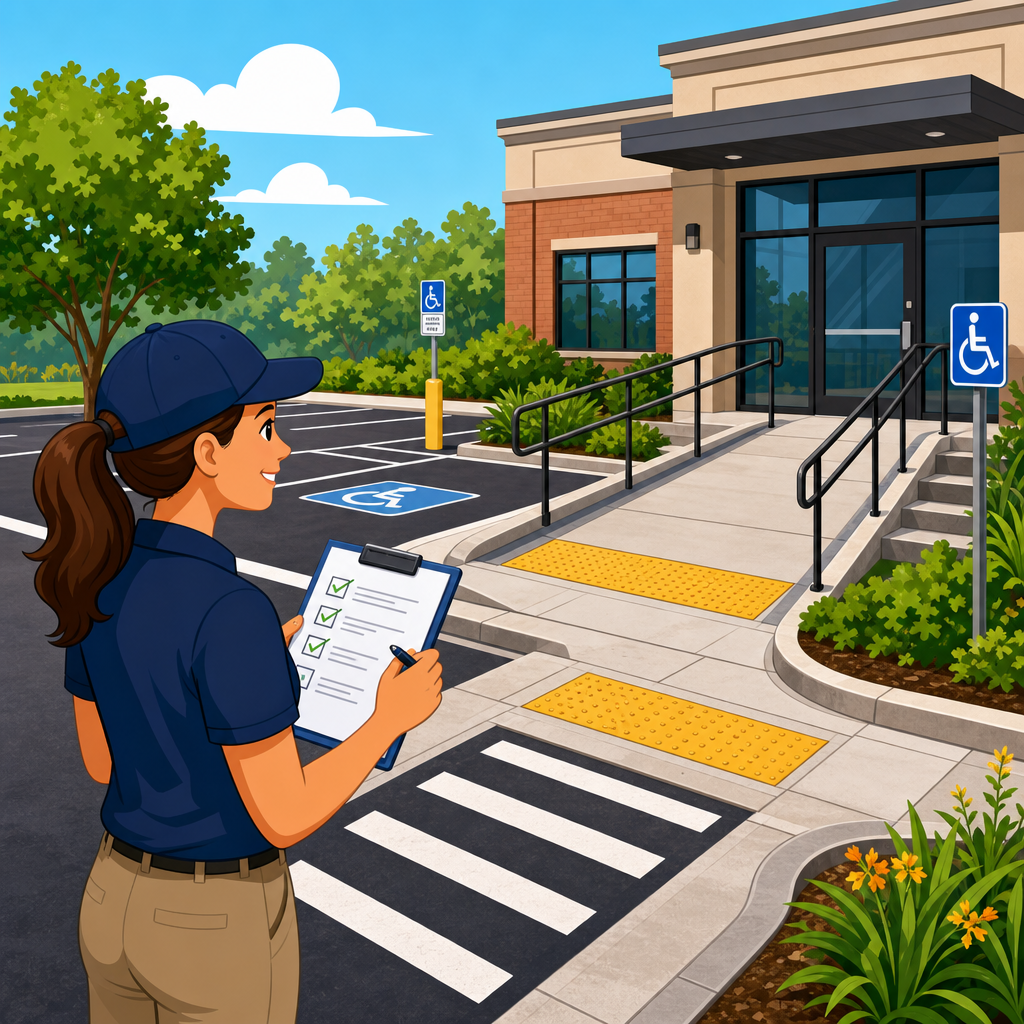
Auditing exterior site elements for ADA risk starts with understanding that many access failures happen before a person reaches the front door. Parking, passenger loading zones, sidewalks, curb ramps, site arrival points, stairs, handrails, grates, and outdoor routes all determine whether a building is meaningfully accessible. Under the ADA, exterior site design is not a cosmetic issue; it is part of the legally required accessible path of travel. In practice, Chapter 5: General Site and Building Elements is where many of the most common, most visible, and most preventable compliance problems appear.
When I assess properties, I treat an exterior ADA audit as a route-based investigation rather than a checklist completed in isolation. The goal is to verify that a person using a wheelchair, walker, cane, scooter, crutches, or low-vision navigation can arrive, park, unload, orient, move across the site, and reach an accessible entrance without encountering barriers that exceed technical tolerances. “ADA risk” means both legal exposure and practical usability failure. A site can look orderly yet still violate required dimensions, slopes, edge conditions, reach ranges, or detectable warnings. It only takes one broken link in the chain to make the full route inaccessible.
This hub article covers Chapter 5 comprehensively and sets the foundation for deeper articles on parking, curb ramps, accessible routes, exterior stairs, handrails, doors, and site signage. The core standards most auditors rely on are the 2010 ADA Standards for Accessible Design, often cross-checked with state building codes and the International Building Code where applicable. Because enforcement, renovation triggers, and safe-harbor questions vary by property type and alteration history, a strong audit documents conditions precisely instead of making assumptions. Measurements, photographs, and route logic matter more than broad impressions. That disciplined approach reduces errors, supports remediation planning, and gives owners a defensible understanding of where genuine ADA exposure exists across the site.
Start With Scope, Standards, and the Accessible Route
The first step in auditing exterior site elements is defining scope. Chapter 5 generally covers site and building features that shape access before and around entry, including parking spaces, access aisles, curb ramps, passenger loading zones, stairs, handrails, walking surfaces, protruding objects, and doors along the route. On large campuses or retail centers, I map every public arrival point first: street sidewalk connections, transit stops, employee entrances used by the public, parking fields, garages, drop-off areas, and secondary entrances. Then I identify which routes are intended to be accessible and whether they connect continuously to an accessible entrance.
An accessible route is a continuous, unobstructed path connecting site arrival points and accessible building entrances. That definition sounds simple, but most exterior failures come from interruptions: a compliant parking space feeding into a noncompliant curb ramp, a proper ramp leading to a heavy noncompliant gate, or a smooth sidewalk interrupted by a utility grate with openings that catch mobility devices. Exterior route auditing must therefore follow the entire user journey, not isolated components. I usually walk and roll the route mentally in sequence: arrival, unload, transition to the sidewalk, directional finding, cross-slope changes, grade transitions, maneuvering clearances, and final entrance approach.
Accuracy requires the right tools. A digital level or smart level, 25-foot tape, wheel measure, laser distance meter, fissure gauge, camera, and field forms are standard. For slope readings, auditors should distinguish running slope from cross slope and measure in the direction of travel and perpendicular to it. A route that appears flat can fail because cross slope exceeds tolerance, especially where asphalt has settled near trench drains or patched utility cuts. Weather also matters. Ponding, debris, loose gravel, and seasonal heaving may indicate maintenance-related barriers even when original construction was closer to compliance. Good field notes record both dimensional violations and operational issues that affect access in real use.
Audit Parking and Passenger Loading Zones First
Parking is often the highest-risk exterior element because it is the main arrival point for many users and one of the most frequently litigated conditions. An audit should verify the required number of accessible spaces, including van spaces, based on the total parking count provided on the site. Then confirm width, access aisle dimensions, markings, signage, vertical clearance for van access, and the connection from each accessible space to the accessible route. I routinely find properly striped spaces with compliant counts but no safe route to the entrance because users must travel behind parked cars or cross a steep curb without a ramp.
Surface slope in parking spaces and access aisles is a critical detail. Excessive slope affects transfers in and out of vehicles and can cause wheelchairs to drift. Fresh striping does not correct a sloped surface. In one retail audit, a center had recently repainted every accessible stall and installed new signs, yet the access aisles measured well above allowable cross slope because the lot had been resurfaced without regrading. That owner had invested in visible fixes but left the underlying technical defect in place. Auditors should measure multiple points across each stall and aisle and photograph readings with enough context to identify location.
Passenger loading zones deserve equal attention, especially at hospitals, hotels, schools, senior housing, and event venues. The audit should confirm a vehicle pull-up space, adjacent access aisle, vertical clearance, and a route from the loading zone to an accessible entrance. Covered drop-off areas often hide drainage issues or abrupt level changes at columns and curb returns. If valet operations, security bollards, planters, or temporary queue stanchions narrow the route, note them as operational barriers. A compliant design can become noncompliant through management practices, and exterior ADA risk often comes from that gap between approved plans and day-to-day site conditions.
Evaluate Curb Ramps, Blended Transitions, and Street Connections
Curb ramps are small features with outsized importance because they connect pedestrian circulation elements that would otherwise remain isolated. A proper audit examines ramp width, running slope, cross slope, side flare conditions where pedestrians walk across them, top landing dimensions, bottom transitions, and alignment with the direction of travel. Detectable warnings must be present where required and located correctly. One of the most common field failures is a ramp that technically exists but aims users into the traveled way instead of toward the crossing, forcing a dangerous maneuver in traffic or across uneven gutter flow lines.
Street and sidewalk connections should be reviewed as part of the same network. If a property relies on a public sidewalk for access, the practical route still matters even where maintenance responsibility is shared or contested. Courts and investigators focus on whether people can reach the business or facility, not only on who poured the concrete. I document off-site pinch points that affect site access, then separate them in the report by control level: owner-controlled, landlord-controlled, municipality-controlled, or shared. That distinction helps clients prioritize remediation while preserving an honest record of actual accessibility barriers users face.
Blended transitions can reduce abrupt grade changes, but they are not automatically compliant simply because they feel smoother. Measure the full transition area and verify there is no excessive running slope masquerading as sidewalk grade. Also inspect utility covers, brick pavers, decorative scoring, and drainage channels at the toe of the ramp. Exterior designers often add aesthetic materials that create vibration, instability, or wide joints. In historic districts, auditors should note preservation constraints but still identify where equivalent facilitation or alternate solutions may be necessary. Historic context may shape remediation methods; it does not eliminate the requirement to provide accessible access to the extent required by law.
Inspect Walking Surfaces, Stairs, Handrails, and Site Hazards
Exterior walking surfaces must be stable, firm, and slip resistant in practical performance. In the field, that means looking beyond dimensions to the condition of concrete, asphalt, unit pavers, boardwalk materials, and coatings. Cracks, vertical displacement, loose aggregate, standing water, and heaved joints are common hazards. Surface openings in gratings should prevent passage of objects of the size limited by the standards, and elongated openings should be oriented so they do not trap wheels or cane tips. These details matter because exterior routes deteriorate over time, and maintenance failures can create ADA risk long after original construction.
Where stairs are part of exterior circulation, audit tread and riser consistency, nosing conditions, handrail continuity, gripping surfaces, extensions, clearances from adjacent walls, and edge hazards at landings. Even when an accessible route is provided separately, stairs still matter because inaccessible or unsafe stair design can create broader code and liability issues. I often find retrofit handrails that are mounted too close to masonry walls or interrupted at intermediate posts in ways that break continuity. On older sites, a partial upgrade is common: a new ramp is added nearby, but the stair remains deficient, creating mixed conditions that suggest incomplete modernization.
Protruding objects, site furnishings, and landscape elements are another frequent source of overlooked barriers. Cane-detectable hazards include low tree branches, sign panels, drinking fountains, bench edges, and wall-mounted fixtures along narrow walks. Bollards installed for vehicle security may preserve route width on paper while creating difficult navigation in reality if spacing is too tight or visual contrast is poor. Exterior audits should include lighting observations as well. Although lighting levels are not an ADA dimensional standard in the same way as slope, poor illumination can worsen wayfinding and hazard detection for low-vision users, particularly at ramps, stairs, and changes in level.
Document Findings, Prioritize Risk, and Plan Corrections
A strong exterior ADA audit ends with documentation that a facilities team, architect, contractor, or attorney can actually use. I structure findings by route segment and element type, then assign severity based on impact, frequency, and ease of remediation. Conditions that block access entirely, such as missing curb ramps or inaccessible parking with no compliant route, rise to the top. Conditions that impair safety, such as excessive cross slope, abrupt vertical changes, or missing handrail extensions, follow closely. Minor signage, striping wear, or maintenance housekeeping issues still matter, but they should not obscure the major barriers that control access.
| Exterior element | Common failure | Why risk is high | Typical corrective action |
|---|---|---|---|
| Accessible parking | Access aisle slope too steep | Unsafe vehicle transfer and route instability | Regrade and restripe, then remeasure |
| Curb ramp | Poor alignment into roadway | Directs users into traffic conflict area | Reconstruct ramp and landing geometry |
| Sidewalk route | Cross slope or vertical displacement | Wheelchair drift and trip hazard | Grinding, patching, or full panel replacement |
| Passenger loading zone | No accessible connection to entrance | Arrival point is unusable for many visitors | Add compliant route and signage |
| Exterior stairs | Noncontinuous or nongraspable handrails | Reduced safety during ascent and descent | Replace rail system to current criteria |
Reports should include measured values, photo references, exact locations, applicable criteria, and recommended next steps. Avoid vague phrases like “appears noncompliant” when you have a measurement, and avoid definitive legal conclusions when site history, alteration scope, or local code overlays need counsel review. That balance is important. A property manager needs enough specificity to budget repairs, while legal teams need documentation that reflects actual conditions without overreaching. I also recommend flagging quick wins separately from capital projects. Replacing signs, repainting markings, trimming vegetation, and removing obstructions can reduce immediate risk while larger regrading or reconstruction work is designed.
Because this page serves as the hub for Chapter 5, it should connect readers to detailed guidance on parking counts, access aisle geometry, curb ramp measurements, accessible route slopes, stair and handrail specifications, door maneuvering clearances, and exterior signage. The value of a hub article is clarity: it shows how all site elements interact as one access system. If you are auditing a property, start at the site boundary, follow every public arrival path, measure the conditions that control usability, and document barriers in a way that supports correction. That process turns ADA risk from a vague concern into a manageable, evidence-based action plan for owners, designers, and facility teams.
Exterior ADA compliance is most effective when treated as a connected route, not a collection of isolated details. Chapter 5 matters because it governs the first part of the user experience: arriving, unloading, orienting, traveling across the site, and reaching an accessible entrance safely. The biggest risks usually come from common conditions that are easy to miss without field measurements, including sloped parking aisles, misaligned curb ramps, broken walking surfaces, inaccessible loading zones, and deficient handrails. These are practical barriers for users and recurring exposure points for owners.
The most reliable audit method is simple and disciplined. Define the applicable standards, map every arrival point, measure the route continuously, document conditions with photos and dimensions, and separate high-impact barriers from maintenance items. Use this Chapter 5 hub as the starting point for deeper reviews of each exterior element, then build a correction plan that addresses both immediate fixes and long-term capital work. If you manage, design, or assess a property, walk the site today and verify that the accessible route truly works from curb to door.
Frequently Asked Questions
What exterior site elements should be included in an ADA risk audit?
An ADA risk audit should evaluate every exterior feature a person may encounter from the moment they arrive on the site until they reach an accessible entrance. That usually begins with parking areas, van-accessible spaces, access aisles, passenger loading zones, and site signage. From there, the review should continue along sidewalks, pedestrian circulation paths, curb ramps, blended transitions, crosswalk connections, exterior stairs, handrails, detectable warnings where required, drainage grates, and any changes in level along the route. It is also important to assess site arrival points such as public sidewalks, transit stops, ride-share drop-off areas, and connecting routes from adjacent lots or campus paths.
In practical terms, the audit should focus on whether the accessible path of travel is continuous, usable, and compliant for people with mobility, vision, and balance impairments. That means looking beyond isolated elements and evaluating how they work together as a system. A technically compliant parking space does not reduce risk if the access aisle leads to a steep curb ramp, if the sidewalk narrows below required clear width, or if a grate creates a wheel hazard. Exterior ADA risk is often cumulative. Small deficiencies at multiple points can create a meaningful barrier when combined, which is why a complete site audit should document dimensions, slopes, cross slopes, surface conditions, obstructions, maintenance issues, and route continuity rather than checking only a few obvious features.
Why is the exterior path of travel such a major source of ADA liability?
The exterior path of travel is a major source of ADA liability because it controls whether a person can actually reach and enter a facility. If access breaks down in the parking lot, on the sidewalk, or at a curb ramp, the building may be functionally inaccessible even if interior spaces are well designed. Under the ADA, accessibility obligations do not begin at the front door. Exterior site elements are part of the required route, and barriers in those areas can lead directly to complaints, demand letters, remediation costs, and avoidable legal exposure.
Exterior environments also present more variability than interior spaces. Pavement shifts over time, striping fades, slopes change during resurfacing, tree roots lift sidewalks, drainage design creates cross-slope problems, and maintenance failures can turn a once-compliant route into a barrier. Because of that, organizations often underestimate risk by assuming site conditions are static or by relying on old construction drawings instead of current field conditions. From an audit perspective, this is why exterior review should be evidence-based and site-specific. Measurements, photographs, route mapping, and observed usability all matter. The highest-risk conditions are usually those that interrupt independence and safety, such as inaccessible parking access, excessive running slopes, missing handrails, abrupt level changes, unstable surfaces, or route gaps that force pedestrians into vehicular traffic.
How do you audit parking, curb ramps, and sidewalks for ADA risk in a practical way?
A practical audit starts by tracing the route a real visitor would use. Begin at accessible parking and confirm the correct number and type of spaces, including van spaces, proper dimensions, access aisle layout, signage, and route connection to the accessible entrance. Next, verify that the access aisle and adjoining route are not blocked by wheel stops, curbs, bollards, planters, or drainage features. Then move to curb ramps and transitions, checking slope, cross slope, flare conditions where applicable, landing areas, detectable warnings where required, alignment with the pedestrian path, and whether the ramp actually serves the intended crossing without forcing awkward or unsafe maneuvers.
For sidewalks and exterior walking surfaces, the audit should examine clear width, passing space where needed, running slope, cross slope, surface firmness and stability, vertical changes in level, protruding objects, and any points where utility covers or grates may create a hazard for wheels, canes, or foot traffic. The review should also consider route logic. A site can fail in practice when the “accessible route” is technically present but far longer, poorly marked, or routed behind service areas rather than along the main pedestrian approach. A strong audit records field measurements, notes the exact location of each barrier, documents whether the issue is design-related or maintenance-related, and prioritizes findings based on severity, user impact, and ease of remediation. That approach helps owners move from a checklist exercise to a defensible risk management process.
What are the most commonly overlooked exterior ADA issues during site inspections?
Some of the most commonly overlooked issues are excessive cross slope on sidewalks and parking access aisles, route discontinuities between site features, and poor transitions at curb ramps or building approaches. Inspectors also frequently miss problems caused by resurfacing and restriping projects, where parking spaces may appear orderly but no longer meet dimensional or slope requirements. Another common oversight is assuming that if an accessible parking space exists, the route is compliant. In reality, the route may include steep segments, narrow pinch points, damaged pavement, inaccessible gates, improperly placed signage, or surface obstructions that make independent travel difficult or unsafe.
Other frequently missed risks include stairs without compliant handrails, handrail extensions that are absent or obstructed, grates with openings that can catch mobility devices, settlement that creates abrupt level changes, and exterior doors that are technically reachable but only by crossing noncompliant terrain. Passenger loading zones are also often neglected, even though they may be the primary arrival point for many users. Seasonal and maintenance issues matter as well. Overgrown landscaping, temporary hoses, sandwich boards, misplaced trash enclosures, and snow storage practices can all compromise an otherwise acceptable route. A careful exterior audit should therefore distinguish between permanent construction defects and operational barriers, because both can create ADA risk and both should be addressed in a corrective action plan.
How often should exterior ADA site conditions be audited, and what should happen after the audit?
Exterior ADA conditions should be audited on a recurring basis rather than only during new construction or renovation. At a minimum, sites should be reviewed periodically as part of routine facility risk management, and additional audits should occur after repaving, restriping, utility work, landscaping changes, storm damage, or any project that alters grades, routes, or pedestrian circulation. Exterior conditions change faster than most owners expect, so a one-time review is rarely enough. High-traffic properties, campuses, healthcare sites, retail centers, and multifamily developments often benefit from more structured review intervals because wear, weather, and maintenance practices can quickly affect compliance and usability.
After the audit, the next step should be a prioritized remediation roadmap. Findings should be organized by element, location, applicable standard, observed condition, user impact, and recommended corrective action. Immediate hazards and high-exposure items, such as inaccessible parking routes, dangerous curb ramps, missing handrails, or route barriers at primary entrances, should be addressed first. Mid-term items can be planned into capital projects, while lower-cost operational fixes should be assigned promptly to maintenance or site management teams. The audit should also produce documentation that supports internal decision-making: photos, measurements, route diagrams, and a clear explanation of why each issue matters. That record is valuable not only for repairs, but also for demonstrating a proactive accessibility program. The most effective organizations treat the audit as the beginning of an ongoing compliance and usability strategy, not the end of a checklist.