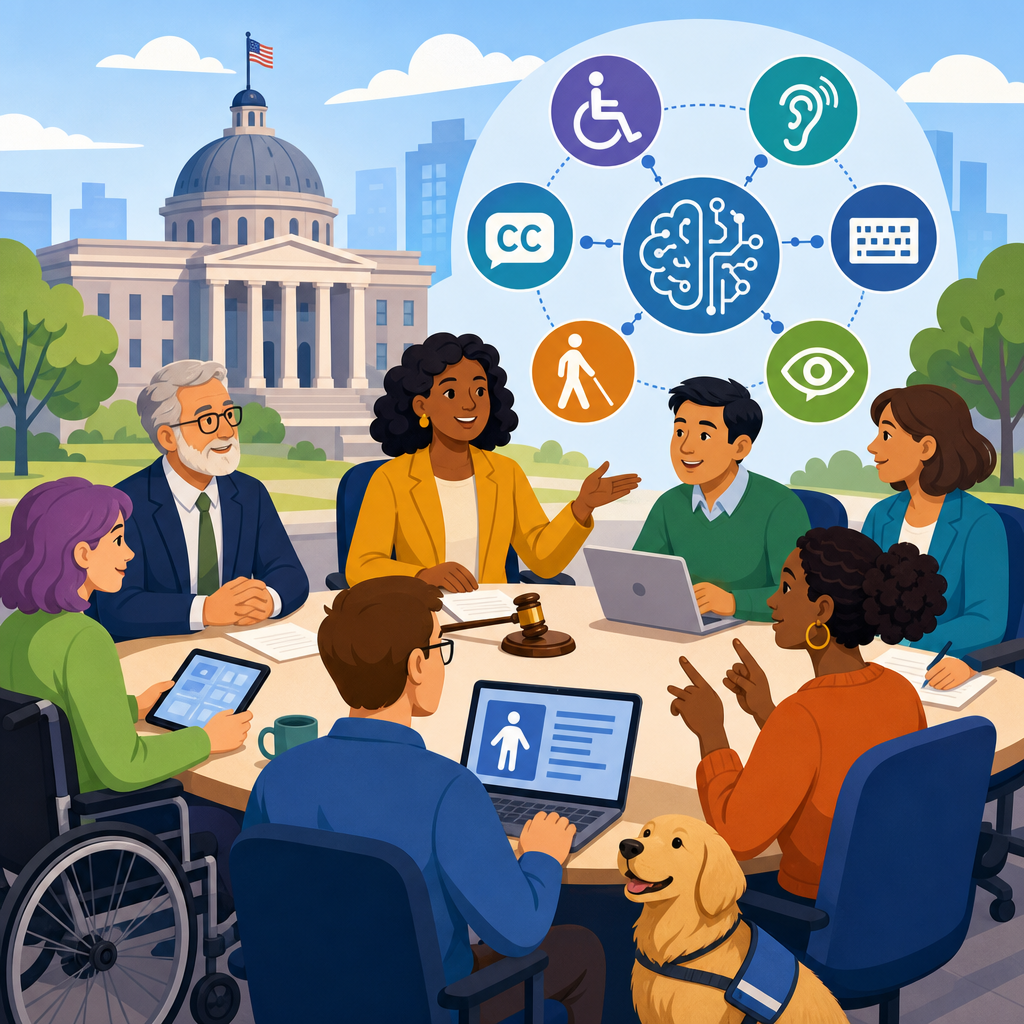
Public agencies are rapidly adopting artificial intelligence tools to power chatbots, automate document workflows, caption meetings, screen job applicants, translate content, and personalize digital services, but many accessibility claims attached to these products are vague, incomplete, or legally risky. Governing AI accessibility claims means creating a clear process for evaluating what a vendor or internal team says an AI system can do for people with disabilities, testing those claims against recognized accessibility standards, documenting limitations, and controlling how those statements appear in contracts, procurement records, websites, and public communications. In the AI and ADA context, this matters because agencies do not merely buy software; they deliver legally mandated public services under civil rights rules that require equal access, effective communication, and nondiscrimination.
In practice, I have seen accessibility statements for AI products range from careful and evidence-based to marketing copy that promises “full ADA compliance” without describing the standard, test method, assistive technology support, or human fallback process. That gap is dangerous. The Americans with Disabilities Act, Section 504 of the Rehabilitation Act, and Section 508 for federal agencies and many state analogs do not treat accessibility as a slogan. They require usable access. If an AI chatbot misreads screen reader focus order, an automated captioning tool drops medical terminology, or a résumé screener penalizes disability-related employment gaps, the legal exposure falls on the agency using the system, not only on the vendor selling it.
This hub article explains how public agencies should govern AI accessibility claims across procurement, implementation, oversight, and public reporting. It defines the core terms, identifies the governing legal and technical standards, and gives a practical framework for evaluating claims before and after deployment. It also serves as the anchor for deeper work on related issues such as automated decision tools, website accessibility, digital documents, language access, disability bias in hiring, and contract controls. The goal is straightforward: help agencies separate substantiated accessibility performance from unsupported promises, so residents with disabilities receive services that are genuinely usable.
What AI accessibility claims include and why they are high risk
An AI accessibility claim is any representation that an AI-enabled product or feature improves, preserves, measures, or guarantees accessibility for people with disabilities. Common examples include claims that a chatbot is screen-reader compatible, automated captions are accurate enough for public meetings, image descriptions are suitable for blind users, voice interfaces help users with mobility impairments, translation models support deaf-blind communication, or automated summaries make complex notices easier to understand. Agencies also encounter indirect claims, such as statements that a product is “inclusive by design,” “ADA compliant,” or “meets all accessibility requirements” without supporting detail.
These claims are high risk for three reasons. First, AI outputs are probabilistic and can vary across contexts, users, dialects, and disability types. A model that performs well on generic English captions may fail on names, legal terminology, accents, or noisy public hearing audio. Second, accessibility is not one feature. It includes perceivability, operability, understandability, robustness, compatibility with assistive technologies, and equitable human support when automation fails. Third, agencies make public commitments. If a transit authority says its AI assistant provides accessible trip planning for blind riders, then routes, timing changes, map alternatives, and error messages must actually work in real use, not just in a demo.
The most common governance mistake is treating accessibility claims as purely technical. They are also legal, procurement, communications, records-management, and service-delivery claims. A procurement officer may collect a vendor VPAT, but if the communications team later publishes broader promises on a website, or if staff rely on auto-generated captions without quality review, the agency can exceed what the evidence supports. Good governance closes that gap by tying every claim to a standard, a test, a scope statement, a limitation, and an accountable owner.
The legal framework agencies must map before making or accepting claims
For U.S. public agencies, the core legal map starts with Title II of the ADA, which requires state and local governments to provide equal access to services, programs, and activities. Section 504 applies to entities receiving federal financial assistance and prohibits disability discrimination. Section 508 directly governs federal agencies and strongly influences state and local procurement because it provides a widely used technical baseline for information and communication technology. Agencies should also track state disability laws, public records obligations, consumer protection rules, and sector-specific requirements in education, health, transportation, voting, and employment.
The technical standards most often used to evaluate digital accessibility include WCAG 2.1 or 2.2 Level AA, the Revised 508 Standards, EN 301 549 for public procurement in Europe, and applicable platform guidance from Apple, Google, Microsoft, and assistive technology vendors. These standards matter because “ADA compliant” by itself is not a testable statement. Agencies need a measurable benchmark. For websites, mobile apps, and many user interfaces, WCAG is the practical reference point. For software procurement, a VPAT based on Section 508 or EN 301 549 can be useful, but it is only a starting artifact, not proof of accessibility in the agency’s environment.
AI introduces additional legal questions that ordinary accessibility reviews can miss. If an AI system affects employment, benefits eligibility, housing, education access, law enforcement interactions, or healthcare triage, disability bias and due process concerns become central. The Equal Employment Opportunity Commission has warned that algorithmic tools can violate disability rights laws when they screen out qualified individuals or fail to provide reasonable accommodations. The Department of Justice has also emphasized effective communication and accessible digital services. Agencies therefore need a legal inventory that connects each AI use case to the rights at stake, not just to generic software compliance language.
A governance model for procurement, validation, and public communication
The strongest model I have implemented uses a three-gate review. Gate one is claim intake during procurement or internal development. Every accessibility-related statement from a vendor, project manager, or communications draft is captured in a claim register. Gate two is validation. The agency tests the claim against standards, user scenarios, assistive technologies, and service conditions. Gate three is publication and monitoring. Only validated claims are allowed into contracts, implementation documents, FAQs, and public webpages, and each approved claim carries a date, scope, evidence source, and review owner.
This governance model works because it treats claims as controlled content rather than casual descriptions. For example, if a vendor says its generative AI tool creates alt text for public image libraries, the agency should not publish “images are fully accessible through AI descriptions.” It should state the narrower truth: “The system generates draft alt text that staff review before publication; complex charts and maps require manual description.” That wording reflects the actual workflow, informs users what to expect, and preserves room for human quality control. It also prevents procurement records from implying a guarantee the agency cannot verify.
| Governance step | What the agency should require | Example evidence | Main risk if skipped |
|---|---|---|---|
| Claim intake | List every accessibility statement tied to the AI tool | Vendor proposal, sales deck, draft FAQ | Unverified promises spread across teams |
| Standards mapping | Connect each claim to WCAG, Section 508, policy, or service rule | Requirements matrix | “Accessible” remains undefined |
| Technical testing | Test with keyboard, screen readers, captions, contrast, error handling | Audit reports using Axe, WAVE, JAWS, NVDA, VoiceOver | Interfaces fail in real use |
| User validation | Include disabled users in scenario-based testing | Moderated usability sessions | Conformance misses usability barriers |
| Human fallback review | Define how users get help when AI fails | Escalation workflow, SLA | No effective communication alternative |
| Public statement control | Approve only evidence-backed language | Claim register with owner and review date | Misleading accessibility representations |
How to evaluate common AI and ADA use cases
Different use cases require different tests. For AI chatbots, agencies should evaluate screen-reader compatibility, keyboard navigation, response clarity, timeout behavior, plain-language output, and escalation to a human agent. A county benefits chatbot may answer simple eligibility questions well, yet fail when a blind user needs form-specific guidance or when the model produces a hallucinated deadline. For speech recognition and automated captions, the agency should test word error rates on domain vocabulary, speaker identification, punctuation quality, multilingual audio, and noisy environments. Public meeting captions that are 90 percent accurate can still be unusable if the missing 10 percent includes names, votes, legal motions, or medication terms.
For generative image description, agencies should separate decorative images from informative visuals. Draft alt text may be acceptable for simple photos after human review, but maps, infographics, engineering diagrams, and emergency notices usually require authored long descriptions. For document automation, agencies should test tagged PDF structure, heading hierarchy, reading order, form labels, table markup, and language metadata. I have repeatedly seen agencies deploy AI summarization to make notices “easier to understand,” only to discover the generated summaries omit exceptions, deadlines, or appeal rights. That is not merely a usability flaw; in some contexts it can undermine legal notice.
Employment tools deserve special scrutiny. If an AI system ranks applicants, scores interviews, or flags attendance patterns, the agency must ask whether the model penalizes disability-related communication styles, assistive technology use, gaps in work history, or requests for accommodation. A timed game-based assessment may be inaccessible even if the vendor claims broad inclusion. The safer approach is to require accommodation pathways, alternative assessments, validation studies tied to actual job requirements, and disability-impact review before deployment.
Evidence, testing methods, and contract language that make claims defensible
Defensible claims rest on layered evidence. Start with documentation: VPATs, accessibility conformance reports, model cards, data sheets, security architecture, and product roadmaps. Then move to independent verification through manual audits and assistive technology testing. Tools such as Axe DevTools, WAVE, Accessibility Insights, PAC for PDF, JAWS, NVDA, VoiceOver, TalkBack, and Dragon can reveal different classes of defects. But automated scanning alone is insufficient. Most scanners catch only a subset of WCAG failures, and they do not judge whether an AI answer is complete, understandable, or appropriate for a person seeking a public service.
User testing is the point where many unsupported claims collapse. Agencies should recruit participants with blindness or low vision, deafness or hard-of-hearing profiles, mobility disabilities, cognitive disabilities, speech disabilities, and where relevant, neurodivergent users. Scenario design matters. Ask a resident to renew a permit with a screen reader, join a captioned council meeting from a phone, request a language interpreter through a chatbot, or review an AI-generated notice for appeal rights. Measure task completion, error recovery, time on task, confidence, and whether human assistance was needed. Accessibility that works only for expert users under ideal conditions is not dependable service accessibility.
Contracts should convert this evidence into enforceable obligations. Require identified standards, current conformance documentation, remediation timelines, notice of material product changes, cooperation in user testing, and rights to withhold acceptance if accessibility defects block core workflows. Ban unqualified phrases such as “fully ADA compliant.” Require the vendor to describe known limitations, provide accessible support channels, and notify the agency when model updates alter captions, summaries, interfaces, or decision logic. Strong clauses do not eliminate risk, but they give agencies leverage to fix problems before residents bear the cost.
Operational oversight after launch and how this hub supports deeper work
Governance does not end at go-live because AI systems drift. Models are retrained, interfaces change, browser updates alter behavior, and new content types expose fresh barriers. Agencies need ongoing monitoring that combines complaint review, periodic audits, procurement checkpoints, and change management. Every material update to an AI system should trigger an accessibility impact review. If a virtual assistant gains voice input, if a captioning engine switches providers, or if a document tool begins summarizing enforcement notices, retesting is mandatory. Accessibility regression is common, and agencies should expect it unless they actively manage it.
This article is the hub for a broader AI and ADA program. From here, agencies should build linked guidance on AI in hiring and reasonable accommodation, automated captions and meeting access, website and chatbot accessibility, document automation, algorithmic bias in benefits and enforcement decisions, procurement and contract controls, and complaint response procedures. The unifying principle is simple: accessibility claims must be specific, testable, current, and limited to what the agency can prove in actual service delivery. When agencies govern claims this way, they reduce litigation risk, improve procurement discipline, and most importantly provide more reliable access for residents with disabilities.
Public agencies should treat every AI accessibility claim as a governance decision, not a marketing line. Define the claim, map the legal duty, test the user experience, document the limitation, and control the public statement. That discipline turns the AI and ADA conversation from abstract compliance into operational accountability. If your agency is expanding AI use now, start with a claim register and a cross-functional review team. That one step will reveal where your accessibility promises are strong, where they are overstated, and what must change before the public relies on them.
Frequently Asked Questions
What does it mean for a public agency to govern AI accessibility claims?
Governing AI accessibility claims means establishing a formal, repeatable process for reviewing, validating, approving, and monitoring statements about how an AI system serves people with disabilities. In practice, this includes examining what a vendor, contractor, or internal team says an AI tool can do; identifying whether those statements are specific, measurable, and relevant to actual user needs; and confirming that the claims hold up through testing, documentation review, and legal scrutiny. For public agencies, this is not simply a procurement exercise. It is part of broader compliance, risk management, and service delivery responsibilities under disability rights laws, digital accessibility requirements, records obligations, and public accountability standards.
A strong governance process usually covers the full lifecycle of the technology. Before purchase or deployment, the agency should require clear accessibility representations, supporting evidence, known limitations, and remediation commitments. During implementation, the agency should test the system in realistic use cases, including workflows involving screen readers, keyboard-only navigation, captions, transcripts, plain language outputs, multilingual content, and human review. After launch, the agency should continue monitoring performance because AI systems can drift, change models, add features, or behave differently across user groups and content types. Governance also means controlling who inside the agency is allowed to make public statements about accessibility so that no team overpromises capabilities that have not been independently verified.
In short, governing AI accessibility claims is about replacing vague assurances like “our AI is fully accessible” with evidence-based decision-making. Public agencies need a disciplined way to determine what is true, what is partially true, what depends on conditions, and what should never be promised without qualification. That process protects residents, reduces legal exposure, and helps agencies choose tools that actually improve access rather than creating new barriers.
Why are vague AI accessibility claims especially risky for government organizations?
Vague AI accessibility claims are especially risky in the public sector because government services are not optional for many users. Residents may need to access benefits, apply for jobs, participate in hearings, submit forms, attend public meetings, or receive emergency information through systems the agency controls. If an AI product is described as accessible but fails for people with disabilities, the harm can be immediate and significant. A chatbot that cannot be used with assistive technology, an automated captioning system with poor accuracy for deaf users, or a document workflow tool that produces inaccessible PDFs can directly interfere with equal access to public services.
There is also a legal risk. Accessibility obligations generally cannot be outsourced to a vendor, and broad marketing language does not shield an agency from compliance failures. If a product claim turns out to be overstated, incomplete, or misleading, the agency may face complaints, audits, remediation costs, procurement disputes, or litigation. Even if the AI product includes some accessibility features, that does not mean the overall service experience is compliant or usable in context. Agencies have to assess both the technology itself and the way it is deployed within public-facing workflows.
Another risk is operational and reputational. Public trust can erode quickly when agencies promote inclusive innovation but release tools that exclude users. Teams may also build dependencies around assumed capabilities, such as relying on AI translation, auto-captioning, or resume screening without understanding error rates, edge cases, or human oversight needs. Vague claims create a false sense of assurance that can spread across procurement, communications, policy, IT, and program teams. The safest approach is to require precise language, documented evidence, known limitations, and defined accountability before any accessibility claim is accepted or repeated.
What kinds of evidence should agencies require before accepting an AI accessibility claim?
Public agencies should require evidence that is specific, current, and tied to the actual way the tool will be used. At a minimum, that means asking vendors or internal development teams to identify the exact accessibility claim being made, the product version or model involved, the features covered, the environments tested, and the standards or criteria used for evaluation. General statements such as “designed with accessibility in mind” are not enough. Agencies should look for concrete documentation like conformance reports, accessibility testing summaries, issue logs, remediation timelines, user guidance, and descriptions of known limitations. If a claim relates to outputs generated by AI, the agency should also ask how quality, consistency, and error handling were evaluated.
Independent and scenario-based testing is particularly important. A vendor may provide a template conformance document or product statement, but agencies should verify whether that evidence reflects real user journeys. For example, if an AI meeting tool claims to provide accessible captions, the agency should examine caption accuracy across accents, technical vocabulary, speaker overlap, and noisy environments, as well as how captions are displayed, corrected, exported, and paired with transcripts. If an AI translation tool claims to improve access, the agency should evaluate whether translated content preserves meaning, instructions, forms, deadlines, and rights-related language. If an AI hiring system is said to support accessibility, the agency should test whether applicants using assistive technology can complete the process without being screened out by inaccessible interfaces or biased automation.
Agencies should also require disclosure of limits. Credible evidence does not only describe what works; it explains where the system may fail, what confidence thresholds are used, how human review is triggered, and what accommodations remain necessary outside the AI tool. In many cases, the most responsible claim is a narrow one, such as saying an AI feature can assist with drafting captions or identifying document structure but must be reviewed by trained staff before publication. That level of specificity is exactly what agencies should reward. It enables informed approval decisions and reduces the chance that accessibility is treated as a marketing slogan instead of a verifiable performance obligation.
How should agencies test AI accessibility claims in real-world conditions?
Real-world testing should be based on the agency’s actual services, not just generic product demos. The first step is to identify high-impact use cases: public-facing chatbots, virtual assistants, document automation, translation tools, meeting captioning, benefits intake, applicant screening, form assistance, and personalized service recommendations are all common examples. For each use case, agencies should define what success looks like for users with different disabilities, what assistive technologies may be involved, what accommodations may still be required, and where errors could produce serious consequences. Testing should cover both the interface and the outputs the AI generates, because a technically accessible interface can still produce inaccessible or misleading content.
Effective testing includes multiple methods. Technical accessibility review should examine keyboard access, focus order, labels, screen reader compatibility, color contrast, error messaging, timing controls, transcripts, export formats, and mobile behavior. Functional testing should walk through end-to-end tasks such as asking a chatbot for benefits information, receiving translated service instructions, downloading AI-processed documents, or participating in a live meeting with captions. User testing with people with disabilities is especially valuable because it reveals friction that checklists and automated scans often miss. Agencies should also test edge cases, such as complex tables, legal terminology, multilingual speech, nonstandard document layouts, and situations where the AI expresses uncertainty or produces incomplete results.
Just as important, agencies should document the results in a way that supports governance decisions. Every accepted, rejected, or qualified claim should be tied to evidence, testing conditions, known gaps, and remediation responsibilities. If the system only works accessibly under certain conditions, the claim should reflect that reality. Agencies should then retest after updates, model changes, configuration changes, or expanded use cases, because AI systems are not static. A governance program is strongest when it treats accessibility testing as an ongoing control, not a one-time event completed during procurement.
What policies and internal controls help agencies manage AI accessibility claims over time?
Agencies need internal controls that make accessibility claim review part of procurement, deployment, communications, and operational oversight. A useful starting point is a written policy stating that no AI accessibility claim may be published, relied on for a purchasing decision, or used in program design unless it has been reviewed through an approved process. That process should identify who is responsible for collecting evidence, who conducts accessibility and legal review, who approves qualified claims, and how unresolved risks are escalated. It should also define standard language for describing partial support, known limitations, required accommodations, and human oversight obligations.
Contract terms are another essential control. Agencies should require vendors to provide accurate accessibility representations, disclose material limitations, notify the agency of major product changes, cooperate with testing, remediate issues within defined timelines, and avoid making unsupported statements in sales or implementation materials. Internally, agencies should train procurement staff, project managers, communications teams, disability access staff, IT, legal counsel, and program owners so they understand the difference between an accessibility feature and an approved accessibility claim. This helps prevent a common problem in which a marketing phrase from a vendor deck gets repeated in public materials without verification.
Long-term governance also depends on monitoring. Agencies should maintain a record of approved claims, supporting evidence, test results, exceptions, complaints, incidents, and corrective actions. They should periodically review whether deployed AI systems are still performing as represented, especially after software updates, new integrations, or expanded use. Feedback channels for residents and employees with disabilities are critical because they provide direct evidence of whether the system is working in practice. When agencies combine policy, testing, documentation, contracting, and continuous review, they create a durable framework that supports innovation while keeping accessibility claims accurate, defensible, and centered on real user access


