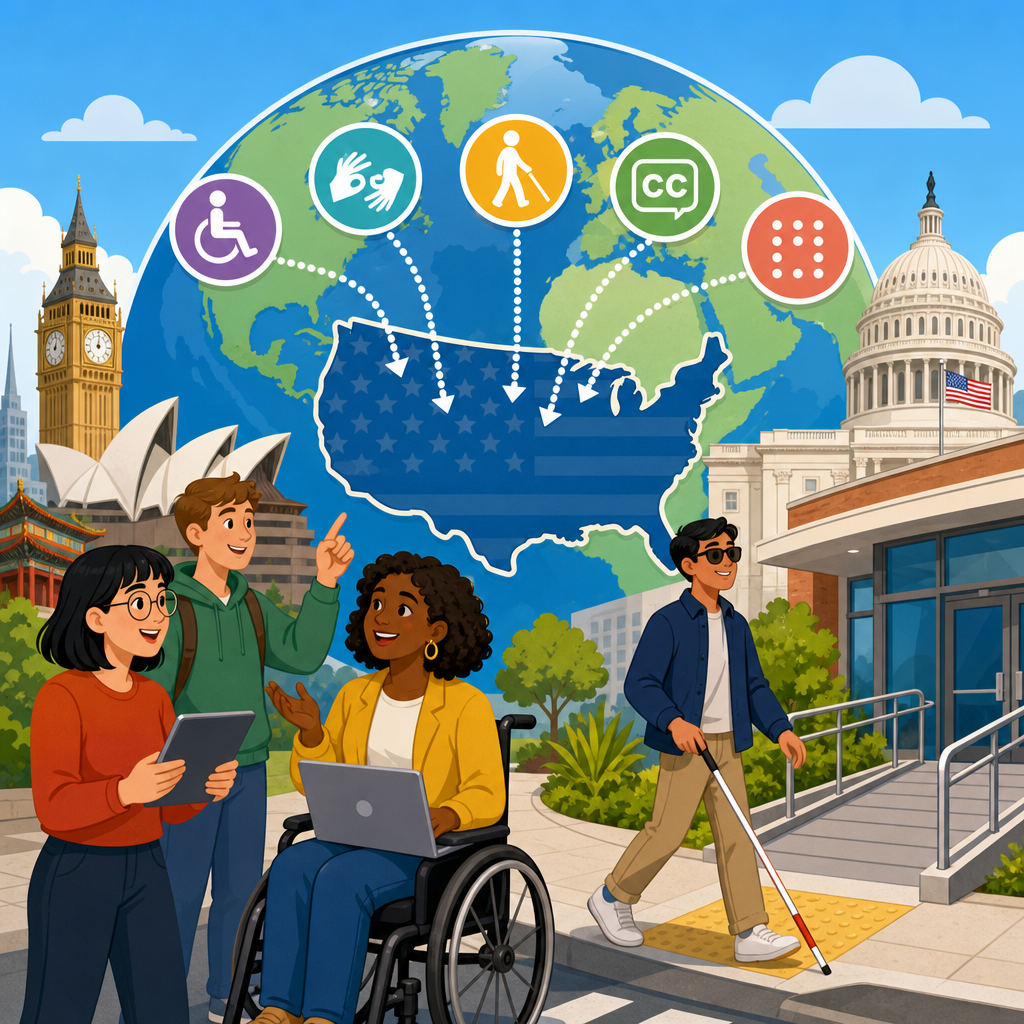
Accessibility practice in the United States is often described through domestic laws such as the Americans with Disabilities Act, Section 504, and Section 508, yet much of the field evolves through international accessibility standards, shared technical guidance, and cross-border design patterns. In day-to-day accessibility work, I have seen U.S. teams assume compliance starts and ends with American regulation, then discover that their procurement requirements, product roadmaps, and testing methods are already shaped by global frameworks. Understanding how international accessibility standards influence U.S. practice matters because digital products, buildings, transportation systems, documents, and customer service experiences rarely stay inside one jurisdiction for long. A software platform launched in California may be sold in Canada, the European Union, Japan, and Australia within months, and each market brings expectations that affect design decisions from the start.
At a basic level, accessibility standards are agreed technical or operational requirements intended to make environments, products, and services usable by people with disabilities. They can be legal standards, voluntary consensus standards, procurement specifications, design guidelines, or testing benchmarks. International innovations and strategies in accessibility include global web standards, harmonized procurement models, accessible design research, inclusive education methods, and transportation practices that migrate across borders. In the U.S., these influences appear in the language agencies use, the checkpoints auditors test, the captions procurement teams demand, and the way designers think about keyboard support, color contrast, plain language, document structure, and assistive technology compatibility. This article serves as a hub for the wider international perspective topic by explaining the major standards, where they come from, and how they shape practical U.S. decisions.
Several key terms help frame the discussion. Accessibility means people with disabilities can perceive, operate, understand, and robustly interact with a product, place, or service. Usability refers to how effectively and efficiently people can use it. Interoperability matters because accessibility often depends on software, hardware, and assistive technologies working together predictably. Harmonization means aligning standards across jurisdictions so organizations can meet multiple requirements with one implementation strategy. Conformance is the measurable act of meeting a defined standard, while compliance is the legal or contractual obligation attached to that conformance. These distinctions are not academic. They determine whether a U.S. team treats accessibility as a lawsuit defense, a procurement line item, or a durable quality discipline that scales across markets.
The U.S. accessibility landscape has never been isolated. Federal agencies rely on technical requirements influenced by international web standards. Universities compare their digital accessibility policies against global norms. Multinational employers import inclusive hiring and workplace accommodation practices proven abroad. Even when American law does not directly adopt an overseas rule, U.S. organizations still absorb the rule through vendors, platforms, contracts, and risk management. That is why accessibility leaders need an international lens. It reveals where requirements are heading, which design approaches are becoming baseline expectations, and how to build systems that remain usable and defensible as regulations change.
Global standards bodies and the frameworks U.S. teams use most
The strongest international influence on U.S. accessibility practice comes from standards bodies and collaborative technical organizations rather than from any single foreign law. The World Wide Web Consortium, or W3C, has had the clearest effect through the Web Content Accessibility Guidelines, known as WCAG. Although WCAG is not itself a U.S. statute, it is the benchmark most American organizations use for websites, mobile web experiences, web applications, and increasingly native apps. I have worked with legal, procurement, and engineering teams that spoke in domestic legal terms at the contract stage but switched immediately to WCAG success criteria when implementation began. That pattern is common because WCAG offers testable requirements where many laws remain broad.
Other global institutions matter as well. The International Organization for Standardization and the International Electrotechnical Commission develop standards that influence software quality, ergonomics, human-system interaction, and assistive technology compatibility. The International Telecommunication Union affects media accessibility and communications policy. Meanwhile, the European standard EN 301 549 has become highly influential because it translates accessibility requirements into procurement-ready language covering websites, software, documents, hardware, and support services. U.S. teams that sell to public sector buyers or enterprise clients often encounter expectations modeled on EN 301 549 even when the contract is domestic, because multinational vendors prefer one baseline across regions.
International accessibility standards influence U.S. practice in three recurring ways. First, they provide technical specificity that domestic law may lack. Second, they normalize common testing methods and documentation, such as accessibility conformance reports based on the Voluntary Product Accessibility Template, or VPAT. Third, they create market pressure. When a product team knows a feature must work in Europe, Canada, and the U.S., accessible design becomes the lower-friction path. In practice, multinational distribution has done as much to raise American accessibility maturity as litigation has.
How WCAG became the de facto technical language in the United States
WCAG is the clearest example of an international standard shaping American work at scale. Developed through the W3C with global participation, WCAG organizes accessibility around four principles: content must be perceivable, operable, understandable, and robust. Those principles translate into success criteria that cover text alternatives, keyboard access, focus order, error prevention, adaptable layouts, contrast, captions, semantics, and compatibility with assistive technologies. Section 508’s 2017 refresh explicitly incorporated WCAG 2.0 Level A and AA for federal information and communication technology, and that move cemented WCAG as the practical baseline far beyond government.
In private sector projects, WCAG now functions as the working definition of digital accessibility. Courts in the U.S. have not issued one universal technical rule for every website, but settlements, consent decrees, and remediation plans frequently point to WCAG 2.0 or 2.1 Level AA. That has made an international framework the everyday standard for American developers, designers, QA analysts, content authors, and procurement teams. A designer creating an e-commerce checkout in Texas may never mention international law, yet the requirements for labels, error identification, focus visibility, and screen reader announcements come directly from globally authored criteria.
The practical strength of WCAG lies in its portability. It gives U.S. organizations a common language for design reviews, bug triage, third-party audits, and internal policy. It also supports scalable testing. Automated tools such as axe, WAVE, Lighthouse, and Accessibility Insights can flag a portion of issues, while manual testing with NVDA, JAWS, VoiceOver, TalkBack, switch devices, zoom, and keyboard-only navigation validates real use. No serious accessibility program treats automation as sufficient, but international standardization has at least made tool outputs more comparable across teams and regions.
Procurement, policy, and product strategy shaped by cross-border requirements
One of the least visible but most powerful channels of influence is procurement. Public sector and enterprise buyers increasingly require vendors to document accessibility before purchase, and those requests often reflect international models. In the U.S., the VPAT format is common, but the criteria mapped inside the report are frequently WCAG and Section 508, and for global vendors the same product may also be mapped to EN 301 549. I have seen U.S. procurement teams adopt stricter review habits after comparing vendor responses prepared for European customers. The international market effectively raises the standard for everyone.
Cross-border policy also shapes product strategy. A U.S. software company deciding whether to build caption editing, scalable text, reduced motion settings, or accessible authentication may initially view these as optional enhancements. Once the company enters markets where procurement rules are explicit, those capabilities become competitive requirements. The same is true for document accessibility in PDF and Office files, support for real-time text in communications, and compatibility with braille displays. What starts as international readiness often becomes domestic best practice because the engineering investment is easier to justify when it supports multiple markets.
| International influence | How it appears in U.S. practice | Practical example |
|---|---|---|
| WCAG from W3C | Primary benchmark for web and app accessibility | Retail site adds keyboard support, alt text, and error identification to meet AA targets |
| EN 301 549 procurement model | Broader accessibility requirements in vendor reviews | SaaS buyer requests evidence for software, documents, and support channels |
| ISO and IEC ergonomics standards | Human-centered design and interoperability expectations | Hardware team tests tactile controls, reach ranges, and assistive technology compatibility |
| Global media accessibility practices | Captions, transcripts, and audio description become standard deliverables | Training library includes synchronized captions and descriptive narration |
This procurement effect reaches beyond government and large enterprise. Universities, healthcare systems, banks, and nonprofits often reuse contract language from major frameworks because it reduces ambiguity. As a result, even smaller U.S. organizations inherit international accessibility standards through templates, vendor questionnaires, and cyber-risk reviews. The lesson is straightforward: if an organization wants fewer surprises, it should treat accessibility as a product requirement from discovery onward, not as an audit step after launch.
International innovations in accessibility that U.S. organizations adopt
Standards matter, but innovation often travels through implementation examples rather than formal rules. Many U.S. organizations improve accessibility by studying what has worked abroad in transportation, public services, education, and digital government. European rail systems, for example, have influenced expectations around multimodal wayfinding, consistent visual contrast, tactile surfaces, audible announcements, and step-free route planning. Those ideas reappear in U.S. transit apps and station modernization projects, even though the legal structures differ. The innovation is not just the physical feature; it is the systems thinking that combines signage, mobile information, staff training, and maintenance.
Digital government provides another strong source of influence. Countries with centralized service design practices have demonstrated that accessibility improves when design systems, content rules, and component libraries are shared across agencies. U.S. teams increasingly follow that pattern by building accessible design systems with tested form fields, modal dialogs, accordions, navigation menus, and notification patterns. In my own work, reusable components have been the fastest way to reduce recurring defects because they convert accessibility from individual memory into institutional infrastructure. International examples strengthened that case by showing measurable gains in consistency and speed.
Education and workplace accessibility show similar cross-border exchange. Caption-first lecture workflows, accessible document governance, plain-language content standards, and remote interpreting models have all spread internationally. So have inclusive research methods that recruit participants with disabilities early instead of validating after release. U.S. teams that adopt these strategies usually find that accessibility defects decrease, support costs drop, and user satisfaction rises for broader groups, including older adults, people using mobile devices outdoors, and people navigating temporary impairments.
Where international influence creates tension, tradeoffs, and needed adaptation
International accessibility standards are not plug-and-play. U.S. practice still requires legal interpretation, budget prioritization, and adaptation to local infrastructure. One common tension is that standards describe what good outcomes look like but not always how to retrofit legacy systems affordably. A federal agency with a decades-old document archive, for example, cannot remediate everything at once. It needs triage rules, exception handling, and a content lifecycle plan. Global frameworks help define the target state, but implementation still depends on governance and resourcing.
Another tradeoff involves scope. WCAG is strong for digital interfaces, yet it does not answer every accessibility question about customer support, physical environments, or organizational process. That is why U.S. programs need layered governance: technical standards for products, operational standards for service delivery, and policy standards for accountability. There is also the issue of interpretation. Reasonable experts can disagree on whether a complex interaction pattern fully satisfies a criterion, especially in single-page applications, custom components, or emerging authentication flows. Teams need documented decision-making, not just checklist reading.
Language, culture, and disability expectations also matter. Plain language guidance that works in one country may need adjustment for U.S. reading patterns, legal terminology, or multilingual communities. Color symbolism, icon familiarity, and educational assumptions can shift across borders. The best U.S. accessibility programs use international standards as a baseline, then validate with disabled users in their own target populations. That is the difference between nominal conformance and reliable usability.
How to build a U.S. accessibility program with an international perspective
The most effective approach is to set one clear baseline, apply it consistently, and widen the lens beyond bare compliance. For most digital teams, that means adopting WCAG 2.2 Level AA as the default target unless a contract or regulation specifies otherwise. From there, build an operating model: procurement requirements, accessible design patterns, engineering standards, content rules, QA protocols, training, and executive reporting. Include accessibility in definition of done, release gates, and vendor onboarding. Require human testing for critical user journeys such as login, checkout, form submission, account management, video playback, and document download.
U.S. organizations should also monitor international developments because today’s external signal often becomes tomorrow’s domestic expectation. Watch updates from the W3C, revisions to EN 301 549, changes in Canadian and European public sector requirements, and emerging rules on accessible media, kiosks, and mobile authentication. Use those signals for roadmap planning instead of waiting for a complaint. A mature accessibility program does not chase standards reactively; it translates them into durable product quality.
This international perspective hub should guide the rest of your research. Explore detailed articles on global web standards, public procurement models, international accessible transportation strategies, cross-border document accessibility practices, inclusive research methods, and accessibility governance for multinational organizations. The core lesson is simple: international accessibility standards influence U.S. practice because markets, technologies, and user expectations are interconnected. Build with that reality in mind, audit against recognized benchmarks, and invest in systems that make accessibility repeatable. If you lead accessibility, product, procurement, or compliance work, use this hub as your starting point and turn global insight into better U.S. outcomes.
Frequently Asked Questions
1. Why do international accessibility standards matter in the United States if U.S. organizations already follow laws like the ADA, Section 504, and Section 508?
International accessibility standards matter in the United States because accessibility work rarely stays confined to one legal framework, one market, or one technical interpretation. U.S. laws such as the ADA, Section 504, and Section 508 are essential, but they do not function in isolation from the global accessibility ecosystem. In practice, many of the technical expectations U.S. teams rely on are shaped, clarified, or reinforced by international standards and guidance, especially when organizations build digital products, purchase software, work with multinational vendors, or serve audiences across borders.
For example, a U.S. company may believe it only needs to satisfy domestic legal obligations, but its product team may later discover that procurement documents, enterprise customer requirements, or platform-level accessibility expectations reference globally recognized criteria and testing approaches. This is common in software development, design systems, user experience research, and product governance. International standards help create a shared language for accessibility, which is especially valuable when products are designed in one country, engineered in another, and sold in many more.
These standards also influence what “good accessibility practice” looks like beyond the minimum text of a statute. U.S. laws often establish broad civil rights obligations or procurement requirements, while international standards provide the technical detail teams need to make practical decisions about design, development, testing, documentation, and quality assurance. That means U.S. practitioners frequently use international guidance to translate legal obligations into repeatable processes and measurable outcomes.
In short, international standards matter because they shape real-world implementation. They affect how teams write requirements, how vendors prove accessibility, how products are evaluated, and how organizations reduce risk while creating more usable experiences for people with disabilities.
2. Which international accessibility standards most commonly influence U.S. accessibility practice?
The most influential international accessibility standards in U.S. practice are typically the ones that provide broadly accepted technical criteria, testable requirements, and procurement-ready language. In many digital accessibility environments, the most recognizable benchmark is the Web Content Accessibility Guidelines, often used as the practical foundation for evaluating websites, web applications, mobile experiences, and digital documents. Although many U.S. professionals encounter accessibility through domestic law, the day-to-day technical work often revolves around standards and guidelines that are internationally recognized and widely adopted.
Another major influence comes from international standardization bodies and regional procurement frameworks that consolidate accessibility expectations into structured requirements. These resources matter because they help organizations compare products, define conformance expectations, and align teams that operate across multiple jurisdictions. In many cases, U.S. teams are not directly adopting a foreign legal regime; instead, they are borrowing or responding to a global technical baseline that has become standard in contracts, audits, and enterprise accessibility programs.
International standards also influence U.S. practice indirectly through vendors, consultants, platform providers, and testing tools. A design or development team may never formally say, “We are following an international standard,” yet still rely on components, issue taxonomies, audit methodologies, and remediation priorities shaped by those standards. This can be seen in how teams discuss keyboard access, color contrast, focus management, semantic structure, captions, alternative text, error identification, and compatibility with assistive technologies.
What makes these standards so important is not just their visibility, but their operational usefulness. They help U.S. organizations create accessibility requirements that are specific enough to build against, test against, and procure against. That consistency is one reason international standards have such a strong influence on U.S. accessibility work, even when the legal trigger is domestic.
3. How do international standards affect accessibility procurement and vendor management in the U.S.?
International standards have a major impact on accessibility procurement and vendor management in the United States because organizations need a consistent way to evaluate whether third-party products and services can meet accessibility expectations. When U.S. teams buy software, platforms, learning tools, enterprise systems, kiosks, documents, or digital services, they often need more than a general promise of accessibility. They need technical detail, evidence, and a structure for comparing one vendor’s claims to another’s. International standards help provide that structure.
In procurement, this influence often appears in requirements documents, accessibility questionnaires, contract language, and conformance reports. Even when a purchasing organization is focused on compliance with U.S. law, the criteria used to assess a product may come from internationally recognized accessibility guidance. That happens because legal obligations often need to be translated into testable product characteristics. Procurement teams, accessibility specialists, legal reviewers, and IT stakeholders all benefit from having a common framework for discussing what a product should do and how it will be assessed.
Vendor management is also shaped by these standards after the contract is signed. Organizations may ask vendors for remediation plans, test results, timelines, accessibility roadmaps, and evidence of ongoing quality controls. International standards make those conversations more precise. Instead of debating accessibility in purely general terms, teams can discuss specific barriers, measurable criteria, and expected fixes. This reduces ambiguity and improves accountability.
There is also a practical business reason for this global influence. Many vendors serve customers in multiple countries, so they often build their accessibility programs around standards that can support cross-market sales. U.S. buyers then encounter those same frameworks during evaluations. As a result, procurement and vendor governance in the United States are frequently shaped by international accessibility expectations, even when the buyer’s core obligations arise from domestic law.
4. Do international accessibility standards replace U.S. legal requirements?
No. International accessibility standards do not replace U.S. legal requirements, and that distinction is important. U.S. laws establish the legal obligations that organizations must follow in the American context, especially in areas such as non-discrimination, equal access, federally funded programs, and federal procurement. International standards, by contrast, usually serve as technical guidance, implementation benchmarks, or shared conformance references. They help organizations understand how to build and evaluate accessible experiences, but they are not automatically a substitute for legal compliance analysis.
In practice, the relationship is complementary rather than competitive. U.S. legal frameworks often define the obligation at a high level, while international standards help teams operationalize that obligation in design, code, testing, and documentation. That is why many organizations use international standards to support compliance efforts: they offer specificity where laws may be broad, principles-based, or context dependent. But using a standard does not end the legal conversation. Organizations still need to consider how courts, agencies, contracts, and sector-specific rules apply to their particular products, services, and audiences.
This matters because legal compliance is rarely achieved by checklist alone. A product could align with many technical criteria and still create barriers in actual use, or it could satisfy a standard in a limited way while failing to meet broader obligations around effective communication, equal participation, or reasonable accommodation. On the other hand, organizations that ignore international standards often make implementation much harder because they lose access to a mature body of shared technical practice.
The best approach is to understand international standards as tools that strengthen U.S. accessibility practice. They are highly influential and often indispensable, but they work alongside legal analysis, governance, user testing, and organizational accountability rather than replacing them.
5. What should U.S. accessibility teams do to align their work with both domestic requirements and international standards?
U.S. accessibility teams should start by recognizing that strong accessibility practice requires both legal awareness and technical maturity. A useful first step is to map the organization’s obligations and risks: what laws apply, what products or services are in scope, what customer commitments exist, and what procurement or partnership requirements may introduce international accessibility expectations. This creates a more realistic picture than assuming domestic regulation alone defines the work.
From there, teams should establish a clear accessibility baseline for design, development, content creation, testing, and procurement. In many organizations, that means adopting a recognized technical standard as the operational benchmark while also documenting how internal policies address applicable U.S. legal duties. This alignment should show up in product requirements, design reviews, issue tracking, component libraries, quality assurance processes, and release criteria. Accessibility works best when it is built into the product lifecycle rather than treated as a final compliance check.
Teams should also strengthen cross-functional coordination. Accessibility is influenced by legal, procurement, UX, engineering, content, product management, security, and customer support. International standards are especially helpful here because they provide a common vocabulary across disciplines. When everyone uses the same reference points for keyboard access, structure, labeling, contrast, focus, media alternatives, and error handling, collaboration becomes more effective and remediation becomes easier to prioritize.
Another important step is to validate technical conformance with real-world usability. Standards are necessary, but they are not a complete substitute for testing with assistive technologies and, ideally, with disabled users. U.S. teams that combine standard-based evaluation with practical usability feedback usually make better decisions and reduce the chance of overlooking significant barriers.
Finally, accessibility teams should treat this area as ongoing practice, not static compliance. International standards evolve, platform conventions change, user expectations grow, and procurement demands become more sophisticated. The organizations that adapt well are the ones that build repeatable governance, maintain internal expertise, monitor updates, and use international accessibility standards as part of a broader strategy for inclusive, legally informed, high