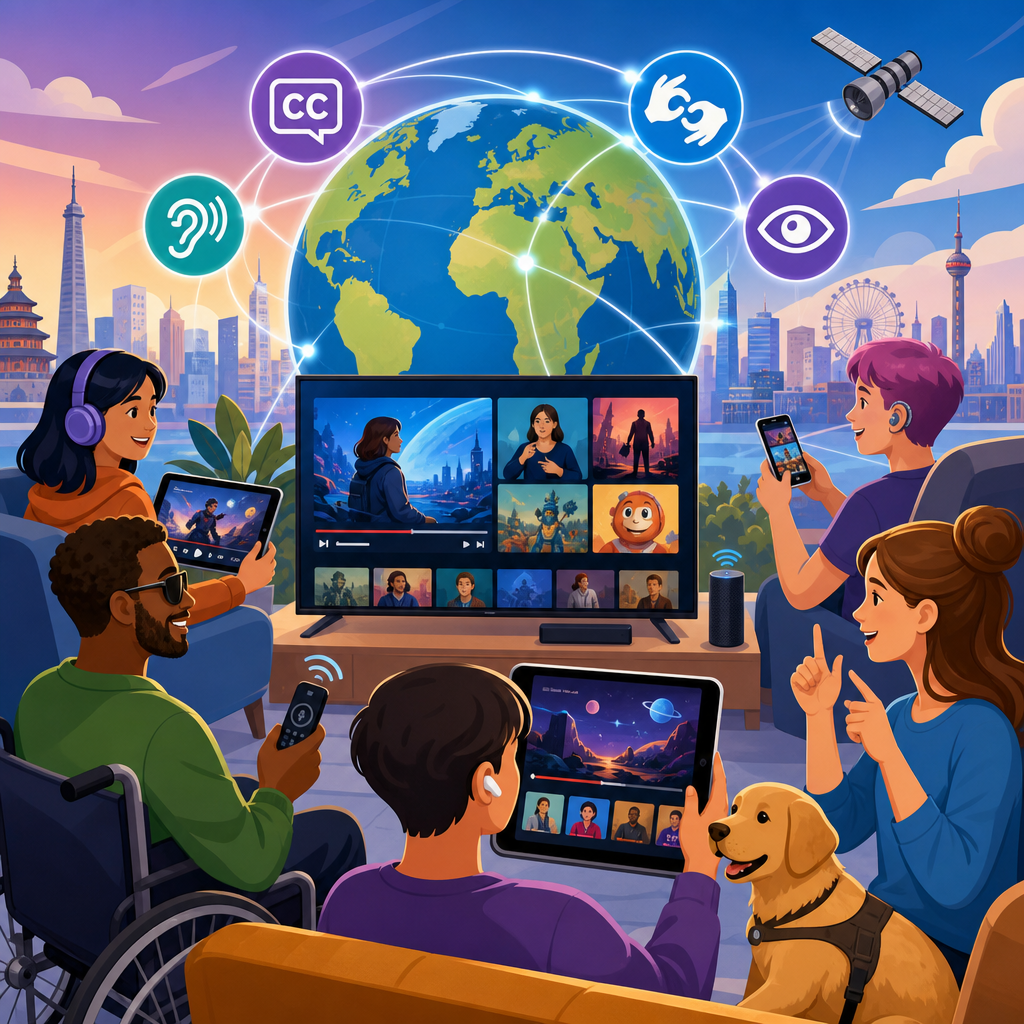
Accessible media and streaming are moving from niche compliance concerns to central features of global entertainment, public communication, and digital rights. In practical terms, accessible media means film, television, live video, podcasts, gaming streams, and educational content designed so people with disabilities can perceive, understand, and enjoy them with comparable independence. That includes captions for deaf and hard of hearing viewers, audio description for blind and low vision audiences, sign language interpretation, accessible players, keyboard navigation, screen reader compatibility, clear language, and adaptable interfaces. Streaming refers to on-demand and live delivery over the internet, now the dominant distribution model in most major markets and an increasingly important route in emerging ones.
This topic matters because media access shapes civic participation, culture, education, and employment. Over the last decade, I have watched platform teams treat accessibility as an afterthought, then scramble when regulations, user pressure, and market expansion made that approach untenable. Global audiences now expect accessibility by default, not as a premium add-on or a hidden setting. At the same time, disability rights frameworks have matured. The United Nations Convention on the Rights of Persons with Disabilities established access to information and cultural life as rights, and many national laws increasingly apply those principles to digital media distribution. The result is a structural shift: accessibility is becoming part of international media strategy, procurement, product design, and content operations.
Future international trends in accessible media and streaming are being shaped by four forces at once: regulation, technology, localization, and audience power. Services expanding across borders cannot rely on one-country standards because legal obligations differ between the European Union, the United States, Canada, Australia, India, Japan, Latin America, and African markets. Yet there is convergence around recognizable benchmarks such as WCAG for digital interfaces, interoperability with assistive technology, and measurable service quality for captions and descriptions. The best global operators are no longer asking whether accessibility is required. They are asking how to scale high-quality access features across dozens of languages, rights windows, device types, and content formats without degrading user experience or production speed.
Accessibility is becoming a global baseline for media rights
The first major trend is simple: accessibility is moving from voluntary best practice to expected baseline. Laws are a driver, but not the only one. Public broadcasters, global subscription platforms, sports streamers, ministries of education, and social video platforms are all under pressure from disability organizations, investors, advertisers, and users. In Europe, the European Accessibility Act is pushing digital services toward more consistent expectations for consumer-facing products and services. In the United States, the Americans with Disabilities Act, the 21st Century Communications and Video Accessibility Act, and Federal Communications Commission rules continue to shape obligations around captioning and video access. Canada’s Accessible Canada Act and provincial requirements add another layer. These frameworks differ, but together they send a clear signal: media access is not optional.
That baseline is expanding beyond traditional television rules. Historically, many obligations focused on broadcast caption quotas or limited categories of programming. Streaming changed the equation because libraries are global, interfaces are software-driven, and viewers expect parity across smart TVs, phones, tablets, web players, and game consoles. A platform that offers captions on web but not on connected television creates a real access gap. A service that produces audio description in English but neglects Spanish, French, Hindi, or Arabic limits reach in multilingual markets. Future leaders will treat accessibility as a distribution requirement attached to every asset, metadata set, and playback environment.
Interface accessibility will matter as much as content accessibility
A second trend is the recognition that accessible content fails if the product experience is inaccessible. I have seen platforms proudly launch captioned originals while basic tasks like searching, activating subtitles, changing playback speed, or managing profiles remained difficult with a screen reader or keyboard. That disconnect is disappearing. International streaming growth now depends on mature accessibility across apps, websites, billing flows, recommendation modules, and customer support channels. WCAG 2.2 success criteria, semantic structure, focus visibility, contrast, error prevention, and clear labeling are no longer edge concerns. They directly affect retention and customer satisfaction.
Voice interfaces and remote-control navigation will also become more important. Many users access streaming primarily through televisions, where input constraints are different from mobile or desktop. Accessible future design means fewer hidden controls, consistent menu placement, larger hit areas, readable time bars, and support for platform-level assistive technologies such as VoiceOver, TalkBack, Android TV accessibility features, Apple TV screen reader support, and smart TV magnification options. For global services, testing cannot stop at one flagship device. Real accessibility requires device matrices, assistive technology compatibility testing, and region-specific user research because affordable hardware in one market may behave very differently from premium devices in another.
AI will accelerate access features, but quality control will decide trust
Artificial intelligence is transforming how captions, subtitles, dubbing, transcripts, and audio description are produced, but the future will favor hybrid models rather than fully automated pipelines. Automatic speech recognition has already cut turnaround times for live captions and post-production transcripts. Machine translation can speed subtitle localization. Synthetic voices can make some descriptive workflows faster. However, automated outputs still fail on speaker identification, overlapping dialogue, tone, sarcasm, proper nouns, dialect, and culturally specific references. In accessibility work, those errors are not cosmetic. They can distort plot, erase context, or make fast-moving live events unusable.
The likely international standard is human-supervised automation. In sports, live news, and parliamentary streams, AI-assisted captioning will remain essential because of time pressure, but trusted providers will layer in trained respeakers, editors, and latency management. For scripted entertainment, AI may handle first-pass timing and segmentation while human linguists refine readability, line breaks, and audience suitability. Audio description will also use AI for shot detection, object recognition, and draft suggestions, yet human describers will remain critical for narrative judgment: what matters in a scene, what can fit between dialogue, and what should be left for the audience to infer. Platforms that over-automate without disclosure will face user backlash and possible regulatory attention.
| Access feature | What AI improves | Where human review remains essential | International implication |
|---|---|---|---|
| Captions | Speed, draft creation, live transcription | Accuracy, speaker labels, sound cues, timing | Needed for multilingual live events and archives |
| Subtitles | Machine translation and template reuse | Idioms, reading speed, cultural adaptation | Critical for cross-border catalog growth |
| Audio description | Scene detection and draft prompts | Narrative relevance, tone, concise writing | Quality varies sharply by language market |
| Sign language video | Scheduling and asset management support | Performance, regional sign variation, trust | Requires local language community input |
Localization will shift from translation to disability-inclusive cultural adaptation
One of the most important future international trends in accessible media and streaming is deeper localization. Accessibility is often discussed as if one caption file or one audio description track can serve everyone. In reality, access preferences are shaped by language, literacy, local regulation, education systems, and disability culture. Closed captions in the United States are not identical to subtitles for the deaf and hard of hearing in the United Kingdom. Sign languages are distinct languages, not universal gestures. Reading speed tolerances vary by market. The treatment of honorifics, songs, profanity, and on-screen text also differs. Global services that ignore these differences produce technically available but functionally weak access.
Future-ready operations will build regional expertise into commissioning and quality assurance. That means working with local disabled creators, translators, caption editors, and advocacy groups, not just exporting a central template from Los Angeles or London. A Korean drama distributed in Brazil may require more than Portuguese subtitles; it may need adapted subtitle density, localized sound effect conventions, and audio description choices that align with Brazilian audience expectations. An Indian educational platform serving multiple states may need captions, transcripts, and Indian Sign Language support, plus low-bandwidth delivery for rural users. Accessibility at scale is therefore not just language management. It is cultural operations management.
Disability representation will influence product strategy, not only programming
Another trend is the growing connection between accessible media and disability representation. For years, companies separated the two: one team handled compliance, another handled diversity in storytelling. That separation is breaking down. When disabled people appear on screen, work in production, advise on scripts, test products, and shape policy, accessibility improves in measurable ways. I have seen content teams commission better audio description because blind consultants were involved early. I have seen player redesigns improve because deaf users highlighted how buried subtitle settings created friction. Representation changes decision quality because it brings lived experience into product and editorial systems.
This matters globally because disability is not experienced identically across countries. Infrastructure, stigma, education, and assistive technology availability differ widely. A European platform entering Southeast Asia or Africa cannot assume the same user needs, broadband conditions, or support ecosystems. The future hub for global accessibility and disability rights will therefore center disabled participation at every layer: research, procurement, vendor evaluation, commissioning briefs, usability testing, and complaint resolution. Services that build these feedback loops will outperform those that treat disability solely as a legal checkbox.
Live streaming, sports, and events are the next major access battleground
On-demand libraries have improved faster than live content, but future gains will come from live streaming, where access is harder and stakes are higher. News, elections, sports, concerts, esports, and emergency briefings demand low latency, high reliability, and multilingual support. Captions that arrive fifteen seconds late can ruin a football match and weaken understanding during a public health announcement. Audio description for live sports requires preparation, trained commentators, and coordination with production teams. Sign language interpretation for live government streams requires dedicated screen space, camera framing, and platform support so the interpreter remains visible on all devices.
International examples already show the direction of travel. Major sporting events such as the Paralympic Games have raised expectations for inclusive broadcasting. Public health crises exposed the value of sign language interpretation and plain-language communication. Elections in several countries triggered criticism when debates streamed without reliable captions. The next phase will include service-level metrics: caption latency targets, completeness rates, audio description availability by event type, and transparent accessibility status pages during live incidents. Platforms that publish these metrics will build more trust than those that hide behind vague promises.
Procurement, metadata, and rights management will become core accessibility infrastructure
The least visible but most consequential trend is operational. Accessible media at international scale depends on procurement language, metadata discipline, and rights management. If contracts do not require caption files, description scripts, timed text formats, language variants, and edit updates, access assets go missing. If metadata does not clearly identify whether a title includes SDH, closed captions, audio description, sign language, or transcript availability by territory and device, users cannot discover what they need. If rights systems separate content from access assets during regional licensing, a platform may legally stream a show in twenty markets while accidentally stripping out the description track.
Leading organizations are solving this with delivery specifications, automated validation, and accessibility checkpoints in content operations. Common formats such as WebVTT, TTML, IMSC, and SRT matter because interoperability affects whether features render correctly across platforms. Media supply chains increasingly include caption quality reviews, player conformance testing, and packaging standards for OTT delivery. For executives, the lesson is blunt: accessibility quality is often determined months before release, when contracts, workflows, and asset schemas are set. Fixing it at launch is expensive and usually incomplete.
The future of global accessibility and disability rights depends on enforcement and public expectation
Technology alone will not deliver equitable access. The future of global accessibility and disability rights in media depends on enforcement, public expectation, and sustained pressure from disabled communities. Rights are strongest when they can be measured, compared, and challenged. Regulators need clear rules. Platforms need transparent reporting. Users need usable complaint channels and fast remediation paths. Advocacy groups need data on feature availability, accuracy, and consistency. Without these mechanisms, accessibility can regress quietly when budgets tighten or catalogs expand too quickly.
The strongest long-term outlook combines legal duty with competitive advantage. Accessible media expands audience reach, improves search and discoverability through transcripts and structured metadata, supports language learners and aging populations, and reduces friction for everyone in noisy, mobile, or low-attention environments. More importantly, it affirms that culture and information belong to all audiences. If you manage content, product, policy, or procurement in international media, make accessibility a release criterion, a contract requirement, and a measurable service standard now. The platforms that do this well will define the next era of streaming.
Frequently Asked Questions
What are the biggest international trends shaping the future of accessible media and streaming?
The biggest global trend is that accessibility is no longer being treated as a narrow legal checkbox. It is becoming a standard expectation across entertainment, education, public communication, and digital platforms. Streaming services, broadcasters, social video networks, and live event producers are increasingly expected to provide captions, subtitles, audio description, accessible interfaces, and screen reader compatibility as part of the core user experience rather than as optional add-ons. This shift is happening because audiences are more aware of digital inclusion, governments are modernizing accessibility laws, and media companies are recognizing that accessible design improves reach, retention, and user satisfaction across many demographics.
Another major trend is the globalization of accessibility standards. International markets are moving toward more consistent expectations around caption quality, multilingual subtitling, audio description workflows, and accessible player design. While regulations still vary by country, there is growing alignment around principles such as equivalent access, usability, and independence for disabled audiences. This means media organizations are increasingly building accessibility into production pipelines from the beginning so content can scale across regions without requiring costly retrofits. As cross-border streaming expands, accessibility is becoming a competitive advantage as well as a compliance requirement.
Technology is also accelerating progress. Artificial intelligence is improving speech-to-text captioning, live transcription, voice navigation, and metadata tagging, while human review remains essential for accuracy, timing, tone, and cultural nuance. In parallel, user personalization is becoming more important. Viewers increasingly expect to adjust caption appearance, choose different audio tracks, navigate with keyboard or assistive technology, and access content across mobile, smart TV, web, and gaming environments without barriers. Taken together, these trends point to a future where accessible media is embedded into platform strategy, content licensing, and audience development worldwide.
How will captions, subtitles, and audio description evolve in international streaming markets?
Captions, subtitles, and audio description are expected to become more available, more customizable, and more integrated into global distribution models. In the past, accessibility features were often inconsistent across titles, languages, and devices. Going forward, streaming platforms are investing in infrastructure that allows these features to travel with the content more reliably across territories. That means a larger share of films, series, documentaries, live streams, and educational media will launch with accessibility elements already prepared for multiple markets instead of being added later only when required.
Captions themselves are likely to become more sophisticated. Beyond basic transcription, high-quality captions increasingly reflect speaker identification, sound effects, music cues, tone, and timing that supports understanding for deaf and hard of hearing audiences. At the same time, platforms are giving users more control over caption size, color, background, and placement, which helps people with low vision, cognitive disabilities, language processing differences, and diverse viewing conditions. Subtitles are also evolving as global audiences consume more cross-border content. Services are being pushed to distinguish clearly between translation subtitles and accessibility-focused captions so users can choose the option that best fits their needs.
Audio description is also gaining momentum internationally, especially as more regulators, disability advocates, and mainstream audiences recognize its value. Better production workflows now allow description tracks to be scripted and recorded earlier, making them more natural and better synchronized with the creative intent of the work. In some markets, AI may help identify visual elements or draft description support materials, but skilled human describers will remain central because strong audio description depends on judgment, pacing, narrative awareness, and respect for genre. The future is not just more accessibility tracks, but better quality, wider language coverage, and more consistent availability across every screen and region.
What role will AI and automation play in making media and streaming more accessible worldwide?
AI and automation will play a very important role, but they will work best as part of a human-guided accessibility strategy rather than as a complete replacement for expert oversight. One of the clearest benefits is speed and scale. Automated speech recognition can generate first-pass captions, live event transcripts, and searchable media archives much faster than traditional manual processes alone. Machine translation can also help expand subtitle access across languages, while AI-assisted tools can support audio description drafting, content tagging, scene analysis, and interface personalization. For fast-moving global platforms, these efficiencies are significant.
However, accessibility is not just a technical output. It is also about clarity, usability, context, and dignity. Automated captions can still struggle with accents, multiple speakers, background noise, comedy timing, specialist vocabulary, and emotional nuance. Machine-translated subtitles may miss idioms or cultural meaning. AI-generated description may identify objects in a scene without understanding what matters narratively. That is why the strongest future model is likely to be hybrid: automation handles repetitive tasks and increases baseline coverage, while trained editors, captioners, describers, localization specialists, and disabled testers ensure quality and relevance.
AI will also influence accessibility beyond media files themselves. It can improve voice search, recommend accessible content, adapt interfaces to user preferences, and support real-time communication in live events and social streaming. Viewers may increasingly see personalized accessibility settings that follow them across devices, such as preferred caption styling or audio navigation options. Still, trust will depend on transparency. Platforms that clearly explain how accessibility features are created, reviewed, and improved will be better positioned to serve international audiences responsibly. In short, AI is likely to expand access dramatically, but human expertise will remain essential to making that access meaningful.
Why is accessibility becoming a strategic priority for global streaming platforms instead of just a compliance issue?
Accessibility is becoming a strategic priority because it directly affects audience growth, brand reputation, content discoverability, and long-term platform value. Globally, hundreds of millions of people live with disabilities, and many more benefit from accessible features in everyday situations, such as watching video in noisy environments, learning in a second language, or navigating content while multitasking. Captions, audio description, transcripts, and accessible controls improve usability for a much broader audience than many companies once assumed. As competition in streaming intensifies, platforms are looking for ways to reduce friction and keep viewers engaged, and accessibility is one of the clearest ways to do that.
There is also a strong business case tied to international expansion. When a platform enters new markets, accessible content and interfaces help it serve diverse user populations more effectively from day one. Accessibility supports localization, educational partnerships, public sector contracts, and reputation with regulators and advocacy groups. It can also reduce operational inefficiencies over time. If accessibility is built into commissioning, production, post-production, and publishing workflows, companies avoid the repeated expense of retrofitting content after release. That operational maturity matters for global libraries containing thousands of titles and live streams.
Just as importantly, accessibility now shapes public trust. Audiences increasingly expect media companies to reflect social responsibility and inclusive design in visible, measurable ways. A platform that offers strong captions, reliable description, keyboard navigation, and compatibility with assistive technologies signals that it takes all viewers seriously. This is especially relevant for news, public information, cultural programming, and educational content, where inaccessible media can limit civic participation and equal opportunity. So while compliance remains important, the larger story is that accessibility now influences market reach, user loyalty, and the legitimacy of digital media brands on a global stage.
What should media companies, creators, and streaming services do now to prepare for the future of accessible media internationally?
The most important step is to move accessibility upstream. Instead of treating it as a final technical layer, organizations should plan for it from concept development through distribution. That means writing with captioning and description in mind, capturing clean audio, designing visual storytelling that can be described effectively, and choosing production tools that support accessible outputs across formats and languages. Platforms should also audit their media players, apps, websites, and smart TV experiences to ensure they work with screen readers, keyboard controls, contrast settings, and other assistive technologies. The future belongs to organizations that treat accessibility as a system, not a side project.
Companies should also invest in quality standards and real user testing. International accessibility is not only about whether a caption file exists or whether an audio description track has been uploaded. It is about whether those features are accurate, understandable, easy to activate, and available consistently across devices and territories. Working with disabled users, accessibility specialists, and local language experts helps companies identify barriers that internal teams may miss. This is particularly important for live streaming, multilingual releases, educational media, and user-generated content environments where speed can compromise quality if workflows are not mature.
Finally, organizations should prepare for a future in which accessible media is measured, reported, and expected by partners and audiences alike. That means tracking coverage rates, quality metrics, turnaround times, and feature availability by region and platform. It also means training editorial, engineering, design, legal, and product teams so accessibility is shared across departments. Media companies that act now can position themselves ahead of regulatory change, improve global audience trust, and create content experiences that are genuinely more inclusive. In practical terms, the best preparation is simple: build accessibility into strategy, budget, technology, and culture before international expectations make it unavoidable.