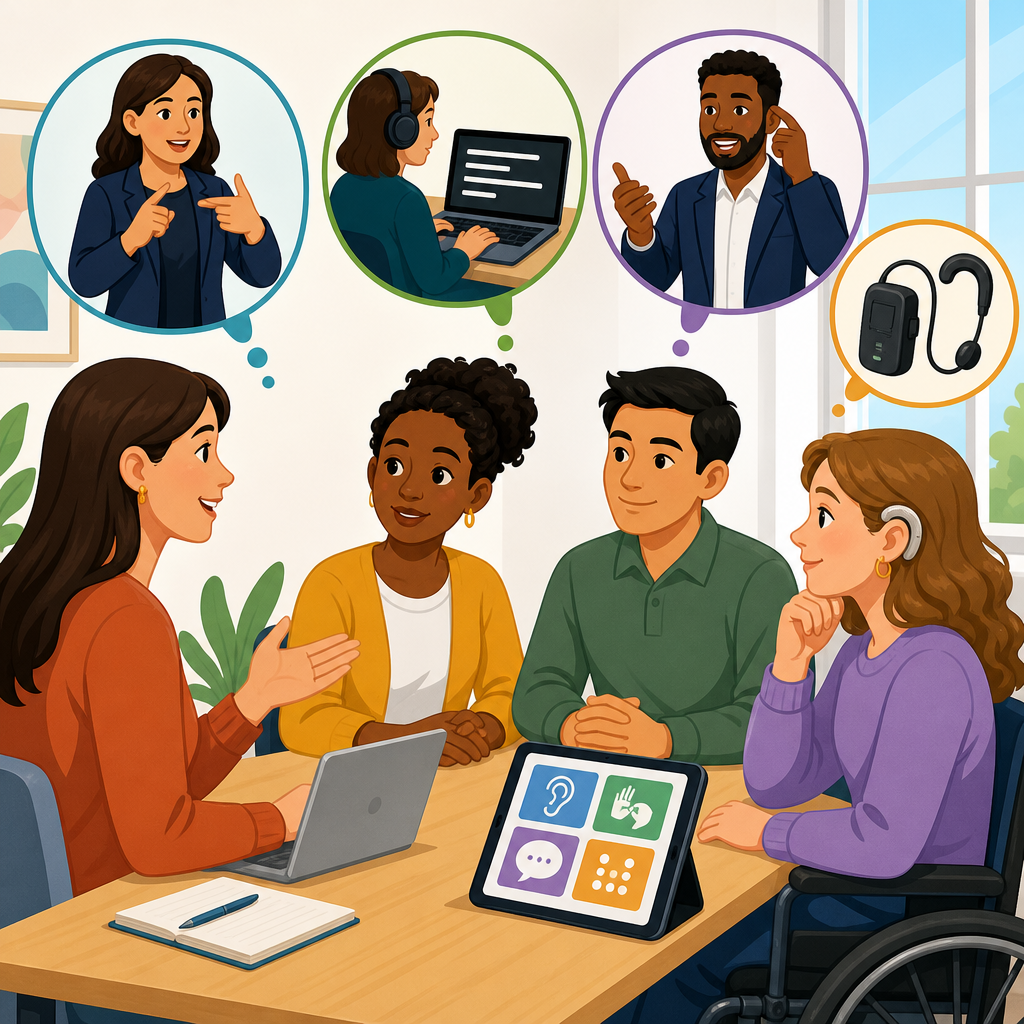
An effective communication policy tells an organization when it must provide interpreters, CART, captioning, plain language materials, assistive listening systems, or other communication aids so people with disabilities can receive information as accurately, promptly, and privately as everyone else. In practice, this policy sits at the center of compliance and implementation because communication failures trigger many of the complaints, investigations, and corrective action plans that follow. I have helped organizations rewrite these policies after avoidable breakdowns in clinics, schools, housing offices, and public meetings, and the pattern is consistent: staff members mean well, but without a clear rule set they guess, delay, or default to whatever seems easiest. That creates legal exposure, operational confusion, and most importantly unequal access.
Key terms matter. Effective communication means the person with a disability can understand and participate in the interaction. Auxiliary aids and services include qualified sign language interpreters, tactile interpreters, real-time captioning known as CART, written notes, accessible electronic documents, audio description, screen-reader compatible forms, assistive listening devices, and speech-to-speech relay support. A qualified interpreter is not simply someone who knows some signs; qualification depends on the ability to interpret effectively, accurately, and impartially, using any necessary specialized vocabulary. CART, or Communication Access Realtime Translation, converts spoken content into live text, often displayed on a screen or personal device, and it is especially useful for meetings, classes, training sessions, and events with technical language.
This subject matters because communication access is both a civil rights obligation and a quality control issue. Title II and Title III of the Americans with Disabilities Act, Section 504 of the Rehabilitation Act, Section 1557 in health programs receiving federal financial assistance, and parallel state and local laws all shape expectations. The exact rule may vary by setting, but the operating principle is stable: the organization must assess the communication context and provide appropriate aids unless doing so would fundamentally alter the service or impose an undue burden, and even then it must look for an effective alternative. A strong policy therefore does more than list devices. It assigns responsibility, explains the decision process, defines complaint routes, documents exceptions, and requires corrective action when practice fails. As a hub topic, Policies, Complaints & Corrective Action starts here, because every downstream procedure depends on this policy being specific, usable, and enforced.
What an effective communication policy must cover
The best policies answer frontline questions before they arise. Who can approve an interpreter? How fast must staff act? Can a family member interpret? What happens during an emergency? A complete policy should begin with scope. It should state which programs, services, meetings, websites, forms, videos, kiosks, call centers, and contracted activities are covered. It should apply to patients, customers, students, parents, companions where legally required, job applicants, and members of the public attending events or hearings. If vendors operate on the organization’s behalf, the policy should require equivalent access standards in contracts, service level agreements, and procurement specifications.
Next, the policy should identify available aids and the factors used to select them. These factors usually include the person’s preferred method of communication, the length and complexity of the interaction, the importance of the information, privacy concerns, the communication setting, and whether the exchange is scheduled or spontaneous. For example, a brief retail transaction may be handled effectively with written notes or a speech-to-text app, while a medical informed consent discussion about surgery generally requires a qualified interpreter or high-quality remote interpreting if on-site coverage is unavailable. A housing grievance hearing with witness testimony may call for both an interpreter and CART, especially if multiple speakers are involved.
Finally, the policy should establish roles. In well-run systems, frontline staff identify needs and escalate immediately; supervisors approve routine requests without delay; an accessibility coordinator manages complex situations, vendors, and complaint trends; information technology handles accessible digital content; procurement validates vendor capabilities; and legal or compliance reviews denials and hardship claims. That structure prevents the common failure where everyone assumes someone else is handling the request.
When to offer interpreters, CART, or other aids
The direct answer is simple: offer the aid when it is necessary for effective communication in that context, and do so early enough for the aid to be useful. The harder part is determining necessity. In my experience, organizations improve fastest when they stop treating access requests as exceptions and instead use a decision standard. Ask four questions. What is the communication task? How complex or lengthy is it? What does the person say works best? What risks arise if communication is inaccurate, delayed, or incomplete?
Qualified interpreters are typically appropriate for conversations that are interactive, nuanced, high stakes, or emotionally charged. Examples include intake interviews, disciplinary meetings, legal consultations, classroom lectures with active discussion, medical diagnosis, informed consent, mental health treatment, emergency briefings, and public hearings. CART is often the strongest option when the user relies on text rather than sign language, when many people will speak, or when a transcript supports later review. Open or closed captions are essential for prerecorded and live video where speech content matters. Assistive listening systems help people who use hearing aids or cochlear implants in lecture halls, courtrooms, worship spaces, and conference rooms. Accessible electronic documents, large print, Braille, and plain language versions become critical when the communication is document-heavy, deadline-sensitive, or rights-related.
Organizations should not assume one aid fits every deaf or hard of hearing person. Some people use American Sign Language, some prefer Signed Exact English, some use spoken language with amplification, some rely on lip reading, and many combine methods depending on fatigue, acoustics, and subject matter. The same principle applies to people with vision, speech, cognitive, or manual dexterity disabilities. Effective communication depends on the match between the person, the content, and the setting.
| Situation | Usually Appropriate Aid | Why |
|---|---|---|
| Medical informed consent discussion | Qualified interpreter or qualified VRI; accessible written materials | Complex, interactive, high risk, privacy sensitive |
| Large training with multiple speakers | CART plus microphones and captions for recordings | Fast pace, technical content, many voices |
| Brief service desk transaction | Written notes, speech-to-text app, assistive listening device | Short, low complexity, immediate response needed |
| Public hearing or board meeting | Interpreter, CART, accessible agenda and minutes | Public participation, formal record, varied speakers |
| Website instructions and forms | Screen-reader compatible files, alt text, plain language, captions | Independent access outside business hours |
Requests, interactive assessment, and documentation
A sound policy makes requesting aids easy. People should be able to request accommodations by phone, email, web form, in person, or through relay services. Notices should appear on websites, appointment confirmations, event registrations, printed forms, and lobby signage. The request pathway must identify a response time, such as same day for urgent service needs and several business days for scheduled events. Requiring excessive paperwork is a mistake. Most requests can be resolved through a short interactive assessment documented in the case record or event file.
That assessment should capture the requested aid, the communication context, any time constraints, and the final plan. If the preferred aid cannot be provided, the record should explain why and what equally effective alternative was arranged. Documentation protects both access and compliance. It lets managers audit patterns, confirm that vendors showed up, and identify departments with repeat failures. It also gives complaint investigators facts rather than conflicting memories. I recommend tracking no-show rates, fulfillment times, denials, and situations where staff substituted a lesser aid. Those metrics reveal whether the written policy is functioning operationally.
Privacy belongs in this section. Staff should record only what they need to arrange access, not unnecessary medical details. If the communication involves health, discipline, benefits, immigration, or legal rights, confidentiality rules become stricter. The policy should state plainly that aids must preserve privacy to the maximum extent possible. That is one reason family members, friends, and minor children generally should not be used as interpreters except in narrowly defined emergencies or when the individual specifically requests it and reliance is appropriate under the circumstances.
Complaints, investigations, and corrective action
Because this page anchors Policies, Complaints & Corrective Action, the complaint system deserves equal weight with the access rules themselves. Every effective communication policy should include a clear grievance route that is separate from frontline service channels. People need to know where to complain if an interpreter was refused, captions were inaccurate, staff relied on a relative, or materials were inaccessible. The process should allow complaints in accessible formats and should not require legal language. Acknowledge receipt, set investigation timelines, interview relevant staff, preserve scheduling and vendor records, and communicate the outcome in an accessible format.
Investigations should focus on root cause, not just the single incident. Was there a scheduling gap after business hours? Did a supervisor misunderstand who pays? Did procurement choose a vendor without healthcare vocabulary or educational captioning experience? Did staff not know that communication with companions may also require aids in healthcare settings? Corrective action should match the failure. Possible steps include staff retraining, script updates, vendor replacement, budget adjustments, workflow changes in electronic scheduling systems, signage revisions, disciplinary action for repeated noncompliance, and follow-up monitoring for a defined period.
When regulators review these matters, they look for evidence that the organization took the complaint seriously and fixed the system. The Department of Justice has repeatedly emphasized individualized assessment and appropriate auxiliary aids, while the Department of Health and Human Services has enforced communication access in health settings. Courts also examine whether delays themselves denied access. A flawless policy on paper is not enough. If requests routinely stall until the appointment is over, the organization is not communicating effectively.
Implementation, training, and continuous improvement
Implementation is where most policies succeed or fail. Start with training tailored to roles. Front desk staff need scripts for identifying requests and avoiding prohibited shortcuts. Managers need approval rules and escalation steps. Clinicians, faculty, investigators, and hearing officers need scenario-based training on selecting aids for high-stakes communication. Information technology teams need standards for accessible PDFs, captioning workflows, and platform compatibility with screen readers and keyboard navigation. Security and emergency teams need procedures for evacuations, alerts, and shelter communication.
Budgeting should be centralized whenever possible. When departments must absorb interpreter or captioning costs individually, they often delay or discourage requests. Central funding supports consistency and reduces unlawful denials driven by local budget pressure. Vendor management also matters. Use qualified providers, verify credentials where relevant, test remote interpreting platforms, and maintain backup options for evenings, weekends, and emergencies. For digital communication, align internal standards with WCAG, use accessibility checkers in Microsoft Office and Adobe Acrobat, and test key user journeys with assistive technology rather than relying only on automated scans.
Continuous improvement closes the loop. Review complaint data quarterly. Audit a sample of appointments, classes, meetings, and public events. Ask users whether the aid was timely and effective, not merely whether something was provided. Then update the policy as technology, law, and service models change. If your organization operates under the Compliance and Implementation topic, make this page the operating hub: link it to procedures for request intake, vendor procurement, grievance handling, staff discipline, website accessibility, event planning, and corrective action tracking. Effective communication is not a courtesy add-on. It is a measurable operational standard. Review your policy now, test it against real scenarios, and fix the gaps before the next complaint exposes them.
Frequently Asked Questions
What is an effective communication policy, and why is it so important?
An effective communication policy is a written framework that explains how an organization will ensure people with disabilities can receive, understand, and share information as effectively as others. In practical terms, it tells staff when and how to provide interpreters, CART, captioning, assistive listening systems, plain language materials, large print, accessible electronic documents, or other auxiliary aids and services. A strong policy does more than list possible accommodations. It establishes responsibilities, timelines, decision-making standards, escalation steps, and documentation practices so communication access is handled consistently rather than improvised case by case.
This policy is especially important because communication failures are often the root of legal complaints, operational mistakes, poor service experiences, and breakdowns in trust. If a patient cannot understand treatment options, a client cannot participate in a meeting, or a customer cannot access key instructions, the harm is immediate and often preventable. An effective communication policy helps organizations respond promptly and appropriately before those failures become formal grievances, investigations, or corrective action plans. It also helps leadership show that accessibility is part of core operations, not an afterthought.
Just as important, the policy should focus on the actual communication needs of the individual and the context of the interaction. A brief check-in at a front desk may require a different aid than a legal consultation, training session, disciplinary meeting, or medical consent discussion. The goal is not simply to provide some form of assistance. The goal is to provide communication that is accurate, timely, effective, and private enough for the situation involved. That standard is what makes the policy meaningful in daily practice.
When does an organization need to offer an interpreter, CART, or another communication aid?
An organization should offer an interpreter, CART, or another aid whenever it is necessary to ensure a person with a disability can communicate as effectively as others in that specific situation. The right choice depends on the individual’s communication method, the complexity of the information being exchanged, the length and setting of the interaction, and whether accuracy, speed, and privacy are critical. There is no one-size-fits-all solution. For example, a deaf person using American Sign Language may need a qualified interpreter for a complex meeting, while another person may prefer real-time captioning, written communication, or another aid that works better for them.
High-stakes or information-dense interactions usually require more robust communication support. Examples include medical appointments, mental health sessions, legal consultations, intake interviews, school disciplinary conferences, employee investigations, safety trainings, benefits meetings, grievance procedures, and public hearings. In these settings, misunderstandings can have serious consequences, so organizations should not rely on guesswork or informal methods. If the interaction involves detailed questions, specialized vocabulary, back-and-forth discussion, or confidential information, the policy should direct staff to assess and arrange the aid most likely to provide full and equal access.
Timing matters too. A good policy should require staff to consider communication needs as early as possible, not after a problem develops. That means asking about access needs during scheduling, registration, event planning, onboarding, or intake whenever appropriate. It also means having procedures for urgent and unplanned situations. If immediate communication is necessary, staff may need to use interim measures while arranging the appropriate service, but the final goal should still be effective communication. The policy should make clear that convenience, habit, or budget alone should not determine whether an aid is offered when communication access is required.
How should an organization decide which communication aid is appropriate?
The best starting point is always the individual’s stated communication preference. People with disabilities are often the best source of information about what allows them to communicate effectively. A qualified policy should instruct staff to consult with the person, consider the nature of the communication, and then select the aid or service that is likely to work in that setting. This approach is both practical and respectful because it avoids assumptions. Two people with the same disability may prefer entirely different accommodations depending on language fluency, reading level, technology comfort, hearing environment, or the purpose of the interaction.
Organizations should evaluate several factors before making a decision. These include the complexity and length of the communication, whether the interaction is one-way or interactive, the importance of accuracy, the need for privacy, the physical or virtual environment, and whether specialized terminology will be used. For example, a prerecorded training video may require accurate captions, a live conference may call for CART, a one-on-one counseling session may require a qualified sign language interpreter, and a group presentation may also require assistive listening technology. Plain language versions, translated written materials, accessible PDFs, or visual supports may also be part of effective communication depending on the audience.
A strong policy should also explain who has authority to approve aids, how to obtain them quickly, and what to do if the preferred option is temporarily unavailable. Staff should not be left to invent standards on the spot. The organization should maintain vendor contacts, internal resources, backup procedures, and escalation protocols so access does not depend on one employee’s judgment or awareness. Most importantly, the policy should emphasize that the appropriate aid is the one that allows the person to participate meaningfully and understand information with a level of effectiveness comparable to others.
Can an organization rely on family members, companions, or written notes instead of professional communication services?
In most important situations, organizations should not rely on family members, friends, companions, or informal written notes as a substitute for appropriate communication services when a more effective aid is needed. While there may be limited circumstances in which an individual specifically chooses to use a companion and that choice is appropriate, informal methods often create serious problems with accuracy, impartiality, completeness, and confidentiality. A child, spouse, coworker, or friend may not know the correct terminology, may filter sensitive information, or may be uncomfortable interpreting difficult subjects. That can undermine the person’s ability to make informed decisions and participate independently.
Written notes can also be inadequate, especially in conversations that are fast-moving, technical, emotionally charged, or nuanced. They may work for a brief and simple exchange, but they often fail during longer or more interactive discussions. For people who use sign language as their primary language, written English may not provide equivalent access, particularly for complex concepts. Likewise, speech-to-text apps or ad hoc technology may be helpful in limited settings but should not be treated as an automatic replacement for qualified interpreters, CART providers, or other proven accommodations when the situation demands more reliable communication support.
An effective communication policy should set clear limits on the use of informal methods and should train staff not to default to whatever seems easiest in the moment. It should also address privacy and autonomy. Many interactions involve personal, financial, legal, employment, or medical information, and people with disabilities should not be forced to disclose that information through a relative or companion simply because the organization failed to plan ahead. The policy should reinforce that effective communication means preserving accuracy, dignity, and confidentiality, not merely finding any available way to exchange words.
What should be included in a strong effective communication policy to reduce complaints and compliance risk?
A strong policy should be specific, operational, and easy for staff to follow. At minimum, it should define effective communication, explain the organization’s commitment to providing appropriate auxiliary aids and services, identify who is responsible for arranging them, and outline how communication needs will be assessed. It should also include procedures for advance requests, urgent requests, event planning, virtual meetings, walk-in interactions, and emergencies. The more clearly the policy maps out these steps, the less likely staff are to delay, deny, or mishandle communication access.
The policy should also list common aids and services and explain when each may be appropriate. That includes qualified interpreters, video remote interpreting where suitable, CART, captioning, assistive listening systems, plain language materials, large print, Braille where needed, accessible electronic documents, visual supports, and communication boards or other assistive tools. It should address standards for timeliness, quality, privacy, and vendor qualifications. In addition, it should include procedures for documenting requests, decisions, and follow-up, along with a process for resolving disagreements or escalating difficult situations quickly. Good documentation is essential because it shows whether the organization consistently evaluated and responded to access needs in a reasoned way.
Finally, a strong policy should not sit on a shelf. It should be supported by regular staff training, public notice of available aids, budgeting and procurement systems, quality assurance reviews, and periodic updates based on experience, technology, and legal developments. Organizations reduce complaints and compliance risk when staff know what to do, services can be arranged without unnecessary delay, and leadership monitors whether the policy is actually working in practice. In other words, the most effective communication policies are not only compliant on paper. They are built to function reliably in real-world interactions where access, trust, and accountability all matter.