Accessibility incident response is the set of policies, actions, and communications an organization uses when a critical access feature fails, especially a lift, elevator, or self-service kiosk. In practice, this means restoring access quickly, protecting safety, documenting what happened, offering an equivalent alternative, and preventing the same breakdown from happening again. I have helped teams manage these failures in transit stations, medical offices, retail stores, and higher education buildings, and the pattern is consistent: the mechanical problem is only half the issue. The other half is whether the organization responds in a way that is lawful, humane, and operationally sound.
For this article, an accessibility incident includes any unplanned outage or malfunction that blocks or materially limits access for disabled people. A lift may stop between floors, an elevator may be taken out of service for inspection, or a payment kiosk may become unusable because the screen reader, tactile keypad, audio jack, or card reader fails. These incidents trigger more than maintenance work. They trigger complaint handling, escalation paths, temporary accommodations, internal reporting, vendor coordination, and corrective action. If those elements are missing, a short outage can become a reputational event, a compliance finding, or a discrimination complaint.
This topic matters because many accessibility failures happen in essential service environments where delay carries real consequences. A broken platform lift can block entry to a courtroom. An inoperable elevator can prevent a patient from reaching imaging. A kiosk audio failure can stop a blind customer from paying independently. The legal and operational standards vary by sector, but the central duty is stable: people must have an effective way to access goods, services, programs, and facilities. That is why strong incident response belongs under compliance and implementation, not just facilities management. It connects policy, complaints, corrective action, and service continuity into one system.
What counts as an accessibility incident and who owns the response
An accessibility incident is not limited to total equipment failure. It includes intermittent faults, repeated resets, communication breakdowns, and conditions that make a feature technically available but functionally unusable. Examples include a vertical platform lift that only works when a specific employee is present, an elevator with inoperative audible floor announcements, or a kiosk whose headphone port works but whose privacy screen settings make touch targets impossible to locate. If a disabled user cannot use the feature reliably, the organization should treat the situation as an incident.
Ownership must be cross-functional. Facilities or engineering typically owns physical repair. Information technology may own kiosk software, network connectivity, or peripheral devices. Frontline operations owns customer handling and temporary service delivery. Compliance, legal, or risk teams own complaint triage, retention, and remediation tracking. Procurement may need to enforce service-level agreements with vendors. The most effective programs define a single incident commander for significant outages, usually an operations manager, with a written escalation matrix that identifies who approves shutdowns, who posts notices, who arranges alternatives, and who closes the incident after verification testing.
In mature programs, the response begins with a severity classification. A sole elevator outage in a multistory public building is typically high severity when it eliminates the only accessible route. A kiosk issue may be high severity if the kiosk is the exclusive check-in or payment method. Classifying the incident on intake helps teams apply the correct timers for response, communication, workaround deployment, executive notification, and post-incident review.
Immediate response steps when a lift, elevator, or kiosk fails
The first priority is safety. If a lift or elevator appears unsafe, remove it from service under the site’s lockout, tagout, or equipment shutdown procedure and contact the qualified service provider. If people are entrapped, follow emergency rescue procedures and local code requirements; untrained staff should not attempt improvised extraction. For kiosks, isolate the problem without creating additional barriers. A reboot may be appropriate, but only if it does not erase queued transactions or expose customer data. Preserve the state of the device when that information will help diagnose a recurring accessibility defect.
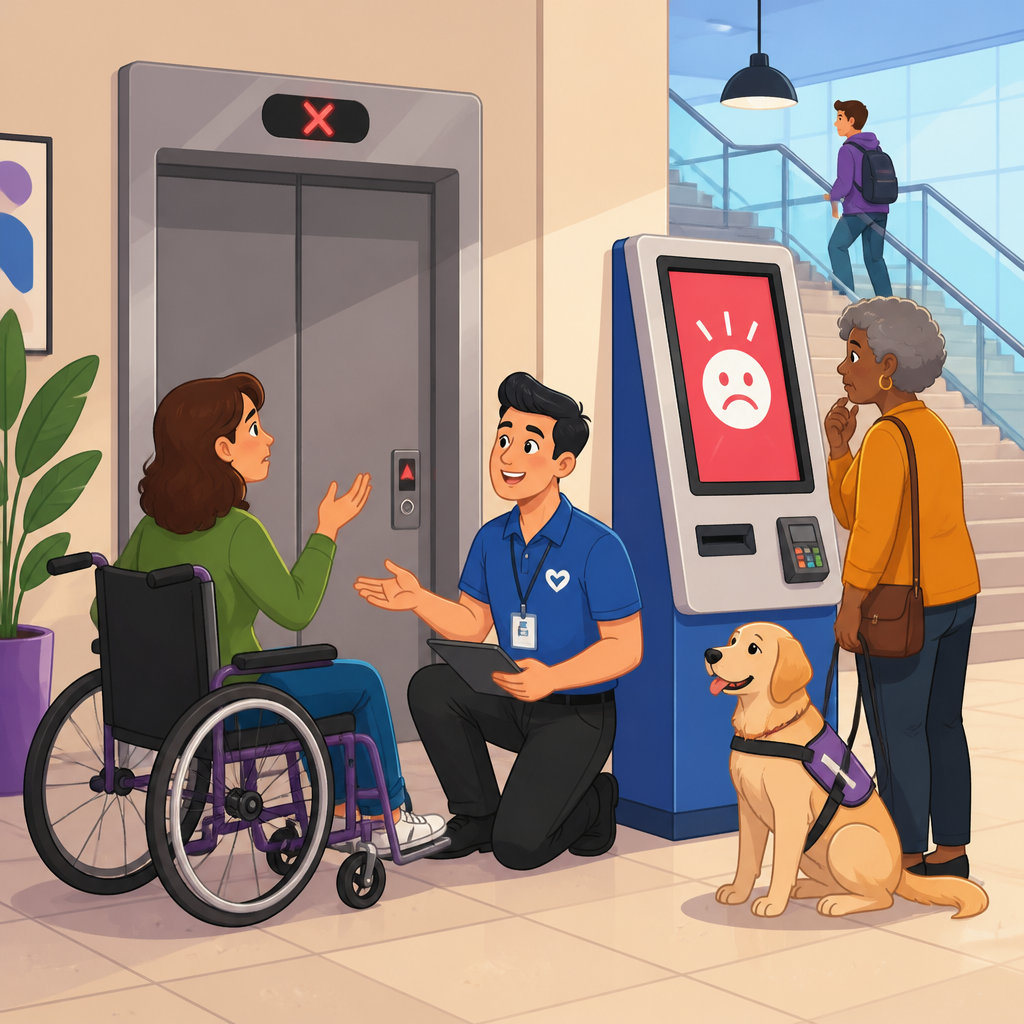
The second priority is continuity of access. The organization should immediately provide an equivalent or nearest-equivalent method of service. That might mean escorted entry through an accessible alternate route, staff-assisted check-in on a tablet, mobile point-of-sale at a service desk, relocation of the service to an accessible room, or curbside completion of the transaction. “Equivalent” does not always mean identical, but it must be timely, effective, and respectful. Requiring a disabled customer to wait substantially longer, disclose unnecessary personal information, or accept reduced privacy is not a strong substitute.
The third priority is communication. Staff need a simple script: what failed, what alternative is available right now, how long the outage is expected to last, and who can help. Signage should be posted at decision points, not just on the broken device. Digital channels matter too. Transit agencies often publish elevator alerts through station pages, feeds, and text notifications because riders need the information before they travel. Similar logic applies in hospitals, campuses, malls, and government buildings. Early notice allows people to reroute before the access barrier becomes a crisis.
| Incident type | Immediate action | Temporary accommodation | Owner |
|---|---|---|---|
| Only public elevator out of service | Shut down safely, call licensed elevator contractor, post notices | Relocate service to accessible floor or provide escorted alternate route | Facilities plus site operations |
| Platform lift intermittent failure | Remove from service after repeated fault, document error codes | Use accessible entrance or mobile service at ground level | Facilities plus compliance |
| Kiosk audio or tactile controls fail | Take kiosk out of service if independent use is blocked | Staff-assisted transaction or accessible secondary device | IT plus frontline operations |
| Accessible route blocked during repair | Secure area and reroute traffic | Wayfinding support and updated signage | Project manager plus site operations |
Complaint intake, recordkeeping, and investigation standards
Every accessibility incident should generate a record, even when the problem appears minor. At minimum, log the date, time, location, asset ID, reporter, symptoms, affected functions, immediate accommodation provided, vendors contacted, and restoration time. If a person experienced harm or filed a complaint, capture that separately under the organization’s complaint process. This distinction matters because maintenance logs answer “what broke,” while complaint records answer “how access was affected and whether the remedy was sufficient.” Both are necessary for defensible corrective action.
Complaint intake should be available through more than one channel. A phone number alone is not enough if wait times are excessive, and a web form alone is not enough if it is not accessible. Good programs offer phone, email, web, and in-person reporting, then route submissions into one tracking system. I recommend assigning each complaint a unique identifier, acknowledgment deadline, and required status updates. Acknowledging within one business day is realistic for most organizations, while high-severity access disruptions may require same-day contact.
Investigation should ask five direct questions. What failed technically? When did the organization first know? What access barrier did users experience? What interim measures were offered, and were they effective? What root cause and preventive action are supported by evidence? Evidence may include service tickets, CCTV where appropriate, kiosk logs, elevator controller fault history, cleaning records, staff statements, and prior complaints. Repeated incidents in the same location are especially important because they often show that the organization addressed symptoms without fixing the underlying process, procurement issue, or maintenance gap.
Corrective action: from repair to durable prevention
Corrective action is broader than fixing the machine. It is the disciplined process of identifying root cause, assigning ownership, setting deadlines, verifying effectiveness, and closing the loop with affected stakeholders. A common mistake is stopping at “vendor repaired unit.” That is restoration, not full corrective action. If the same kiosk loses audio every two weeks because the headphone jack assembly was poorly specified, or the same elevator repeatedly fails because preventive maintenance intervals are too long for usage volume, the organization has not solved the compliance problem.
Use root cause methods that fit the complexity of the incident. For straightforward failures, the Five Whys can be enough. For systemic problems, a fishbone diagram or fault tree is better because it forces the team to consider environment, training, design, maintenance, procurement, and human factors. In one retail deployment I reviewed, a payment kiosk passed factory testing but failed in stores because nightly cleaning fluid degraded the tactile overlay adhesive. The durable fix was not repeated overlay replacement. It was changing the cleaning specification, retraining staff, and updating the maintenance checklist.
Preventive action should be specific and measurable. Examples include reducing elevator service response time through a revised contractor agreement, adding daily accessibility checks to opening routines, requiring kiosk software updates to pass regression testing with screen reader mode enabled, or creating redundancy by ensuring at least one staffed accessible service option is always available. Closure should require verification. That means retesting the lift, elevator, or kiosk in the manner users actually depend on, not just confirming that the device powers on.
Policy design for outages, accommodations, and escalation
A strong policy answers the practical questions staff face under pressure. Who can declare an accessibility outage? How quickly must the issue be escalated? What interim accommodations are preapproved? When is executive leadership notified? Which incidents require legal review, regulator notification, or insurer involvement? The best policies are short enough to use and detailed enough to remove guesswork. They also align with sector rules, local building codes, and contractual obligations to tenants, clients, agencies, or funding bodies.
Outage policy should define minimum service expectations. If the only accessible entrance is unavailable, the site cannot simply post a sign and wait for repair. It must implement the backup method named in policy. If a self-service kiosk is inaccessible and no equivalent self-service option exists, policy should authorize staff to complete the task immediately without making the customer repeat information at multiple counters. Escalation policy should also define when repeated failures become a capital planning issue. Chronic incidents often indicate end-of-life equipment, undersized infrastructure, or poor vendor support that cannot be solved through frontline effort alone.
Training is part of policy implementation, not a separate afterthought. Frontline employees need brief, scenario-based instruction: how to assist without taking over, how to preserve privacy, when to apologize, and when to call for support. Supervisors need deeper training on documentation, service recovery, and de-escalation. Technical teams need clear acceptance criteria for restored service. Annual policy review is advisable, but high-use sites should also review after any major outage to capture lessons while they are fresh.
Special considerations for lifts, elevators, and kiosks
Lifts and elevators are governed by safety codes, inspection regimes, and licensing requirements that vary by jurisdiction, so incident response must respect those rules. Unauthorized resets or bypasses can create safety risk and liability. Teams should maintain current contact lists for licensed elevator contractors, building management, and emergency services, and they should know the difference between passenger entrapment, nuisance faults, and planned shutdowns. Planned shutdowns deserve the same communication discipline as unplanned failures because the access impact is often identical from the user’s perspective.
Kiosks present a different pattern of failure. Hardware may work while accessibility features fail silently after a software update, content change, or peripheral replacement. Common defects include mislabeled fields in the accessible interface, touch targets that become unusable after a layout revision, broken focus order, payment timeout settings that do not account for assistive technology use, and inaccessible identity verification steps. Because these issues often evade standard IT monitoring, organizations should add accessibility checks to change management, user acceptance testing, and vendor release approvals.
Where possible, build redundancy into the service model. A building with one public elevator should have a documented relocation protocol. A clinic that relies on kiosks for intake should keep accessible staffed registration available. A transit operator should maintain route guidance for stations affected by vertical transportation outages. Redundancy does not eliminate the duty to repair quickly, but it materially reduces harm during the outage window.
Metrics, audits, and continuous improvement
If you do not measure accessibility incidents, you will underestimate them. Track outage count, mean time to acknowledge, mean time to restore, percentage of incidents with an effective interim accommodation, repeat incident rate, complaint volume, and closure aging for corrective actions. Segment the data by site, asset type, vendor, and severity. Those cuts reveal patterns. A high repeat rate on one elevator bank may support modernization. A cluster of kiosk complaints after software releases may point to weak regression testing.
Audits should sample both records and lived experience. Review whether logs are complete, whether signs were posted, whether alternatives were offered promptly, and whether closed incidents stayed closed. Then test the actual path a user would take. I have seen incident records marked resolved while the “accessible alternative” required a locked side entrance and a phone number no one answered. Desktop compliance looked acceptable; real-world access did not. That gap is exactly what a good audit is designed to expose.
As a hub page for policies, complaints, and corrective action, this topic should connect to your related guidance on preventive maintenance, accessible procurement, staff training, complaint procedures, vendor management, and audit readiness. The core principle is simple: when a lift, elevator, or kiosk fails, access cannot fail with it. Organizations that prepare clear policies, handle complaints seriously, document facts carefully, and verify corrective action build resilience as well as compliance. Review your current outage process, test it against a real scenario, and update the weak points before the next incident forces the lesson.
Frequently Asked Questions
What is an accessibility incident response, and when should an organization activate one?
An accessibility incident response is the organized process an organization uses when a critical access feature stops working or becomes unsafe to use. That can include a lift at a transit station, an elevator in a medical office or campus building, or a self-service kiosk in a retail or public-facing setting. The goal is not just to “fix the equipment.” It is to protect safety, reduce disruption, provide an equivalent way for people with disabilities to access the same service, document what happened, and prevent the issue from happening again. A strong response treats the failure as an operational and customer access issue, not only a maintenance issue.
An organization should activate its incident response plan as soon as the failure affects equal access, health and safety, or the ability of a customer, patient, student, employee, or visitor to complete an essential task. For example, if the only accessible route to a platform is blocked by an inoperable elevator, if a patient cannot reach an exam room because a lift is out of service, or if a kiosk is the main way to check in, order, or pay and its accessible features are unavailable, the response should begin immediately. Waiting until a complaint arrives is too late. The trigger should be the loss of accessible service itself.
In practice, activation usually includes notifying the right internal teams, confirming the scope of the outage, posting clear notices, arranging an equivalent alternative, and starting a repair and documentation workflow. Organizations that handle these incidents well usually have a written plan, named decision-makers, vendor contacts, communication templates, and pre-approved workarounds. That preparation makes the difference between a short disruption and a serious access failure that damages trust and creates legal risk.
What should staff do first when a lift, elevator, or kiosk fails?
The first priority is safety. Staff should verify whether the equipment is merely unavailable, completely nonfunctional, or actively dangerous. If there is a risk of injury, entrapment, or unsafe use, the feature should be taken out of service immediately and secured according to site procedures. For a lift or elevator, that may mean placing barriers, posting out-of-service signs in accessible locations, and contacting facilities, security, and the service vendor right away. For a kiosk, it may mean disabling transactions and redirecting users before they encounter an inaccessible or broken workflow.
The second priority is restoring access through an equivalent alternative. This is where many organizations struggle. It is not enough to simply put up a sign that says the equipment is down. Staff need a practical replacement path that allows the person to get the same service with similar timeliness, dignity, and privacy whenever possible. Depending on the setting, that could mean escorting someone to an alternate accessible entrance, dispatching staff to provide manual check-in or checkout, arranging service on another floor, rerouting to another platform or station, or offering immediate one-to-one assistance without extra cost or burden. The alternative should be real, immediate, and easy to understand.
After safety and service continuity are addressed, staff should begin documentation and communication. They should record when the failure started, who discovered it, which features are affected, what temporary accommodations are being offered, and who has been notified. Frontline teams need a short script so they can explain the situation consistently and respectfully. Internal leaders need enough detail to assess whether the issue is isolated or part of a larger pattern. This early documentation becomes essential later for repairs, compliance review, customer follow-up, and prevention planning.
How should an organization communicate an accessibility equipment outage to the public?
Good communication should be fast, clear, specific, and actionable. People need to know what is out of service, where it is located, when the outage began if known, what alternative is available right now, and how to get help immediately. Vague notices such as “temporarily unavailable” are rarely enough. A better message explains the exact impact: for example, that the elevator serving the west entrance and second-floor clinic is out of service, that staff are available at a nearby desk or phone number, and that patients can be escorted to an alternate accessible route or rescheduled without penalty if needed. The notice should tell people what to do next, not just what went wrong.
Communication should also be delivered through more than one channel. On-site signage matters, but it should be paired with website updates, app notifications where relevant, customer service scripts, call center messaging, and direct outreach if scheduled visitors or patients are affected. In a transit setting, public announcements and real-time service alerts may be necessary. In healthcare or higher education, front desk staff, security, and scheduling teams all need the same current information so they do not give conflicting directions. The more critical the access feature, the more proactive the communication should be.
Equally important is the tone. Messages should be respectful, direct, and free of blame. They should not place the burden on the disabled person to “find another way.” Instead, they should state what the organization is doing to restore access and how staff will assist. If repair timing is uncertain, say that honestly and commit to updates. Strong communication reduces confusion, supports independence, and shows that the organization understands accessibility as an essential service issue rather than a minor inconvenience.
What counts as an “equivalent alternative” when an accessible feature is unavailable?
An equivalent alternative is a temporary method of delivering the same service or access when the original accessible feature fails. The key word is “equivalent.” The replacement should be as close as possible in usefulness, dignity, timeliness, and privacy to the original experience. If an elevator is down, telling someone to use stairs is not an alternative at all. If an accessible kiosk is unavailable, telling the customer to come back later may also fail to provide equal access. The organization should ask: can the person still complete the same task, at the same location if possible, without unreasonable delay, extra cost, or humiliating treatment?
The answer depends on the environment. In retail, an equivalent alternative might be immediate staff-assisted checkout, product lookup, or ordering at the same prices and promotions available through the kiosk. In a medical office, it could mean moving the appointment to an accessible room, bringing registration to the patient, or arranging same-day service in another accessible area. In transit, it may involve providing a staffed reroute, shuttle connection, or other transportation support that gets the rider to the same destination safely. In higher education, it might mean relocating a class, lab, meeting, or student service to an accessible space without making the student negotiate the solution alone.
Organizations should be careful not to confuse “some help” with equal access. An alternative that requires long waits, repeated explanations, public disclosure of private information, or dependence on unavailable staff may not be sufficient. The best practice is to plan alternatives in advance for each high-risk failure point. That means mapping backup routes, identifying manual service procedures, training staff, and testing whether the workaround actually works in real conditions. A prepared alternative can preserve trust even during a failure; an improvised one often exposes deeper accessibility gaps.
How can organizations prevent repeated accessibility failures and improve their response over time?
Prevention starts with treating accessibility incidents as operational signals, not one-off annoyances. Every outage should be reviewed to understand root cause, duration, user impact, communication quality, and whether the temporary alternative truly worked. Was the failure caused by deferred maintenance, poor vendor response, environmental conditions, software issues, user interface design, or lack of staff training? Did the organization know quickly enough? Did frontline employees have authority to help? These questions turn an incident into a learning opportunity.
From there, organizations should build a repeatable improvement cycle. That typically includes preventive maintenance schedules, vendor service-level expectations, spare parts planning where appropriate, escalation paths for prolonged outages, and routine testing of critical access features. For kiosks, software updates, peripheral checks, and accessibility feature verification should be part of standard quality control. For elevators and lifts, leaders should know which assets are mission-critical, which locations have no meaningful backup route, and what emergency access procedures are in place. Data matters here. Tracking outage frequency, repair time, accommodation use, and complaint patterns helps teams prioritize investment and spot recurring weak points.
Training and accountability are just as important as equipment reliability. Staff should know how to identify an accessibility incident, who to call, how to communicate respectfully, and what alternatives they are authorized to provide. Managers should review incidents regularly and close the loop on unresolved risks. It is also wise to include disabled users in testing and after-action feedback, because they often identify barriers that internal teams miss. Over time, the organizations that improve fastest are the ones that combine maintenance discipline, clear incident playbooks, strong communication, and honest post-incident review. That approach not only reduces repeat failures, it builds credibility with the people who depend on accessible service every day.