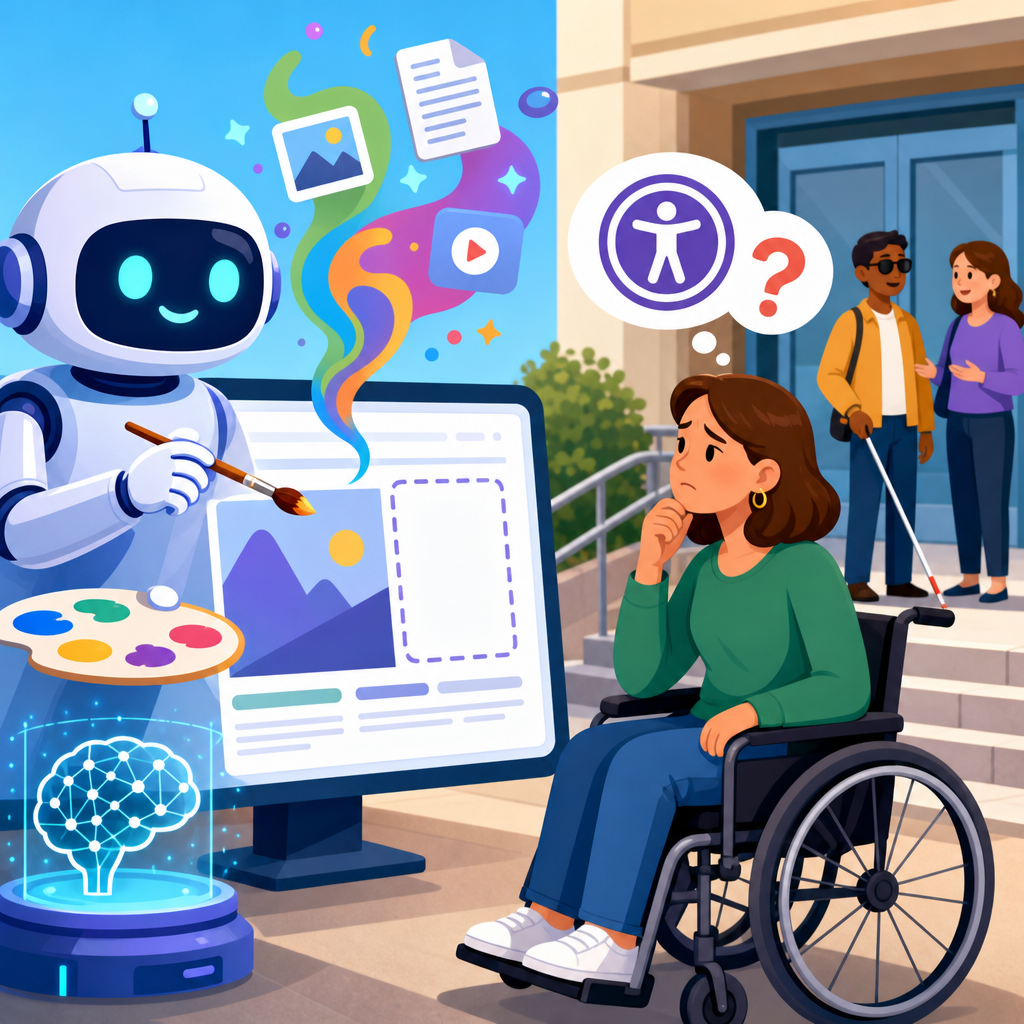
Generative artificial intelligence is rapidly changing how organizations communicate, hire, serve customers, and deliver digital experiences, and that shift raises a serious legal question: can generative AI create new liability under the Americans with Disabilities Act? The short answer is yes. In practice, I have seen teams deploy chatbots, image generators, automated summaries, and AI-assisted screening tools with little accessibility review, only to discover that the systems block disabled users, distort information, or create unequal treatment. The ADA does not mention large language models, diffusion models, or retrieval systems by name, but its core rule is technology-neutral: covered entities cannot deny equal access to qualified people with disabilities.
To understand why this matters, it helps to define the terms. Generative AI refers to systems that produce new content such as text, images, code, audio, or video based on patterns learned from training data. ADA usually refers to the Americans with Disabilities Act of 1990, along with related regulations and enforcement guidance. In digital settings, the most common legal touchpoints are Title I, which governs employment, Title II, which applies to state and local governments, and Title III, which covers public accommodations. Section 504 of the Rehabilitation Act and Section 508 standards often overlap in public-sector or federally funded contexts, and the Web Content Accessibility Guidelines, especially WCAG 2.1 and 2.2, frequently serve as the operational benchmark for accessibility.
Generative AI creates ADA risk in two ways. First, it can become the interface through which people must access jobs, services, education, healthcare, or commerce. If that interface is inaccessible, the barrier itself can trigger liability. Second, AI can shape decisions about people, including whether they are interviewed, accommodated, authenticated, or believed. If the system misreads disability-related behavior or content, the result may be disparate treatment, screen-out effects, or failure to provide effective communication. Because generative systems are probabilistic, opaque, and often layered onto existing software, they can introduce defects that are harder to predict than traditional form or website errors.
This article is the hub for AI and ADA issues because the problem is broader than website alt text or chatbot etiquette. It includes employment assessments, AI transcription, voice interfaces, document remediation, kiosks, customer support, search, fraud detection, and procurement. It also includes governance: how organizations document accessibility testing, vendor obligations, human review, accommodation workflows, and incident response. The key takeaway is straightforward. Generative AI can create new ADA liability when it adds barriers, automates exclusion, or degrades communication for disabled users. Organizations that treat accessibility as a design requirement rather than a legal afterthought reduce both litigation exposure and operational failure.
How generative AI triggers ADA obligations
Generative AI can trigger ADA obligations whenever it becomes part of a covered program, service, activity, or employment practice. That means liability does not depend on whether a company “uses AI” in the abstract. It depends on what the system does, who must use it, and whether disabled people can use it with equal effectiveness. A hiring chatbot that requires rapid typing may disadvantage applicants with motor impairments. An AI-powered support widget that cannot be operated by keyboard may block blind users who rely on screen readers. A system that summarizes medical benefits in plain language may help many users, but if it hallucinates eligibility rules, users with cognitive disabilities may be misled at higher rates.
The Department of Justice has repeatedly emphasized that accessibility duties apply to digital tools used by covered entities. The Equal Employment Opportunity Commission has also warned that software, algorithms, and AI used in hiring, monitoring, and performance evaluation can violate federal disability law if they screen out qualified individuals or fail to allow reasonable accommodation. In real deployments, generative AI often sits on top of existing systems through browser overlays, third-party APIs, or software development kits. That architecture can obscure responsibility, but legally it rarely removes it. If the tool is part of the user journey, the organization adopting it remains accountable for accessible use.
Three recurring legal theories appear most often. The first is inaccessible design: the AI interface cannot be perceived, understood, navigated, or operated by users with disabilities. The second is discriminatory output or decision support: the system produces responses, rankings, or recommendations that unfairly burden disabled users. The third is ineffective accommodation: the organization relies on AI in ways that undermine captioning, interpretation, alternative formats, or interactive processes. These theories often overlap. For example, an AI note-taking tool used during a public meeting may generate inaccurate captions for deaf participants and simultaneously fail to provide a reliable accommodation.
Employment: hiring, monitoring, and accommodation risk
Employment is one of the clearest areas where generative AI can create ADA liability. Title I prohibits discrimination against qualified individuals with disabilities and requires reasonable accommodation absent undue hardship. When employers use AI to draft interview questions, score application materials, summarize video interviews, or flag “communication quality,” they can unintentionally encode disability bias. I have reviewed systems that treated nonstandard speech patterns as low confidence, penalized gaps in eye contact, or overvalued fast response time. Those signals may correlate with disability rather than job performance.
Generative AI also creates risk during assessments. If an applicant must complete a conversational AI interview without accessible controls, caption accuracy, screen-reader support, or extra time, the process itself may screen out disabled candidates. The EEOC has explained that employers must provide accommodations for algorithmic tools just as they would for other selection procedures. That can include alternative formats, human-administered interviews, extended time, compatibility with assistive technology, and clear instructions on how to request accommodation. A system is not compliant merely because a vendor claims it was “tested for fairness.” Disability discrimination often hides in usability failures rather than in headline demographic metrics.
Workplace monitoring raises another layer of concern. Generative AI can summarize employee communications, detect sentiment, or draft performance narratives. If those tools misinterpret disability-related communication styles, flare periods, assistive technology usage, or medical leave patterns, they can contaminate performance management. The safest approach is to narrow the role of AI in high-stakes decisions, document essential job functions, validate any scoring criteria against actual business necessity, and maintain a meaningful human review process with authority to override machine-generated recommendations.
Digital accessibility in customer-facing AI systems
Customer-facing generative AI tools create ADA exposure because they increasingly serve as the front door to products and services. Retailers use AI shopping assistants, hospitals use symptom chat, banks use AI help centers, universities use virtual advisors, and travel brands use itinerary generators. If those systems are not accessible, users may be denied equal access even when the rest of the site technically meets basic standards. A chatbot that steals keyboard focus, times out quickly, or responds only to drag-and-drop inputs can become the practical barrier that matters most.
Accessibility failures in generative systems tend to cluster around a few patterns: unlabeled controls, dynamic content not announced to assistive technology, poor focus management, inaccessible CAPTCHAs, low-contrast generated elements, and output that lacks structure. AI-generated answers may also create cognitive accessibility problems if they are verbose, inconsistent, or hard to follow. For users with intellectual or learning disabilities, reliable headings, predictable layouts, plain language, and the ability to repeat or simplify instructions are not optional enhancements. They are part of effective access.
| AI use case | Typical ADA risk | Practical mitigation |
|---|---|---|
| Hiring chatbot | Screen-out of applicants using assistive technology | Keyboard support, captioning, alternative application path |
| Customer service assistant | Inaccessible dynamic interface or inaccurate guidance | WCAG testing, human escalation, answer validation |
| AI transcription | Errors that defeat effective communication | Human review for critical interactions, quality thresholds |
| Image generator | Missing or misleading text alternatives | Manual alt text workflow, editorial review |
| Internal productivity copilot | Bias in performance summaries or task allocation | Use limits, audit logs, accommodation-aware review |
One common mistake is assuming that an accessibility overlay or browser widget will fix a generative AI interface. It usually will not. Screen-reader users depend on semantic markup, focus order, ARIA where appropriate, and stable interaction patterns. If the underlying component is inaccessible, an overlay cannot reliably repair it. Organizations should test AI features with real assistive technologies such as JAWS, NVDA, VoiceOver, TalkBack, switch controls, and speech recognition software, not just automated scanners.
Content generation, effective communication, and accuracy
Generative AI can help create captions, transcripts, summaries, alt text, easy-read content, and translated materials, but those benefits come with legal and operational limits. Under the ADA, covered entities must provide effective communication. “Effective” does not mean merely available; it means the communication must be timely, accurate, and usable for the person involved. If a hospital uses AI to generate discharge summaries in plain language but the output omits medication warnings, the problem is not only medical. It may also be a disability access failure for patients who depend on simplified communication.
Alt text is another example. AI-generated image descriptions can improve coverage at scale, but they are often generic, incomplete, or wrong about context. For an ecommerce product image, “a person holding a device” is weaker than “customer wearing behind-the-ear hearing aid while using black smartphone.” For charts, diagrams, and legal notices, a superficial description is not enough. The content must communicate the same meaningful information available visually. In my experience, AI works best as a first draft for accessibility content, with human review rules based on risk, content type, and audience.
Accuracy becomes even more important when generative AI supports legal rights, benefits, education, transportation, or healthcare. Hallucinated policies can cause users to miss deadlines, misunderstand accommodation procedures, or rely on nonexistent options. That is why answer validation, source grounding, and escalation pathways matter. High-risk responses should cite approved content repositories, preserve version control, and route uncertain cases to trained staff. A polished answer that is wrong is more dangerous than a plain answer that is incomplete, because users trust the confidence of machine-generated language.
Procurement, vendor management, and governance
Many ADA problems begin in procurement. Organizations buy AI tools quickly, often based on productivity promises, then discover inaccessible components after launch. Procurement teams should require vendors to disclose conformance testing, accessibility roadmaps, known limitations, and support for assistive technology. A Voluntary Product Accessibility Template can be useful, but it should never be accepted without scrutiny. I have seen VPATs describe partial support in vague terms while critical workflows remained unusable. Contract language should require remediation timelines, indemnity where appropriate, cooperation in complaint response, and notice before major interface changes.
Governance should cover more than website compliance. A mature AI and ADA program maps where generative AI appears across the organization, classifies use cases by risk, sets approval thresholds, and defines ownership across legal, accessibility, security, procurement, HR, and product teams. It also creates testing protocols. Automated accessibility scans are helpful for regressions, but they do not capture conversation design, hallucination risk, caption quality, accommodation workflows, or the lived experience of disabled users. Include manual testing and, where possible, usability sessions with people who use assistive technology daily.
Documentation matters because complaints and investigations turn on what the organization knew and when it knew it. Keep records of accessibility reviews, prompt guardrails, model updates, incident reports, human override procedures, and accommodation requests linked to AI systems. If a chatbot repeatedly fails to provide accessible billing support and the business ignores those failures, the legal risk compounds. Good records will not cure a barrier, but they help prove diligence, support remediation, and reveal patterns early enough to fix them.
Best practices to reduce AI and ADA exposure
The most effective way to reduce AI and ADA exposure is to treat accessibility as a release criterion. Start with a simple rule: no generative AI feature should become mandatory for users unless there is an equivalent accessible path. Build to WCAG 2.2 AA where applicable, test with assistive technology, and verify that dynamic updates are announced properly. In hiring and other high-stakes contexts, offer a clear non-AI alternative and make accommodation requests easy to submit without forcing medical disclosure beyond what is necessary.
Next, limit AI autonomy in sensitive decisions. Use generative tools to assist humans, not to replace judgment in accommodation, eligibility, discipline, or safety decisions. Ground responses in approved sources, require confidence thresholds for critical outputs, and block unsupported legal or medical advice. For content generation, create editorial policies for alt text, captions, summaries, and translations. Define when human review is mandatory, such as for healthcare, education, legal rights, public services, and individualized accommodations.
Finally, train teams on disability-inclusive design. Product managers should know how AI features affect keyboard navigation, cognitive load, and assistive technology. HR teams should understand how algorithmic tools can screen out qualified applicants. Support teams should know when to escalate from AI to a trained human. If you audit your AI stack now, remediate barriers, and update contracts and workflows, you can capture the efficiency benefits of generative AI without creating preventable ADA liability. That is the practical path forward for any organization operating on the legal and technological frontier.
Frequently Asked Questions
Can generative AI create new ADA liability for businesses and organizations?
Yes. Generative AI can create new ADA liability when it is deployed in ways that exclude, burden, screen out, or otherwise disadvantage people with disabilities. The legal risk does not come from the fact that a tool is labeled “AI.” It comes from how that tool functions in the real world. If a generative AI chatbot cannot be used with screen readers, if an image generator produces important visual content without meaningful text alternatives, if automated summaries omit critical accessibility information, or if an AI-assisted hiring tool disproportionately filters out qualified disabled applicants, the organization using that system may face ADA exposure.
The Americans with Disabilities Act generally requires covered employers, public entities, and places of public accommodation to provide equal access and avoid discriminatory practices. When generative AI becomes part of customer service, recruiting, onboarding, internal workflows, education, healthcare communication, or digital service delivery, it can become part of the access chain. If the AI layer introduces barriers that did not previously exist, or makes existing barriers worse, the organization may be responsible for the result. That is especially true when the tool is embedded into websites, applications, kiosks, support channels, or employment decision-making processes.
A common misconception is that liability belongs only to the software vendor. In reality, the organization deploying the technology often remains responsible for compliance. Businesses cannot usually avoid ADA duties by outsourcing a function to a third party. If the AI system is part of the way the organization interacts with applicants, employees, students, patients, or customers, decision-makers should assume that accessibility and nondiscrimination obligations still apply. In short, generative AI does not replace ADA compliance; it creates another operational area where ADA compliance must be evaluated carefully.
What kinds of generative AI tools are most likely to create ADA-related accessibility problems?
Several categories of generative AI tools create recurring accessibility concerns. Customer-facing chatbots are a major example. If a chatbot is the primary way users obtain help, schedule services, submit requests, or resolve account issues, it must be usable by people with disabilities. Problems arise when the interface is not keyboard accessible, when screen readers cannot interpret dynamic responses, when time limits are too short, when voice-only interactions lack text alternatives, or when the bot fails to understand disability-related requests for accommodation.
Image and media generation tools also present risk. Organizations increasingly use AI to generate promotional graphics, product illustrations, training content, and social media assets at scale. If those outputs are published without alt text, captions, transcripts, or accessible formatting, disabled users may lose access to important information. The speed of AI content generation can multiply the problem because inaccessible content can be produced much faster than human teams can review and remediate it.
AI-assisted hiring and screening tools may be even more legally sensitive. Resume screening, candidate ranking, automated interview summaries, skill assessments, and personality analysis systems can all create disability-related bias or procedural barriers. For example, a system may penalize communication patterns associated with speech disabilities, may rely on timed tasks that disadvantage certain applicants, or may not provide a reasonable alternative process for candidates who need accommodation. Even if the tool appears neutral, the practical effect may be discriminatory.
Automated summarization and content transformation tools can also cause problems when they remove context that disabled users need. A summary may strip out instructions about accommodation requests, omit warnings, reduce plain-language clarity, or alter headings in ways that hurt navigation. In all of these examples, the issue is not that AI exists. The issue is that AI outputs and workflows can quietly interfere with equal access, effective communication, and fair participation unless they are tested and governed intentionally.
How can generative AI affect ADA compliance in hiring, recruiting, and employment decisions?
Generative AI can affect ADA compliance in employment settings at multiple stages, from job advertising and application intake to screening, interviewing, and onboarding. An employer may use AI to draft job descriptions, rank resumes, summarize interview notes, evaluate writing samples, or interact with candidates through automated assistants. Each of these uses can create risk if disabled applicants are excluded directly or indirectly. The ADA does not just prohibit obvious discrimination. It also reaches practices that unfairly disadvantage qualified individuals with disabilities or fail to provide reasonable accommodation in the hiring process.
For example, an AI system may screen candidates based on communication style, response speed, facial expressions, speech patterns, gaps in work history, or standardized assessment performance. Those factors may correlate with disability in ways the employer does not intend or even understand. A chatbot collecting application information may not work properly with assistive technology. An online assessment platform may impose rigid time constraints without a clear accommodation path. An automated interview analysis tool may reward eye contact, vocal tone, or body movement in ways that disadvantage neurodivergent candidates or candidates with sensory, speech, or mobility disabilities.
There is also a documentation and oversight problem. Employers often assume AI outputs are objective, but that assumption can lead to overreliance on flawed recommendations. If no one audits the tool for disability-related impact, the employer may not recognize patterns of exclusion until a complaint, demand letter, agency inquiry, or lawsuit arises. The safest approach is to treat AI-enabled hiring tools as high-risk systems requiring advance accessibility review, validation, human oversight, accommodation procedures, vendor scrutiny, and ongoing testing. Employers should also ensure that alternative application routes are available and that candidates are clearly informed how to request accommodations at every stage of the process.
If a third-party vendor provides the AI system, is the organization still responsible under the ADA?
In many situations, yes. Organizations often assume that because a vendor built, trained, hosted, or licenses the generative AI product, the vendor alone bears the legal responsibility. That is usually too simplistic. Under the ADA, responsibility often follows the function being performed and the relationship to the applicant, employee, customer, patient, student, or member of the public. If your organization is using the AI system as part of its website, employment process, support model, or service delivery, your organization may still be accountable if that system creates access barriers or discriminatory outcomes.
This is why vendor contracts, procurement procedures, and implementation governance matter so much. Accessibility and nondiscrimination cannot be treated as afterthoughts. Before deployment, organizations should ask specific questions: Has the tool been tested with screen readers and keyboard-only navigation? Does it support captions, transcripts, and alt text workflows? Can it be used without speech, vision, or precise mouse movement? Does the vendor provide documentation about disability impact, accommodation handling, and known limitations? Are there audit rights, indemnity terms, remediation obligations, service-level commitments, and accessibility warranties in the contract?
Even strong contract language is not enough if the organization never verifies real-world performance. A vendor may claim accessibility, but implementation choices can still introduce barriers. For instance, the AI engine may be sound while the organization’s front-end integration is inaccessible. Or the tool may perform adequately for general use but fail in edge cases involving assistive technology or accommodation requests. The practical takeaway is clear: third-party sourcing does not eliminate ADA risk. It simply means the risk must be managed through due diligence, contracting, testing, monitoring, and internal accountability.
What should organizations do now to reduce ADA liability when using generative AI?
Organizations should begin with an AI accessibility and disability-impact review before deployment, not after complaints arise. Start by mapping where generative AI is already being used or is planned for use across customer service, marketing, web content, recruiting, HR, training, education, healthcare communication, and internal operations. Many organizations discover that AI has been introduced informally by separate teams with little legal, accessibility, or compliance review. That visibility step is critical because you cannot manage ADA risk in systems you do not know exist.
Next, build accessibility into procurement and design. Require accessibility standards in vendor selection, contract terms, pilot testing, and implementation plans. Test tools with people who use assistive technology, not just with automated scanners. Evaluate keyboard access, screen-reader compatibility, captions, transcripts, error handling, language clarity, color contrast, focus order, and whether users can complete essential tasks through more than one modality. In employment contexts, assess whether AI tools create disparate effects on disabled candidates and whether reasonable accommodations can be requested and delivered smoothly.
Organizations should also maintain meaningful human oversight. Do not allow AI systems to become the only path for communication, support, or decision-making where an inaccessible or biased result could block participation. Provide alternative channels, publish accommodation instructions clearly, train staff to recognize AI-related accessibility failures, and create escalation paths when users encounter barriers. Ongoing monitoring matters because generative AI systems change over time through updates, model changes, prompt changes, new integrations, and shifting use cases.
Finally, involve legal, compliance, HR, IT, procurement, accessibility specialists, and business owners together. ADA risk from generative AI is rarely just a technical bug. It is usually a governance problem that shows up through technology. Organizations that treat accessibility as a core deployment requirement, rather than a final checklist item, are in a much better position to reduce liability, improve user experience, and avoid the costly mistake of scaling inaccessible AI across the enterprise.


