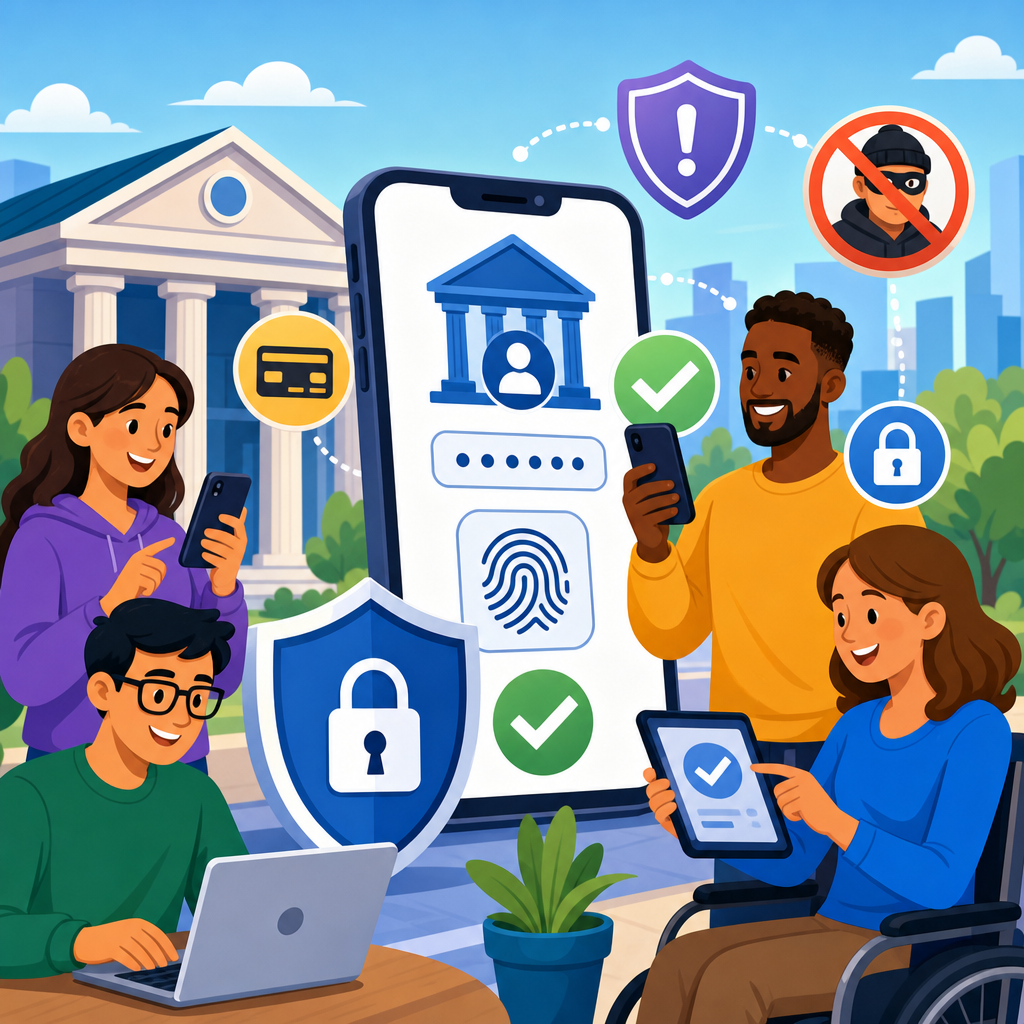
Banking authentication, fraud controls, and accessible security sit at the center of modern financial services because every digital account, card transaction, wire transfer, and customer interaction depends on verifying identity without creating unnecessary friction. In practice, banking authentication is the set of methods a bank uses to confirm a person is who they claim to be, fraud controls are the layered systems that detect, block, or investigate suspicious activity, and accessible security means those protections must still work for older adults, people with disabilities, limited-English users, and customers using assistive technology. I have worked on financial services security programs where the hardest problem was not choosing one tool, but designing a full journey that balances regulatory obligations, customer trust, operational cost, and the reality that criminals adapt quickly. This matters because banks now operate across mobile apps, call centers, ATMs, branch systems, payment rails, and open banking interfaces, while attackers use phishing kits, SIM swaps, synthetic identities, account takeover malware, and social engineering at scale. A strong hub page for financial services must connect these topics clearly, because teams rarely solve fraud with one control alone. They combine identity proofing, multifactor authentication, device intelligence, transaction monitoring, case management, customer education, and inclusive design. When these elements align, banks reduce losses, satisfy auditors, support vulnerable customers, and improve completion rates for legitimate users.
Financial services security has become more complex for two reasons. First, the attack surface expanded as customer expectations moved from branch-first banking to always-on digital access. Second, regulation tightened around data protection, strong customer authentication, anti-money laundering, sanctions screening, and fair access. In the United States, banks commonly align controls with FFIEC guidance, NACHA requirements for ACH activity, PCI DSS for card environments, and identity obligations under CIP and KYC programs. In Europe and the United Kingdom, firms also design around PSD2, strong customer authentication rules, and privacy requirements. The best banking authentication programs are risk-based, meaning they adapt to the transaction, channel, and customer context rather than forcing the same challenge every time. The best fraud programs are layered, because any single signal can fail. The best accessible security programs are tested with real users, because a perfectly secure flow that locks out a blind customer or a customer without a smartphone is not a successful control. This article serves as the financial services hub for the topic, tying together core methods, common fraud patterns, operational design, and practical decisions banks make every day.
How banking authentication works across financial services channels
Banking authentication usually begins with identity proofing at account opening, then continues through login, session management, step-up verification, and high-risk transaction approval. Identity proofing answers whether a new applicant is a real person. Authentication answers whether the returning user is the legitimate account holder right now. Authorization answers what that user is allowed to do. In banking, those distinctions matter because opening a checking account online, viewing a balance, changing a phone number, adding a new payee, and sending a same-day wire each carry different levels of risk. A modern bank therefore combines something the user knows, such as a password or passphrase, with something the user has, such as a FIDO2 security key, banking app push approval, or one-time code generator, and sometimes something the user is, such as a face or fingerprint stored securely on the device. Good systems add contextual signals too, including device binding, IP reputation, geolocation consistency, time-of-day anomalies, impossible travel detection, and behavioral biometrics.
In my experience, the most effective programs avoid treating multifactor authentication as a checkbox. SMS codes can still help in lower-risk situations, but banks know they are weaker than app-based cryptographic approval or hardware-backed passkeys because SIM swaps and message interception remain real threats. Call centers require a different approach, since the customer may not be online. There, banks use layered knowledge-based verification sparingly, voice callback procedures, account activity confirmation, and increasingly voice biometrics with strong fraud monitoring. ATM and branch channels rely on cards, PINs, chip technology, terminal controls, staff procedures, and back-end detection systems. Corporate banking adds another layer through dual authorization, payment templates, entitlements, and out-of-band approval for treasury actions. The core lesson is simple: banking authentication is not one login screen. It is a channel-wide architecture that must reflect transaction risk, customer capability, and fraud pressure.
Core fraud controls banks use to prevent account takeover and payment abuse
Fraud controls in financial services are most effective when arranged in preventive, detective, and responsive layers. Preventive controls stop bad activity before money moves. Detective controls identify suspicious behavior in near real time or during review. Responsive controls contain loss, preserve evidence, and support recovery. For account takeover, banks typically use credential stuffing defenses, bot management, rate limiting, password breach screening, session risk scoring, device fingerprinting, and impossible travel rules. For payment fraud, they monitor recipient changes, unusual transfer amounts, new-device high-value transactions, rapid funds movement, mule account indicators, and known scam narratives. Card fraud teams rely on authorization models, merchant category analysis, tokenization, card controls, and dispute workflows. Deposit fraud teams focus on check alterations, duplicate presentment, remote deposit capture anomalies, and first-party misuse. Commercial banking teams look closely at business email compromise, vendor payment redirection, and anomalous ACH or wire behavior.
| Control Area | Primary Use | Common Banking Example | Main Limitation |
|---|---|---|---|
| Multifactor authentication | Prevent account takeover | Push approval for login from a new device | Can create friction if backup methods are weak |
| Device intelligence | Assess session risk | Flag emulator use or device mismatch during transfer | Shared devices can reduce precision |
| Behavioral analytics | Detect abnormal activity | Typing and navigation differ from normal customer pattern | Needs tuning to avoid false positives |
| Transaction monitoring | Stop payment fraud | Hold a wire after sudden beneficiary change | May delay legitimate urgent payments |
| Case management | Investigate alerts | Analyst reviews linked accounts and prior contacts | Requires trained staff and clear workflows |
Real-world results depend on orchestration. A bank that blocks every anomaly will frustrate customers and overwhelm analysts with false positives. A bank that allows too much for convenience will absorb preventable losses. The strongest teams set thresholds by product and customer segment, then review outcomes weekly. For example, a retail bank may permit low-risk balance checks with a remembered device but require step-up approval for adding an external account. A commercial bank may require dual approval and callback verification for first-time international wires. Analysts also need feedback loops. If scams are slipping past controls, rules and machine learning features should change quickly. If legitimate customers are failing because a push notification is inaccessible or delayed, fallback paths must improve. Fraud control quality is measured not only by blocked attacks, but also by customer completion rate, alert precision, time to decision, investigator productivity, and recoveries after incident response.
Accessible security design for customers with different needs and abilities
Accessible security in banking means protection that works for everyone, not just digitally confident users with the latest smartphone. Under standards such as WCAG and expectations tied to disability law, banks should ensure login, enrollment, transaction approval, alerts, and recovery flows are usable with screen readers, keyboard navigation, zoom, high-contrast settings, captions, clear labels, and understandable error messages. Security teams sometimes underestimate how often controls fail because of design choices rather than fraud pressure. A timed one-time passcode may expire before a screen reader user finishes navigation. A CAPTCHA may be unreadable for a low-vision customer. A push approval that depends on color alone may exclude color-blind users. An account recovery flow that requires a smartphone selfie can block customers without modern devices or stable connectivity. In fraud work, I have seen preventable lockouts create repeat call-center contacts, abandonment, and reputational harm that could have been reduced by better design and testing.
Accessible security also includes choice. Banks should offer more than one strong authentication path, such as passkeys, app approval, hardware security keys, and secure phone support with carefully designed fallback procedures. Backup codes must be readable and storable. Voice prompts should be concise and repeatable. Forms should explain why data is needed, especially during identity verification. For older customers and people facing cognitive overload, plain-language warnings about scams outperform dense legal copy. For deaf or hard-of-hearing customers, recovery and support options cannot rely only on voice calls. For blind customers, image-based identity checks need alternative support paths. Accessibility is not the enemy of fraud prevention; it improves it by reducing insecure workarounds. When customers cannot complete a secure process, they reuse weak passwords, write codes on paper, or share credentials with relatives. Inclusive design therefore lowers operational risk while improving trust, adoption, and compliance across the financial services customer base.
Regulation, governance, and risk management in financial services security
Banks do not build authentication and fraud controls in a vacuum. Governance determines how decisions are made, who owns exceptions, how risk appetite is set, and how evidence is documented for auditors and regulators. In most institutions, responsibility is shared across information security, fraud operations, digital product, compliance, legal, customer experience, call-center leadership, and enterprise risk management. Effective governance starts with a clear control inventory mapped to risks, products, channels, and regulations. That inventory should show where customer identity is proofed, where strong authentication is enforced, which transactions trigger step-up controls, how alerts are investigated, and how customers are notified. It should also identify compensating controls when a channel cannot support the strongest method. For example, if a legacy treasury portal cannot yet support passkeys, a bank may require hardware tokens, IP allowlisting, dual control, and payment anomaly review until the platform is upgraded.
Model risk and vendor management deserve special attention. Many banks rely on third-party identity proofing, device intelligence, sanctions screening, and fraud scoring tools from providers such as LexisNexis Risk Solutions, Experian, TransUnion, BioCatch, NICE Actimize, Feedzai, Featurespace, and Alloy. These tools can be powerful, but banks remain accountable for outcomes. They must validate performance, monitor bias, understand false positive rates, review data usage, and test incident response with vendors. Governance also covers metrics. Boards and senior leaders need concise reporting on account takeover losses, scam losses, authentication success rate, step-up challenge rate, abandonment, accessibility defects, investigator queue aging, suspicious activity reporting trends, and customer complaint themes. Without this view, banks can optimize one area while creating hidden risk in another. Strong governance turns isolated controls into a managed system, which is exactly what financial services security requires.
Building a practical roadmap for stronger banking security
A practical roadmap starts by identifying highest-risk journeys, not by buying tools first. For most retail banks, those journeys include account opening, credential recovery, new-device login, contact detail changes, external account linking, peer-to-peer payments, ACH setup, wire initiation, and card-not-present activity. For commercial banks, priority journeys include user administration, entitlement changes, payroll files, beneficiary maintenance, international wires, and API access. Map each journey step by step, document current controls, review fraud loss data, and measure where legitimate users struggle. Then strengthen the weakest links. In many programs, the first wins come from eliminating vulnerable recovery paths, tightening device binding, adopting phishing-resistant authentication for high-risk users, improving transaction anomaly models, and redesigning scam warnings in plain language. Next, test accessibility with real assistive technologies and customer scenarios. Finally, align internal content so teams can easily navigate related guidance on identity proofing, payment fraud, call-center verification, vendor risk, card security, and digital accessibility.
The main takeaway is clear: banking authentication, fraud controls, and accessible security work best as one coordinated strategy across the full financial services environment. Banks protect customers most effectively when they verify identity with strong, risk-based methods, monitor transactions with layered controls, and design every security step so legitimate users can actually complete it. That approach reduces account takeover, payment abuse, operational drag, and avoidable lockouts at the same time. It also prepares institutions for audits, changing attack patterns, and growing customer expectations across mobile, web, branch, and call-center channels. If you manage security, fraud, product, compliance, or customer experience in financial services, use this hub as the starting point for your broader program: review your highest-risk journeys, measure friction and failure points, strengthen weak controls, and make accessibility a core requirement rather than a late fix. The banks that do this consistently build safer systems, better customer trust, and more resilient growth.
Frequently Asked Questions
What is banking authentication, and why is it so important in digital financial services?
Banking authentication is the process a financial institution uses to verify that a customer, employee, or connected system is truly who they claim to be before granting access to accounts, approving payments, changing profile information, or completing other sensitive actions. In modern banking, this can include passwords, one-time passcodes, biometric checks such as fingerprint or face recognition, device recognition, security keys, and behind-the-scenes risk analysis that evaluates login behavior. Authentication matters because nearly every digital banking interaction depends on trust. If identity verification is too weak, fraudsters can take over accounts, initiate unauthorized transfers, open new products, or steal personal and financial data. If it is too aggressive or confusing, legitimate customers may be locked out of their accounts or unable to complete important transactions.
Effective banking authentication is important not only for account security but also for customer confidence, regulatory compliance, and operational efficiency. Strong identity controls help reduce losses tied to phishing, credential stuffing, social engineering, and account takeover. At the same time, banks must design authentication systems that work across mobile apps, websites, call centers, ATMs, and in-branch services. The best authentication strategies are layered and adaptive. Rather than relying on a single checkpoint, banks combine multiple signals to determine whether activity appears normal or suspicious. This allows low-risk actions to proceed smoothly while prompting additional verification for higher-risk situations, creating a more secure and more usable experience overall.
How do fraud controls work alongside authentication to protect banking customers?
Authentication and fraud controls are closely connected, but they do different jobs. Authentication focuses on confirming identity at login, enrollment, or transaction approval. Fraud controls extend beyond that point and continuously monitor for suspicious behavior before, during, and after an interaction. In other words, authentication checks whether the user should have access, while fraud controls evaluate whether the activity itself looks legitimate. A customer may successfully log in with correct credentials, for example, but a fraud system may still flag a sudden high-value wire transfer to a new destination, especially if it follows unusual device usage, an unfamiliar location, or a recent password reset.
Modern fraud controls often include transaction monitoring, velocity checks, behavioral analytics, geolocation review, anomaly detection, device fingerprinting, sanctions screening, account takeover detection, and real-time alerting. Banks also use case management tools so analysts can investigate suspicious events and decide whether to block, hold, or escalate them. Some controls are fully automated, such as declining a clearly suspicious card transaction, while others route activity for manual review. The most effective fraud programs use a layered approach that balances precision with customer convenience. Instead of stopping every unusual event, banks prioritize context and risk scoring. This helps prevent losses while reducing unnecessary friction for legitimate customers who may simply be traveling, using a new phone, or making a larger-than-usual purchase.
What does accessible security mean in banking, and why should banks prioritize it?
Accessible security means designing authentication and fraud prevention measures so they can be used safely and effectively by the widest possible range of customers, including people with disabilities, older adults, people with limited digital literacy, and customers who may face language, cognitive, visual, auditory, or motor challenges. In banking, this is especially important because access to financial services is essential. If a security control is technically strong but difficult to understand, impossible to navigate with assistive technology, or dependent on a method some customers cannot use, it can create serious barriers to account access and financial independence.
Banks should prioritize accessible security because inclusion, safety, and usability all reinforce one another. For example, a one-time code delivered only by SMS may be difficult for some users to receive or manage, while a poorly labeled mobile app prompt may confuse screen reader users. Accessible alternatives such as voice support, authenticator apps, hardware security keys, passkeys, larger text interfaces, clear step-by-step prompts, and support for assistive technologies can improve both security and customer success. Good accessible design also reduces support calls, failed logins, and customer frustration. Most importantly, it ensures that stronger security does not come at the expense of fairness or access. In a regulated industry built on trust, accessible security is not just a design preference; it is a core part of responsible service delivery.
What are the biggest challenges banks face when balancing strong security with a smooth customer experience?
One of the biggest challenges is managing friction. Every additional step in the authentication process can improve protection in some situations, but it can also increase abandonment, login failures, support contacts, and customer dissatisfaction. Banks must defend against increasingly sophisticated threats such as phishing kits, SIM swapping, malware, synthetic identities, deepfake-enabled impersonation, and social engineering, all while customers expect fast, intuitive, always-available access to their money. This creates constant pressure to strengthen controls without making routine actions feel difficult or disruptive.
Another major challenge is context. Not every login or transaction carries the same level of risk, so treating every interaction identically is inefficient. Banks need systems that can distinguish between normal and suspicious behavior in real time. That requires data quality, accurate risk models, cross-channel visibility, and careful tuning to reduce false positives. Accessibility is also part of this balancing act. A control that works well for one group of users may create obstacles for another. In practice, the most successful banks use risk-based authentication, layered fraud controls, clear customer communication, and multiple secure verification options. They test these systems continuously, monitor outcomes, and refine policies as attack patterns and customer needs evolve. The goal is not zero friction at all costs or maximum restriction everywhere; it is the right level of security at the right moment for the right customer.
How can customers strengthen their own banking security without making account access overly complicated?
Customers can meaningfully improve their banking security by focusing on a few high-impact habits. The first is using strong, unique passwords for banking and email accounts, ideally stored in a reputable password manager. Email security is particularly important because email often becomes the recovery path for financial accounts. Customers should also enable multifactor authentication whenever it is offered and choose the most secure available method, such as an authenticator app, passkey, or hardware security key when supported. Keeping devices updated, installing apps only from trusted sources, and avoiding banking activity on unsecured public Wi-Fi can further reduce exposure to common threats.
Equally important is learning to recognize fraud tactics. Customers should be cautious with links in texts and emails, never share one-time codes with unexpected callers, and verify payment instructions independently if a transfer request seems urgent or unusual. Reviewing account alerts and transaction history regularly can help catch unauthorized activity early. If something looks wrong, reporting it quickly gives the bank a better chance to stop or recover funds. Customers who need accessibility accommodations should also ask their bank about alternative authentication methods and support options. Strong personal banking security does not have to be complicated when it is built around practical, repeatable steps. The combination of secure login habits, device hygiene, scam awareness, and prompt monitoring provides a strong foundation without adding unnecessary burden to everyday account access.