Stadiums, arenas, and other event venues succeed when every guest can enter, move through the building, find their seat, use restrooms and concessions, and enjoy the event with dignity. An ADA guide for stadiums, arenas, and event seating gives owners, architects, operators, and facility managers a practical framework for making sports and recreation spaces accessible under federal requirements while improving safety, customer experience, and revenue protection.
The Americans with Disabilities Act sets the baseline. For most venues, the key technical standard is the 2010 ADA Standards for Accessible Design, enforced primarily through Title II for public entities and Title III for places of public accommodation. In real projects, I have found that accessibility planning cannot stop at wheelchair seating counts. It also includes routes from parking and transit, ticketing policies, companion seating, sightlines over standing spectators, assistive listening, accessible team stores, suite access, wayfinding, and emergency procedures.
This matters because sports and entertainment venues are uniquely complex. A restaurant might serve a few hundred people in fixed conditions, but an arena can process twenty thousand guests in a compressed period, under loud conditions, with changing crowd flows and temporary event infrastructure. One inaccessible turnstile bank, one mislocated platform lift, or one premium section without proper companion seating can create both legal exposure and a highly visible guest service failure. Accessibility is therefore an operational discipline, not a last-minute checklist item.
Sports and recreation operators also face a broader expectation from fans, sponsors, universities, municipalities, and leagues. Accessible seating inventory affects ticket yield and resale controls. Accessible routes affect circulation and concession spend. Better captioning and assistive listening improve the experience for deaf and hard of hearing guests. Family restrooms and clear wayfinding help many users beyond those who identify as disabled. In practice, the best venues treat accessibility as part of universal guest planning, with ADA compliance serving as the minimum floor rather than the finish line.
What ADA compliance means in sports and recreation venues
For stadiums and arenas, compliance starts with the distinction between new construction, alterations, and barrier removal in existing facilities. New construction and altered areas must meet the applicable ADA Standards in full unless a specific exception applies. Existing venues that have not been altered still have ongoing obligations to remove architectural barriers where doing so is readily achievable, and to provide program access or effective communication depending on the governing title. Many operators miss this point and assume an older bowl is grandfathered. It is not that simple.
The practical scope usually includes parking, passenger loading zones, public sidewalks, entry gates, security screening, vertical circulation, seating bowls, clubs, suites, concourses, concessions, merchandise areas, restrooms, drinking fountains, locker room or community recreation components, signage, and communication features. Temporary overlays for concerts and special events also matter. If a floor seat buildout removes accessible locations or blocks an accessible route, the venue can create a fresh compliance problem even if the base building was sound.
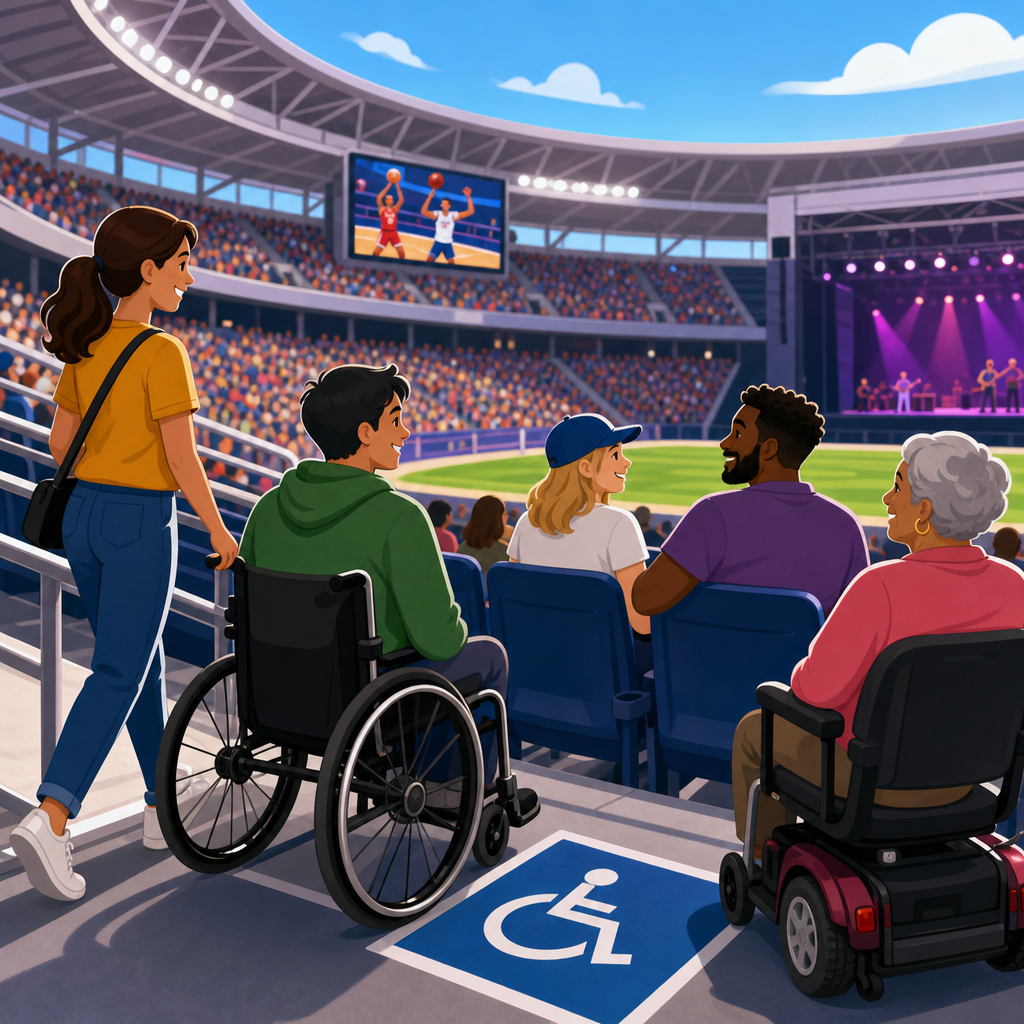
Accessible seating must be integrated and dispersed. That means guests using wheelchairs should have choices across price levels and viewing angles, not only in one end zone or one rear platform. Companion seats must adjoin wheelchair spaces. In assembly areas, lines of sight must allow viewing of the playing area or stage even when spectators in front stand. This point has driven major enforcement and litigation for decades because standing is routine in sports and concerts. If the accessible platform only works while everyone is seated, it fails in real use.
Ticketing is equally important. The Department of Justice has made clear that accessible seats must be sold through the same hours, channels, and terms as other seats, with rules for hold and release, comparable pricing, and resale protections. Operators should train box office teams and third-party platforms so policies for exchanges, transfers, and unsold inventory do not unintentionally discriminate. In my experience, many venue problems arise from software settings and staff scripts rather than from concrete and steel.
Accessible routes, entrances, and vertical circulation
The guest journey begins before the turnstile. Accessible parking must connect to an accessible route that reaches the entrance without forcing people into traffic lanes. Where venues rely on rideshare, shuttle, or paratransit arrivals, passenger loading zones need curb-free access, adequate width, and weather-conscious path planning. On campus and municipal sites, the route from public transit often matters as much as the parking field, especially for weekday games and downtown arenas.
Entrances should offer equivalent public access. If most fans enter through a ceremonial grand stair while accessible entry is hidden at a service door fifty yards away, the experience is not comparable even if technically possible. Power-assisted doors, level thresholds, security screening lanes sized for mobility devices, and clear staff positioning all reduce friction. I have seen smooth operations where magnetometer banks include at least one wider lane at each major gate, with nearby tables placed to preserve turning space and avoid bottlenecks.
Inside, circulation depends on continuous accessible routes to every required amenity and seating location. Elevators are usually essential in multi-level venues; platform lifts can solve limited level changes but should not become the main strategy for moving large crowds. Ramps must respect slope and landing requirements, and cross aisles cannot become storage zones for portable chairs, cleaning carts, or camera cases. Event-day operations often break accessibility after a compliant design is built, so pre-event walkthroughs are necessary.
Wayfinding should support independent travel. Permanent signs identifying accessible entrances, elevators, restrooms, family rooms, and assistive listening pick-up points reduce reliance on staff memory. Digital maps in venue apps can help if they are screen-reader compatible and updated for each event configuration. A concise rule works well: every path promoted to the public should identify whether it is accessible, and every inaccessible path should direct guests clearly to the nearest accessible alternative.
Event seating, sightlines, and premium spaces
Seating design is the core issue in any ADA guide for stadiums, arenas, and event seating because it combines code compliance, ticket economics, and fan experience. Wheelchair spaces are not ordinary loose chairs removed on request. They are planned locations with adjoining companion seats, clear floor space, and accessible routes. They must be dispersed both horizontally and vertically so patrons can select midfield, sideline, baseline, club, upper bowl, and other meaningful options where those choices exist for the general public.
Sightlines require special attention. In sports and concerts, spectators routinely stand during key moments. The accessible seat must still provide a view over standing patrons within the relevant viewing cone. This often changes guardrail heights, row depths, and platform elevations. Designers who only test sightlines in a fully seated condition risk producing compliant drawings that fail on opening night. I always recommend modeling the most likely standing scenarios, including playoff atmosphere or headline concerts, because that is when complaints surface.
Premium environments deserve the same scrutiny as public seating. Suites, loge boxes, club lounges, and bunker seating often involve thresholds, loose furniture, stepped platforms, and food service features that create barriers. If a venue markets premium inventory broadly, accessible options must exist within those offerings where comparable choices are provided. An arena cannot satisfy the requirement by saying wheelchair users can buy a standard concourse platform seat while every luxury buyer without a disability can choose clubs or suites.
| Venue element | Common compliance issue | Better practice |
|---|---|---|
| Upper bowl wheelchair spaces | Clustered only at the rear | Disperse across sections and price points |
| Concert floor seating | Temporary chairs block routes or views | Reserve integrated accessible platforms in the event layout |
| Suites and clubs | Step-up platforms limit entry and viewing | Provide accessible premium inventory with equivalent amenities |
| Companion seating | Separated by aisle or loose chair placement | Adjoin companion seats directly to each wheelchair space |
| Guardrails | Rail height obstructs seated viewing | Coordinate rail design with verified sightline studies |
Temporary seating plans require discipline. Floor seats for graduations, wrestling mats, boxing rings, and special community events can alter route widths, restroom travel distances, and the number or quality of accessible locations. Venue operators should use standard overlay templates reviewed in advance by accessibility specialists, not improvised setups by rental crews under time pressure. That single process change prevents many avoidable failures.
Restrooms, concessions, communication, and guest services
Accessible spectator experience extends beyond the seat. Restrooms need compliant clearances, turning space, grab bars, lavatories, accessories, and door maneuvering clearances, but distribution matters too. If the only accessible restroom on a level is hidden in a staff corridor, fans will not find it during intermission or halftime. Family or all-gender assisted-use rooms can be valuable additions for caregivers, parents, and patrons needing privacy, though they do not replace required multi-user accessibility features.
Concessions and retail areas should offer accessible sales counters, queue routes, condiment access, and payment devices within reach range. High-top drink rails, self-order kiosks, and mobile pickup shelves are frequent problem points in renovated arenas. The fix is usually straightforward: maintain a portion of counters at accessible height, provide staff assistance protocols, and test kiosk software for screen-reader and captioning support. Accessibility at points of sale directly affects spending and wait-time satisfaction.
Communication access is often underdeveloped in sports venues. Assistive listening systems are required in many assembly areas and should be easy to obtain, clean, and return. Captioning on scoreboards and ribbon boards helps deaf and hard of hearing guests follow announcements, penalties, lyrics, and emergency messages. Public address scripts should be mirrored visually during emergencies. Service animal relief areas, sensory rooms, and quiet spaces are not universally mandated in every scenario, but they are increasingly common best practices in modern guest services planning.
Staff training closes the gap between design intent and real-world delivery. Ushers should know accessible seating locations, elevator routes, transfer procedures for movable armrests where provided, and the venue policy for companion seat disputes. Security teams should understand how to screen mobility devices respectfully. Guest services should track accommodation requests before each event and document recurring issues. The most accessible buildings still fail if frontline staff improvise or give conflicting directions.
Operations, audits, and long-term risk management
Accessibility is not a one-time construction milestone. Stadiums and arenas are constantly changing through renovations, sponsorship activations, technology upgrades, and event overlays. Every change can affect circulation, reach ranges, communication access, or seating dispersion. A new self-service beer market, for example, may look efficient but create inaccessible transaction points if gates, shelving, or payment screens are not reviewed. A disciplined venue keeps accessibility in capital planning, procurement, and event operations meetings.
The best audit process combines document review, on-site measurement, event observation, and policy testing. Review drawings and ticket maps first, then verify conditions in the field, then attend a live event to watch crowd behavior. I have seen routes that measured correctly on an empty Tuesday become unusable on Saturday because portable merch carts narrowed the concourse. Include digital systems in the audit as well: website ticketing, mobile applications, parking instructions, and post-purchase communications should all support accessible use.
Prioritization matters, especially in older facilities with budget constraints. Start with barriers that block basic participation: inaccessible entrances, broken elevators, missing seating options, obstructed routes, and ineffective communication during events. Next address high-frequency friction points such as restroom accessories, counter heights, and signage gaps. Then build a phased plan for larger structural corrections. Written transition planning, preventive maintenance logs, and annual staff retraining show seriousness and reduce the chance that known issues are ignored.
As the hub page for Sports and Recreation accessibility, this guide should connect readers to deeper resources on accessible bleachers, aquatic centers, fitness facilities, recreation trails, school stadiums, and temporary event seating. Use this article as your operating baseline: verify the governing ADA standards, audit the full guest journey, protect accessible seating inventory, and train every team that touches the event-day experience. If you manage or design a venue, schedule an accessibility review before your next season or renovation and turn compliance into a measurable service standard.
Frequently Asked Questions
What does the ADA require for stadiums, arenas, and event seating?
The Americans with Disabilities Act requires stadiums, arenas, and similar venues to provide equal access to guests with disabilities across the full event experience. That includes accessible routes from parking, public transit drop-off areas, and sidewalks into the facility; accessible entrances; ticketing access; seating choices; restrooms; concessions; elevators where needed; and access to amenities such as team stores, clubs, and premium spaces. The goal is not simply getting a guest through the door, but making sure they can navigate and use the venue with the same dignity, convenience, and independence as other attendees.
For seating specifically, the ADA focuses on more than just the number of wheelchair locations. Accessible seating must be integrated into the overall seating bowl, dispersed to offer a range of viewing angles, ticket prices, and experiences, and paired with companion seating. In many cases, guests with disabilities must also have lines of sight comparable to other spectators, including the ability to see the event when others stand. Venues also need policies and operations that support access in practice, such as accessible ticket sales, relocation procedures when seats are unavailable, maintenance of lifts and elevators, and staff training for guest assistance. Compliance is both a design issue and an operational responsibility.
How should accessible seating be distributed throughout a stadium or arena?
Accessible seating should be spread throughout the venue in a way that gives guests with disabilities real choice. That means wheelchair and companion seats should not be limited to one section, one price point, or one type of viewing experience. A compliant and guest-friendly venue typically offers accessible seating on multiple levels where feasible, in different areas of the seating bowl, and in locations that reflect the same variety available to the general public, such as lower bowl, upper bowl, sideline, end zone, center court, club areas, and premium seating options where those spaces are offered.
Distribution matters because accessibility is not just about capacity; it is about equivalent opportunity. A guest using a wheelchair should be able to choose between family-friendly areas, quieter locations, premium experiences, or lower-cost seats just like any other customer. Good planning also considers route access to those seats, nearby restrooms and concessions, emergency egress, and whether sightlines remain usable during high-energy moments when crowds stand. Operators should review not only the original design drawings, but also how seating inventory is managed in ticketing systems, how temporary platforms or removable seating affect compliance, and whether renovations have unintentionally reduced usable accessible options over time.
Do accessible seats need to provide clear sightlines when other spectators stand?
Yes. In assembly areas such as stadiums and arenas, accessible seating is generally expected to provide lines of sight comparable to those for other spectators, including in conditions where people in front stand during exciting parts of the event. This is one of the most important and most frequently misunderstood ADA issues in sports and entertainment venues. A wheelchair location that technically faces the playing surface but becomes unusable the moment the crowd stands may create a poor guest experience and raise compliance concerns.
From a practical standpoint, sightline planning should be addressed early in design and carefully reviewed during renovations. Designers often study riser heights, row spacing, guardrail placement, and the relationship between wheelchair spaces and the rows in front. Operators should also remember that sightlines can be affected by temporary staging, camera platforms, standing-room installations, or event-specific layouts. The best approach is to verify that accessible locations remain functional across the range of events hosted in the venue, not just under ideal conditions. Clear sightlines help protect guest satisfaction, reduce complaints, and support the venue’s obligation to offer meaningful access rather than a lesser experience.
What other venue features beyond seating are critical for ADA compliance?
Seating is only one part of accessibility. A truly ADA-conscious stadium or arena must also provide accessible parking and passenger drop-off zones, curb ramps, wide and stable pathways, compliant door hardware, accessible box offices and ticket counters, elevators or ramps where level changes occur, and accessible restrooms on convenient routes. Concession areas should include reachable service counters, readable menus, and maneuvering space for guests using wheelchairs or mobility devices. Drinking fountains, ATMs, retail counters, and guest service desks also need to be evaluated. If the venue offers suites, clubs, press areas, locker room tours, or other specialty spaces to the public, those spaces must be considered as well.
Communication access is just as important. Venues may need assistive listening systems, accessible wayfinding, clear signage, captioning support for audiovisual content, and policies for service animals. Staff training is essential because many access failures happen during operations rather than construction. For example, an accessible route blocked by storage carts, an inoperable elevator, or staff who do not understand accessible ticket exchanges can turn a technically compliant building into an inaccessible experience. The strongest ADA programs combine physical design, preventive maintenance, event-day procedures, and ongoing audits so accessibility remains dependable over time.
How can stadium and arena operators improve accessibility while reducing legal and operational risk?
The most effective strategy is to treat accessibility as an ongoing facility management priority rather than a one-time construction checklist. Operators should start with a comprehensive ADA review of the venue, including seating inventory, accessible routes, vertical transportation, restrooms, concessions, signage, parking, emergency procedures, and ticketing policies. That review should identify both architectural barriers and operational gaps. Once issues are documented, the venue can prioritize corrective actions based on guest impact, life safety, legal exposure, and budget. Even older facilities that cannot be fully rebuilt immediately can often make meaningful improvements through barrier removal, equipment upgrades, policy changes, and better staff training.
Risk reduction also depends on documentation and consistency. Maintain records of inspections, repairs, accessibility complaints, employee training, and any seating or route changes made for special events. Coordinate accessibility planning with architects, code consultants, ticketing teams, security, and guest services so decisions are not made in isolation. When renovations are planned, review them carefully to ensure they improve rather than reduce access. Most importantly, listen to guest feedback. People with disabilities often identify practical issues that are easy to overlook in drawings or compliance checklists. A venue that invests in accessibility not only lowers the chance of complaints and enforcement issues, but also strengthens reputation, expands audience reach, and creates a better event experience for everyone.