ADA compliance, Section 504, and Section 508 are closely related legal frameworks that shape how organizations provide equal access, yet they apply in different ways and to different environments. For schools, healthcare systems, employers, state agencies, software vendors, and federal contractors, understanding where these rules overlap is essential because accessibility failures rarely stay confined to one law. A university website can trigger digital accessibility issues under Section 504 and website access concerns associated with ADA compliance. A federal procurement team may need Section 508 conformance while also managing broader nondiscrimination obligations. I have worked with institutions mapping these obligations across facilities, digital products, procurement, training, and complaint response, and the pattern is consistent: confusion usually comes from assuming the laws are interchangeable.
They are not interchangeable, but they are connected. ADA compliance generally refers to meeting obligations under the Americans with Disabilities Act, a civil rights law prohibiting disability discrimination in employment, government services, public accommodations, transportation, and telecommunications. Section 504 of the Rehabilitation Act prohibits disability discrimination by recipients of federal financial assistance and by certain federal entities. Section 508 of the Rehabilitation Act requires federal agencies to ensure information and communication technology is accessible. In practical terms, the ADA often sets the broad expectation of equal access, Section 504 extends that expectation through federally funded programs, and Section 508 operationalizes accessibility for digital tools, software, documents, and technology procurement within the federal sphere.
This matters because organizations increasingly operate across physical, programmatic, and digital environments at the same time. A hospital may renovate entrances under ADA standards, provide auxiliary aids under Section 504 obligations tied to federal funding, and purchase accessible kiosks or electronic forms that mirror Section 508 criteria. A school district may think only about ramps and classroom accommodations, then discover its PDFs, learning platforms, and video captions create equal access barriers. The cost of misunderstanding these frameworks can include Office for Civil Rights investigations, Department of Justice enforcement, procurement delays, litigation, reputational harm, and avoidable exclusion of disabled users. The better approach is to understand the scope, triggers, and overlap points from the start.
Introduction to ADA Compliance: Scope, Standards, and Core Obligations
ADA compliance starts with a simple principle: people with disabilities must have equal opportunity to participate in everyday life. In implementation, that principle becomes a layered compliance program covering policies, facilities, communication, employment practices, digital access, and complaint resolution. The ADA has several titles, and the most relevant in day-to-day operations are Title I for employment, Title II for state and local government, and Title III for private businesses open to the public. Each title has different enforcement mechanisms and technical expectations, but all require organizations to remove barriers where reasonable and to avoid exclusionary practices.
Key ADA concepts include reasonable accommodation, effective communication, program accessibility, and nondiscriminatory eligibility criteria. For employment, a reasonable accommodation may include schedule changes, assistive technology, or reassignment to a vacant position. For public services and customer-facing operations, effective communication may require sign language interpreters, captioning, accessible websites, or documents in alternate formats. Physical access is often measured against the 2010 ADA Standards for Accessible Design, which cover routes, entrances, restrooms, counters, signage, parking, and more. Digital access is more complex because the ADA does not contain a single codified website checklist, yet enforcement actions and settlements consistently point organizations toward WCAG 2.1 AA as the prevailing technical benchmark.
In practice, ADA compliance is not a one-time retrofit. It is an operational discipline. The strongest programs assign ownership, maintain accessibility policies, train staff, test digital properties, document accommodations, and review vendors before purchase. Organizations that treat ADA compliance as only a facilities issue fall behind quickly because user journeys now move across buildings, mobile apps, self-service kiosks, video content, and cloud software. If this article is your hub page for compliance and implementation, the central idea is this: ADA compliance provides the broad civil rights framework that should inform every accessibility decision, even when another statute supplies the more specific rule.
What Section 504 Covers and Why It Reaches So Many Organizations
Section 504 is often underestimated because many leaders assume it applies only to schools. In reality, it reaches any program or activity receiving federal financial assistance, including colleges, hospitals, housing providers, state agencies, nonprofit service organizations, and many contractors operating funded programs. Section 504 states that no qualified individual with a disability shall, solely by reason of disability, be excluded from participation in, denied benefits of, or subjected to discrimination under covered programs. That language is broad, and enforcement has historically been broad as well.
In education, Section 504 is widely associated with academic adjustments, equal access to programs, and 504 plans for students whose disabilities substantially limit major life activities. In healthcare, it can affect communication access, accessible medical equipment, intake forms, websites, and service delivery policies. In housing and social services, it can shape application processes, grievance procedures, and physical or digital access to benefits. Agencies such as the U.S. Department of Education Office for Civil Rights and the U.S. Department of Health and Human Services enforce Section 504 within their sectors, often examining whether an organization has equal access in practice, not merely written intent.
One reason Section 504 overlaps so often with ADA compliance is that institutions receiving federal funds are frequently also employers, public entities, or places of public accommodation. A public university, for example, may face ADA Title II obligations while also being directly accountable under Section 504. When I assess these environments, I usually find that governance failures matter more than legal theory. Separate teams handle disability services, procurement, website management, facilities, and HR, but users experience one institution. If policies are fragmented, the same barrier can violate multiple frameworks simultaneously.
What Section 508 Requires for Digital Accessibility and Procurement
Section 508 is narrower in scope than the ADA or Section 504, but it is more concrete in digital implementation. It requires federal agencies to develop, procure, maintain, and use accessible information and communication technology. The modern 508 standards, refreshed in 2017, align substantially with WCAG 2.0 AA for web and electronic content and also address software, hardware, support documentation, and telecommunications. For teams that need a practical rule set, Section 508 often serves as the clearest compliance baseline because it translates the principle of equal access into testable technical criteria.
The law matters beyond federal agencies because procurement requirements cascade to vendors. If you sell software, websites, platforms, electronic documents, kiosks, or IT services into the federal market, accessibility conformance becomes a business requirement. The most common evidence requested is the Voluntary Product Accessibility Template, or VPAT, which vendors use to document how products conform to the relevant accessibility criteria. A VPAT is not a certification, and weak VPATs are easy to spot. They overstate support, ignore exceptions, or fail to describe testing methods. Federal buyers increasingly expect detailed, accurate reporting backed by manual testing, assistive technology validation, and remediation plans.
Section 508 also influences organizations outside the federal government because it provides a familiar framework for digital accessibility governance. State universities, healthcare systems, and enterprise procurement teams often adapt 508-style requirements into contracts, design systems, and document workflows. That does not mean Section 508 applies directly to every private company. It means its standards and procurement discipline are useful models. In many implementations, I have seen 508 act as the operational bridge between broad legal obligations and the actual work of fixing code, documents, media, and technology purchasing.
Where ADA Compliance, Section 504, and Section 508 Overlap
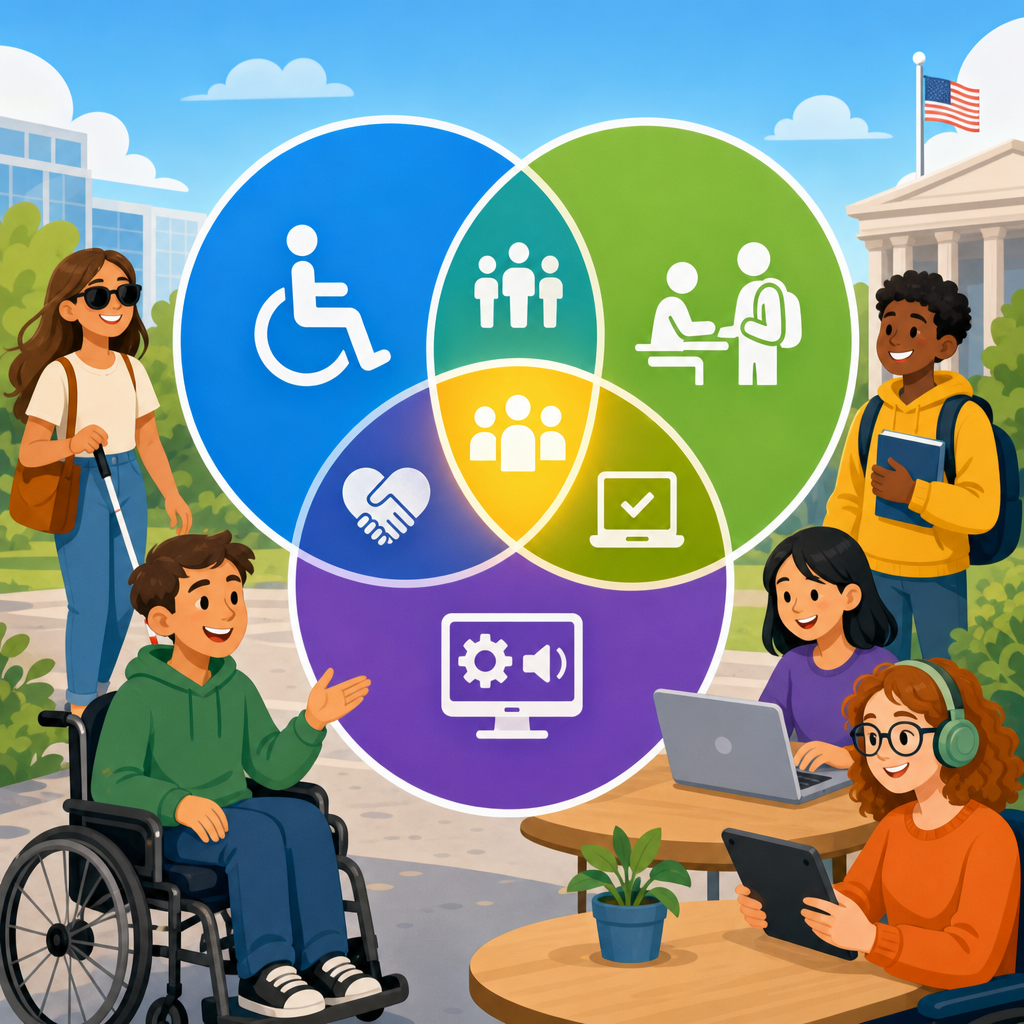
The overlap is easiest to understand by looking at the user experience rather than the statutes. If a person with a disability cannot apply for a job, enroll in a class, access a public service, use a website, read a PDF, watch a training video, or operate a kiosk, the organization may have created a barrier that triggers more than one legal obligation. The common denominator is equal access. All three frameworks seek to prevent exclusion, require accommodations or accessible design, and expect covered entities to act proactively when barriers are known.
| Framework | Primary Coverage | Common Accessibility Focus | Typical Example |
|---|---|---|---|
| ADA | Employers, public entities, public accommodations | Physical access, communication, policies, digital access | Accessible entrance, captioned videos, website usability |
| Section 504 | Federal fund recipients and certain federal programs | Program access, accommodations, nondiscrimination | Accessible student services and medical intake process |
| Section 508 | Federal agencies and federal ICT procurement | Accessible technology, documents, software, hardware | WCAG-conformant web platform with tested keyboard access |
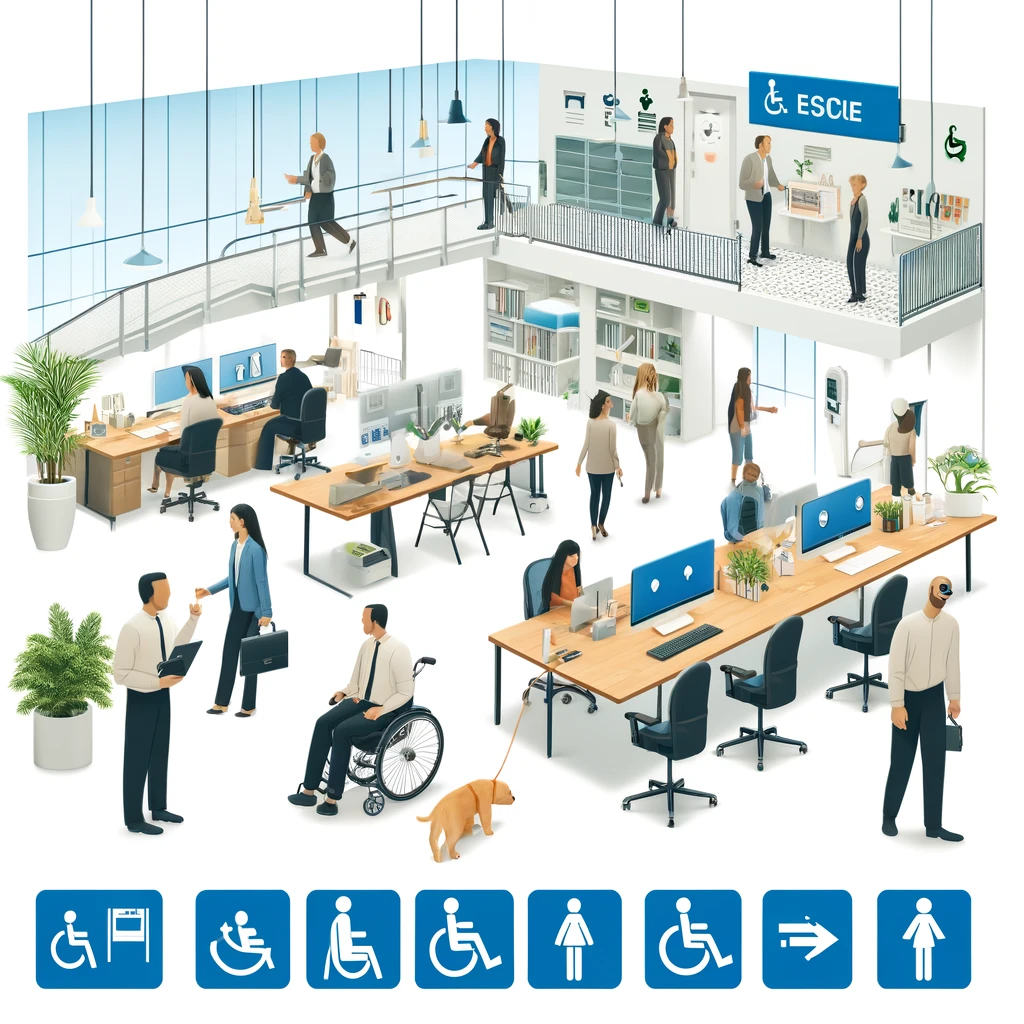
Consider a community college. Its campus pathways and classrooms implicate ADA physical access standards. Its academic programs and student support services are subject to Section 504 because of federal funding. Its website, learning management system content, and digital documents may be reviewed through both ADA and Section 504 lenses, while any federal procurement conditions may borrow 508-style criteria. Or consider a hospital system. Interpreter services, exam table access, online appointment tools, patient portal forms, and discharge instructions may all be part of one accessibility journey even though different teams manage them. The legal analysis differs by setting, but the implementation work overlaps heavily.
This is why mature organizations build a unified accessibility program instead of treating each law as a silo. Policies should define standards, assign accountability, require accessible procurement, establish accommodation workflows, and create a clear path for remediation. The overlap is not a source of redundancy to avoid; it is a signal that accessibility must be integrated across operations.
Key Differences, Common Misunderstandings, and Practical Compliance Strategy
The biggest difference is coverage. The ADA is the broad civil rights framework covering employment, public services, and public accommodations. Section 504 is tied to federal funding and program access. Section 508 is specifically about accessible information and communication technology in the federal context. Another difference is how technical the rules are. ADA obligations can be broad and principle driven, especially for digital access, while Section 508 offers more explicit technical criteria through incorporated standards. Section 504 often sits in the middle, pairing broad nondiscrimination requirements with sector-specific guidance and enforcement expectations.
A common misunderstanding is that passing an automated website scan equals compliance. It does not. Tools like axe, WAVE, Accessibility Insights, and Lighthouse are valuable for detecting missing labels, contrast issues, and structural errors, but they cannot verify meaningful alternative text, logical focus order, accurate captions, or screen reader usability in complex workflows. Another mistake is assuming accessibility belongs only to legal or IT teams. Real compliance depends on content authors, procurement staff, facilities managers, HR professionals, trainers, and leadership. If purchasing contracts ignore accessibility, inaccessible systems will keep entering the environment faster than remediation teams can fix them.
The most effective strategy is to start with a risk-based inventory. Identify your public-facing websites, internal systems, forms, video libraries, mobile apps, PDFs, kiosks, physical service points, and accommodation processes. Map which laws apply based on entity type, funding, and procurement role. Then adopt standards, usually the 2010 ADA Standards for physical spaces and WCAG 2.1 AA or stronger for digital content. Build testing into design and procurement, require credible VPATs from vendors, train content owners, and document remediation decisions. Accessibility complaints should feed directly into governance, because recurring issues usually reveal a broken process, not a one-off mistake.
The practical takeaway is straightforward: ADA compliance, Section 504, and Section 508 overlap wherever disabled people interact with organizations, but each framework has its own trigger, scope, and implementation style. The ADA sets the broad expectation of equal opportunity across employment, public services, and public accommodations. Section 504 extends that expectation throughout federally funded programs and activities. Section 508 makes digital accessibility and technology procurement measurable within the federal ecosystem, while also influencing best practices far beyond it.
For a compliance and implementation hub, the most important lesson is to stop treating accessibility as a narrow legal checkbox. It is a governance issue, a design issue, a procurement issue, and a service delivery issue. Organizations that succeed usually do three things well: they understand which laws apply, they adopt clear technical and operational standards, and they assign responsibility across departments. That approach reduces legal risk, improves user experience, and creates more resilient systems for everyone, including people using screen readers, captions, keyboards, voice input, or alternative formats.
If you are building or updating your accessibility program, use this page as your starting point. Review your obligations, inventory your barriers, align your standards, and prioritize remediation where people are most likely to be excluded. Then move from awareness to implementation with audits, training, procurement controls, and documented accessibility governance.
Frequently Asked Questions
What is the main difference between ADA compliance, Section 504, and Section 508?
The main difference is scope: each law or regulatory framework is aimed at preventing disability-based exclusion, but they apply to different entities, activities, and types of access barriers. The Americans with Disabilities Act, or ADA, is the broad civil rights law that applies across much of public life, including employment, state and local government services, and places of public accommodation. Section 504 of the Rehabilitation Act applies to programs and activities that receive federal financial assistance, as well as certain federal entities. Section 508 of the Rehabilitation Act is more specifically focused on information and communication technology used, developed, procured, or maintained by the federal government.
In practice, that means the ADA is often the broadest framework people recognize, Section 504 is especially important for schools, universities, hospitals, and other federally funded organizations, and Section 508 is the rule set most commonly associated with digital accessibility obligations in federal technology. They overlap because accessibility problems often affect more than one legal duty at the same time. For example, an inaccessible university website may raise concerns under Section 504 if the institution receives federal funds, and it may also implicate ADA obligations depending on the institution’s status and services. Likewise, a federal contractor selling software to an agency may need to meet Section 508 technical accessibility expectations while also thinking about broader ADA and Section 504 exposure in how the product is used by employees, students, patients, or members of the public.
Where do ADA, Section 504, and Section 508 overlap the most?
The strongest overlap usually appears where digital access, public services, education, employment, and federally supported programs intersect. All three frameworks are rooted in the same basic principle: people with disabilities must have meaningful, equal access rather than being shut out by preventable barriers. That shared principle is why a single accessibility failure can quickly become a multi-law issue. A broken captioning workflow, an inaccessible online form, a learning platform that cannot be used with a screen reader, or software that requires a mouse can create risks in more than one legal category at once.
Educational institutions are one of the clearest examples. A college or university may face ADA responsibilities, Section 504 obligations because of federal funding, and, in some contexts, technology procurement standards that reflect Section 508 requirements or expectations. Healthcare systems can face similar overlap when patient portals, telehealth tools, intake forms, and employee systems are inaccessible. State and local agencies may encounter ADA Title II obligations while also operating federally funded programs that trigger Section 504 requirements. Federal agencies and the vendors that support them often see the overlap in procurement, internal systems, public-facing websites, and digital documents.
Put simply, the overlap is greatest anywhere accessibility is not just about a building entrance or restroom but about the full user experience: websites, software, forms, documents, videos, kiosks, mobile apps, classroom tools, HR systems, and customer-facing services. That is why organizations should not treat these laws as isolated checklists. Accessibility governance, training, procurement review, testing, and remediation need to work across legal categories, because users do not experience barriers according to statutory boundaries.
Does meeting Section 508 automatically mean an organization is compliant with the ADA or Section 504?
No. Meeting Section 508 can be very helpful, especially for digital accessibility, but it does not automatically guarantee ADA or Section 504 compliance. Section 508 is focused on accessibility standards for information and communication technology in the federal context, and it is often tied to technical criteria and procurement expectations. By contrast, the ADA and Section 504 are broader civil rights requirements that look at whether individuals with disabilities have equal access to programs, services, benefits, employment opportunities, and participation overall.
This distinction matters because legal compliance is not only about whether a website, document, or software product technically aligns with accessibility standards. It is also about whether people can actually use the service in a timely, effective, and equivalent way. An organization may have a product that appears to satisfy many Section 508-related technical measures, yet still fail under the ADA or Section 504 if its policies, support processes, accommodation procedures, training gaps, or implementation choices create barriers. For instance, accessible software can still be deployed in an inaccessible workflow if staff upload unreadable PDFs, provide uncaptioned videos, or route disabled users through slower and less effective alternatives.
That is why organizations should think in layers. Section 508 can provide a strong technical foundation for accessible ICT, but ADA and Section 504 analysis requires a broader operational view. The strongest compliance strategy is to combine technical conformance testing with user-centered review, policy development, procurement controls, documentation standards, captioning and document workflows, and clear accommodation procedures.
Which organizations need to pay the closest attention to all three frameworks at once?
Organizations that operate across education, healthcare, government, public services, employment, and technology procurement should pay particularly close attention to all three. Public universities, community colleges, hospital systems, state agencies, local governments, research institutions, and large nonprofits that receive federal funds are frequently in the overlap zone. So are software vendors and federal contractors whose products are used by agencies, educational institutions, or healthcare organizations. In many cases, even private employers and businesses that do not think of themselves as “federal” entities still encounter Section 504 or Section 508 expectations indirectly through contracts, grants, partnerships, or customer requirements.
Universities are a classic example because they often employ large workforces, serve the public, receive federal financial assistance, and rely heavily on websites, learning management systems, course materials, research tools, procurement platforms, and mobile applications. Healthcare systems similarly manage patient-facing and employee-facing technologies while navigating civil rights, funding, and operational obligations. State agencies and municipalities must consider public access to services while also reviewing the accessibility of documents, online portals, and third-party software. Vendors should be especially cautious because their accessibility commitments are often scrutinized during procurement and can later become central in complaints, audits, contract disputes, or remediation demands.
The practical takeaway is simple: if an organization serves the public, receives federal funds, sells technology into regulated environments, or manages digital systems used by employees, students, patients, or residents, it should assume accessibility duties may overlap. Waiting to sort out which law applies after a complaint arrives is a risky and expensive approach.
What is the best way for an organization to manage overlapping ADA, Section 504, and Section 508 obligations?
The best approach is to build one coordinated accessibility program instead of treating each legal framework as a separate silo. Organizations should start by identifying where accessibility obligations arise: employment, websites, mobile apps, PDFs, videos, procurement, classroom tools, customer service channels, patient portals, internal systems, and physical service delivery. From there, leadership should assign ownership, adopt clear accessibility policies, and create review processes that cover both technical standards and practical user access.
A strong program usually includes accessible procurement requirements, regular audits of websites and software, document and media accessibility workflows, staff training, accommodation procedures, complaint handling protocols, and remediation timelines. It should also include contract language for vendors, testing before rollout, and ongoing monitoring after deployment. For organizations working with federal agencies or federally funded programs, documenting accessibility decisions and evaluation methods is especially important. If a product is purchased, updated, or custom-built, decision-makers should be able to show what standards were used, what testing occurred, what exceptions were considered, and how barriers will be addressed if discovered.
Most importantly, organizations should focus on usability, not just paperwork. Real users with disabilities should be able to complete core tasks independently and effectively, whether that means applying for a job, registering for classes, accessing medical records, filling out forms, watching required video content, or using internal workplace systems. When organizations center accessibility in governance, procurement, design, and service delivery, they are in a far better position to manage ADA, Section 504, and Section 508 obligations together rather than reacting to them one complaint at a time.