The Americans with Disabilities Act (ADA) was signed into law on July 26, 1990. This landmark civil rights legislation has played a pivotal role in promoting the rights and inclusion of people with disabilities in various aspects of daily life. From ensuring accessible public spaces to mandating non-discriminatory employment practices, the ADA has been a vital force in fostering equality.
One of the most significant areas where the ADA has had an impact is in the realm of assistive technologies. These technologies span a wide range of devices and services designed to enable and enhance the functional capabilities of individuals with disabilities. The evolution of assistive technologies has helped bridge the gap between limitations and potential, allowing for greater independence, productivity, and inclusion.
This article delves into the past accomplishments, current advancements, and future prospects of assistive technologies under the ADA framework. By exploring specific focus areas, we aim to shed light on how these technologies have transformed lives and what exciting innovations lie on the horizon.
Early Assistive Technologies Before the ADA
Before the ADA was enacted, assistive technologies were often rudimentary and limited in scope. Devices such as basic prosthetics, hearing aids, and manual wheelchairs were among the primary aids available. While these devices did provide some level of assistance, they were far from sufficient in addressing the broad spectrum of needs and challenges faced by individuals with disabilities.
The lack of legal mandates for accessible infrastructure further compounded these challenges. For example, public buildings rarely had ramps or elevators, making it difficult for wheelchair users to access them. Communication tools for those with hearing or visual impairments were also scarce, rendering many educational and professional opportunities inaccessible.
During this era, assistive technologies were largely seen as supplementary rather than essential. Funding for research and development was limited, and there was a significant gap in public awareness regarding the potential of these technologies to enhance quality of life. The ADA’s introduction marked a turning point, signaling a commitment to addressing these gaps and promoting broader accessibility through technological innovation.
Post-ADA Advancements in Assistive Technologies
The enactment of the ADA catalyzed a wave of advancements in assistive technologies. One of the primary drivers was the law’s requirement for public and private entities to accommodate individuals with disabilities, which spurred innovation and increased investments in this field.
Notable advancements included the development of more sophisticated mobility aids, such as powered wheelchairs and stairlifts. Computer-based technologies also began to make significant strides. Screen readers, like JAWS (Job Access With Speech), opened up the digital world to visually impaired users, while speech recognition software enabled individuals with mobility impairments to operate computers and other devices hands-free.
Hearing aid technology also saw remarkable improvements, with digital and programmable models offering better sound quality and bespoke settings that could cater to a wide range of hearing impairments. Furthermore, text-to-speech and speech-to-text technologies became invaluable tools for individuals with communication disorders.
These advancements were not just instrumental in improving daily life for individuals with disabilities but also paved the way for greater educational and employment opportunities. The ADA’s influence ensured that assistive technologies were no longer seen as optional, but as integral components of a fully inclusive society.
Assistive Technologies in Education
The impact of the ADA on educational settings has been transformative. Assistive technologies have played a critical role in leveling the playing field for students with disabilities. Schools, colleges, and universities are now more equipped than ever to provide accessible learning environments.
One key area of development has been in personalized learning tools. Software applications that provide real-time transcription of lectures, for instance, have been incredibly beneficial for students with hearing impairments. Similarly, digital textbooks with adjustable fonts and screen reader compatibility have made learning materials more accessible to students with visual impairments.
Cognitive and learning disabilities have also been addressed through technology. Apps and software designed for task management, time tracking, and organizational skills have empowered students with ADHD and other cognitive disorders to excel in academically demanding environments. Additionally, tools such as augmentative and alternative communication (AAC) devices have enabled students with speech impairments to participate actively in classroom discussions.
The ADA has set the stage for an inclusive educational experience, ensuring that assistive technologies are implemented to support every student’s right to learn and succeed, irrespective of their disabilities.
Workplace Integration of Assistive Technologies
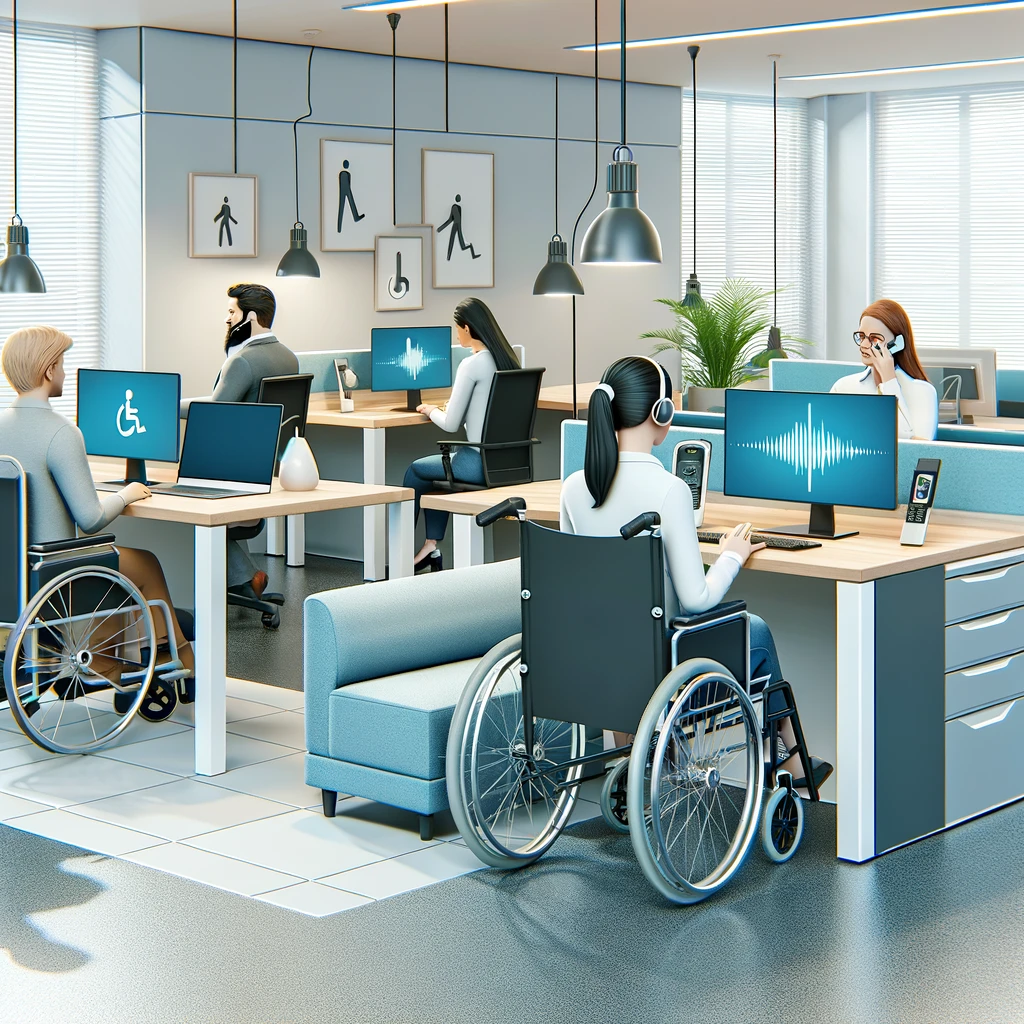
Ensuring that workplaces are accessible to all has been a pivotal aspect of the ADA. Assistive technologies have been integral to achieving this goal, allowing individuals with disabilities to contribute effectively and efficiently in professional settings.
Ergonomic workstations designed to accommodate various physical needs, such as adjustable desks and adaptive keyboards, have become commonplace. For visually impaired employees, screen magnifiers and Braille displays have made computer tasks much more accessible. Similarly, hearing-impaired workers can now benefit from advanced hearing aids and real-time captioning services during meetings and conference calls.
Software solutions have also facilitated greater inclusivity. Voice-to-text applications enable employees with motor impairments to manage documentation and communication tasks seamlessly. Additionally, remote work technologies and teleconferencing tools have ensured that individuals with mobility issues have the flexibility to work from environments that best suit their needs.
The ADA’s emphasis on reasonable accommodation has driven employers to adopt various assistive technologies, fostering a workplace culture that values the contributions of all employees and supports their need for customized work solutions.
Future Prospects of Assistive Technologies
The horizon of assistive technologies looks promising with continuous advancements fueled by emerging technologies like artificial intelligence (AI), augmented reality (AR), and the Internet of Things (IoT).
AI-driven applications hold immense potential in the realm of assistive technology. For instance, AI-powered speech recognition is becoming more accurate and intuitive, offering improved communication tools for individuals with speech and language disorders. Smart prosthetics, guided by AI, are evolving to provide feedback and adjustments in real-time, significantly enhancing mobility and dexterity.
AR is another exciting frontier. By overlaying digital information onto the physical world, AR can create immersive learning environments for students with disabilities. For instance, AR apps can provide directions and detailed descriptions of museum exhibits through visual and auditory cues, making cultural experiences more inclusive.
The IoT is paving the way for a more connected and responsive ecosystem of assistive devices. Smart homes equipped with IoT devices can tailor environments to meet the specific needs of their residents, such as automated lighting, climate control, and security systems that are easily navigable by individuals with various disabilities. The continued integration of these sophisticated technologies is set to revolutionize the assistive tech landscape, offering new levels of accessibility and independence.
Conclusion
Since its inception, the ADA has been a cornerstone of disability rights and accessibility in the United States. Its impact on the development and implementation of assistive technologies cannot be overstated. By mandating accessibility and promoting the rights of individuals with disabilities, the ADA has fostered an environment of innovation and inclusion.
From the early days of rudimentary aids to the sophisticated technologies we see today, assistive devices have come a long way. They have broken down barriers, creating opportunities for education, employment, and day-to-day living. The advancements propelled by the ADA have enabled countless individuals to lead more independent, productive, and fulfilling lives.
As we look towards the future, the continued evolution of assistive technologies promises to open up even more possibilities. Emerging technologies like AI, AR, and IoT stand to further transform how we think about inclusion and accessibility. The future is bright, and the ADA will undoubtedly continue to be a guiding force in ensuring that technological innovations benefit everyone.
In summation, the ADA’s influence on assistive technologies represents a key victory in the broader struggle for disability rights and accessibility. It is a testament to the importance of legislation in shaping a more equitable society and the powerful role that technology can play in achieving these ideals.