Accessible transit innovations beyond the United States are reshaping how cities move older adults, disabled passengers, tourists, and families with strollers, proving that inclusive mobility is not a niche upgrade but a core public service. In transportation, accessibility means designing vehicles, stations, sidewalks, ticketing systems, and staff procedures so people with different physical, sensory, cognitive, and language needs can travel safely and independently. I have worked on accessibility content and transport audits long enough to see a clear pattern: the strongest systems do not rely on one feature, such as wheelchair ramps or priority seating. They combine policy, engineering, digital information, maintenance standards, and frontline training. That matters because public transit is often the gateway to employment, education, health care, and civic life. When a station elevator fails, an audio announcement is unclear, or a bus stop lacks tactile guidance, the result is not a minor inconvenience; it is exclusion. Looking beyond the United States is especially useful because many countries have approached accessibility through different legal frameworks, urban forms, and funding models. Japan has integrated universal design into rail modernization, the United Kingdom has strengthened passenger rights and step-free planning, Singapore has tied accessibility to network expansion, and cities in Latin America have embedded access improvements into bus rapid transit and public space upgrades. This hub article maps the most important international innovations and strategies in accessibility, explains why they work, and highlights where they still fall short. It is designed to give readers a practical foundation for deeper exploration across the broader International Perspective topic.
Universal design in stations, stops, and vehicles
The most effective accessible transit systems start with universal design, a planning approach that reduces the need for special accommodation by making ordinary infrastructure usable by the widest range of people. In practice, that means step-free station entrances, level boarding, high-contrast wayfinding, tactile paving, consistent handrail placement, accessible fare gates, and space for wheelchairs and mobility scooters inside vehicles. Japan offers one of the clearest examples. Under barrier-free transport policies, rail operators in major metropolitan areas have steadily expanded elevators, platform screen doors, accessible toilets, and tactile ground surface indicators. Tactile paving, first developed in Japan, is now a global standard and remains one of the most visible examples of a local innovation scaling internationally.
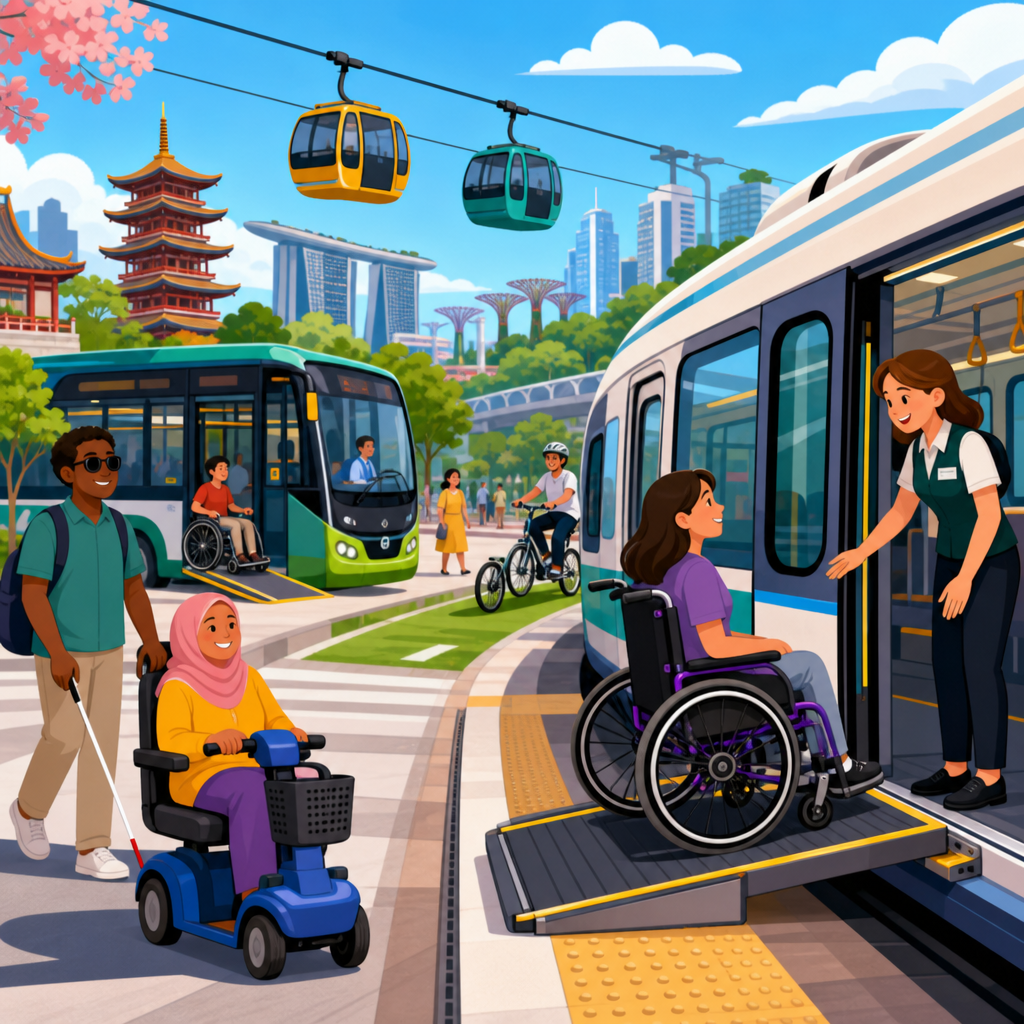
Vehicle design has evolved as well. Low-floor buses in cities such as London, Berlin, and Stockholm reduce boarding time while improving access for wheelchair users, travelers with luggage, and parents with prams. Many tram systems in France and Germany pair low-floor rolling stock with raised platforms to minimize horizontal and vertical gaps. In my experience reviewing system design choices, level boarding delivers one of the highest accessibility returns because it removes friction for many users at once. The tradeoff is cost and legacy infrastructure complexity. Older networks often require expensive platform reconstruction, selective station upgrades, or mixed fleets during transition periods. Even so, the long-term operational benefits are substantial: fewer boarding delays, lower dependence on staff assistance, and more predictable journeys for everyone.
Information accessibility and multilingual wayfinding
Physical access is only half of accessible transit. Passengers also need information they can perceive, understand, and trust. Leading systems outside the United States increasingly treat accessible information as infrastructure, not decoration. That includes synchronized audio and visual announcements, clear signage, plain-language service alerts, induction loops at help points, tactile maps, and digital trip tools built to recognized accessibility standards such as WCAG. Transport for London has invested heavily in multimodal information, combining maps, announcements, staff protocols, and accessibility guides so riders can plan around step-free routes, platform gaps, and interchange constraints. The result is not perfect, but it shows that detailed journey information can be as important as ramps and elevators.
Multilingual wayfinding is another major international strategy, especially in cities with large tourist flows or diverse resident populations. Singapore’s transit system pairs high legibility signage with consistent pictograms and route numbering that reduce dependence on language fluency. In Seoul and Hong Kong, real-time displays, color-coded lines, and standardized station naming support both disabled passengers and occasional users navigating complex systems. For blind and low-vision riders, consistency matters more than flashy design. A sign family with predictable placement, contrast, and terminology is easier to use than a visually impressive but inconsistent system. For deaf and hard-of-hearing users, visual redundancy matters most. Every operational announcement should have an on-screen equivalent. Systems that treat communication as a layered experience tend to outperform those that rely on one channel.
Digital tools, real-time data, and journey confidence
Recent innovation has shifted from static compliance toward dynamic journey confidence. A wheelchair user does not just need to know whether a station has an elevator; they need to know whether that elevator is working right now. A blind passenger does not just need a route map; they need reliable stop announcements and accurate turn-by-turn guidance between street and platform. This is where digital accessibility and operational data intersect. In the United Kingdom, rail and urban transport agencies increasingly publish elevator status, disruption alerts, and accessibility maps through websites and apps. In the Netherlands, integrated journey planners can filter routes based on access needs, reducing uncertainty before a trip begins.
Some of the most promising work is happening through open data. When agencies publish machine-readable information on stop accessibility, boarding conditions, and outages, third-party developers can build specialized tools for users with specific needs. That creates an ecosystem instead of a single official interface. It also raises a governance issue I have seen repeatedly: bad data can be worse than missing data. If a map claims a route is step-free but leaves out a steep transfer ramp or a recurring lift outage, trust collapses quickly. High-performing agencies therefore connect accessibility data to asset management, maintenance reporting, and customer service. Accuracy, update speed, and accountability are what turn digital features into genuine accessibility innovations.
Policies, enforcement, and funding strategies
International accessibility gains rarely happen through design alone. They depend on enforceable policy, dedicated funding, and measurable deadlines. The United Kingdom’s Equality Act, European rail passenger rights rules, and national accessibility regulations across countries such as Australia and Canada have pushed operators to formalize standards for assistance, vehicle procurement, and station upgrades. Policy matters because transit agencies naturally face competing demands: capacity expansion, decarbonization, state-of-good-repair work, and labor costs. Without clear legal obligations, accessibility can slide into a deferred improvement category.
Funding strategy is equally important. Some countries tie accessibility upgrades to major renewal cycles, using fleet replacement and station modernization projects to capture efficiency. Others create targeted capital programs. The strongest approach usually combines both. Accessibility should be embedded in baseline investment decisions, but some barriers are too urgent to wait for long asset cycles. A practical way to understand the policy landscape is to compare how common strategies function in real systems.
| Strategy | How it works | Example beyond the U.S. | Main limitation |
|---|---|---|---|
| National legal mandate | Sets minimum accessibility duties for operators and infrastructure owners | United Kingdom equality and passenger rights framework | Compliance can be uneven across older networks |
| Universal design procurement | Requires new vehicles and stations to meet access specifications from the start | Singapore MRT and bus fleet upgrades | Legacy stations may still create gaps |
| Network renewal integration | Adds lifts, signage, and platform works during broader modernization | Japanese rail station retrofits | Progress can be gradual where networks are large |
| Open data and service transparency | Publishes outage and route accessibility information for trip planning | Dutch and British journey planning tools | Requires disciplined data maintenance |
Enforcement remains the deciding factor. Standards that are not audited, funded, and tied to operator performance tend to produce visible flagship projects but inconsistent daily service. The lesson from international practice is simple: accessibility improves fastest when it is treated as an operational requirement, not an optional design aspiration.
Training, assistance models, and the human factor
Even highly accessible infrastructure can fail passengers if staff procedures are weak. Across Europe and Asia, one of the most important but undervalued innovations has been the professionalization of assistance services. This includes standardized boarding assistance protocols, disability awareness training, escalation procedures during disruption, and clear responsibility for helping passengers complete transfers. On many rail systems, booked assistance remains essential for some trips, especially where platform gaps or legacy stations persist. The best operators use that model as a bridge, not a substitute for independent access.
I have seen firsthand that training quality determines whether a policy works under pressure. A staff member who understands how to communicate with a deaf passenger during a platform change, position a boarding ramp safely, or describe wayfinding verbally can prevent a stressful trip from becoming an impossible one. Countries such as the United Kingdom and Australia have invested in formal guidance and complaint mechanisms that push operators beyond token awareness sessions. Meanwhile, Japan’s emphasis on station staffing and orderly passenger flow often supports effective on-the-ground assistance, though heavy peak demand can still create challenges. Human support must also account for hidden disabilities and neurodivergent riders. Quiet spaces, predictable announcements, and simplified disruption messaging are not extras; they are practical features that widen access.
Lessons from bus rapid transit, paratransit, and inclusive urban mobility
Accessible transit innovation is not limited to metro and rail networks. In Latin America, bus rapid transit systems in cities such as Curitiba and Bogotá helped popularize features like level boarding platforms, off-board fare collection, and clearly designated boarding zones. These systems were not designed perfectly for every user, and overcrowding can undermine accessibility, but they showed that bus-based networks can deliver high-capacity service with strong access features when stations, vehicles, and sidewalks are designed together. The broader lesson is that accessibility depends on the full trip chain. A low-floor bus is far less useful if the path to the stop is broken, unlit, or blocked.
Paratransit and demand-responsive transport also remain part of the international accessibility picture. No fixed-route system can meet every need, especially in low-density areas or for riders requiring door-to-door support. The most effective strategy is integration rather than substitution. Cities should improve mainstream transit while coordinating specialized services, concessionary fares, and accessible taxi programs. European cities increasingly connect these modes through unified booking, payment, or travel training. That matters because independence is shaped by options. A person may use rail for commuting, a demand-responsive service for medical appointments, and an accessible taxi during disruptions. Inclusive mobility planning recognizes that real lives do not fit a single mode.
What this hub covers and where international practice is heading
As a hub for International Innovations and Strategies in Accessibility, this page frames the questions readers should ask when evaluating any transit system beyond the United States. Does the network provide step-free access from street to vehicle? Are audio, visual, tactile, and digital information channels aligned? Can riders verify elevator status and route conditions in real time? Are staff trained to support both visible and non-visible disabilities? Is accessibility built into procurement, capital planning, and performance management? Those questions apply whether the case study is a Tokyo rail interchange, a London bus corridor, a Singapore MRT extension, or a Bogotá BRT station.
International practice is moving toward a more complete standard: accessible transit must be continuous, data-informed, and independently usable. The next wave will likely focus on predictive maintenance for lifts and escalators, better indoor navigation, more accurate crowding data, and stronger co-design with disabled riders. The core takeaway is clear. The best accessible transit innovations beyond the United States do not emerge from isolated features. They come from systems that connect design, information, operations, and accountability. Use this hub to compare countries, identify transferable strategies, and dig into the linked subtopics that explain how inclusive mobility is being built in the real world today.
Frequently Asked Questions
What does “accessible transit” mean in an international context?
Accessible transit refers to transportation systems that are intentionally designed so people with a wide range of needs can use them safely, comfortably, and independently. In practice, that goes far beyond adding a ramp to a bus. It includes low-floor vehicles, level boarding between platforms and trains, elevators that are reliable and easy to find, tactile paving for blind and low-vision passengers, clear audio and visual announcements, multilingual wayfinding, accessible ticket machines, priority seating, stroller-friendly layouts, and staff training that supports respectful assistance. In many countries, accessibility also includes digital tools such as mobile journey planners with step-free routing, real-time elevator outage alerts, and booking systems that work with screen readers.
Outside the United States, the most successful transit systems tend to treat accessibility as a system-wide design principle rather than a special service for a small group. That means older adults, wheelchair users, people with hearing or vision disabilities, travelers carrying luggage, parents with strollers, and visitors unfamiliar with the language all benefit from the same improvements. Internationally, accessible transit is increasingly viewed as a core public service and a measure of good urban governance. When accessibility is built into infrastructure, operations, information, and customer service from the start, transit becomes more usable for everyone and cities become easier to navigate overall.
Which countries or cities are leading in accessible transit innovations beyond the United States?
Several cities and countries have become important examples, though each excels in different ways. In Europe, cities such as London, Vienna, Stockholm, and Barcelona have invested heavily in step-free access, coordinated wayfinding, and multimodal planning that helps riders move between bus, tram, metro, and rail systems with fewer barriers. London is particularly notable for publishing accessibility information in detail, including step-free maps and station-specific features, which helps riders make informed decisions before they travel. In Scandinavia, transit agencies often pair physical accessibility with strong passenger information systems, making the full journey more predictable.
In Asia, cities such as Singapore, Tokyo, and Seoul are frequently cited for combining high-capacity transit with impressive attention to usability. Singapore has built a strong reputation for barrier-free station design, elevator availability, tactile guidance, and integrated trip planning. Japan, while operating in a very complex rail environment, has advanced platform safety measures, accessible station retrofits, detailed signage, and highly organized staff support. Seoul has expanded low-floor buses, accessible metro features, and digital information tools that improve navigation for both residents and visitors.
Elsewhere, Australia and parts of Canada have also contributed important models, especially in accessible tram systems, curb design, and universal design standards. The key point is that no single city has solved everything. The most instructive international examples are those that combine infrastructure, operations, technology, and policy into one coherent approach. Cities that lead on accessibility usually do so because they treat it as an ongoing public commitment, not a one-time construction project.
What kinds of innovations are making the biggest difference for disabled riders, older adults, and families?
The most effective innovations are often the ones that remove friction across the entire travel chain. Level boarding is one of the biggest game changers because it reduces or eliminates the gap between vehicle and platform, making boarding easier for wheelchair users, people using walkers or canes, and parents with strollers. Low-floor buses and trams, wider doorways, dedicated mobility spaces, and better platform design also improve everyday usability. Elevators and ramps matter, but reliability matters just as much; an elevator that is frequently out of service can make an otherwise “accessible” route unusable.
Information design is another major area of progress. Clear visual displays, high-quality audio announcements, tactile maps, simplified station layouts, color-coded lines, and internationally understandable symbols help people with sensory, cognitive, and language-related needs. Real-time alerts about delays, platform changes, and equipment outages can prevent riders from getting stranded. Mobile apps that include accessibility filters, step-free routing, and first-and-last-mile guidance are especially valuable in unfamiliar cities.
Operational improvements are equally important. Staff training in disability awareness, consistent boarding procedures, and well-designed assistance programs can significantly improve rider confidence. Some systems also use platform attendants, call points, induction loops for hearing aid users, and accessible customer service channels. For families and older adults, innovations such as smoother sidewalks, better curb cuts, sheltered stops, seating at stations, and easier fare payment systems can make the difference between using transit regularly and avoiding it altogether. The strongest systems recognize that accessibility is not only about mobility devices; it is about reducing physical, sensory, cognitive, and procedural barriers at every stage of travel.
Why is accessible transit considered a universal benefit rather than a niche improvement?
Accessible transit is often misunderstood as serving only a small number of riders, but in reality it improves the experience for a very broad share of the population. A low-floor bus helps a wheelchair user board independently, but it also helps an older adult with limited balance, a parent pushing a stroller, a traveler carrying luggage, and a passenger recovering from an injury. Clear signage supports blind and low-vision riders when paired with tactile and audio tools, but it also helps tourists, new residents, and anyone navigating a complex station under time pressure. Elevators, ramps, benches, weather protection, and intuitive ticketing systems all have similarly wide benefits.
This is why many international transit agencies and urban planners now frame accessibility as universal design in action. Cities are aging, household structures are changing, and travel patterns are becoming more diverse. A transportation network that only works well for fast-moving, confident, able-bodied riders is not truly efficient; it excludes too many people from education, employment, healthcare, tourism, and community life. By contrast, accessible transit expands independence, reduces social isolation, and supports economic participation. It can also increase ridership by making public transportation a realistic choice for more people more often.
From a policy perspective, accessible transit also strengthens resilience and public value. Systems that are easier to understand and navigate tend to perform better during disruptions. They reduce the need for costly specialized workarounds and make cities more welcoming to residents and visitors alike. In that sense, accessibility is not an optional add-on. It is a practical investment in equity, efficiency, and long-term urban competitiveness.
What can other cities learn from accessible transit innovations outside the United States?
One of the biggest lessons is that accessibility works best when it is planned as an integrated network, not as a collection of isolated fixes. Many successful international examples show that vehicles, stations, sidewalks, crossings, digital tools, and customer service must all work together. A station elevator is useful only if the sidewalk leading to the station is navigable, the ticket machine is accessible, the platform information is understandable, and the destination stop is also usable. Cities that make the most progress tend to map the entire rider journey and identify where barriers stack up.
Another lesson is that good accessibility depends on operational discipline as much as capital investment. Reliable maintenance, accurate real-time information, and staff who understand how to assist without creating new obstacles are just as important as major infrastructure upgrades. International systems that earn strong reputations in this area usually publish detailed accessibility data, communicate clearly during disruptions, and involve disabled riders directly in planning, testing, and evaluation. That feedback loop is essential because real-world user experience often reveals gaps that technical standards miss.
Finally, cities can learn that accessibility is most durable when it is embedded in policy, procurement, and performance measurement. That means requiring accessible design in new projects, retrofitting older infrastructure strategically, setting measurable targets, and treating rider dignity as a core service standard. The broader international lesson is simple: accessible transit is not achieved through one technology or one regulation. It comes from sustained commitment, cross-agency coordination, and the recognition that inclusive mobility is fundamental to a city that wants to serve everyone well.