Accessible disaster recovery centers are a civil rights issue as much as a logistics issue, because survivors cannot rebuild if the public systems meant to help them are physically, digitally, or programmatically out of reach. After the immediate emergency passes, people turn to disaster recovery centers for FEMA applications, housing assistance, insurance guidance, replacement documents, small business help, and referrals to state and local programs. For disabled residents, older adults, deaf and hard of hearing people, blind residents, people with low vision, neurodivergent survivors, and people with limited stamina or chronic illness, access barriers at that stage can block essential aid just when deadlines are short and stress is highest. In practice, I have seen recovery efforts succeed when access is treated as a core operating requirement, not an accommodation added after complaints begin.
An accessible disaster recovery center is a temporary or semi-permanent public-facing site where recovery services can be used with equal opportunity, effective communication, and reasonable modification. The legal framework is straightforward. State and local governments generally must comply with Title II of the Americans with Disabilities Act, while many nonprofit or private operators serving the public may also be covered by Title III. Section 504 of the Rehabilitation Act applies when federal financial assistance is involved, which is common in disaster programs. The Fair Housing Act, the Stafford Act, and telecommunications requirements can also matter depending on the service being delivered. Equal access means more than a ramp at the entrance. It includes parking, routes, counters, restrooms, interpreters, captioning, alternate formats, service animal access, clear signage, quiet space, website compatibility, and policies that do not screen people out.
This page serves as a hub for public services and civic access after disasters. It explains what rights apply at recovery centers, how common barriers appear on the ground, what agencies should do to prevent exclusion, and what survivors can do when access fails. It also connects the larger topic: voting access after displacement, accessible emergency alerts, court and benefits access, public meeting participation, transit to recovery sites, and document replacement through agencies such as motor vehicle departments and vital records offices. The core principle is simple: when government or government-funded services are open to the public after a disaster, disabled people have the right to use them in a way that is equally effective, timely, and dignified.
What ADA access requires at disaster recovery centers
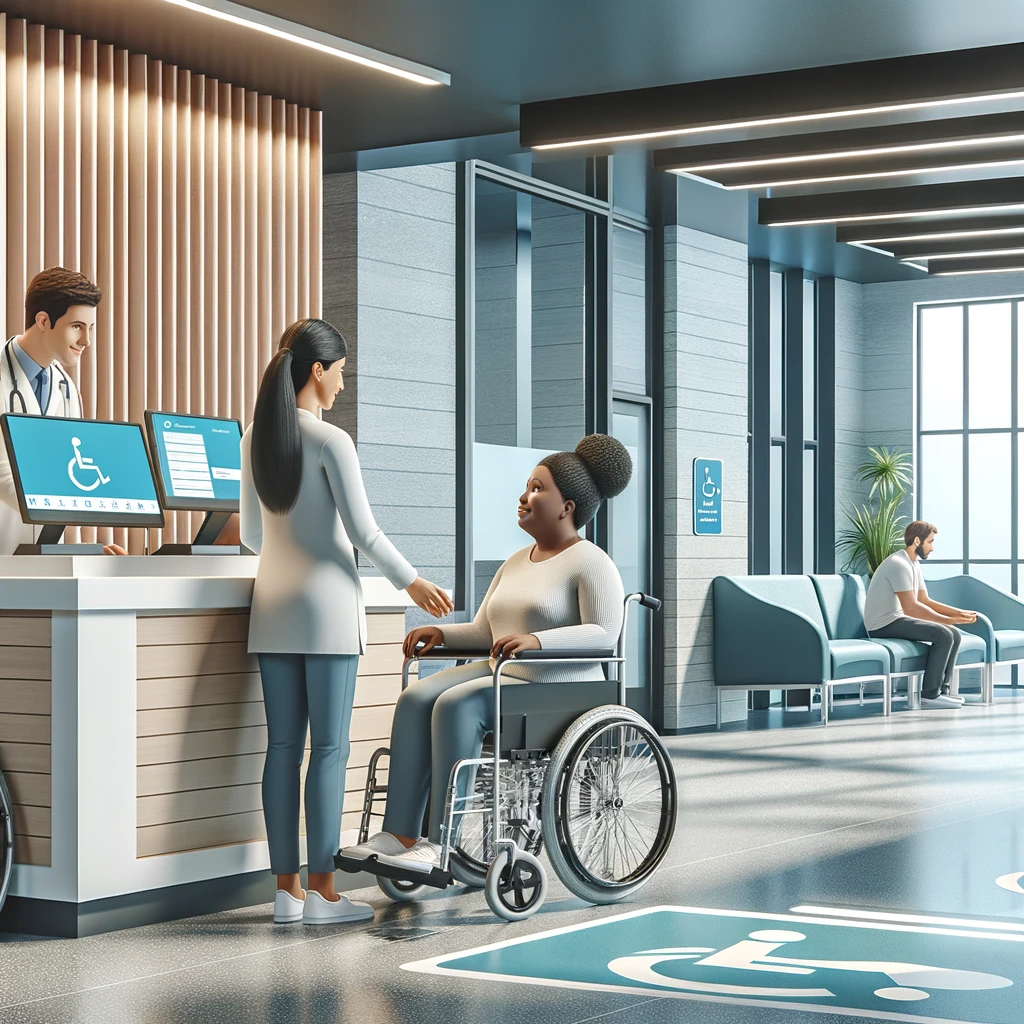
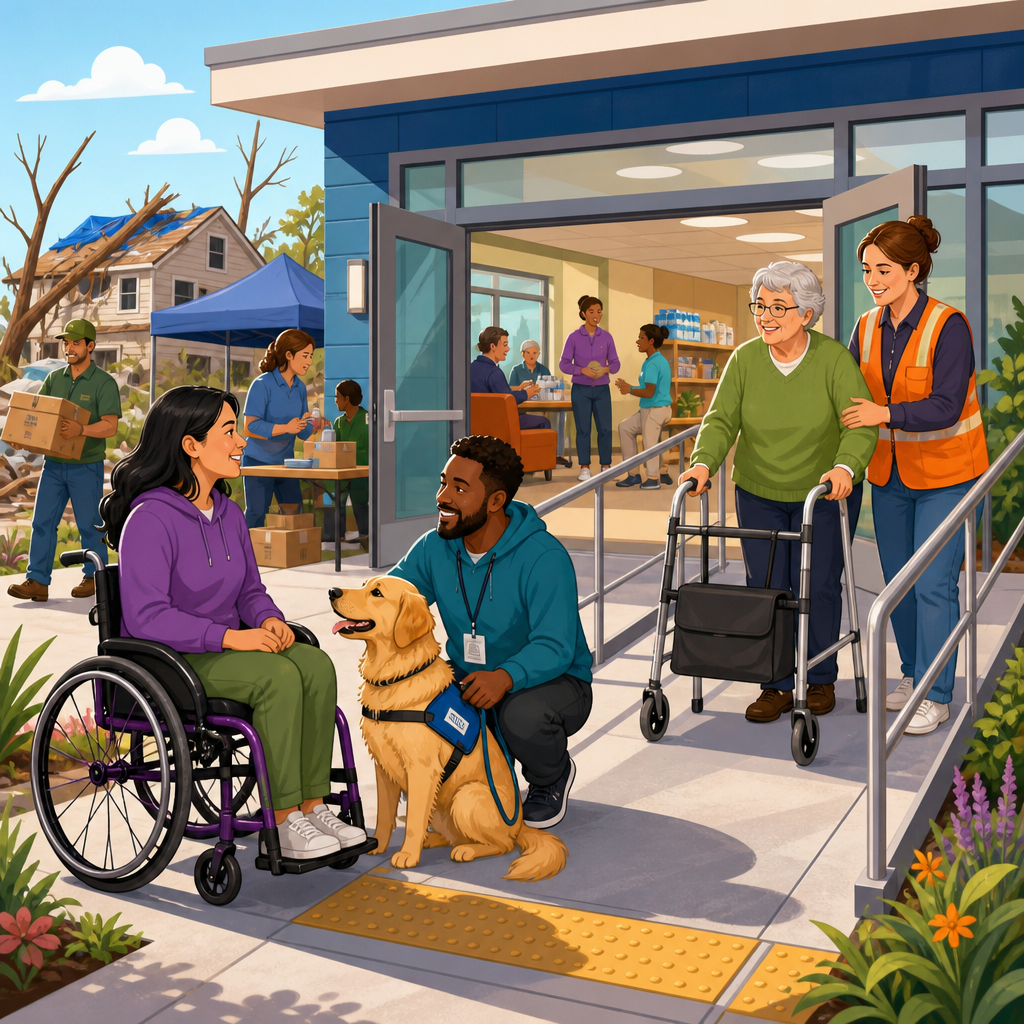
At a minimum, an accessible disaster recovery center must provide an accessible route from parking or drop-off to the entrance, a doorway and interior circulation space usable by wheelchair and scooter users, and service counters or consultation spaces where people can communicate privately without being excluded by height or layout. Temporary sites in schools, churches, libraries, convention halls, and community centers often fail here because planners assume an existing public building is automatically compliant. It is not. A center can be inaccessible because the accessible parking is too far away, the only entrance has a heavy manual door, registration lines snake through narrow aisles, or forms are distributed on clipboards to people who cannot stand long enough to complete them. These are operational failures, not minor inconveniences.
Effective communication is equally important. Under ADA standards and Department of Justice guidance, covered entities must communicate with people with disabilities as effectively as with others. In a recovery setting, that can mean qualified sign language interpreters, video remote interpreting that actually works, real-time captioning for group briefings, assistive listening systems, large print forms, Braille when appropriate, screen-reader compatible digital materials, plain language explanations, and staff who know how to relay information without talking past the person to a companion. I have repeatedly seen agencies rely on handwritten notes for complex benefits discussions with deaf survivors; that is often inadequate because it does not provide the same speed, accuracy, or opportunity for questions as spoken communication.
Reasonable modifications in policy and procedure are another major requirement. A center may need to allow extra time for appointments, permit a support person to assist with forms, accept alternative signatures where legally allowed, adjust queue systems for people who cannot tolerate long standing, or meet a survivor in an accessible side room instead of insisting on a loud open floor. Service animals must generally be admitted. Staff cannot impose unnecessary proof demands on someone whose records were destroyed in the disaster when alternative verification is available. Access must be integrated when possible, but separate arrangements may be acceptable if they provide an equally effective result without delay or stigma. Speed matters, because missed application windows can cause real financial loss.
Common barriers survivors face after the immediate emergency
Most barriers at disaster recovery centers are predictable. Physical access problems include gravel parking lots, curb cuts blocked by temporary fencing, registration desks too high for seated communication, inaccessible portable restrooms, poor lighting for low-vision users, and waiting areas with no seating options for people with fatigue, heart conditions, or chronic pain. Communication barriers include staff who do not know how to obtain interpreters, videos played without captions, forms unavailable in accessible digital formats, and websites that require mouse use or image-based CAPTCHA. Cognitive access problems are just as serious. Recovery programs are complex, and many survivors are processing trauma, medication changes, brain injury symptoms, or language barriers at the same time. Dense jargon and rushed instructions can effectively exclude people even when the doorway is compliant.
Transportation is one of the most overlooked barriers in public services and civic access. A center can be technically accessible yet practically unusable if paratransit does not reach it, sidewalks are damaged, or the site is far from shelters, hotels, and temporary housing. After hurricanes, floods, and wildfires, I have seen survivors spend more time arranging a ride than receiving assistance. Agencies should coordinate with transit providers, post accessible route information clearly, and offer remote alternatives such as phone intake, accessible online applications, or mobile teams that visit shelters and homebound residents. If a person must appear in person, transportation barriers become civil rights barriers because they deny equal opportunity to participate in the program.
Administrative barriers also matter. Survivors may be told to return later because the “accessible staff person” is not there, asked to bring their own interpreter, or directed from one desk to another without ownership of the issue. That fragmentation disproportionately harms disabled people because each handoff adds fatigue and confusion. Public services work best when one trained staff member can identify the barrier, secure auxiliary aids, document the request, and keep the application moving. The goal is not special treatment. The goal is to prevent disability-related obstacles from stopping a person at the exact moment public recovery systems are supposed to stabilize the community.
How agencies can design inclusive recovery operations
Inclusive recovery operations start before the first applicant arrives. Site selection should use an accessibility checklist based on the 2010 ADA Standards for Accessible Design and program accessibility requirements under Title II and Section 504. In practical terms, teams should verify parking, drop-off areas, entrance width, door pressure, interior turning space, restroom access, acoustics, lighting, and emergency egress. Technology should be tested in real conditions, not assumed to work because it worked in an office. Video remote interpreting fails regularly when bandwidth is weak or tablets are not positioned correctly. Screen-reader testing should be done with common tools such as JAWS, NVDA, and VoiceOver. If digital kiosks are used, they need tactile controls, speech output, and reachable placement.
Staff training is the next decisive factor. Frontline workers need concise, scenario-based instruction on disability etiquette, service animals, communication access, plain language, and modification requests. Supervisors need authority to solve problems quickly instead of escalating every issue through multiple layers. In the field, I have found that a one-page access protocol posted at intake desks prevents many failures: ask the person what they need, provide the aid or modification promptly, document it, and continue service. That approach is faster and more accurate than making staff guess. Agencies should also designate an ADA or disability integration lead at each site who can troubleshoot barriers, coordinate interpreters, and review complaints daily.
Accessible operations also require redundancy. A center should never depend on a single interpreter vendor, one accessible printer, or one employee who understands disability rights. Power outages, device failures, and staffing gaps are common after disasters. Strong operations build backup methods for communication and intake. They also publish clear access information in advance, including transportation options, interpreter availability, parking details, and how to request accommodations. The table below highlights the most common public-facing access needs and the operational response that works best.
| Access need | Common failure | Effective response |
|---|---|---|
| Mobility access | Steps, narrow aisles, distant parking | Accessible route, wider layout, marked parking, seated service points |
| Deaf communication | No interpreter or unreliable video interpreting | Qualified on-site interpreters or tested remote platform with backup |
| Blind or low-vision access | Print-only forms and unlabeled digital files | Large print, accessible PDFs, staff reading assistance, screen-reader tested forms |
| Cognitive access | Dense instructions and noisy environment | Plain language, step-by-step guidance, quiet room, extra processing time |
| Transportation | Remote site with no accessible transit link | Paratransit coordination, shuttle options, remote or mobile services |
What survivors can do when a recovery center is not accessible
If a disaster recovery center is inaccessible, survivors should ask immediately for a specific fix and document the request. Specific requests get better results than general complaints. For example: “I need a qualified ASL interpreter for my FEMA interview today,” “I cannot stand in this line because of my disability and need a seated check-in option,” or “This form is not readable with my screen reader; please provide an accessible digital copy or staff assistance.” Write down the date, time, location, the staff names if available, and what happened. Photos of blocked entrances, inaccessible parking, or posted notices can help. If a correction is offered, note whether it was timely and effective. If the agency delays until a deadline passes, the harm is not cured by a later apology.
Survivors can also escalate within the agency. Ask for the site supervisor, disability integration specialist, ADA coordinator, civil rights office, or equal opportunity office. FEMA, state emergency management agencies, and local governments often have civil rights complaint channels. If the issue involves a state or local government service, a complaint to the U.S. Department of Justice may be appropriate. If federal funding is involved, the responsible federal agency’s civil rights office may also have jurisdiction. Many legal aid programs, protection and advocacy organizations, centers for independent living, and disability rights nonprofits help with these issues at no cost. The strongest complaints tie the barrier to a concrete denial, such as missed benefits, inability to submit forms, loss of privacy, or forced reliance on family members for interpretation.
It is important to ask for alternate access while the complaint is pending. A phone appointment, home visit, mobile intake unit, deadline extension, or transfer to an accessible site may solve the immediate problem. That practical step can protect benefits while preserving the right to challenge the barrier itself. People sometimes worry that speaking up will slow their case. In my experience, respectful but direct escalation often speeds resolution because it alerts managers that the problem creates legal risk and operational delay. Public services and civic access only work when agencies hear where the system breaks. Reporting barriers can help the next survivor as much as the current one.
How this hub connects the wider public services and civic access landscape
Disaster recovery centers are one doorway into a much larger network of rights. The same accessibility principles apply when displaced voters need absentee ballot help, when residents must attend public hearings on rebuilding plans, when court dates are moved online, when transit routes change, or when social services require identity documents that were lost in the disaster. This hub supports related articles on accessible voting after displacement, interpreter rights in emergency benefits programs, website accessibility for relief applications, accessible transportation to government services, ADA rules for public meetings, and replacing IDs, birth certificates, and property records without discriminatory barriers. Survivors often move through all of these systems in a single month, so failures compound quickly.
The key takeaway is that accessibility after the immediate emergency is not optional, charitable, or secondary to recovery. It is part of lawful, effective public administration. Agencies that build access into site selection, communications, staffing, transportation, and complaint handling serve more people faster and with fewer errors. Survivors who know their rights can ask for precise solutions, protect deadlines, and push systems to improve. If you are planning recovery operations, audit every public touchpoint now. If you are seeking help, document barriers early and request the access you need clearly. Equal access is how recovery becomes real.
Frequently Asked Questions
What makes a disaster recovery center “accessible” under the ADA after the immediate emergency?
An accessible disaster recovery center is one that disabled people can actually use in practice, not just one that is technically open to the public. After the immediate emergency phase, the Americans with Disabilities Act requires state and local governments to provide equal access to services, programs, and activities, including disaster assistance offered in person, online, by phone, or through partner agencies. That means accessibility has to be considered across the entire recovery process, not just at the building entrance.
Physical accessibility is the most visible part. The site should have accessible parking, a step-free entrance, usable interior routes, accessible restrooms, seating options, clear signage, and service counters that can be reached by wheelchair users and people of short stature. But accessibility does not stop there. Communication access is equally important. People who are deaf or hard of hearing may need qualified sign language interpreters, real-time captioning, assistive listening devices, or text-based communication options. People who are blind or have low vision may need forms in large print, accessible digital documents, screen-reader compatible kiosks, and staff who can read materials aloud or help complete paperwork without taking away the person’s control over the process.
Programmatic accessibility matters just as much as bricks and mortar. If the center requires long periods of standing, has complex intake procedures, uses inaccessible websites or tablets, or refuses support persons, service animals, or reasonable modifications to standard practices, then the center may still be inaccessible even if the doorway is wide enough. Recovery services should be delivered in ways that work for people with mobility disabilities, cognitive disabilities, mental health disabilities, chronic illnesses, sensory disabilities, and older adults with overlapping access needs. In short, an accessible disaster recovery center is one where disabled survivors can obtain FEMA help, housing support, insurance guidance, replacement documents, and referrals with dignity, privacy, and an equal opportunity to succeed.
What ADA rights do disabled survivors have when seeking help at a disaster recovery center?
Disabled survivors generally have the right to equal access, effective communication, and reasonable modifications when using recovery services run by state or local governments, and often when services are delivered through contractors or partner organizations on the government’s behalf. In plain terms, you should be able to apply for assistance, ask questions, submit documents, attend appointments, and understand your options without being screened out by inaccessible systems. The ADA is a civil rights law, so the goal is not special treatment. The goal is equal opportunity to benefit from the same public recovery systems everyone else uses.
Those rights can include the right to request auxiliary aids and services, such as sign language interpreters, captioning, note-taking, plain language communication, or alternative formats for documents. You may also have the right to reasonable modifications in policies and procedures. For example, a center may need to allow extra time for appointments, permit a support person to assist with communication, modify a “first come, first served” process that disadvantages someone with a disability-related need, or offer an alternative method for submitting required information if the standard process is inaccessible. People with disabilities also have the right to be accompanied by service animals in areas open to the public, subject to the usual ADA rules.
Just as important, disabled survivors should not be forced into separate or lesser services if integrated access is possible. A center should not tell someone to “come back with a family member,” “use the website later,” or “call another office” when the same help is available on site for others. If a public entity cannot provide immediate access in one format, it should still offer an equally effective way to deliver the service without unnecessary delay. When rights are not respected, survivors can document the barrier, ask for a supervisor or ADA coordinator, request a formal accommodation, and consider filing an administrative complaint with the relevant agency or, depending on the situation, with the U.S. Department of Justice or another oversight body. Accessibility in recovery is not optional customer service; it is a legal and civil rights obligation.
What should I do if a disaster recovery center is physically inaccessible or the process is unusable because of my disability?
Start by clearly telling staff what barrier you are experiencing and what change would allow you to access the service. Specific requests often work better than general complaints. For example, you might say that the entrance ramp is blocked, the intake tablet is not screen-reader accessible, you need a qualified ASL interpreter, you cannot stand in a long line because of a mobility or health condition, or you need written information in large print or plain language. Ask to speak with a supervisor, site manager, disability integration specialist, or ADA coordinator if front-line staff are not able to help. Many barriers can and should be fixed on the spot through reasonable modifications or alternative service methods.
If the problem is not resolved quickly, document what happened. Write down the date, time, location, names of staff if possible, exactly what barrier you encountered, what accommodation you requested, and how the agency responded. Photos, screenshots, copies of forms, and witness names can also help. This record can be useful if you need to follow up with FEMA, a state emergency management agency, a local government, a legal aid office, or a protection and advocacy organization. It can also help show whether the issue was a one-time mistake or part of a larger pattern of inaccessibility.
While pursuing a fix, ask for an alternative way to complete your task right away so you do not lose critical recovery time. That could include curbside assistance, a paper application instead of an inaccessible kiosk, a phone appointment, help from an accessible satellite location, home visit options in some programs, or an extension if the inaccessible process caused a deadline problem. The key point is that agencies should not let accessibility failures block your ability to apply for aid, replace documents, or move your case forward. Disaster recovery deadlines can be strict, so it is important to push for both immediate access and a record of the barrier in case you need to challenge a denial or delay later.
Do disaster recovery centers have to provide interpreters, accessible documents, and digital access for people with communication disabilities?
Yes, in many cases they do. Effective communication is a core ADA requirement, and it applies to disaster recovery services just as it applies to other public programs. If a recovery center communicates with the public through spoken instructions, forms, websites, video content, kiosks, text alerts, or one-on-one interviews, it must take appropriate steps so disabled survivors can receive information and communicate back with substantially equal effectiveness. The exact aid or service required depends on the person’s disability, the complexity of the communication, and the context, but the obligation is real and it extends beyond simply handing someone a brochure.
For deaf and hard of hearing survivors, effective communication may require qualified sign language interpreters, video remote interpreting that actually works, captioned videos, assistive listening systems, speech-to-text tools, or written communication for simpler exchanges. For blind or low-vision survivors, it may include accessible digital forms, screen-reader compatible websites, large print, Braille in some contexts, audio versions, or staff assistance to review and complete paperwork. For people with cognitive or intellectual disabilities, agencies may need to use plain language, break down complex steps, repeat key instructions, and confirm understanding without being patronizing. For people with speech disabilities, staff may need to allow additional time, use alternative communication methods, or accept information through assistive communication devices.
Digital accessibility is especially important because so much post-disaster recovery now happens through online portals, emailed notices, uploaded documentation, and identity verification tools. A physically accessible center is not truly accessible if the application portal, appointment system, or benefits tracker cannot be used with assistive technology. If a digital tool is inaccessible, the agency should provide another equally effective path to complete the same task. Survivors should not be told to rely on a friend, guess at inaccessible forms, or forfeit privacy in order to receive help. Communication access is not a courtesy feature. It is part of meaningful access to public recovery programs.
How can families, advocates, and community organizations help protect ADA access during long-term disaster recovery?
Families, disability advocates, aging organizations, legal aid groups, and community-based nonprofits play a major role in making sure recovery systems remain accessible after media attention fades. In the weeks and months following a disaster, barriers often shift from rescue-related issues to bureaucratic ones: inaccessible applications, missed notices, confusing documentation demands, transportation problems, and fragmented referrals between agencies. Community support can help survivors navigate these systems, but it can also help hold public entities accountable for fixing structural access problems rather than leaving individuals to struggle alone.
One effective strategy is to gather and report patterns, not just isolated stories. If multiple survivors encounter the same inaccessible website, lack of interpreters, unusable intake process, or denial of accommodation, that may indicate a systemwide ADA issue. Organizations can elevate those concerns to emergency management officials, municipal ADA coordinators, state disability offices, FEMA disability integration staff, elected officials, or oversight agencies. Advocates can also request public-facing accessibility information, push for disability-inclusive outreach, ask that forms and notices be revised into plain language and accessible formats, and encourage agencies to consult disabled residents directly when redesigning recovery operations.
At the individual level, families and advocates can help survivors prepare documentation, keep records of barriers, meet deadlines, and