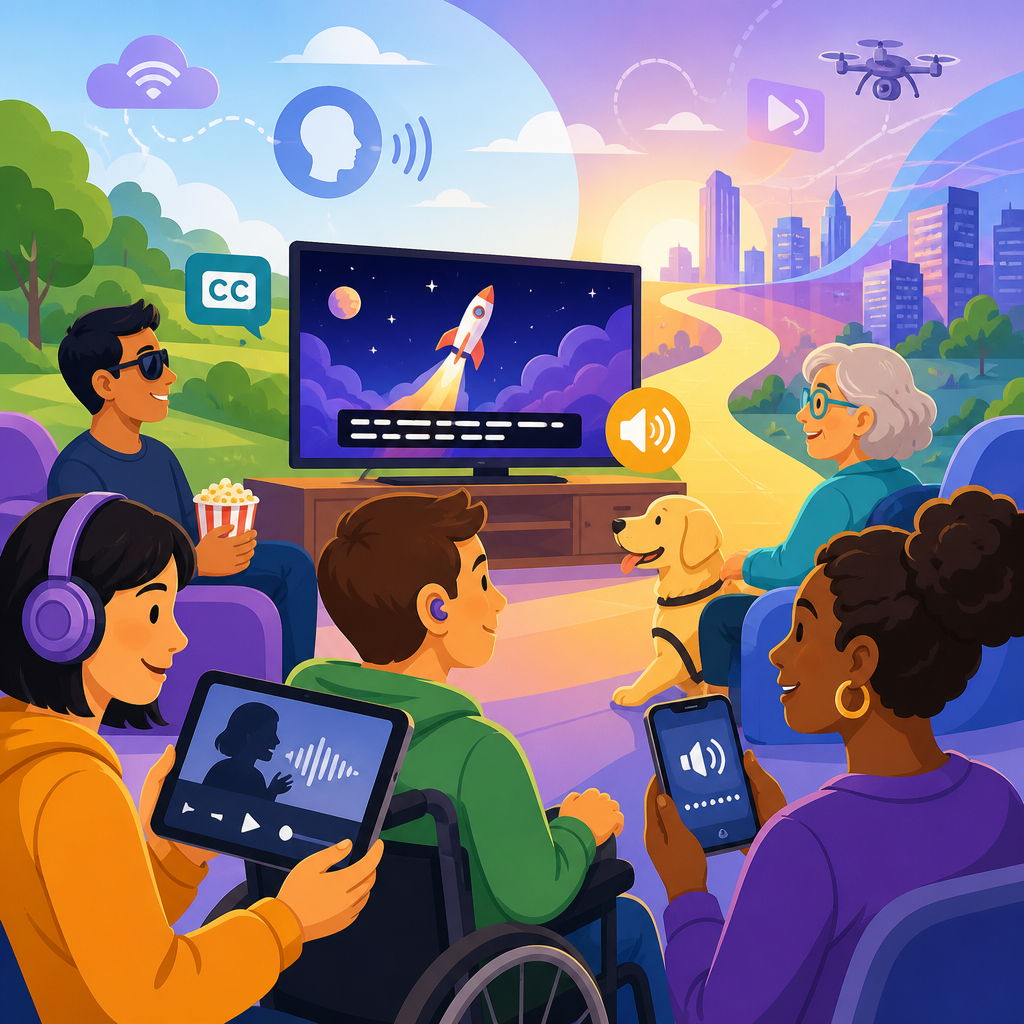
Accessible captions, audio description, and media are entering a decisive period as disability rights law, streaming technology, artificial intelligence, and user expectations reshape how video and audio content is produced, distributed, and experienced. In practical terms, captions are synchronized text for spoken dialogue and meaningful sounds, audio description is additional narration that explains important visual information, and accessible media is the broader discipline of making video, audio, live events, podcasts, e-learning, social clips, and interactive media usable by people with disabilities. I have worked with media teams that treated accessibility as a late-stage compliance task, and I have also seen the measurable gains when it is planned from scripting through publishing: wider audience reach, lower remediation costs, stronger search performance, and fewer legal risks. That shift from reactive fixes to proactive design is the central trend defining the next phase of ADA developments.
Why this matters now is straightforward. Media has become the default format for education, marketing, customer support, entertainment, and internal communication, while legal and technical expectations have become more specific. The Americans with Disabilities Act remains a foundational civil rights law in the United States, but media accessibility decisions are also shaped by Section 504, Section 508, the Web Content Accessibility Guidelines, and state-level requirements, along with platform policies from YouTube, Netflix, Zoom, TikTok, LinkedIn, and enterprise learning systems. At the same time, users increasingly expect accurate captions in noisy environments, multilingual subtitle options, descriptive audio on premium content, and accessible controls on every device. The future of accessible captions, audio description, and media will not be defined by one regulation or one tool. It will be driven by converging forces: tighter enforcement, better automation, more integrated workflows, broader content formats, and rising expectations for quality, personalization, and measurable outcomes.
This hub article explains the major future trends and predictions in ADA developments for media accessibility, with a focus on what organizations should expect over the next several years. It covers the likely direction of rules and enforcement, how AI is changing captioning and description production, where live and interactive media still struggle, what quality standards will matter most, and how teams can prepare. For readers asking simple questions such as “What is changing in accessible media?” or “How should we plan for future ADA compliance?” the short answer is clear: build accessibility into every media workflow now, because expectations are expanding faster than manual, ad hoc processes can keep up.
Regulatory pressure will push accessibility upstream
The most reliable prediction is that accessibility requirements for media will move earlier in the content lifecycle. Instead of checking captions or audio description only after a complaint, organizations will be expected to show that accessibility was considered during procurement, production, platform selection, and publishing. That change is already visible in higher education, public sector contracting, healthcare communications, and large enterprise procurement questionnaires, where buyers ask vendors about WCAG conformance, player keyboard support, transcript availability, and caption accuracy thresholds before purchase orders are approved.
Future ADA developments will likely produce more explicit references to digital media expectations, even when the governing rule does not list every technical detail. In practice, enforcement has been moving toward outcome-based standards: can users access the information, operate the controls, and receive equivalent content without unreasonable barriers? If not, the legal argument for “substantial compliance” becomes weak. Organizations that continue relying on auto-generated captions without review, unlabeled media controls, or visual-only training videos will face growing risk, especially when accessible alternatives are technically feasible and operationally common.
From experience, the biggest operational mistake is treating legal compliance as separate from content operations. The stronger approach is to align accessibility with content governance. Editorial checklists, video templates, procurement standards, and design system components should all include media accessibility requirements. When accessibility is embedded at those decision points, organizations reduce rework and create a defensible record of good-faith effort.
AI will accelerate production, but human review will remain essential
Artificial intelligence is already changing captioning, transcription, translation, speaker identification, and synthetic voice generation for description tracks. Over the next few years, AI tools will get better at punctuation, diarization, domain-specific vocabulary, and timing alignment, which will lower turnaround times and costs. Teams producing webinars, product demos, social videos, and training libraries will increasingly use AI-first workflows because they can process large media volumes that manual methods alone cannot support.
However, the idea that AI will “solve” accessible media by itself is inaccurate. Caption quality is not just speech-to-text accuracy. Good captions preserve meaning, identify speakers when necessary, time lines for readability, represent significant sounds, and avoid segmentation choices that confuse viewers. Audio description quality is even less automatable because it depends on editorial judgment: what visual details are essential, where can they fit between dialogue, and how can they be written concisely without changing tone or interpretation?
I have seen AI perform well on clear corporate speech and fail badly on overlapping dialogue, accented speakers, product names, legal terminology, and fast-paced demonstrations. The same pattern will continue. The future belongs to hybrid workflows in which AI handles first-pass generation and humans perform targeted quality assurance, style normalization, and exception handling. Media teams that plan staffing around that reality will outperform those that assume automation eliminates review.
| Media task | What AI will improve | Where human oversight remains critical |
|---|---|---|
| Closed captions | Fast transcription, draft timing, speaker separation, multilingual output | Accuracy review, sound cues, line breaks, brand terminology, readability |
| Audio description | Scene detection, draft summaries, voice synthesis options | Script writing, prioritizing visual details, tone, legal and educational nuance |
| Live events | Realtime speech recognition, glossary injection, faster post-event cleanup | CART support, monitoring latency, handling crosstalk, correcting names and jargon |
| Video libraries | Bulk processing, search indexing, transcript extraction, metadata tagging | Sampling strategy, exception triage, retention policy, governance decisions |
Quality standards will become more specific and more visible
As accessible media matures, organizations will be judged less on whether captions exist and more on whether they are usable. Expect more procurement language and internal policies to define measurable quality criteria such as synchronization, completeness, placement, speaker labeling, and treatment of non-speech information. Many teams already use caption style guides based on broadcaster practices, platform specifications, and accessibility guidance. That trend will expand because standardized quality rules make vendor management and auditing much easier.
Audio description will follow a similar path. Today, many organizations still provide description only for flagship content, but that boundary is narrowing. Educational explainers, product tutorials, onboarding videos, and public service content often contain critical visual information that cannot be inferred from dialogue alone. As a result, future standards discussions will focus on proportionality and content significance: not every clip needs the same level of production, but any visual-only instruction that affects comprehension or task completion needs a reliable equivalent.
Visibility will also increase. Platforms are making accessibility settings more prominent, viewers are more comfortable reporting defects, and internal analytics teams can now track completion rates for captioned versus uncaptioned assets. Once leadership sees that accessible media improves engagement and lowers abandonment, quality stops looking like a niche requirement and starts looking like performance infrastructure.
Live, interactive, and short-form media will be the hardest frontier
Pre-recorded video is relatively manageable because teams can edit, review, and republish. The harder challenge is live and interactive media: webinars, all-hands meetings, virtual conferences, livestream commerce, classroom sessions, gaming streams, telehealth consultations, and customer support calls. These formats combine time pressure, multiple speakers, screen sharing, chat overlays, and platform limitations. Future ADA developments will increasingly focus here because inaccessible live media blocks participation in real time, when remediation is least useful.
Short-form media adds another layer of complexity. Social video often relies on visual jokes, rapid cuts, on-screen text, and platform-native editing tools that can undermine accessibility if creators work too quickly. I routinely advise teams to treat social clips as first-class media assets rather than disposable content. That means planning safe text zones, checking contrast, editing captions for timing and comprehension, and describing visual context when necessary. As brand communication shifts toward short video, these practices will matter more, not less.
Interactive media will also receive more scrutiny. Training simulations, product tours, clickable videos, and immersive environments can fail accessibility even if their captions are accurate, because users may not be able to navigate hotspots, pause narration, access transcripts, or understand visual changes. The next phase of media accessibility therefore includes player controls, focus order, gesture alternatives, and multimodal equivalent experiences, not just text overlays.
Personalization, multilingual access, and user control will define the next user experience
The future of accessible media is not only compliance; it is adaptive delivery. Users increasingly want to control caption size, font, color, background opacity, screen position, playback speed, language selection, transcript search, and audio description activation across devices. Some of these preferences support disability access directly, while others improve usability more broadly. The important point is that accessible media is moving from a one-format obligation to a customizable experience layer.
Multilingual support will expand quickly. Global organizations already need translated subtitles, translated transcripts, and region-specific terminology management. AI translation will speed this work, but quality still depends on context, especially in healthcare, law, software training, and public policy. A mistranslated medical term or software command can make content unusable. Forward-looking teams are building terminology databases and review loops by language market, which is a sign of operational maturity.
User control also intersects with disability diversity. Deaf users, hard-of-hearing users, blind users, low-vision users, neurodivergent users, and people with cognitive disabilities do not all need the same format. Some prefer full transcripts before watching. Others rely on audio description plus tactile or visual supports. Future-ready media strategies accept that no single accessibility feature serves everyone equally. The better goal is layered access: captions, transcripts, description, keyboard-operable controls, clear structure, and consistent interaction patterns.
Organizations will need governance, not isolated fixes
The most important organizational prediction is that accessible media will become a governance issue. Companies that treat every inaccessible video as a one-off remediation ticket will fall behind. Companies that establish standards, assign ownership, train creators, select compliant vendors, and audit outcomes will scale. In my work, the turning point usually comes when leadership realizes how many teams publish media independently: marketing, HR, learning and development, sales, support, legal, product, and executive communications. Without governance, accessibility quality varies wildly.
A durable program includes several elements. First, define media accessibility requirements aligned to WCAG, platform realities, and your content types. Second, document workflow checkpoints for scripting, recording, editing, review, and publishing. Third, choose tools that support caption editing, transcript exports, description tracks, accessible players, and analytics. Common stacks may include 3Play Media, Verbit, Rev, Adobe Premiere Pro, YouTube Studio, Vimeo, Panopto, Kaltura, Zoom, and enterprise DAM systems, but tool choice matters less than workflow discipline. Fourth, train creators on practical issues such as speaking pace, visual narration, slide readability, and microphone quality. Fifth, create an exception process for urgent live content while requiring post-event remediation.
This hub article should guide readers to deeper subtopics, because the field is broad. Separate articles can examine AI captioning risks, live event accessibility, audio description standards, social media accessibility, procurement requirements, caption quality assurance, and ADA litigation trends. Used together, those pieces form a practical roadmap: understand obligations, improve production methods, measure quality, and build accountability across the organization.
What to do now to prepare for future ADA developments
Start with an audit of your actual media ecosystem, not just your website templates. Inventory videos, podcasts, webinars, social clips, archived training, customer tutorials, and embedded third-party players. Check whether captions are accurate, transcripts are available, audio description is provided where visuals carry meaning, and controls work by keyboard and screen reader. Then prioritize by risk and impact: public-facing content, required training, customer support media, and instructional assets should usually come first.
Next, set policies that are specific enough to execute. Require reviewed captions for published media, define when transcripts are mandatory, establish criteria for audio description, and specify service levels for live events. Build accessibility into contracts with agencies and platforms. Finally, measure results. Track defect rates, turnaround time, cost per hour, complaint volume, and engagement differences between accessible and non-accessible assets. Data is what turns accessibility from a promise into an operating standard.
Accessible captions, audio description, and media are moving toward a future where quality, speed, and inclusivity must coexist. The organizations that succeed will not wait for the next complaint or regulation update. They will build accessible media into content strategy, procurement, production, and measurement now. The core lesson is simple: future ADA developments are making accessible media more expected, more testable, and more central to digital communication. Use this hub as your starting point, then map the subtopics most relevant to your team and begin closing the gaps today.
Frequently Asked Questions
1. What is changing most rapidly in accessible captions, audio description, and media?
The biggest shift is that accessibility is moving from a niche compliance task to a core part of media production and distribution. Captions and audio description are no longer being treated as optional add-ons created at the very end of a project. Instead, they are becoming expected features across streaming platforms, social media, e-learning, live events, corporate communications, and entertainment. This change is being driven by several forces at once: stronger disability rights enforcement, wider public awareness, global streaming competition, and a growing understanding that accessible media improves the experience for many people, not just disabled audiences.
Technology is also accelerating change. Automated speech recognition has made caption generation faster and cheaper, while artificial intelligence tools are helping identify speakers, segment dialogue, and flag synchronization issues. At the same time, advances in text-to-speech and scene analysis are influencing how audio description is drafted and voiced. But speed alone is not the whole story. As more organizations publish video at high volume, the industry is placing greater emphasis on quality, editorial standards, and user control. Audiences increasingly expect accurate captions, well-written description, multilingual access, customizable display options, and support across every device.
Another major development is that accessible media is being understood more holistically. The conversation is no longer limited to “Are there captions?” or “Is there audio description?” It now includes whether captions identify meaningful sounds, whether description is well timed and emotionally appropriate, whether players support keyboard navigation and screen readers, whether transcripts are available, and whether accessible features work consistently in apps, websites, and connected TVs. In short, the future is not just more accessibility features. It is better integration, higher quality, and a broader view of what truly accessible media looks like in practice.
2. How will artificial intelligence affect captions and audio description in the coming years?
Artificial intelligence will have a major impact, but most likely as a force multiplier rather than a complete replacement for human expertise. In captions, AI already helps with first-pass transcription, timecoding, punctuation, speaker labeling, and language translation. These tools can dramatically reduce turnaround times, especially for live streams, news, webinars, and large content libraries. For audio description, AI can assist by detecting scene changes, identifying on-screen text, recognizing objects or actions, and suggesting draft description language. This can make the production process more efficient and scalable.
Even so, accessible media requires judgment that automation still struggles to deliver reliably. Accurate captions need more than correct words. They need proper synchronization, readable line breaks, speaker distinction, treatment of meaningful non-speech sounds, and sensitivity to tone, dialect, technical vocabulary, and context. Audio description requires even more interpretation. A good describer must decide what visual details matter most, how to fit them naturally into pauses, how much to explain, and how to support the intended mood and pacing of the work. These are editorial and creative decisions, not just technical ones.
As a result, the most realistic future is a hybrid model. AI will handle repetitive and time-consuming tasks, while trained professionals focus on review, correction, prioritization, and quality assurance. That hybrid approach can improve speed and cost without sacrificing usability. It also raises important questions about transparency and standards. Organizations will need to decide when machine-generated accessibility is acceptable, what level of human review is required, and how to measure quality in meaningful ways. The winners will not simply be those who automate the most. They will be the ones who use AI responsibly to deliver accessible media that is accurate, usable, and respectful of the audience.
3. Why are captions and audio description becoming more important from a legal and business perspective?
Legally, accessible media is becoming more important because disability rights requirements are increasingly being applied to digital experiences, not just physical spaces. Depending on the jurisdiction, organizations may face obligations under disability access laws, broadcasting rules, education regulations, procurement standards, or consumer protection frameworks. As video becomes central to communication, training, entertainment, and public information, inaccessible media can create real barriers that expose organizations to complaints, investigations, litigation, and reputational harm. Regulators and courts are paying closer attention to whether digital content can actually be used by people with disabilities in practice.
From a business standpoint, the case is just as compelling. Accessible media expands audience reach, improves engagement, and supports international and multilingual distribution. Captions help people watch in noisy or quiet environments, improve comprehension, and increase video completion rates on mobile and social platforms. Audio description opens visual content to blind and low-vision audiences while often benefiting anyone who is multitasking or listening without full visual attention. Transcripts and structured text can also improve search visibility, knowledge retention, and content reuse across marketing, support, and education.
There is also a brand and trust dimension. Audiences increasingly expect companies, schools, media platforms, and public institutions to design for inclusion from the start. When accessibility is missing, users notice. When it is done well, it signals professionalism, care, and long-term thinking. In that sense, captions and audio description are no longer just compliance checkboxes. They are indicators of digital maturity and audience respect. Organizations that invest early tend to build more resilient workflows, reduce remediation costs later, and position themselves better for future standards, partnerships, and market expectations.
4. What does “high-quality” accessible media actually mean beyond simply adding captions?
High-quality accessible media means that accessibility features are accurate, usable, consistent, and built into the overall viewing experience rather than awkwardly attached at the end. For captions, quality starts with verbatim or meaningfully equivalent text that accurately reflects spoken dialogue. It also includes proper timing, readable segmentation, speaker identification when needed, and inclusion of meaningful sounds such as laughter, music cues, alarms, or applause when those details affect understanding. Good captions are easy to follow without covering important visuals or lagging behind the content.
For audio description, quality depends on relevance, clarity, and timing. Strong description tells users what they need to know about important visual information such as actions, settings, facial expressions, on-screen text, costumes, or scene changes, without overwhelming the soundtrack or interrupting the flow. It should feel natural and purposeful, matching the tone of the content while preserving the creator’s intent. In some formats, extended description may be appropriate; in others, concise scripting is essential. Either way, the goal is to provide access to meaning, not just a list of visual facts.
Accessible media also includes the player and platform experience. Users should be able to turn captions and description on or off easily, customize appearance where possible, navigate with a keyboard, and use the interface with assistive technologies such as screen readers. Transcripts, multilingual support, reliable playback on different devices, and consistent feature availability all contribute to quality. In practical terms, truly accessible media is not achieved when a file exists. It is achieved when people can discover the feature, activate it, and use it successfully in real-world conditions.
5. What should content creators, publishers, and media companies do now to prepare for the future of accessible media?
The most important step is to treat accessibility as part of the production workflow from the beginning. That means planning for captions, audio description, transcripts, and accessible player support during budgeting, scheduling, scripting, editing, and publishing rather than after release. When accessibility is built in early, quality improves and costs usually become more manageable. Teams should establish clear standards for caption accuracy, timing, sound identification, description style, review procedures, and delivery formats so that accessibility remains consistent across projects and platforms.
Organizations should also audit their technology stack. A strong accessible media strategy depends on more than content creation. It requires video players that support caption tracks and audio description reliably, content management systems that preserve metadata, workflows for multilingual localization, and testing processes that include assistive technology and disabled users where possible. If AI tools are being used, teams should define where automation fits, where human review is mandatory, and how quality will be measured. Accessibility vendors, internal teams, and platform partners all need aligned expectations.
Finally, creators and media leaders should adopt a mindset of continuous improvement. Standards, laws, formats, and user expectations will continue to evolve. The organizations best prepared for the future will monitor regulatory developments, follow emerging best practices, collect user feedback, and update workflows regularly. They will also recognize that accessible media is not only a legal duty or operational task. It is a fundamental part of communication quality. When captions, audio description, and accessible design are treated as essential components of media, the result is content that reaches more people, performs better, and remains relevant in a rapidly changing digital environment.


