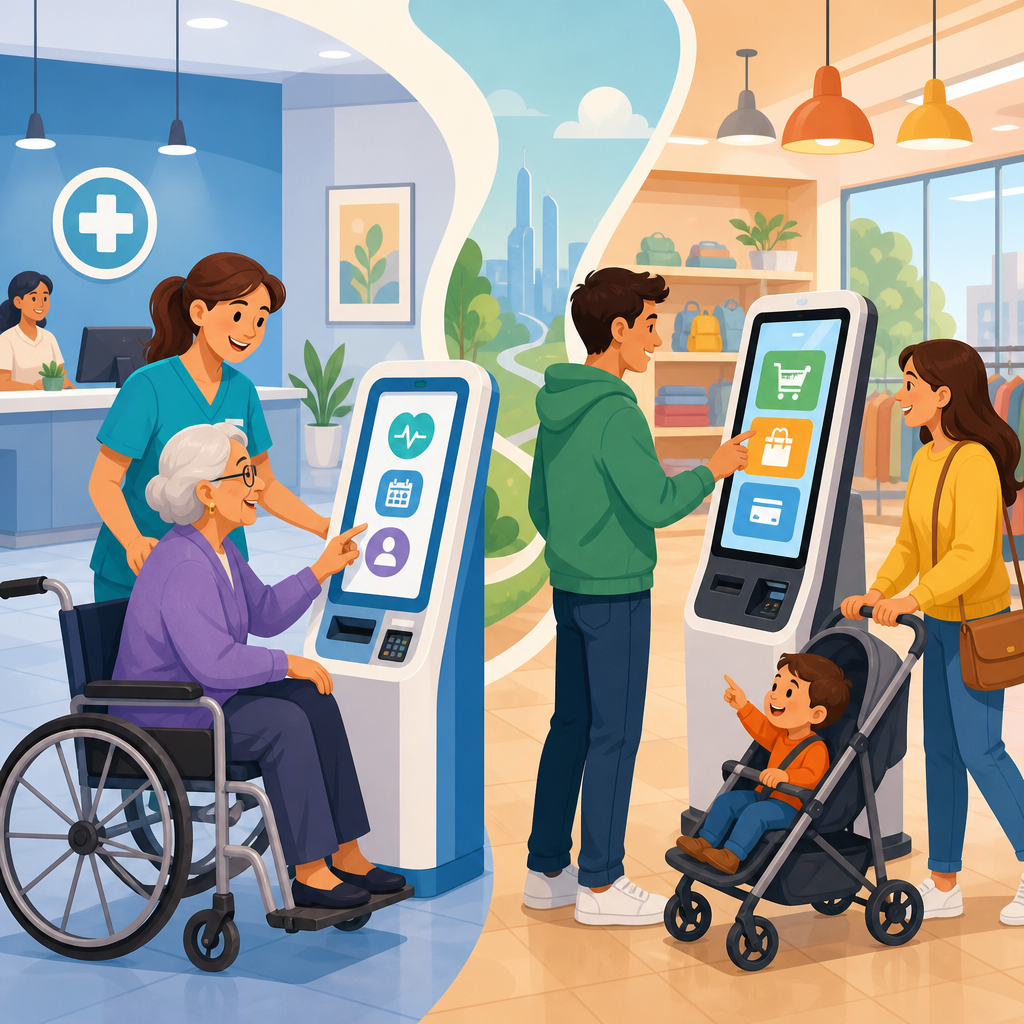
Predictions for kiosk accessibility in health care and retail point to a simple reality: self-service technology will keep expanding, and accessibility will shift from a compliance afterthought to a core product requirement. In both sectors, kiosks now handle check-in, payments, queue management, prescription pickup, wayfinding, loyalty programs, and identity verification. When these systems are not usable by people with disabilities, the barrier is immediate and costly. A patient can miss an appointment, a shopper can abandon a purchase, and an organization can trigger complaints, remediation costs, and reputational damage. Accessibility in this context means designing hardware, software, content, and workflows so people with visual, hearing, mobility, cognitive, and speech disabilities can complete the same essential tasks with comparable privacy, independence, and dignity.
In practice, kiosk accessibility sits at the intersection of disability law, user experience, procurement, and operations. Standards already shape the field. The Americans with Disabilities Act sets the civil rights baseline, while Section 508 influences public-sector purchasing and often affects health systems tied to government funding. Technical guidance commonly draws from the Web Content Accessibility Guidelines, the Revised 508 Standards, and hardware provisions from the 2010 ADA Standards for Accessible Design where reach range, clear floor space, and operable parts matter. I have seen organizations focus narrowly on screen-reader output and miss larger failure points, such as inaccessible card readers, timed sessions that expire during assisted use, or audio jacks mounted where wheelchair users cannot reach them. The next wave of development is broader: not just whether a kiosk speaks, but whether the whole transaction works for real people under real conditions.
This matters now because deployment models are changing fast. Hospitals are replacing staffed front desks with digital intake stations. Pharmacies and supermarkets are adding more self-checkout lanes and pickup lockers. Retailers are connecting kiosks to mobile apps, loyalty ecosystems, and biometric authentication. At the same time, regulators, plaintiff firms, and advocacy groups are paying closer attention to inaccessible digital interfaces in physical places. The organizations that will navigate this well are not the ones waiting for complaints. They are the ones treating accessible kiosks as durable infrastructure, with measurable requirements, test protocols, and governance. That is the central prediction for future ADA developments in this area: expectations will become more explicit, more testable, and more closely tied to everyday service delivery.
Accessibility will move upstream into procurement and product roadmaps
The strongest near-term prediction is that kiosk accessibility will be decided earlier, during vendor selection and product definition rather than after installation. For years, many buyers accepted generic accessibility statements that were written for websites, not physical self-service devices. That approach is failing. Health systems and national retailers increasingly ask for VPAT documentation, keyboard interaction details, audio support specifications, hardware dimensions, timeout controls, and evidence of user testing with assistive technology. In my work reviewing deployments, the best outcomes happen when these questions are built into the request for proposal and into acceptance criteria before contracts are signed.
This shift is practical, not theoretical. Retrofitting a live fleet is expensive. If the enclosure places the receipt printer too high, if the touch targets are too small, or if the software lacks a persistent audio pathway, remediation often requires field visits, replacement parts, retraining, and downtime. Procurement teams are learning that accessibility defects behave like structural defects. They are cheaper to prevent than to patch. Expect future contracts to include explicit service-level commitments for accessibility defects, mandatory regression testing after updates, and clear ownership between kiosk manufacturers, software vendors, payment providers, and facility operators.
Another likely development is tighter internal coordination. Accessibility officers, risk teams, digital product managers, facilities, and frontline operations often work separately. Kiosks force them together because the barrier can originate anywhere in the chain. A health care check-in station may require an accessible software flow, reachable scanner, privacy screen that does not block wheelchair positioning, and staff protocol for alternate service. The organizations that mature fastest will create cross-functional governance and maintain a single accessibility requirement set across web, mobile, and kiosk channels.
Health care kiosks will face higher scrutiny because the stakes are higher
Health care will likely become the most closely watched environment for kiosk accessibility because failures can affect treatment access, protected information, and patient safety. A retail customer who cannot use self-checkout may switch lanes. A patient who cannot complete registration may miss a specialist visit, fail to confirm insurance, or be unable to update allergy information. Because of that difference, hospitals and clinics are likely to adopt stricter design and operational controls than many retailers.
Expect patient intake kiosks to support multimodal interaction as a baseline. That means speech output through a standard headphone jack or private handset, tactilely discernible controls, clear focus order, plain-language error messages, adjustable time limits, and support for users who cannot perform gestures requiring fine motor precision. It also means accessible signature capture alternatives, because many current signature pads still create bottlenecks for users with low vision, tremors, limited reach, or one-handed use. Better systems will allow consent and acknowledgment through accessible digital forms tied to account records rather than requiring a stylus-based signature alone.
Privacy will become a larger design factor. In clinics, accessible service must also protect confidentiality. Audio guidance that is too loud can expose personal details, while staff assistance can undermine independence. The better model is a kiosk that enables a private audio session, minimizes spoken sensitive content, and lets patients transfer unfinished tasks to their own device through a secure link or QR code. Major electronic health record ecosystems and patient engagement platforms are already pushing omnichannel intake; accessibility will make that handoff more important.
Retail will treat accessible self-service as a conversion and labor strategy
Retail adoption will accelerate for a different reason: accessible kiosks can reduce abandonment and preserve labor flexibility. Self-checkout, endless aisle terminals, return kiosks, and pickup stations are now central to store operations. When a kiosk excludes shoppers with disabilities, staff must intervene, lines slow down, and the promised efficiency disappears. Retailers are beginning to understand accessibility not as a niche legal issue but as a throughput issue tied to sales conversion, basket completion, and customer loyalty.
Expect leading chains to standardize accessible interaction patterns across store formats. Shoppers should not need to relearn controls at every location. Consistency in button placement, audio initiation, scanning workflow, coupon redemption, and payment prompts lowers cognitive load for everyone, especially customers with low vision or cognitive disabilities. The same principle already drives web design systems; it will increasingly shape kiosk interfaces. Retailers with mature design systems will extend token libraries, component rules, and content patterns to in-store touchpoints so updates stay consistent across channels.
There is also a growing business case in aging demographics. Older adults are more likely to encounter low vision, hearing loss, reduced dexterity, and slower processing speed, even if they do not identify as disabled. Accessible kiosks with stronger contrast, simpler wording, larger controls, and forgiving error recovery work better for this group and often reduce support calls. In stores, these improvements can directly raise completed transactions. The organizations that measure this honestly will treat accessibility as part of customer experience optimization rather than a separate compliance project.
Technical expectations will become more concrete and more measurable
Over the next several years, the most important ADA-related development will be the translation of broad accessibility obligations into testable kiosk requirements. Many disputes today arise because organizations know they must provide equal access but have not defined what that means for each task. The future will involve clearer checklists tied to user outcomes, not vague assurances.
| Area | Current common gap | Likely future expectation |
|---|---|---|
| Input | Touch-only interaction | Non-touch navigation with tactile controls or equivalent hardware |
| Audio | No private speech output | Headphone jack or handset with persistent, discoverable audio mode |
| Timing | Short fixed timeouts | Adjustable or extendable session limits with clear warnings |
| Reach range | Card readers and printers mounted too high | Hardware placement validated against wheelchair reach requirements |
| Content | Dense medical or promotional wording | Plain language, predictable flows, and specific error recovery guidance |
| Maintenance | Accessible features break after updates | Regression testing in every release and field audit routines |
These expectations will be reinforced by better testing methods. Instead of relying on one-time inspections, organizations will combine lab testing, assistive technology checks, and observational usability sessions with disabled users. For software, teams will increasingly use accessibility acceptance criteria in agile development and include kiosk journeys in design QA. For hardware, they will validate real-world reach, glare, ambient noise, and wheelchair approach in the actual installation environment. A kiosk can pass a software review and still fail in a bright lobby where speech output is inaudible and the floor slope limits positioning.
Another prediction is stronger telemetry. Kiosks will increasingly log completion rates, timeout frequency, abandonment points, and staff override events. When interpreted carefully and with privacy safeguards, this data can reveal accessibility friction. For example, a sudden spike in timeout extensions after a software release may indicate that prompts became harder to understand. Data will not replace user testing, but it will make accessibility issues easier to detect before complaints escalate.
Artificial intelligence will help, but it will not replace inclusive design
Artificial intelligence will influence kiosk accessibility in both promising and risky ways. On the positive side, AI can improve speech recognition, simplify language, personalize guidance, and detect when a user appears stuck. In health care, AI-assisted intake could explain insurance questions in simpler terms or offer translation without forcing the user into a separate workflow. In retail, AI could guide product search, explain promotions, or help complete returns. These features may reduce confusion for users with cognitive disabilities, limited literacy, or limited English proficiency.
But AI will not solve core accessibility failures. A conversational layer cannot compensate for an unreachable payment terminal, an unlabeled control, or a workflow that requires drag-and-drop gestures. It also creates new risks. Speech interfaces can struggle in noisy stores or with atypical speech patterns. Vision-based systems may misread assistive devices or fail on darker environments. Generative responses can be verbose, inconsistent, or wrong. In regulated health contexts, that inconsistency is especially problematic.
The best prediction is that AI will be used as an assistive enhancement, not as the only pathway. Organizations that deploy it responsibly will keep deterministic, testable alternatives for every essential task. They will constrain AI outputs, monitor failure modes, and make human assistance easy to reach. In other words, the future is not kiosk accessibility by chatbot. It is accessible transaction design supported by selective automation.
Operations, training, and maintenance will matter as much as interface design
One lesson repeated across deployments is that an accessible kiosk can become inaccessible through poor operations. Headphone jacks break, volume settings reset, card readers loosen, privacy screens create glare, and receipts run out. Staff may not know how to start audio mode or may unintentionally steer disabled users away from self-service even when the kiosk is usable. Because of that, future ADA developments will increasingly focus on operational readiness, not just design intent.
Health care providers and retailers should expect stronger expectations around documented maintenance checks, frontline staff training, and alternate service procedures. An accessible route to the kiosk, a clean clear floor space, and working peripherals must be verified regularly, not assumed. Training should cover respectful assistance, how to describe available accessibility features, and when to offer an equivalent staffed option without creating delay or stigma. I have seen organizations avoid complaints simply by training staff to recognize a broken accessible feature and route users quickly to a comparable alternative while logging the defect for repair.
Governance will also mature. Enterprises will inventory kiosk models, software versions, and accessibility features by location, then tie that inventory to incident tracking. This sounds mundane, but it is one of the clearest markers of maturity. If a retailer cannot tell which stores have kiosks with tactile keypads or which clinics are running software with a known timeout issue, it cannot manage accessibility systematically.
The hub opportunity: connect legal updates, standards, and implementation guidance
As a sub-pillar hub within Updates and Developments, this topic should connect readers to three ongoing streams: legal interpretations, technical standards, and field implementation lessons. Future trends in ADA developments for kiosks will not emerge from one source alone. They will come from enforcement actions, settlement patterns, standards updates, court reasoning, vendor innovation, and buyer expectations. Readers need a central resource that tracks all of those signals and translates them into practical decisions for product teams, compliance leaders, facilities managers, and operators.
The most useful approach is to organize related articles around specific questions: What kiosk features are most likely to trigger complaints? How do ADA obligations interact with WCAG and Section 508? What are the differences between health care intake kiosks, pharmacy pickup stations, self-checkout, and ticketing terminals? How should organizations test audio privacy, reach range, timeout settings, and assisted-use flows? A strong hub page answers the high-level question and then points to deeper guidance on each subtopic.
Predictions for kiosk accessibility in health care and retail ultimately come down to one conclusion: accessible self-service will become a standard expectation, and organizations that plan early will spend less, serve more people, and face fewer disruptions. The next phase of ADA-related development will reward specificity. Buyers will ask harder questions, regulators and advocates will focus on real user outcomes, and successful operators will treat accessibility as part of service design, not a side checklist. If this topic affects your organization, use this hub to map the legal changes, technical requirements, and implementation steps you need next, then turn those insights into a funded roadmap.
Frequently Asked Questions
1. Why is kiosk accessibility expected to become a core requirement in health care and retail?
Kiosk accessibility is moving from a box-checking exercise to a core product requirement because self-service technology is now directly tied to essential customer and patient interactions. In health care, kiosks support appointment check-in, identity verification, insurance confirmation, payments, wayfinding, and prescription-related workflows. In retail, they manage self-checkout, loyalty enrollment, returns, queue management, product lookup, and digital ordering. When these systems are inaccessible, the problem is not theoretical. It can prevent a patient from completing intake, delay care, block a shopper from making a purchase, or force a person with a disability to depend on staff for a task that should be private and independent.
Another reason accessibility is becoming central is that organizations are seeing the operational cost of poor design. An inaccessible kiosk increases staff intervention, creates longer lines, frustrates users, and undermines the efficiency gains that justified self-service in the first place. Health systems and retailers are also under greater pressure to reduce friction at every touchpoint, and accessibility failures create exactly the kind of friction that damages customer satisfaction and brand trust. As kiosk adoption grows, accessibility will be treated less as a legal safeguard and more as a quality, usability, and business continuity issue.
Just as important, expectations are changing. Users increasingly assume digital experiences should work for everyone, including people who are blind or low vision, Deaf or hard of hearing, neurodivergent, or living with mobility, speech, or cognitive disabilities. The organizations that plan for this now will be in a stronger position as technology evolves. The likely future is clear: accessible kiosks will be viewed as standard, not specialized, and product teams that ignore that shift will face both reputational and practical consequences.
2. What accessibility features are likely to become standard in future kiosks?
Future kiosks in health care and retail will likely include a broader set of built-in accessibility features by default, rather than offering limited accommodations only when requested. Audio guidance will become more common, especially through private listening options such as headphone jacks, Bluetooth pairing, or secure mobile-device handoff. Screen-reader-style navigation, text-to-speech prompts, adjustable volume, and clear spoken instructions will help users who are blind, low vision, or who process information more effectively through audio.
Visual accessibility will also expand significantly. Expect higher-contrast interfaces, larger default text, simpler layouts, reduced screen clutter, and more consistent navigation patterns. Many kiosks will likely offer on-screen controls for zoom, color contrast adjustments, and language selection. Captions and visual reinforcement for audio instructions will be increasingly important, especially in noisy retail environments or busy medical lobbies. Interfaces may also rely less on fine motor precision by providing larger touch targets, generous spacing, and clearer error recovery paths.
Physical design improvements are also likely to become standard. That includes reachable input and payment components, wheelchair-friendly positioning, support for seated and standing users, accessible card readers, tactile keypads where needed, and enough clear floor space for mobility devices. In health care environments, where privacy matters greatly, accessible design may also extend to better positioning for confidential use and workflows that reduce the need for public verbal disclosure. Over time, the most successful kiosks will combine digital accessibility, hardware accessibility, and environmental usability into one integrated design approach.
3. How will accessibility expectations differ between health care kiosks and retail kiosks?
Health care and retail kiosks share many accessibility needs, but the stakes and workflow expectations are often different. In health care, kiosks are frequently part of time-sensitive, high-consequence interactions. A patient may need to verify personal information, confirm insurance, sign consent forms, pay a balance, or navigate to a clinic area. If the kiosk is inaccessible, the result can be missed appointments, delayed treatment, privacy concerns, and added stress during already sensitive situations. That means health care kiosks will likely face increasing pressure to support accessible identity verification, understandable medical intake flows, multilingual communication, and stronger privacy protections for users who require assistance.
Retail kiosks, by contrast, tend to center on speed, convenience, and transaction volume. Customers may use them for self-checkout, price checks, returns, loyalty accounts, ordering, or product discovery. Accessibility in these environments still matters deeply, but the interaction patterns may prioritize quick navigation, easy payment completion, and flexible input methods. Retailers will likely focus on minimizing abandonment, reducing confusion in fast-paced settings, and making independent use possible without slowing the overall flow of store operations.
Even with these differences, the long-term expectation in both sectors is convergence around inclusive design principles. Users do not separate “medical accessibility” from “shopping accessibility” in their lived experience. They simply expect technology to work. The biggest difference will probably be in the details: health care kiosks may need more robust support for privacy, legal documentation, and critical instructions, while retail kiosks may lean more heavily on speed, payment accessibility, and broad customer usability at scale. In both cases, accessibility will be judged by whether people can complete tasks independently, accurately, and with dignity.
4. What role will regulations, standards, and legal risk play in the future of kiosk accessibility?
Regulations and legal exposure will continue to be major drivers of kiosk accessibility, but they will not be the only ones. Organizations in health care and retail are already aware that inaccessible self-service technology can trigger complaints, litigation, investigations, and costly remediation. As self-service becomes more embedded in essential services, the legal expectation that these systems be accessible is only likely to become stronger. That puts pressure on operators, manufacturers, software vendors, and procurement teams to treat accessibility as a requirement from the earliest stages of design and purchasing.
Standards will play an increasingly important role because buyers want clearer benchmarks for what “accessible” actually means in practice. Instead of vague promises, health systems and retailers will look for documented conformance, testing evidence, and accessibility commitments from vendors. Procurement language will likely become more specific, requiring accessible hardware placement, usable software flows, support for assistive technology, and validation through testing with disabled users. This shift matters because it moves accessibility upstream, where it is cheaper and more effective to address.
At the same time, legal risk alone is not a complete strategy. A kiosk can technically satisfy portions of a standard and still frustrate real users if the experience is confusing, inconsistent, or dependent on staff workarounds. That is why future leaders in this space will go beyond minimum compliance and focus on practical usability. The organizations that perform best will likely be those that combine regulatory awareness with inclusive design, quality assurance, user testing, and governance processes that keep accessibility from slipping during updates or hardware refreshes.
5. What should health care providers and retailers do now to prepare for the next wave of accessible kiosk design?
The most important step is to stop treating accessibility as a late-stage fix. Health care providers and retailers should evaluate their current kiosk ecosystem now, including hardware, software, placement, transaction flows, payment devices, and support processes. That means identifying where users may struggle with vision, hearing, mobility, speech, cognition, language, timing limits, or complex instructions. It also means reviewing whether critical tasks can be completed independently and privately, without requiring staff intervention that compromises dignity or confidentiality.
Organizations should also strengthen procurement and vendor management practices. Accessibility requirements need to be written into requests for proposals, contracts, testing protocols, and acceptance criteria. Buyers should ask vendors not only whether a kiosk is accessible, but how that claim has been validated. Useful evidence may include accessibility documentation, usability testing results, hardware measurements, remediation procedures, and product roadmaps showing how accessibility will be maintained over time. This is especially important because many kiosk environments depend on multiple vendors, and accessibility can break down at the handoff points between software, peripherals, and installation decisions.
Finally, organizations should invest in ongoing testing and governance. The best predictions for kiosk accessibility point toward continuous improvement, not one-time certification. Software updates, new payment modules, revised workflows, and redesigned interfaces can all create new barriers if accessibility is not monitored. Including people with disabilities in testing is essential because real-world feedback often reveals issues that technical reviews miss. Staff training matters as well, since employees need to know how to support users without making the experience more burdensome. In short, the smartest move now is to build accessibility into strategy, procurement, design, testing, and operations so future kiosk expansion supports inclusion from the start.


