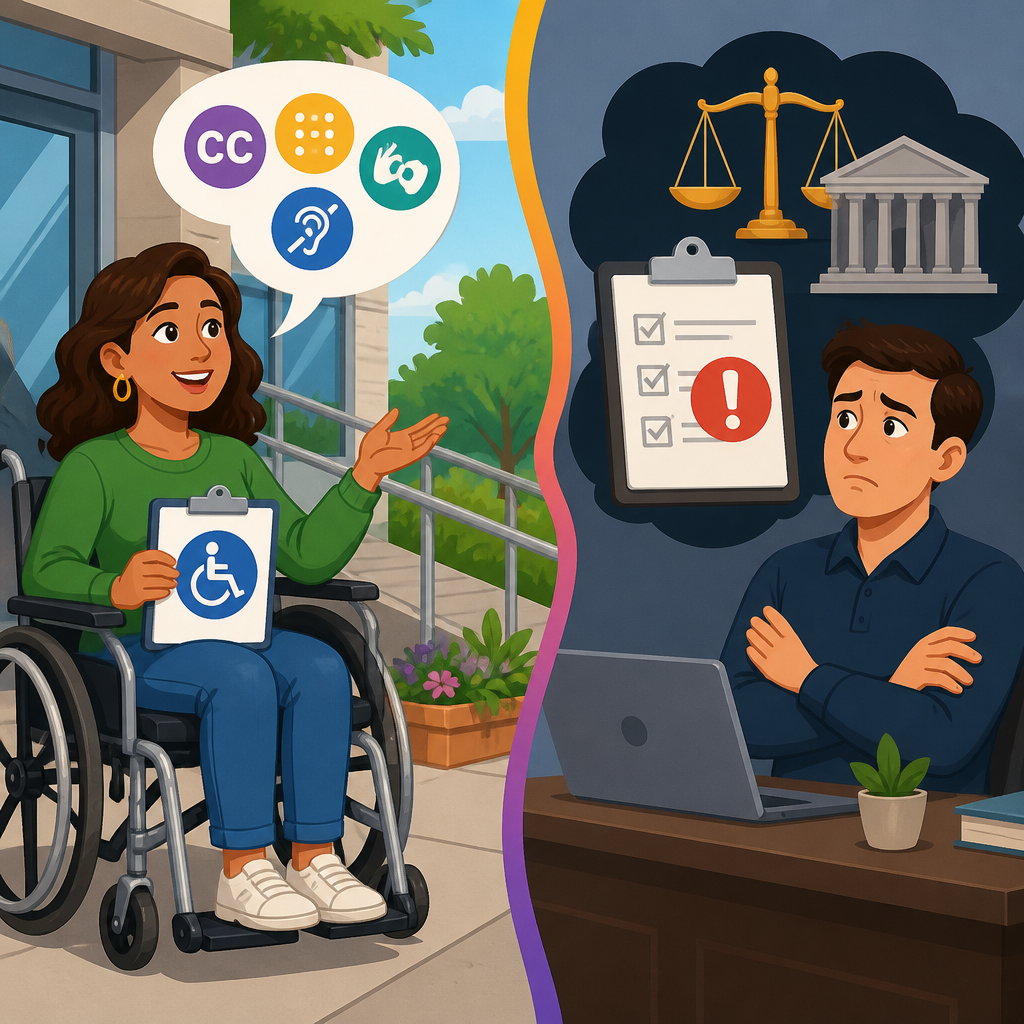
Accessibility requests can become civil rights complaints when an organization fails to provide equal access after notice, denies a reasonable modification without lawful justification, or allows barriers to persist so long that exclusion becomes discrimination. In the context of disability rights, an accessibility request is a person’s ask for an accommodation, auxiliary aid, policy change, or barrier removal that allows meaningful participation. A civil rights complaint is the formal allegation that a public entity, business, school, housing provider, employer, or federally funded program violated legal protections by denying that access. This distinction matters because many people assume the law begins only when a lawyer sends a letter. In practice, the legal and factual record often starts much earlier, with an email asking for captions, a doctor’s office request for an interpreter, a tenant’s ask for an accessible parking space, or a student’s request for testing adjustments.
I have worked on matters where a simple request, handled promptly and respectfully, prevented months of conflict, and I have seen the opposite: a delayed response, a dismissive manager, and no written process turned a fixable barrier into a formal grievance with agency oversight. That pattern is why advanced ADA rights deserve a hub page. The Americans with Disabilities Act is only one part of the framework. Depending on the setting, related protections may also come from Section 504 of the Rehabilitation Act, the Fair Housing Act, the Air Carrier Access Act, the Individuals with Disabilities Education Act, state human rights laws, and local ordinances. Each source has its own standards, timelines, and remedies, but they share a core rule: disability-based exclusion is unlawful when access could have been provided through reasonable steps.
This article explains when accessibility requests cross the line into civil rights complaints, how investigators evaluate those complaints, what evidence matters most, and where the hardest disputes arise. As a sub-pillar hub for advanced topics in ADA rights, it also maps the recurring issues that deserve deeper reading: digital accessibility, effective communication, service animals, public accommodation policies, transportation, housing modifications, employment accommodations, higher education, healthcare access, and retaliation. If you understand the legal triggers, the duty to engage, and the documentation that proves what happened, you are better positioned to solve problems early or escalate them effectively when resolution fails.
The Legal Trigger: When a Request Becomes a Rights Violation
An accessibility request becomes a civil rights issue when the facts show more than inconvenience. The usual trigger is notice plus failure. Notice means the organization knew, or reasonably should have known, that a disability-related barrier existed and that a modification or aid was needed. Failure means the organization refused, ignored, delayed unreasonably, imposed unnecessary conditions, or offered an ineffective alternative. Under Title II of the ADA, public entities must provide equal access to programs and services. Under Title III, places of public accommodation must make reasonable modifications, furnish auxiliary aids and services when necessary for effective communication, and remove architectural barriers when readily achievable. Section 504 applies similar nondiscrimination duties to recipients of federal funding, including many hospitals, universities, and social service providers.
Real cases often turn on whether the requested change was reasonable and necessary. If a deaf patient asks a hospital for a qualified sign language interpreter for informed consent and complex treatment discussions, handwritten notes may not be enough. If a wheelchair user asks a city to relocate a public meeting from an inaccessible second floor room, the city usually must move the meeting or otherwise provide meaningful access. If a student with a documented learning disability requests extra testing time through the established campus process, the school must engage the request on the merits rather than rely on blanket rules. The violation is not the request itself; the violation is the exclusion that follows from an unlawful response.
Intent is not always required. Many claims are proven through the effect of a policy or failure to act. A website checkout flow that cannot be used with a screen reader can deny equal access whether or not anyone meant to discriminate. A transit station without a working elevator can exclude riders even if the outage began as a maintenance problem. In advanced ADA disputes, the focus is on meaningful access, effective communication, reasonable modification, direct threat analysis, undue burden, and fundamental alteration, all terms with specific legal content rather than casual meanings.
Settings Where Complaints Commonly Arise
Accessibility disputes look different across sectors, and understanding the setting is essential. In healthcare, the highest-risk issues are effective communication, accessible medical equipment, and policies that force disabled patients to rely on family members instead of qualified interpreters. The Department of Justice and the Department of Health and Human Services have repeatedly emphasized that clinical accuracy and informed consent depend on communication that actually works. In higher education, disputes often involve note-taking support, housing accommodations, attendance flexibility, accessible course materials, and whether the institution conducted an individualized assessment. In K–12 schools, families may move between ADA, Section 504, and special education procedures, depending on the child’s needs and the school’s obligations.
Public accommodations generate another large category of complaints: retail stores with inaccessible aisles, restaurants that mishandle service animal access, hotels that misdescribe accessible rooms, theaters that fail to provide captioning devices, gyms with inaccessible routes, and banks that offer kiosks unusable by blind customers. Housing raises separate issues under the Fair Housing Act, including reasonable accommodations in rules and policies, such as assistance animals or reserved parking, and reasonable modifications, such as grab bars or ramps. Employment claims generally proceed under Title I of the ADA and often center on interactive process failures, medical inquiry limits, leave as an accommodation, reassignment, and retaliation.
Digital access now cuts across every setting. Courts and enforcement agencies increasingly treat websites, mobile apps, patient portals, online banking, educational platforms, and digital forms as gateways to core services. I have seen organizations invest in a physical ramp while ignoring a broken online intake system that locked out the same customers before they even arrived. That is why advanced ADA rights now require integrated compliance, not siloed fixes.
How Agencies and Courts Evaluate Accessibility Complaints
Investigators generally ask a predictable series of questions. Was the person qualified or otherwise entitled to use the service, program, dwelling, job, or public space? Did the organization have notice of the disability-related need? What exactly was requested? How did the organization respond, and how quickly? Was the alternative offered effective? Would the requested change have created an undue burden, a direct threat, or a fundamental alteration? Were similarly situated nondisabled people treated differently? Is there documentation showing a pattern, such as repeated denials, missing policies, inaccessible design, or staff training gaps?
These questions are why documentation drives outcomes. The strongest files usually include dated emails, portal submissions, photographs, screenshots, witness statements, medical or educational support when relevant, policy excerpts, and records of what happened after the request. For digital claims, I look for reproducible barriers tied to recognized standards such as WCAG 2.1 AA or 2.2 AA, including keyboard traps, unlabeled form fields, missing alt text on functional images, inaccessible PDFs, low-contrast controls, and video content without captions. For communication claims, details matter: who interpreted, whether the person was qualified, what discussion took place, and whether the patient or participant actually understood the information.
| Setting | Common Request | Typical Failure | Evidence That Matters |
|---|---|---|---|
| Healthcare | Qualified interpreter | Using family member or notes instead | Appointment records, consent forms, witness accounts |
| Education | Testing accommodation | Blanket denial or delay past exam date | Disability office emails, syllabus, documentation timeline |
| Housing | Reserved accessible parking | No response or extra fees | Lease, request letter, photos of parking area |
| Digital service | Accessible website or app | Checkout or forms unusable with assistive tech | Screenshots, screen reader testing, WCAG issue log |
| Public entity | Accessible meeting access | Inaccessible location or no captioning | Meeting notice, recordings, venue photos |
Courts also care about remedies and timing. Some statutes allow damages only with proof of intentional discrimination or deliberate indifference, while others focus on injunctive relief, policy change, and access going forward. This is one reason a complaint can be legally strong even when monetary recovery is limited. The point is to stop exclusion and change practice.
The Duty to Engage and the Cost of Delay
One of the most misunderstood principles in advanced ADA rights is the duty to engage in a serious, individualized process. The law does not require organizations to grant every preferred solution, but it does require them to assess requests fairly, communicate with the requester, and consider workable alternatives. Delay can itself be discrimination when time matters. An accommodation approved after the semester ends, after surgery is complete, or after a hiring round closes is often no accommodation at all.
I have reviewed cases where staff believed they were safe because they never said “no.” They simply asked for more paperwork, routed the request through multiple departments, or let it sit. Agencies view that pattern skeptically, especially where the need was obvious or the provider had handled similar requests before. Effective systems have a clear intake method, a trained decision maker, escalation rules for urgent requests, and written rationales when something is denied. Weak systems rely on front-line improvisation, which produces inconsistent outcomes and increases retaliation risk.
Retaliation and interference are major advanced topics because they often follow self-advocacy. A tenant who requests an accommodation and then receives sudden lease scrutiny, an employee who asks for modified equipment and is removed from key duties, or a student who files a grievance and is treated as a problem can have a separate claim even if the original access dispute is unresolved. Anti-retaliation provisions protect the right to ask for access, support someone else’s request, or file a complaint with an agency.
Frequent Defenses and Where They Fail
Organizations often raise the same defenses, and some are valid in narrow circumstances. Undue burden refers to significant difficulty or expense, evaluated in context, not by vague assertions. A small clinic and a national hospital system will not be judged identically. Fundamental alteration means the requested change would substantially modify the nature of the program or service. Direct threat requires evidence-based assessment of actual risk, not stereotypes or generalized fear. Readily achievable barrier removal under Title III considers cost, feasibility, and resources, but “we have never done it that way” is not a defense.
Where these defenses fail is equally important. A business cannot deny a service animal because another customer is uncomfortable with dogs. A school cannot reject an accommodation because it prefers uniform rules over individualized review. A medical provider cannot rely on ad hoc note-writing for every deaf patient regardless of the complexity of the encounter. A website operator cannot claim accessibility is impossible while using a platform that supports accessible coding practices. In my experience, the weakest defense is the unsupported claim that the requester wanted “special treatment.” Civil rights law is built on the opposite premise: equal opportunity sometimes requires different treatment to remove disability-related barriers.
Another recurring mistake is overreliance on one-time fixes. Installing a ramp does not solve inaccessible restrooms. Providing captions on a homepage video does not make an application portal accessible. Approving remote work during an emergency does not answer why the same function became “impossible” once a worker requested it as an accommodation. Investigators notice these inconsistencies because they reveal whether the barrier is truly unavoidable or merely unexamined.
Building a Strong Record Before and After Filing
If informal efforts fail, the next step may be an internal grievance, an agency complaint, demand correspondence, or litigation. The best approach depends on the setting and objective. OCR complaints may fit schools and healthcare providers receiving federal funds. HUD complaints may fit housing matters. DOJ may be appropriate for public entities or public accommodations, particularly where a policy affects many people. State civil rights agencies can be effective, and some have broader coverage than federal law. Employment claims usually require attention to EEOC procedures and deadlines.
Before filing, narrow the ask. State the barrier, the legal context, the requested remedy, and the deadline that would make the remedy meaningful. Attach supporting documentation, but keep the narrative readable. After filing, preserve everything: confirmation notices, agency correspondence, settlement drafts, repair timelines, and records showing ongoing harm. If the organization eventually offers a solution, evaluate whether it is prompt, durable, and equal in quality. Temporary workarounds may be acceptable in emergencies, but they do not erase systemic violations if the core barrier remains.
As a hub for advanced topics in ADA rights, this page should guide readers toward deeper subtopics: digital accessibility standards and audits; interpreter and captioning obligations; service animal disputes; healthcare consent and communication; higher education accommodation processes; public meeting access; transportation and paratransit; housing accommodations versus modifications; employment interactive process failures; retaliation and interference; and litigation trends over website access, kiosk design, and emerging technologies. Across all of them, the governing lesson is consistent: once a disability-related barrier is known, the response must be timely, individualized, and effective.
When accessibility requests become civil rights complaints, the turning point is rarely dramatic. More often, it is a preventable chain of small failures: no policy, no training, no deadline, no individualized review, and no respect for the person reporting the barrier. The law steps in because access to healthcare, housing, education, transportation, employment, and everyday commerce is not optional participation. It is civic belonging. A compliant organization does more than react to complaints; it builds systems that identify barriers early, document decisions carefully, and deliver effective solutions without forcing people into conflict.
The key takeaways are practical. First, notice matters: once an organization knows about a disability-related barrier, it must respond. Second, delay can be as harmful as denial when the missed opportunity cannot be recreated. Third, documentation wins cases and resolves them faster, especially where digital barriers, interpreter failures, or inconsistent policy enforcement are involved. Fourth, the strongest defenses require evidence, not assumptions. Finally, retaliation is its own risk and should be treated as a serious compliance issue from the first request onward.
For readers using this page as a hub under Rights and Protections, the main benefit is clarity. Advanced ADA rights are easier to navigate when you can identify the legal standard, the decision maker, the evidence, and the remedy that fits the setting. Use this article to map your next step, then explore the related subtopics most relevant to your situation. If you are making a request, put it in writing and define the barrier clearly. If you are responding to one, engage promptly and document your reasoning. Early, informed action is still the best way to prevent an access problem from becoming a civil rights complaint.
Frequently Asked Questions
When does an accessibility request become a civil rights complaint?
An accessibility request becomes a civil rights complaint when the issue moves beyond a simple ask for help and into a failure to provide equal access under the law. In practical terms, that usually happens after an organization has notice of the barrier or need, has an opportunity to respond, and still does not take appropriate action. For example, if a person requests an accommodation, auxiliary aid, policy modification, or removal of a barrier so they can participate on equal terms, and the organization ignores the request, unreasonably delays, denies it without a lawful reason, or offers something ineffective, the problem may become more than customer service. It may become discrimination.
In disability rights settings, the key issue is whether the person was denied meaningful access to a program, service, activity, benefit, or place open to the public. A civil rights complaint is the formal allegation that this denial happened because the organization failed to meet its legal obligations. The turning point is often not the request itself, but the organization’s response. If barriers persist long enough that the individual is excluded, deterred, or unable to participate in a way others can, the law may treat that as unequal treatment. The complaint process then becomes a way to assert legal rights, document harm, and seek corrective action.
What kinds of accessibility requests can lead to a civil rights complaint?
Many different types of accessibility requests can lead to a civil rights complaint if they are mishandled. Common examples include requests for sign language interpreters, captioning, screen-reader-accessible documents, alternative formats, wheelchair access, accessible parking, service animal accommodations, flexibility in policies, modified communication methods, or adjustments that allow someone with a disability to participate fully. The request does not have to be complex or highly formal to be legally important. Often, it is simply a person explaining what they need in order to access something that others can use without difficulty.
What matters is whether the requested change is reasonable and necessary for equal access, and whether the organization has a legal duty to provide it. If an entity refuses to communicate effectively, declines a reasonable modification, insists on inaccessible processes, or leaves physical or digital barriers in place, that can create the basis for a complaint. This is especially true when the result is exclusion from school, work-related public services, medical care, transportation, government programs, housing-related services, or businesses serving the public. In short, almost any request tied to meaningful access can become the foundation of a civil rights complaint if the response shows indifference, unjustified denial, or avoidable delay.
Does an organization have to say “no” before someone can file a civil rights complaint?
No. An explicit denial is not always required. A civil rights complaint can arise from silence, repeated delays, incomplete responses, or providing an alternative that does not actually give equal access. In many real-world situations, organizations do not issue a direct refusal. Instead, they postpone action, ask the person to keep waiting, shift responsibility from one department to another, or offer a workaround that is inconvenient, stigmatizing, or ineffective. If those actions prevent meaningful participation, they may still amount to discrimination.
What the law often looks at is the practical effect of the organization’s conduct. If the person could not attend the event, use the service, understand the information, enter the building, complete the process, or benefit from the program because accessibility needs were not addressed, a formal “no” may not matter. Notice and opportunity to fix the problem are important, but once the organization knows about the barrier, it is expected to respond in a timely and effective way. If it does not, the failure itself can support a complaint. In other words, civil rights liability often turns on denied access, not just denied words.
What makes a denial of an accommodation or modification legally problematic?
A denial becomes legally problematic when it is not supported by a valid legal justification and results in unequal access. Organizations are not always required to grant every request exactly as made, but they generally must engage with the request seriously and provide an effective solution when the law requires one. A refusal may raise civil rights concerns if the organization dismisses the request without evaluating it, relies on stereotypes or assumptions about disability, demands unnecessary proof, applies policies inflexibly, or ignores less burdensome ways to provide access.
There are limited defenses in some legal settings, such as undue financial or administrative burden, fundamental alteration of the nature of a service or program, or direct safety concerns based on actual evidence rather than fear or speculation. But those defenses are not blanket excuses. The organization usually must be able to explain why the request could not be granted and whether another effective option was available. If it simply says “we do not do that,” “that is our policy,” or “it is too difficult” without a lawful basis, the denial may support a civil rights complaint. The central question is whether the person was denied a fair and meaningful opportunity to participate because accessibility was treated as optional rather than required.
What should someone document if they think their accessibility request has turned into a civil rights issue?
Good documentation can make a major difference. A person should keep records of what they requested, when they requested it, who received the request, how the organization responded, and what happened as a result. Useful materials may include emails, text messages, letters, screenshots, intake forms, appointment notices, event registrations, policies, recordings where lawful, photographs of barriers, inaccessible documents, and notes of phone calls or in-person conversations. It is also helpful to write down the impact of the failure, such as missed appointments, inability to attend, lost opportunities, humiliation, extra expense, health consequences, or exclusion from a program or service.
Documentation should also show that the organization had notice and that the barrier was not just hypothetical. For example, if someone asked for captions before a meeting and the meeting went forward without them, that sequence matters. If a person requested an accessible entrance and was told to use a back door, wait outside, or rely on others for assistance, that can help show unequal treatment. The goal is not only to prove that a request was made, but to show that the response was ineffective or unlawfully insufficient. Clear records can support internal complaints, agency filings, demand letters, or legal claims, and they often help explain why the issue is not merely inconvenience but a potential civil rights violation.