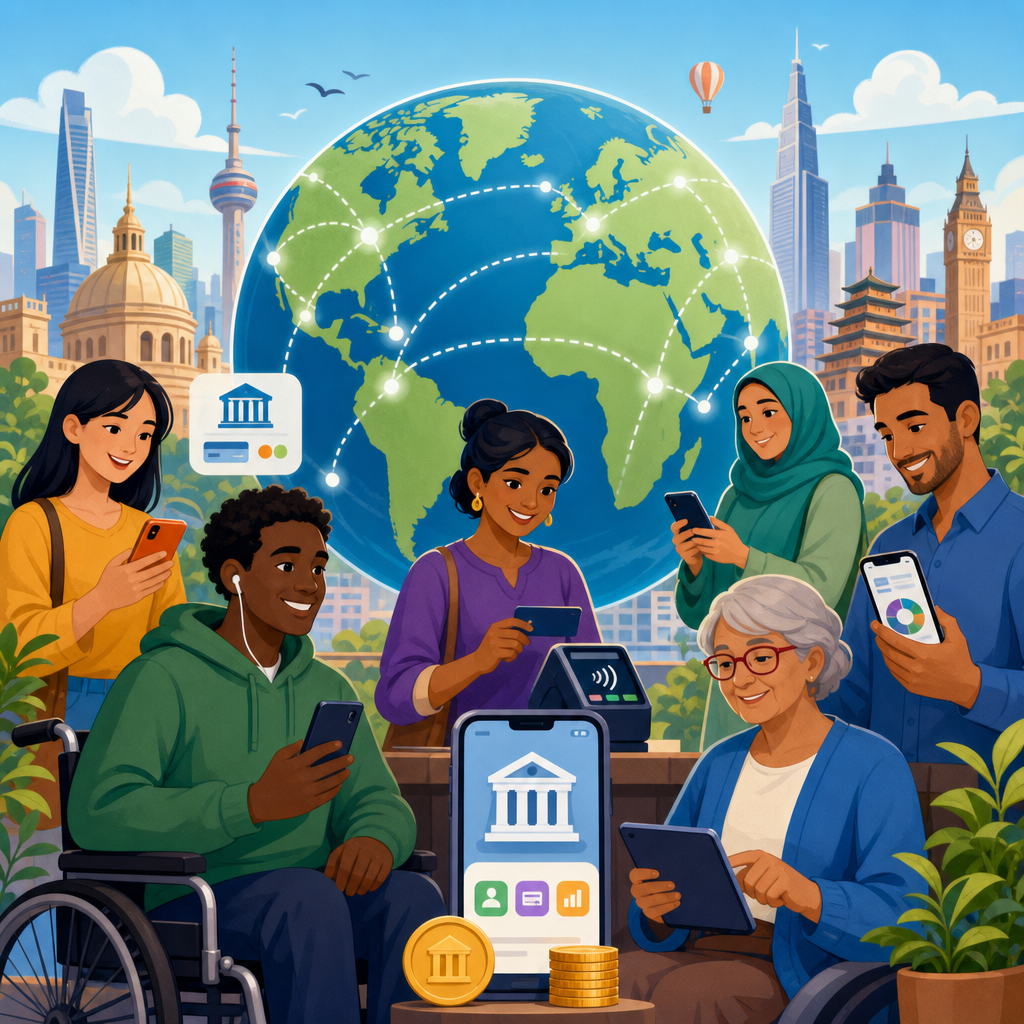
Accessible banking, payments, and fintech are becoming central to financial inclusion as disability rights move higher on policy, design, and business agendas worldwide. In practical terms, accessible banking means financial services can be used by people with visual, hearing, cognitive, speech, and motor disabilities without losing independence, privacy, or safety. Accessible payments covers everything from cash access and card terminals to digital wallets, QR codes, and authentication flows. Fintech adds newer layers such as app-based investing, digital remittances, embedded finance, open banking, and AI-driven support. Together, these systems shape whether millions of people can earn, save, borrow, pay, and participate fully in the economy.
The scale of the issue is global. The World Health Organization estimates that more than one billion people live with a disability, and population aging is increasing the need for inclusive design in every market. Financial exclusion is not only a social problem; it carries direct economic costs. When a blind customer cannot read a payment terminal, when a deaf user cannot complete phone verification, or when a person with a cognitive disability faces confusing consent screens, the result is abandonment, dependency, and greater fraud exposure. I have worked on digital service accessibility reviews where tiny interface decisions, such as unlabeled buttons or time-limited one-time passwords, prevented otherwise capable customers from completing basic banking tasks.
This international outlook matters because accessibility rules, disability rights enforcement, payment infrastructure, and fintech maturity differ sharply across regions. Some countries focus on anti-discrimination law, others on technical standards, and others on public procurement or consumer protection. Yet the direction is consistent: accessible financial services are moving from optional accommodation to core operating requirement. Institutions that act early reduce legal risk, improve customer retention, and create better products for everyone. This hub article explains the future of global accessibility and disability rights through the lens of banking, payments, and fintech, showing the regulatory trends, design priorities, regional differences, and strategic choices likely to define the next decade.
Why accessible finance is becoming a global baseline
Accessible finance is becoming a baseline because disability inclusion now intersects with three forces at once: legal obligation, digital transformation, and demographic change. Traditional branch workarounds are no longer enough when account opening, card management, lending, and dispute resolution move to mobile apps and web portals. If the digital channel is inaccessible, the service is effectively inaccessible. Courts, regulators, and ombudsman schemes increasingly recognize that equal access must cover the full customer journey, including identity verification, transaction alerts, documentation, and customer support.
A second driver is the shift from medical views of disability toward rights-based and social models. The key question is no longer whether a customer can adapt to a product, but whether the product creates avoidable barriers. That principle aligns with established standards such as the UN Convention on the Rights of Persons with Disabilities, Web Content Accessibility Guidelines, and inclusive procurement frameworks used by public and private sectors. In my experience, the most effective banking teams stop treating accessibility as a niche compliance task and instead build it into design systems, release management, and vendor selection from the start.
Payments illustrate the urgency. A chip-and-PIN terminal with poor contrast, flat audio support, or touch-only controls can block a customer at the point of sale. A digital wallet that depends on facial verification without alternatives can exclude users with certain physical differences or camera constraints. A fraud detection system that flags atypical assistive technology behavior can unintentionally lock out legitimate customers. These examples show why accessibility and disability rights are no longer separate from mainstream product governance. They sit inside security, privacy, financial conduct, and customer experience.
Global legal and standards landscape shaping the future
The future of global accessibility and disability rights in finance will be shaped by a patchwork of binding laws, technical standards, and supervisory expectations. At the international level, the UN Convention on the Rights of Persons with Disabilities remains the anchor, especially its principles of non-discrimination, accessibility, and equal recognition before the law. While the convention does not prescribe exact coding rules for a banking app, it has influenced national legislation and regulatory interpretation across Europe, Latin America, Africa, Asia-Pacific, and North America.
In practice, financial firms most often operationalize accessibility through recognized technical benchmarks. WCAG 2.1 and increasingly WCAG 2.2 are the common references for websites, mobile content, and digital documents. EN 301 549 influences procurement and accessibility expectations in Europe. In the United States, the Americans with Disabilities Act, Section 504, and Section 508 shape obligations, even though the exact application to private digital financial services can involve litigation and settlement patterns rather than a single fintech-specific statute. Canada’s Accessible Canada Act, the Accessibility for Ontarians with Disabilities Act, and similar provincial rules have also pushed structured compliance programs.
Region-specific regulation is becoming more detailed. The European Accessibility Act will materially affect consumer banking and payment interfaces through requirements tied to products and services placed on the market. In countries such as Australia and the United Kingdom, equality law, consumer duty expectations, and financial vulnerability guidance are combining to raise the bar. India’s Rights of Persons with Disabilities Act and growing digital public infrastructure discussions are also increasing pressure on inclusive service delivery. Across markets, regulators are moving from general statements of principle to evidence-based expectations: testing records, remediation plans, accessible customer communications, and governance accountability.
Banking and fintech design priorities that will define inclusion
The future will be won or lost in implementation details. The most important design priority is end-to-end accessibility rather than isolated feature add-ons. A bank may offer screen-reader support on its home page yet fail at account opening because document uploads, selfie checks, CAPTCHA challenges, or PDF disclosures are inaccessible. I have seen organizations celebrate accessible color palettes while customers still could not complete strong customer authentication. Real inclusion means every step works: discovery, onboarding, daily use, error recovery, and support.
Authentication is the biggest friction point. Security teams often deploy controls that accidentally discriminate, such as rapid timeout windows, audio CAPTCHA with poor intelligibility, or mandatory gestures difficult for users with motor impairments. Better practice includes passkeys, hardware security key support, accessible authenticator apps, device binding with fallback channels, and clear recovery paths that preserve independence. Biometric options can help many users, but they should never be the only route. Multimodal authentication is the durable model because disability, device quality, language, and connectivity conditions vary widely.
Content clarity is equally important, especially for customers with cognitive disabilities, low literacy, or limited familiarity with formal finance. Plain-language transaction descriptions, predictable navigation, adjustable text size, and consistent error messages reduce mistakes and support informed consent. Accessibility overlaps with financial capability here. If a lending app buries fees in dense legal copy or uses confusing toggles for repayment schedules, the risk is not just poor usability; it becomes a consumer protection issue. Inclusive design improves understanding, which improves fairness.
| Area | Common barrier | Better practice |
|---|---|---|
| Onboarding | Selfie-only identity checks | Offer document plus live-agent or NFC alternatives |
| Payments | Touchscreen terminal without tactile cues | Provide audio guidance and physical keypad options |
| Security | Short OTP expiry and inaccessible CAPTCHA | Use passkeys, accessible MFA, and flexible recovery |
| Support | Phone-only verification | Enable chat, relay, email, and secure messaging channels |
| Documents | Scanned PDF statements | Structured digital statements compatible with assistive tech |
Regional outlook: where momentum is strongest and what differs
Europe currently has some of the clearest forward momentum because accessibility is being reinforced through product, service, and digital regulation rather than left solely to court disputes. The European Accessibility Act, consumer protection frameworks, and strong privacy governance together create an environment where banks and payment firms must think systematically about accessible interfaces, disclosures, and support channels. The United Kingdom, outside the EU framework, is still influential because the Equality Act, Financial Conduct Authority expectations around consumer outcomes, and long-standing work on vulnerability push firms toward practical inclusion measures.
North America remains highly significant because of market size, litigation pressure, and fintech concentration. In the United States, enforcement often advances through lawsuits, consent decrees, and sector guidance. Large banks have invested heavily in accessible ATMs, card controls, and mobile banking, but smaller institutions and newer fintechs are inconsistent. Canada is notable for combining human rights frameworks with structured accessibility legislation, producing more formal planning and reporting obligations. In both countries, open banking developments could either improve inclusion through portability and choice or worsen it if consent dashboards and data-sharing journeys are not accessible by design.
Asia-Pacific is diverse. Australia and New Zealand generally show strong rights-based momentum and mature standards use. Japan, Singapore, and South Korea have advanced digital payments ecosystems, but accessibility outcomes vary by provider and channel. India deserves close attention because its scale, mobile-first finance, and public digital rails can dramatically expand inclusion if accessibility is embedded early. Features such as multilingual interfaces, offline resilience, and low-bandwidth compatibility are especially important in this region. Africa and Latin America also present major opportunity. Mobile money, agent banking, and QR payments have expanded access, yet disability inclusion often lags due to device costs, patchy standards enforcement, and limited assistive technology support. The next leap will come from accessible low-cost smartphones, better local language support, and stronger regulatory guidance.
Emerging technologies, opportunities, and new risks
Several technologies will reshape accessible banking, payments, and fintech over the next decade. Artificial intelligence can materially improve access when used carefully. Speech interfaces, document summarization, real-time captioning, and personalized navigation can help customers complete tasks independently. Fraud models can also be trained to distinguish assistive technology usage from suspicious behavior, reducing false positives. However, AI creates new risks if training data excludes disabled users or if automated decisions cannot be contested through accessible channels. Explainability, audit trails, and human review remain essential.
Open banking and interoperable digital identity systems could be major inclusion enablers. When customers can securely share data across providers, they may access specialized tools tailored to disability-related needs, such as budget coaching with simplified interfaces, consent-managed caregiver support, or account alerts optimized for screen readers and vibration patterns. Yet these benefits depend on accessible consent flows and trustworthy delegation models. Financial autonomy and supported decision-making must be balanced carefully. A helper should be able to assist without stripping a customer of control or creating new abuse risks.
Hardware will matter as much as software. Accessible payment terminals, talking ATMs, haptic feedback, wearable authentication, and better support for switch devices can widen choice in physical and mixed environments. Digital public infrastructure may also play a decisive role, especially where governments influence identity, payment rails, or service standards. The lesson from markets that scaled digital finance quickly is straightforward: if accessibility is omitted during infrastructure buildout, retrofitting later becomes expensive and politically difficult. If it is included from the start, adoption broadens and trust grows faster.
What institutions should do now to prepare
Banks, payment providers, and fintech companies should treat accessibility as an enterprise capability, not a one-time remediation project. Start with executive ownership, policy commitments, and measurable standards tied to procurement, design, engineering, and quality assurance. Require accessibility acceptance criteria in product backlogs. Test with disabled users, not only automated scanners. Maintain accessible alternatives for high-risk journeys such as identity proofing, card disputes, and fraud recovery. Train customer support teams on relay services, communication preferences, and safeguarding issues linked to dependency and coercion.
Second, map accessibility against business-critical outcomes. Look at abandonment rates in onboarding, complaints about verification, chargeback friction, branch accessibility, and statement formats. Tie those findings to remediation roadmaps and vendor management. Many failures originate in third-party software development kits, identity tools, PDF generators, and payment terminal firmware. Contracts should specify conformance targets, defect response times, and testing evidence. This sub-pillar hub connects naturally with related international perspective topics, including cross-border regulation, digital identity, inclusive design standards, and disability rights enforcement trends. Use it as a starting point for deeper work on each region and technology area.
The future of global accessibility and disability rights in finance is clear even if the path is uneven. Financial services will be expected to work for disabled customers as a matter of ordinary product quality, legal compliance, and market fairness. Institutions that build accessible banking, payments, and fintech now will reduce risk, serve more people well, and create stronger systems overall. The practical next step is simple: audit your highest-value customer journeys, involve disabled users directly, and prioritize fixes where exclusion causes financial harm. That is how inclusive finance moves from promise to standard.
Frequently Asked Questions
What does accessible banking, payments, and fintech mean in an international context?
Accessible banking, payments, and fintech refers to financial products and services that can be used effectively by people with a wide range of disabilities, regardless of country, device, language, or channel. In practice, that means someone should be able to open an account, verify identity, check balances, transfer funds, use cards, withdraw cash, authorize payments, and get customer support without unnecessary barriers. Accessibility must work across physical environments such as branches, ATMs, and point-of-sale terminals, as well as across digital environments including banking apps, websites, mobile wallets, QR payment flows, and biometric or multi-factor authentication systems.
Internationally, the concept is broader than compliance with one local rule. Different regions have different legal frameworks, technical standards, digital infrastructure, and cultural expectations, but the core principle is the same: people with visual, hearing, cognitive, speech, and motor disabilities should be able to use financial services independently, privately, and safely. That includes readable interfaces, screen reader compatibility, captions and transcripts, clear language, keyboard navigation, predictable workflows, accessible documents, and alternatives when voice, touch, PIN entry, or facial recognition are not practical.
It also means designing for real-world diversity. A customer may be blind and use a screen reader, Deaf and prefer text-based support, neurodivergent and benefit from simpler task flows, or have limited dexterity and need larger tap targets or voice-free alternatives. In lower-connectivity markets, accessibility may depend on how well services work through USSD, agent networks, cash points, and low-cost smartphones. In advanced digital markets, the focus may include accessible app design, open banking tools, and secure but inclusive authentication. The international outlook matters because accessible finance is no longer a niche feature; it is becoming a core requirement for inclusion, trust, and long-term market growth worldwide.
Why is accessibility becoming such a major issue for banks, payment providers, and fintech companies worldwide?
Accessibility is rising on the global agenda because it sits at the intersection of human rights, regulation, product quality, and commercial opportunity. Around the world, disability rights are receiving greater attention from policymakers, consumer advocates, investors, and the public. Financial access is now widely understood as essential to daily life, economic participation, and independence. If a person cannot complete identity checks, use an ATM, understand a payment prompt, or recover access to an account because of inaccessible design, that is not just a poor user experience; it can become a serious barrier to employment, healthcare, mobility, and basic participation in society.
Regulation is another major driver. Many jurisdictions are strengthening accessibility expectations in digital services, public accommodations, payments, and consumer protection. Even where rules differ, the direction of travel is clear: organizations are being pushed to build inclusive systems from the start rather than retrofitting them later. At the same time, global firms often operate across multiple markets, so they need accessibility programs that can scale beyond one country’s legal minimums. Investors and enterprise customers are also asking tougher questions about inclusive design, governance, and operational resilience.
There is also a strong business case. People with disabilities represent a large and often underserved customer segment, and accessibility improvements frequently benefit everyone. Clearer interfaces reduce errors, better authentication options lower abandonment, well-structured content improves mobile usability, and accessible service channels help older adults, temporary injury users, and people operating in stressful or low-attention contexts. For fintechs in particular, accessibility can be a differentiator in crowded markets where trust and ease of use are critical. In short, the global shift is happening because accessible financial services are increasingly seen as both a social obligation and a smart, measurable business strategy.
What are the biggest accessibility barriers in banking and payments today?
The most common barriers appear in both digital and physical financial journeys. On the digital side, inaccessible mobile apps and websites remain a major issue. Examples include unlabeled buttons for screen readers, poor color contrast, missing focus states, confusing navigation, time-limited sessions that cannot be extended easily, and identity verification flows that rely on gestures, camera positioning, or facial matching without accessible alternatives. Payment checkouts may fail when QR codes are presented without text guidance, when CAPTCHAs block assistive technologies, or when one-time password flows are difficult to read, hear, or enter within short time windows.
Physical access challenges are equally important. ATMs may have touchscreens without tactile guidance, audio jacks that are missing or broken, or privacy features that do not work well for blind users. Card terminals can be hard to navigate for customers with low vision or limited dexterity, especially when keys are flat, screens are reflective, or prompts disappear too quickly. Cash access points may be physically difficult to reach, and branch environments may not support clear communication for Deaf customers or those with speech disabilities. Even simple tasks such as signing forms or reviewing printed terms can become barriers when alternative formats are unavailable.
Another major problem is inconsistency across channels. A bank may offer a reasonably accessible website but an inaccessible mobile app, or a fintech may make onboarding easy but create obstacles in fraud alerts, password resets, chargeback processes, or customer support. Accessibility often breaks down at exactly the moments of greatest urgency, such as account lockouts, suspicious transaction reviews, or payment disputes. These breakdowns can force customers to depend on another person, reducing privacy and autonomy. The biggest lesson for the industry is that accessibility cannot be treated as a one-time design feature. It has to be built into the full customer lifecycle, including security, service, documentation, and exception handling.
How can financial institutions improve accessibility while maintaining security and fraud protection?
The key is to stop treating accessibility and security as competing priorities. In well-designed systems, they reinforce each other. Customers are safer when they can understand what is happening, verify transaction details, and complete tasks independently without sharing PINs, passwords, or verification codes with someone else. Strong security becomes more inclusive when institutions offer multiple ways to authenticate, communicate, and recover access. For example, instead of relying on a single biometric method or a single type of one-time password, providers can offer combinations such as device-based approval, passkeys, hardware tokens, accessible authenticator apps, spoken and visual confirmation options, and support-assisted recovery processes that do not expose the user to unnecessary risk.
Clear design matters just as much as advanced technology. Security prompts should be written in plain language, with obvious explanations of what the user needs to do and why. Transaction confirmation screens should be easy to review with assistive technologies. Session timeouts should be reasonable and extendable. Fraud alerts should be delivered through more than one channel, such as accessible push notifications, SMS, email, and secure in-app messaging, so customers can choose what works best for them. Voice-only systems should have text alternatives, and visual-only systems should have audio or nonvisual alternatives. This reduces the chance that a customer will miss urgent information or make a mistake under pressure.
Organizations also need operational safeguards. Accessibility should be embedded in product design, procurement, quality assurance, and vendor management. Customer support teams should be trained to handle disability-related access issues without creating extra friction or forcing people through rigid scripts. Security teams should test controls with disabled users, not just assume that a standard workflow is usable. The most effective institutions monitor abandonment rates, support escalations, and complaint patterns to identify where accessibility is undermining secure access. The long-term goal is simple: make it possible for customers to verify identity, authorize payments, and resolve problems confidently, without sacrificing independence, privacy, or fraud protection.
What trends are shaping the future of accessible banking, payments, and fintech globally?
Several important trends are shaping the international outlook. First, accessibility is moving earlier in the product lifecycle. Instead of being treated as a post-launch fix, it is increasingly being integrated into design systems, engineering practices, procurement standards, and executive governance. That shift matters because modern financial services are built from many layers, including core banking platforms, payment gateways, identity tools, card hardware, and third-party APIs. If accessibility is addressed only at the surface level, critical barriers often remain hidden deeper in the stack. Leading organizations are now trying to build accessibility into each layer from the start.
Second, digital identity and authentication are becoming central areas of innovation and risk. As more markets adopt remote onboarding, open banking connections, digital wallets, and real-time payments, the ability to verify identity accessibly is becoming a defining issue. Biometric systems, liveness checks, and device-based trust models can improve convenience, but only when they include robust alternatives for people who cannot use a camera easily, do not match a training set well, or face environmental constraints. The future is likely to favor flexible, choice-based authentication models rather than one-size-fits-all methods.
Third, global expectations are converging around measurable inclusion. Financial institutions are being asked not only whether they have an accessibility statement, but whether disabled customers can actually complete key tasks successfully. That means more usability testing with disabled participants, better accessibility metrics, stronger accountability for third-party vendors, and more attention to service outcomes across regions. Emerging technologies such as conversational AI, smarter document reading tools, and personalized interfaces may help if they are developed responsibly, but they can also create new barriers if accessibility is ignored. The most likely winners in the global market will be institutions that treat accessibility as a