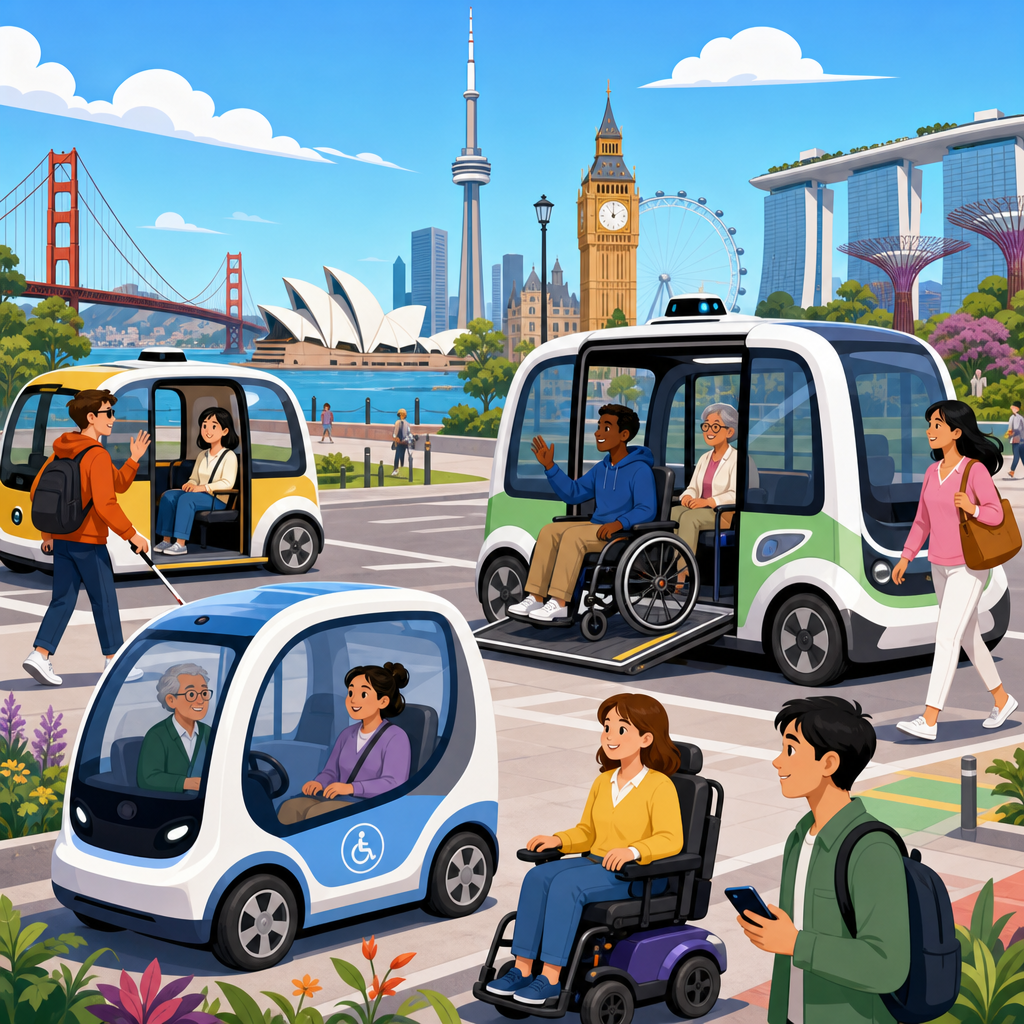
Accessible autonomous mobility pilots are real-world trials of self-driving shuttles, robo-taxis, and on-demand vehicles designed to serve people with disabilities, older adults, and travelers with varied access needs. In practice, that means more than adding a ramp to a vehicle. It includes step-free boarding, securement systems for wheelchairs, audio and visual passenger information, intuitive booking tools, staff support during early deployment, and service policies that work for riders with sensory, cognitive, and mobility differences. I have worked on accessibility reviews for emerging mobility programs, and the same lesson appears in every market: autonomy does not create inclusion by default. It has to be designed, tested, measured, and funded.
This matters because transportation accessibility remains uneven even in cities with strong public transit. Fixed-route buses may have lifts but poor stop access. Rail systems may have elevators but inconsistent wayfinding. Paratransit can be essential yet costly, capacity constrained, and difficult to book spontaneously. Autonomous mobility pilots promise a different model: smaller vehicles, flexible routing, lower operating costs over time, and service windows that can fill gaps in existing networks. For disabled riders, however, the promise only becomes meaningful when pilots address the complete journey, from trip planning to curb access to safe boarding and communication during disruptions.
International examples are especially useful because they show how regulation, urban form, public procurement, and disability policy shape outcomes. A low-speed shuttle in a Nordic business park solves different problems than an autonomous feeder in a dense Asian city or a campus pilot in North America. Yet the strongest programs share common strategies. They involve disability organizations early, define accessibility requirements before procurement, run mixed-method testing with real riders, and publish operational findings instead of treating accessibility as a marketing line. As a hub page for international innovations and strategies in accessibility, this article maps the leading pilots, the design choices behind them, and the lessons agencies can apply when evaluating future deployments.
What Accessible Autonomous Mobility Looks Like in Practice
An accessible autonomous mobility pilot combines vehicle design, digital design, service operations, and public infrastructure. The vehicle may use a low floor, deployable ramp, wide doorway, handrails with contrast markings, and securement areas sized for power wheelchairs. The interface must present route status, stop announcements, and emergency instructions in both audio and visual formats. Booking systems need screen-reader compatibility, plain language, and alternatives to smartphone-only access. The operating model also matters. Many pilots still use onboard attendants because current automation systems cannot handle every edge case, and those attendants often provide the human support that makes the service usable for first-time riders.
Standards help translate broad goals into testable requirements. Agencies commonly reference the Americans with Disabilities Act in the United States, the UK Equality Act, the European Accessibility Act, ISO 21542 on accessibility in the built environment, and Web Content Accessibility Guidelines for digital touchpoints. None of those standards alone guarantees an inclusive autonomous service, but together they create a baseline. In my experience, the strongest pilots convert standards into acceptance criteria: ramp slope under specified conditions, boarding dwell targets, tactile and audible controls, captioned support materials, and response procedures for communication breakdowns. That level of specificity prevents accessibility from becoming an afterthought once vehicles are already selected.
It is also important to distinguish pilot categories. Closed-campus shuttles operate at low speeds in controlled environments and are often the easiest place to validate boarding and interface design. Public-road circulators face more complex curb conditions, mixed traffic, and stop placement challenges. On-demand automated vehicles introduce a further layer of booking, pickup precision, and identity verification. Accessibility requirements should become stricter as the operating domain becomes less controlled. A smooth boarding event at a dedicated bay proves far less than a successful pickup from a busy curb shared with delivery vehicles, cyclists, and pedestrians.
International Pilot Examples and What They Teach
Several countries have produced influential pilots that illustrate different models of accessible autonomous mobility. In France, Navya and EasyMile shuttles have operated in multiple public demonstrations, including transit connectors and district circulators. These projects highlighted the basics of low-floor entry, clear passenger information, and attendant support, but they also exposed recurring gaps: limited wheelchair securement flexibility, dependence on well-managed boarding areas, and the need for better communication around service interruptions. The practical lesson was that accessibility cannot be judged only by vehicle specifications; it has to be assessed in the context of real stops, real surfaces, and real rider stress.
Finland’s Sohjoa program became a widely cited European example because it placed autonomous minibuses in everyday urban settings and documented user experience carefully. Pilots in Helsinki and other cities focused on first- and last-mile service and winter operations. For accessibility, winter matters because snow, slush, and reduced curb definition can defeat otherwise compliant boarding systems. Operators learned that accessible autonomy in northern climates depends as much on maintenance standards for paths and stops as on the vehicle itself. A ramp is ineffective when the landing area is blocked by ice or uneven snowpack.
In Singapore, autonomous shuttles have been tested in university campuses, business parks, and planned town environments, supported by a national approach that links mobility innovation with aging and inclusive design policy. Singapore’s strength has been systems thinking: controlled pilots, strong regulator involvement, integrated land-use planning, and attention to multilingual passenger information. Although many deployments remained experimental, they demonstrated how accessibility can be embedded through procurement and urban management, not left solely to vehicle manufacturers. That is especially relevant for dense cities where curb discipline, wayfinding, and transfer design strongly influence whether disabled riders can use a service independently.
Japan offers a different model through low-speed autonomous pilots responding to population aging and rural access gaps. In communities facing driver shortages, automated shuttles have been explored as connectors to rail stations, clinics, and civic services. The accessibility emphasis often centers on older adults, including low-step entry, simple interfaces, and predictable routes rather than high-tech novelty. This is a valuable reminder: accessible design is not only about compliance categories. It also means reducing cognitive load, minimizing transfers, and making service behavior consistent enough that anxious or first-time users feel confident.
In the United States, pilots in places such as Columbus, Las Vegas, Ann Arbor, and various university campuses have generated extensive public discussion about safety and inclusion. The most useful examples involved direct testing with wheelchair users, blind riders, and older adults rather than relying on generic usability assumptions. Agencies found that automated announcements needed clearer timing, that touchscreen-only interactions excluded some riders, and that attendants remained crucial for trust-building. The best American pilots linked autonomous service to broader transit goals, treating it as a feeder or coverage tool rather than a standalone attraction.
| Country or region | Pilot pattern | Main accessibility lesson |
|---|---|---|
| France | District and transit-connector shuttles | Vehicle accessibility fails without reliable stop design and disruption messaging |
| Finland | Urban first- and last-mile shuttles | Winter maintenance is part of accessibility, not a separate operations issue |
| Singapore | Campus and planned-town trials | Procurement and curb management determine inclusive outcomes |
| Japan | Rural and aging-community connectors | Simplicity and predictability are core accessibility features |
| United States | Campus, downtown, and feeder pilots | Real user testing exposes barriers that specifications miss |
Design Strategies That Make Pilots More Inclusive
The strongest international pilots use a layered design strategy. First, they specify physical access in measurable terms: doorway width, ramp deployment reliability, wheelchair turning space, grab point location, slip resistance, and seating layouts that do not force riders to choose between securement and social inclusion. Second, they design communication redundancy. Every critical message should be available visually and audibly, with plain-language phrasing and high contrast. Third, they build operational accessibility into staff training, incident management, and maintenance. If an accessible bay is routinely blocked or a ramp fault goes unresolved, the service is inaccessible regardless of brochure claims.
One recurring innovation is co-design with disability advocates and frequent riders. Effective programs do not bring users in for a ceremonial demo after engineering decisions are complete. They involve them in route selection, stop audits, interface testing, and trial rides across different conditions. I have seen a single ride-through with a power wheelchair user reveal three issues in minutes: the boarding angle at one curb cut, the placement of an interior display, and the difficulty of reaching a stop request control while secured. Those insights are inexpensive to gather early and expensive to correct later.
Another strategy is pairing vehicle pilots with accessible infrastructure upgrades. Agencies often underestimate how much value comes from improved boarding pads, tactile wayfinding, lighting, seating, and protected waiting areas. In many cases, these upgrades would benefit conventional transit too, making the pilot a catalyst for broader accessibility improvements. This is one reason autonomous mobility should be evaluated as a service ecosystem, not a vehicle demonstration. The most transferable lesson from international programs is that inclusive outcomes depend on coordinated investment across hardware, software, streets, and operations.
Common Barriers, Tradeoffs, and Policy Questions
Despite progress, accessible autonomous mobility pilots still face structural limitations. Many low-speed shuttles have constrained interior layouts, limited maneuvering room for larger power chairs, and awkward securement workflows. Some operate only in geofenced areas with smooth pavements and predictable traffic, which means performance claims do not generalize well to ordinary streets. Others rely on attendants for boarding support, creating a gap between pilot accessibility and future driverless aspirations. That is not a reason to dismiss pilots, but it is a reason to interpret results carefully and avoid overstating readiness.
Policy questions are equally important. Who sets minimum accessibility requirements for automated fleets? How should agencies certify equivalent service if a vehicle cannot physically accommodate every mobility device? What data should operators publish on denied trips, boarding failures, rider complaints, and incident response times? Established transit accessibility law gives part of the answer, but autonomous services create new edge cases around remote assistance, digital identity checks, and software updates that can change user experience overnight. Regulators need reporting frameworks that capture lived accessibility, not just technical compliance.
Cost also requires honest discussion. Custom accessible vehicle platforms, accessible app development, stop reconstruction, and staffed operations can make pilots expensive on a per-trip basis. However, the right comparison is not a simple race against fixed-route transit. In low-density or off-peak conditions, an accessible autonomous shuttle may eventually complement buses, reduce paratransit strain, or improve access to rail without requiring a full-size vehicle. The strategic question is where the service adds net accessibility value. International examples show it works best in defined niches: feeder routes, campuses, medical districts, retirement communities, and underserved connectors where predictable demand supports careful service design.
How Agencies and Cities Should Evaluate Future Pilots
Any city considering an accessible autonomous mobility pilot should start with a service gap, not a technology target. Define the unmet trip types, user groups, transfer barriers, and time periods the pilot is meant to address. Then create an accessibility requirements matrix covering vehicles, booking, stops, staff protocols, and performance reporting. Require vendors to demonstrate evidence, not promises, including ramp testing on varied grades, screen-reader audits, multilingual information design, and user trials with disability organizations. Procurement should score accessibility as a core performance category, not a social add-on.
Evaluation should combine quantitative and qualitative measures. Useful metrics include successful boardings by rider type, average dwell time, denied trip rate, lift or ramp fault frequency, rider confidence scores, complaint resolution time, and transfer completion to buses or rail. Pair those numbers with interviews, ride observations, and mystery-rider testing. Accessible mobility succeeds when people can use it repeatedly without extra stress. That means agencies should ask not only whether a trip was technically completed, but whether the rider would choose the service again and recommend it to someone with similar needs.
International examples of accessible autonomous mobility pilots show a clear pattern: innovation becomes valuable when it solves everyday barriers with discipline and transparency. The best programs in France, Finland, Singapore, Japan, the United States, and other markets do not treat accessibility as a feature list. They treat it as a service outcome shaped by design, policy, operations, and public space. For readers exploring international innovations and strategies in accessibility, this hub page offers the central lesson that connects every subtopic: inclusive mobility must be engineered end to end, then proven with real users in real conditions.
The main benefit of studying these pilots internationally is speed of learning. Cities do not need to repeat the same avoidable mistakes around curb design, app barriers, winter maintenance, or inadequate user testing. They can borrow working methods, adapt standards, and set stronger procurement rules from the start. That approach reduces risk for agencies and improves independence for riders who have long been asked to wait for accessibility improvements after new technology launches.
If you are planning policy, procurement, research, or advocacy in this field, use these examples as benchmarks. Compare claims to evidence, ask how each pilot serves disabled riders across the full journey, and build future programs around measurable accessibility outcomes. That is how autonomous mobility moves from experiment to public value.
Frequently Asked Questions
What is an accessible autonomous mobility pilot, and how is it different from a standard self-driving vehicle trial?
An accessible autonomous mobility pilot is a real-world test of self-driving transportation that is intentionally designed to serve people with disabilities, older adults, and passengers with a wide range of access needs. That distinction matters. A standard autonomous vehicle trial may focus primarily on navigation, safety performance, route planning, and passenger convenience. An accessible pilot, by contrast, must evaluate whether people can actually use the service independently, safely, comfortably, and consistently. In practical terms, that means accessibility is built into the vehicle, the boarding process, the digital tools, the customer support model, and the service rules—not treated as an add-on.
International examples often include autonomous shuttles operating on fixed routes, low-speed neighborhood circulators, first- and last-mile connectors to transit, and on-demand autonomous taxis. What makes these pilots “accessible” is the combination of physical, sensory, cognitive, and operational design features. These may include step-free boarding, ramps or bridge plates, wheelchair securement systems, clear interior circulation space, handholds, audio announcements, visual displays, high-contrast interfaces, multilingual instructions, easy-to-use booking systems, and support for riders who cannot or do not want to rely only on smartphone apps.
Another major difference is that accessible pilots usually measure success with broader criteria. Instead of asking only whether the vehicle drove itself correctly, project teams also ask whether riders could book the trip without barriers, whether pickup locations were reachable, whether wheelchair users could board without difficulty, whether blind or low-vision riders received reliable information, whether older adults felt confident using the service, and whether policies supported riders with service animals, companions, or assistive devices. In the strongest pilots, disability organizations and community representatives are involved from the planning stage through testing and evaluation, helping ensure the service works in the real world rather than only on paper.
What accessibility features are most important in international autonomous shuttle and robo-taxi pilots?
The most important accessibility features are the ones that make the entire trip usable from start to finish. Vehicle design is only one piece. For many riders, the trip begins with discovering the service, understanding eligibility or operating hours, booking a ride, locating the pickup point, boarding safely, traveling with confidence, and exiting at a destination that is also accessible. Because of that, the best international pilots take a systems approach rather than focusing narrowly on one feature such as a ramp.
At the vehicle level, step-free entry is fundamental. Riders using wheelchairs, walkers, canes, or strollers often need level boarding or a dependable ramp solution. Once inside, there must be adequate turning and maneuvering space, securement areas that are practical and dignified to use, seating options for people with limited balance or endurance, grab rails placed at useful heights, and clearly marked interior layouts. Good pilots also include both visual and audible stop information, emergency communication tools that can be used by people with hearing, speech, vision, or cognitive disabilities, and doors that provide enough clearance and time for safe entry and exit.
Digital accessibility is equally important. Booking platforms should work with screen readers, voice control, keyboard navigation, and simplified user flows. Riders should be able to request assistance, indicate mobility needs, travel with a service animal, or specify extra boarding time without facing confusing or exclusionary interfaces. Many accessible pilots also provide alternatives to app-only access, such as telephone booking, staffed support, or integration with existing paratransit and public transit information channels.
Operational features often determine whether the service is truly inclusive. Examples include well-designed curbside pickup zones, trained attendants or onboard stewards during early phases, customer service that can solve problems in real time, and policies that do not unintentionally exclude riders whose travel takes longer or requires more flexibility. In many international pilots, a human safety operator or remote support team plays a key role not only for technical oversight but also for rider reassurance and assistance. The strongest programs recognize that accessibility is not a checklist item. It is the result of coordinated choices across technology, infrastructure, staffing, and policy.
Why are international examples of accessible autonomous mobility pilots so important for cities and transit agencies?
International examples are important because they show how different regions are testing autonomous mobility in real operating conditions, under different regulatory frameworks, street environments, transit systems, and disability inclusion standards. No single pilot provides all the answers. However, when cities and transit agencies study projects across multiple countries, they can identify patterns: which design choices improve usability, which operational models reduce barriers, which partnerships build trust, and which mistakes are repeated when accessibility is considered too late.
These pilots also matter because they broaden the conversation about innovation. Too often, autonomous mobility is discussed mainly in terms of advanced technology, labor implications, or commercial scalability. International accessible pilots shift the focus toward public value. They ask whether autonomous services can expand mobility for people who are underserved by conventional transport, including riders who cannot drive, struggle with complex transfers, live in lower-density areas, or need more predictable boarding conditions. This is particularly relevant for aging populations and for communities where fixed-route transit does not fully meet access needs.
For transit agencies, these examples can inform future procurement and planning. Agencies can learn what vehicle specifications to require, how to write accessibility expectations into contracts, how to coordinate with disability advocates, how to assess pickup and drop-off infrastructure, and how to collect rider feedback in ways that include people with varied communication preferences. For city leaders, international pilots offer evidence on how curb management, road design, digital inclusion, and local accessibility laws interact with autonomous operations.
Perhaps most importantly, international examples help move accessibility from theory to practice. It is easy for vendors to claim that a self-driving shuttle or robo-taxi will eventually be inclusive. It is much more valuable to examine a pilot where actual riders with disabilities have tested boarding, communication, booking, comfort, and safety in day-to-day service. Those real-world lessons can prevent costly missteps and support more equitable transportation systems as autonomous mobility evolves.
What challenges do accessible autonomous mobility pilots still face, even when accessibility is a stated goal?
Accessible autonomous mobility pilots face a number of persistent challenges, and many of them occur at the intersection of technology, infrastructure, and service design. One common issue is that accessibility may be acknowledged in project materials but not fully integrated into deployment decisions. A vehicle might have a ramp, for example, but the curbside environment may still be uneven, obstructed, poorly marked, or unsafe for boarding. In that scenario, nominal accessibility does not translate into practical usability.
Another challenge is variability in passenger needs. Accessibility is not limited to wheelchair access. Riders may be blind or low vision, Deaf or hard of hearing, neurodivergent, living with chronic pain or fatigue, traveling with service animals, or needing human reassurance during unfamiliar trips. Designing for this range of experiences is complex, especially in early-stage pilots where vehicle interiors are small, remote assistance systems are evolving, and agencies are still learning how riders interact with automated service. What works for one group may not fully address the needs of another unless the pilot is developed through extensive co-design and iterative testing.
Booking and communication systems also remain a major barrier. Many pilots rely heavily on smartphone apps, QR codes, and digital notifications. If those tools are not accessible by design, the entire service becomes difficult or impossible to use, even if the vehicle itself is well equipped. The same is true for in-trip information. Riders need clear, redundant communication through both audio and visual channels, along with intuitive ways to get help if something goes wrong.
There are also operational and policy challenges. Pilots may run only on limited routes, at low speeds, during restricted hours, or with conditions that make them more like demonstrations than reliable mobility options. Some services may require advance registration, lack spontaneous trip flexibility, or exclude complex trip types. In addition, staff training is critical. Human attendants, remote operators, and customer service teams must understand disability etiquette, boarding assistance, communication preferences, and emergency procedures. Without that preparation, a technically sophisticated service can still deliver a poor rider experience.
Finally, data and evaluation can be a weak point. If project teams do not gather detailed feedback from disabled riders and older adults, they may overestimate success. Strong pilots look beyond ridership totals and include measures such as independent use, failed bookings, boarding times, comfort, confidence, communication clarity, and equity of service outcomes. Those metrics are essential if autonomous mobility is to become meaningfully accessible rather than merely appearing to be.
How should readers evaluate whether an autonomous mobility pilot is genuinely accessible and not just marketed that way?
Readers should evaluate accessible autonomous mobility pilots by looking for evidence across the entire rider journey, not just by checking whether the vehicle has a visible access feature. Marketing language often highlights innovation, safety, and sustainability, but genuine accessibility requires proof that people with varied disabilities and access needs can use the service under normal conditions. A good starting point is to ask whether disabled riders and advocacy organizations were involved early in the project. If accessibility was shaped through co-design, usability testing, and ongoing feedback, that is a strong sign the pilot is taking inclusion seriously.
Next, look at the service details. Can riders book trips in more than one way? Is the app accessible? Is phone support available? Are pickup and drop-off points