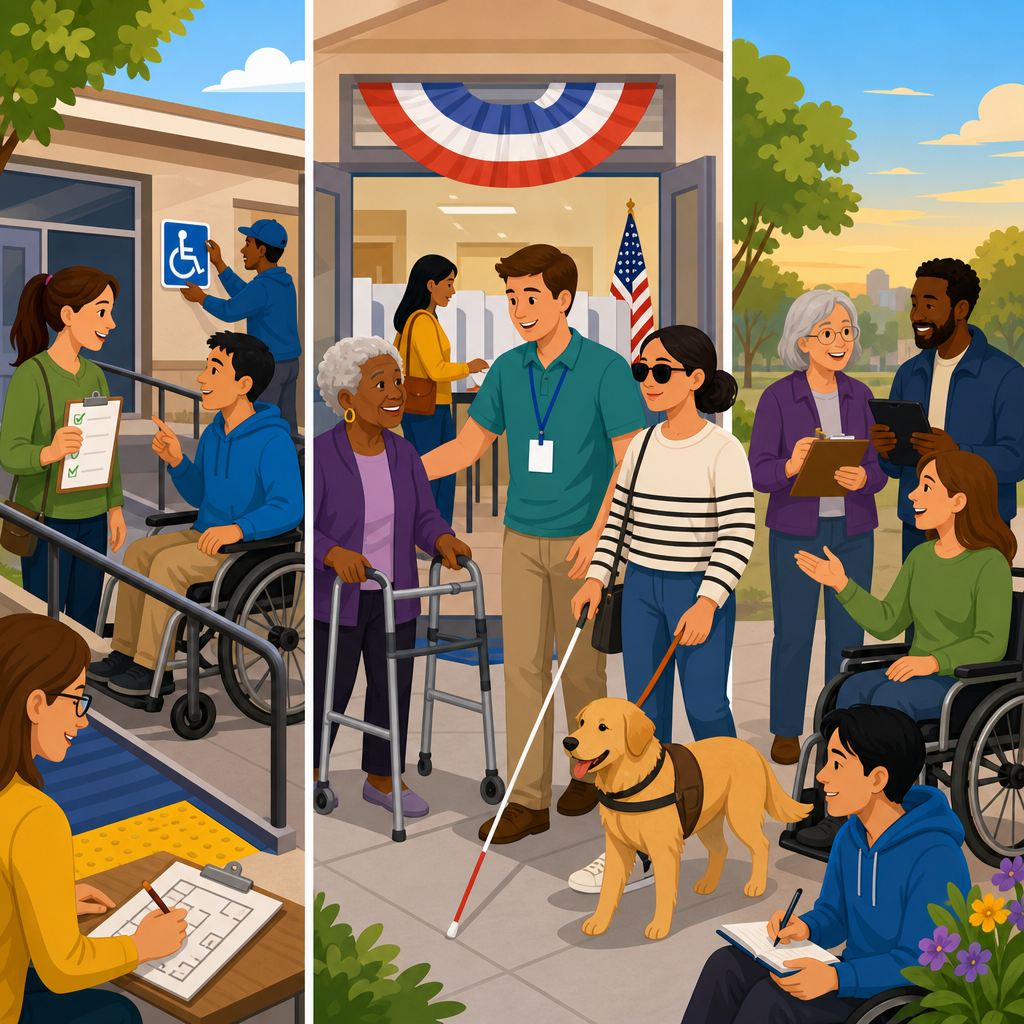
Polling place accessibility before, during, and after Election Day determines whether eligible voters can participate independently, safely, and with dignity. In public spaces and government facilities, accessibility means more than adding a ramp at the front door. It includes the full voter journey: finding accurate information, traveling to the site, entering the building, checking in, using accessible voting equipment, receiving assistance when needed, and exiting without barriers. When I have reviewed voting sites with facilities teams and local election staff, the most common lesson has been simple: small obstacles create major disenfranchisement. A curb without a cut, a temporary sign placed too low, a confusing route from parking to entrance, or poll workers who do not know how to activate an accessible ballot-marking device can block participation as effectively as a locked door.
This matters because polling places are a core civic service delivered in real physical environments that vary widely. Schools, libraries, churches, recreation centers, and municipal buildings often serve as temporary voting locations. Each has different site constraints, maintenance schedules, and staffing realities. Accessibility must therefore be planned as an operational system, not treated as a one-time compliance checkbox. The legal foundation is also clear. The Americans with Disabilities Act, the Rehabilitation Act, the Voting Rights Act, and the Help America Vote Act shape expectations for accessible programs, communications, and voting systems. The most practical approach combines facility assessment, election administration, staff training, and post-election improvement so every voter can cast a private, independent ballot.
What polling place accessibility includes in public spaces and government settings
Polling place accessibility covers physical access, communication access, procedural access, and technology access across the full election cycle. Physical access includes parking, passenger drop-off, curb ramps, sidewalks, routes free of protruding objects, door hardware, thresholds, interior circulation, adequate lighting, accessible restrooms where provided to the public, and voting areas with sufficient maneuvering clearances. Communication access includes readable signage, plain-language instructions, language assistance, effective communication for voters who are deaf, hard of hearing, blind, have low vision, or have cognitive disabilities, and websites or PDFs that meet accessibility expectations before voters ever arrive.
Procedural access is equally important. A technically accessible building can still fail voters if the accessible entrance is locked, if the route is used for storage, or if poll workers incorrectly tell a voter they must bring their own assistant. Technology access refers to at least one accessible voting system that allows private and independent voting, such as a ballot-marking device with audio output, tactile controls, adjustable font or contrast, sip-and-puff compatibility, or switch access depending on jurisdiction. In practice, the strongest government programs map each voter touchpoint and remove barriers in advance rather than improvising on Election Day.
Before Election Day: site selection, audits, and route planning
Accessibility work starts long before polls open. Site selection should favor facilities with step-free entries, compliant parking, good transit connections, and simple interior circulation. Election offices often inherit legacy polling locations because they are familiar or centrally located, but familiarity is not a valid substitute for access. I have seen jurisdictions continue using beloved community buildings where every workaround depended on temporary mats, portable signs, and staff stationed at side doors. Those sites consumed more labor and still delivered a worse voter experience than a nearby library with automatic doors and level access.
A formal accessibility audit should examine the path from arrival to ballot casting. The most useful audits use measurable criteria: number and width of accessible parking spaces, slope of parking access aisles, curb ramp condition, cross-slope of sidewalks, doorway clear width, threshold height, turning space at check-in and voting stations, and reach ranges for buttons, bells, and check-in materials. The ADA Checklist for Polling Places remains a practical reference because it translates standards into election-specific observations. Documentation should include photos, dimensions, temporary fixes, long-term capital needs, and a decision about whether the site is acceptable, conditionally acceptable with mitigation, or unsuitable.
Route planning deserves special attention. The accessible route should match the route actual voters are expected to use, not an obscure alternate entrance hidden behind a loading zone. Exterior wayfinding must begin at the street and continue through parking and drop-off areas. If the accessible entrance differs from the main entrance, signs must be high contrast, placed at decision points, and visible in low light. Jurisdictions that publish accessibility notes for each polling location online, including parking availability, transit stops, and entrance instructions, reduce confusion and lower the burden on both voters and call center staff.
Inside the polling place: layout, equipment, and voter flow
Once inside, accessible design should support a calm and efficient flow. Check-in tables cannot choke circulation paths or force wheelchair users into narrow turns. Queuing should preserve at least a clear accessible route while still maintaining ballot secrecy and crowd control. Voting booths should include seated and standing options, with work surfaces at accessible heights. Extension cords, power strips, and stanchion bases are frequent trip hazards, especially in repurposed public spaces. I recommend a setup walk-through before opening that treats every cable and furniture move as a safety and access issue, not merely housekeeping.
Accessible voting equipment must be installed, powered, tested, and placed where voters can reach it without asking to enter a special back corner. Privacy matters. The point of accessible equipment is not only to let someone vote; it is to let them vote independently and confidentially. Poll workers should know how to start an accessible session, connect headphones, adjust settings, troubleshoot paper jams, and explain options without talking over the voter or making assumptions. In many jurisdictions, the ballot-marking device is used rarely enough that staff confidence fades between elections. Short hands-on refreshers on setup morning prevent avoidable failures.
| Accessibility area | What good practice looks like | Common failure | Practical fix |
|---|---|---|---|
| Parking and arrival | Marked accessible spaces near an accessible route and clear drop-off | Cones, campaign activity, or snow block access aisles | Pre-opening inspection and enforcement perimeter |
| Entrance | Primary entrance unlocked with clear signage and operable door hardware | Accessible entrance is side door with no staff monitoring | Use main accessible entrance whenever possible |
| Check-in | Lower writing surface and clear turning space | Tables packed tightly, limiting wheelchair approach | Reconfigure furniture and preserve route width |
| Voting equipment | Accessible device tested, visible, and private | Machine unplugged or workers unsure how to activate it | Morning checklist and role-based training |
| Communication | Plain-language instructions and effective assistance | Workers give inconsistent or inaccurate directions | Quick reference cards and supervisor escalation |
People, policy, and communication on Election Day
Poll worker training is often the difference between nominal accessibility and real accessibility. Staff need clear instruction on disability etiquette, effective communication, voter assistance rules, curbside voting procedures where allowed, and how to resolve barriers quickly. Good training emphasizes that voters with disabilities are not a special category requiring exceptional treatment; they are voters entitled to equal access. Workers should address the voter directly, ask before assisting, describe available options, and avoid touching mobility devices unless asked. They should also understand service animal access, communication boards or writing methods, and when to contact a site supervisor or election headquarters.
Communication should be designed for stress. Election Day is noisy, fast, and crowded. Simple printed scripts help staff answer recurring questions accurately: Where is the accessible entrance? How does curbside voting work here? Can a voter bring a person of their choice to assist? What if the accessible machine stops functioning? Election offices that maintain centralized hotlines and roving technical support teams respond faster when issues exceed site capacity. In my experience, accessibility incidents escalate when local teams feel they must improvise legal or procedural answers. Standardized guidance, backed by supervisors, reduces inconsistent treatment across sites.
Emergency planning belongs in accessibility planning. Weather, power interruptions, elevators out of service, and long lines can all affect disabled voters disproportionately. Backup lighting, alternate routes, chairs for voters who cannot stand for extended periods, battery checks for voting devices, and a clear protocol for preserving ballot secrecy during equipment replacement are all operational necessities. Public spaces and government buildings should also coordinate with facilities staff so that last-minute maintenance, floor cleaning, landscaping work, or security changes do not create new barriers on voting day.
After Election Day: evaluation, complaints, and continuous improvement
Accessibility does not end when polls close. The post-election period is when jurisdictions learn whether plans worked in real conditions. Strong programs collect structured feedback from poll workers, site leads, disability advocates, and voters. They log specific incidents such as blocked entrances, inaccessible temporary signage, malfunctioning audio ballots, poor acoustics at check-in, or curbside voting delays. Complaint review should look for patterns by site type, vendor, equipment model, and staffing configuration. One isolated issue may be human error; repeated issues usually indicate a process defect that requires redesign.
Post-election review should separate temporary mitigations from capital improvements. If a site required portable ramps, door attendants, or furniture rearrangement every cycle, decision-makers should ask whether the location remains appropriate. Facilities that regularly host elections may justify permanent upgrades such as automatic door openers, restriping accessible parking, replacing lever hardware, improving exterior lighting, or installing better wayfinding. Budget planning works best when election officials and public works or building departments share a joint corrective action list with target dates and responsible owners. Accessibility improves fastest when it becomes part of routine asset management rather than a seasonal emergency.
Transparency builds trust. Publishing accessibility commitments, complaint channels, and improvement steps signals that government takes voting barriers seriously. This hub page should also connect readers to deeper resources on accessible signage, government building wayfinding, temporary event accessibility, maintenance practices in public spaces, and procurement standards for public technology. For administrators, the most valuable mindset is continuous improvement. Every election reveals friction points, and each documented fix makes the next election more inclusive. Review your polling locations now, train staff with realistic scenarios, and turn accessibility from a last-minute task into a reliable public service.
Frequently Asked Questions
What does polling place accessibility really include before, during, and after Election Day?
Polling place accessibility covers the entire voting experience, not just whether a building has a ramp or an automatic door. Before Election Day, accessibility starts with clear and accurate information. Voters need to know where their polling place is, whether it has accessible parking and entrances, what voting equipment is available, whether curbside voting is offered, and how to request assistance or language support. Accessible websites, readable signage, transportation options, and advance communication from election officials all play an important role in helping voters prepare with confidence.
During voting, accessibility includes every step a voter takes once they arrive. That means an accessible path from parking or transit drop-off to the entrance, doors that can be opened and navigated safely, clear wayfinding inside the building, check-in tables at usable heights, and voting stations that support privacy and independence. It also includes accessible voting machines, seating for those who cannot stand for long periods, accommodations for vision, hearing, cognitive, or mobility disabilities, and trained poll workers who understand how to assist without creating new barriers.
After Election Day, accessibility still matters. Election offices should review voter feedback, document barriers that occurred, inspect equipment performance, and improve future site plans. If temporary signs were confusing, if pathways became obstructed, or if poll workers were unsure how to support voters with disabilities, those issues should be addressed before the next election. True polling place accessibility is an ongoing process of planning, testing, training, and improvement so that every eligible voter can participate independently, safely, and with dignity.
How can voters find out whether their polling place will be accessible before they arrive?
Voters should begin by checking official election sources, such as their state or local election office website, voter information guide, or county clerk’s office. Many jurisdictions publish details about polling place locations, parking availability, accessible entrances, voting equipment, and options such as curbside voting or vote-by-mail. If the website is difficult to use or does not provide enough detail, calling the election office directly is often the best next step. Ask specific questions about entrance routes, parking, assistance policies, and what to do if an unexpected barrier appears on Election Day.
It is also helpful to confirm whether the polling place has an accessible voting machine and whether poll workers are trained to set it up correctly. Some voters may want to ask about line management, seating, interpreter availability, service animal access, or whether a companion may assist them. If transportation is a concern, voters should plan ahead by reviewing paratransit schedules, public transit routes, rideshare drop-off points, or local disability advocacy resources that may offer nonpartisan transportation information.
If a voter has had difficulty at a polling place in the past, they should not assume conditions will be the same or improved without verification. Temporary construction, relocated entrances, uneven sidewalks, or changes in room layout can affect access. Contacting election officials in advance can help identify solutions early and reduce stress on Election Day. The most effective approach is to gather information ahead of time, ask direct questions, and keep important contact numbers available in case assistance is needed while traveling to or voting at the site.
What accessibility features should be available at a polling place on Election Day?
An accessible polling place should provide a usable route from arrival to exit. That typically includes designated accessible parking spaces or a safe drop-off area, curb cuts or level pathways, stable walking surfaces, and an entrance that can be used by people with mobility devices. Inside, there should be enough space to move through hallways and doorways, with signs that clearly direct voters to check-in, voting areas, restrooms if available, and exits. Temporary obstacles such as cords, folding chairs, misplaced signs, or crowded furniture layouts should be removed so they do not create hazards or block access.
At check-in and voting stations, accessibility means more than physical clearance. Tables and equipment should be positioned so voters can approach and use them comfortably. Accessible voting systems should allow voters with disabilities to cast a private and independent ballot, often through features such as audio ballots, tactile controls, adjustable display settings, sip-and-puff compatibility, or other assistive options depending on the jurisdiction’s equipment. Poll workers should know how to activate and troubleshoot these features promptly, without forcing voters to wait unnecessarily or disclose more personal information than needed.
Polling places should also accommodate a wide range of voter needs. This may include allowing a person of the voter’s choice to assist, providing curbside voting where permitted, communicating effectively with voters who are deaf or hard of hearing, and supporting those with cognitive disabilities through clear instructions and patient interaction. Accessibility also includes safety, dignity, and privacy. A voter should not be separated, rushed, spoken over, or required to use a less private method when an accessible option exists. The goal is a voting environment where access is built into the process, not treated as an exception.
What should a voter do if they encounter an accessibility barrier at the polling place?
If a voter encounters a barrier, the first step is to notify a poll worker or the polling place supervisor immediately. Many issues can be resolved on the spot, such as opening an alternative accessible entrance, clearing a blocked pathway, lowering a temporary barrier, retrieving accessible equipment, or providing curbside voting where available. Voters should explain the specific problem clearly and ask for the accommodation or access method they need. In many cases, the issue is not intentional discrimination but a setup or training problem that can be corrected quickly when brought to the right person’s attention.
If the problem is not resolved, the voter should contact the local election office, county election board, or the nonpartisan Election Protection hotline if available in their area. If possible, document the barrier by noting the time, location, names or roles of staff involved, and the exact nature of the issue. Photos may also be useful when safe and appropriate. Documentation can help election officials address the immediate problem and can support broader improvements for future elections. The key is to report the barrier while voting is still underway whenever possible, because real-time intervention may help both the individual voter and others at the same site.
Voters should remember that encountering a barrier does not mean they have to give up their right to vote. Depending on state law and local procedures, alternatives may include assistance from a person of the voter’s choice, curbside voting, an accessible machine at the site, a provisional ballot if registration issues arise, or direction to the correct voting location if the voter was sent to the wrong site. After the election, filing a formal complaint or accessibility report can help ensure the barrier is investigated and corrected. Reporting problems is not just about one voter’s experience; it helps strengthen access for the entire community.
Why is post-election review so important for improving polling place accessibility?
Post-election review is where long-term accessibility improvements are made. Even when Election Day appears to run smoothly, barriers can still go unnoticed unless election officials actively gather feedback from voters, poll workers, disability advocates, and site managers. Reviewing what happened at each location helps identify recurring issues such as inaccessible parking routes, poorly placed signage, malfunctioning accessible voting equipment, long lines that disproportionately affect voters with disabilities, or staff uncertainty about assistance procedures. Without that review, the same obstacles are likely to reappear in the next election cycle.
A strong post-election process should include site assessments, incident logs, equipment testing records, and direct voter feedback. Officials should evaluate whether temporary fixes actually worked, whether training materials were clear, and whether facility layouts supported independent voting. If a location repeatedly presents access problems that cannot be adequately corrected, election administrators may need to reconfigure the space or choose a different site altogether. Accessibility should be measured not only by technical compliance, but by whether voters were able to participate fully, privately, and safely from arrival through ballot casting and exit.
This review process also builds public trust. When election offices respond transparently to accessibility concerns and make visible improvements, voters are more likely to feel respected and included. Accessibility is not a one-time checklist completed before polls open. It is a continuing responsibility that requires planning, observation, accountability, and adaptation. The most accessible elections are usually the result of careful work done after the previous one ended, when lessons are documented and turned into better policies, better training, and better voter experiences next time.