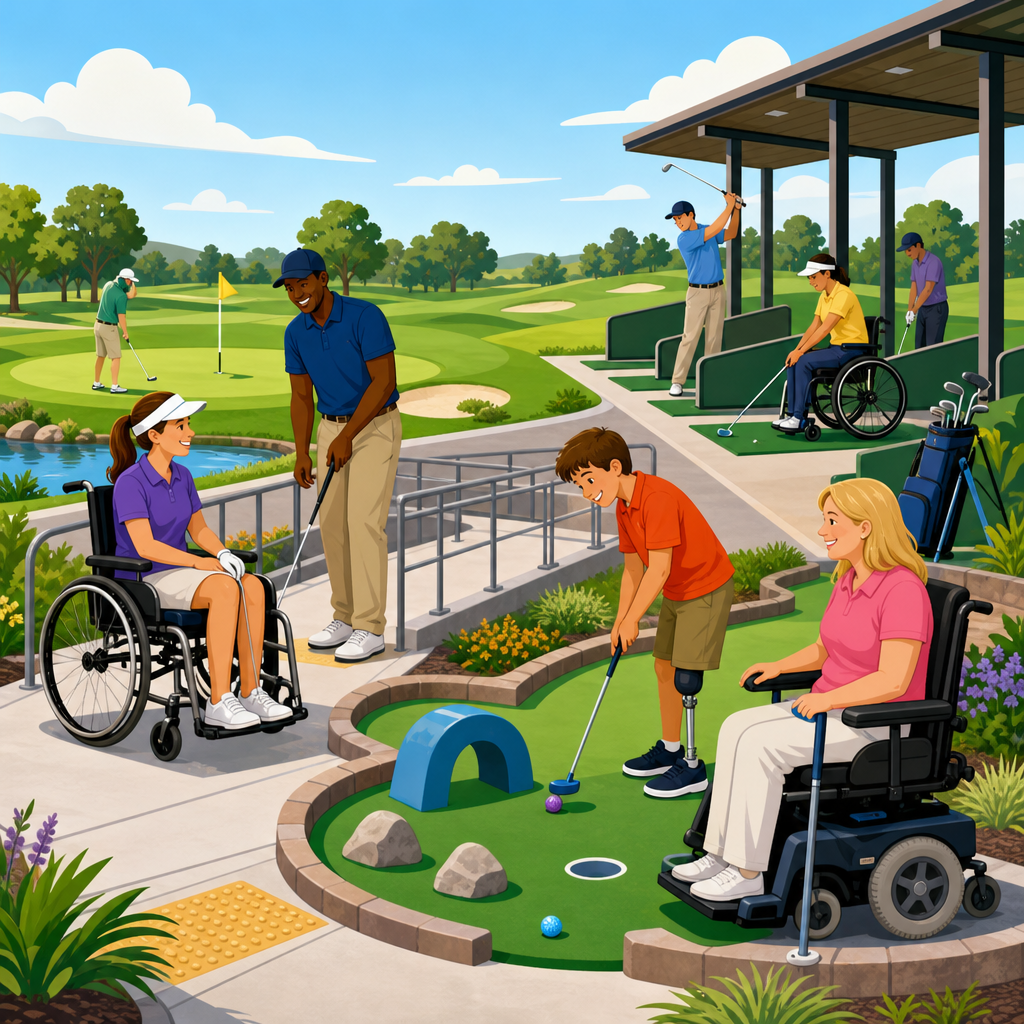
Golf, mini golf, and driving ranges must be designed so people with disabilities can approach, enter, participate, and use core features with dignity, safety, and as much independence as the site conditions reasonably allow. Within ADA Accessibility Standards, these facilities sit in Chapter 10 on recreational facilities, and they often combine outdoor circulation, elevated or sloped terrain, specialized equipment areas, and user spaces that create design mistakes if teams rely only on general accessibility rules. I have reviewed many recreation projects where the biggest compliance problems were not dramatic structural barriers, but small overlooked decisions: a route that stopped short of a tee, a practice bay without clear floor space, a miniature golf hole sequence with no accessible path, or a restroom built to code but disconnected from the clubhouse by a steep walk. This hub article explains the design basics for golf facilities, miniature golf courses, and driving ranges, defines the core terms used in Chapter 10, and shows how those requirements connect with accessible routes, site arrival, parking, restrooms, dining, pro shops, and practice amenities. The goal is simple: help owners, architects, contractors, and facility managers understand what accessibility requires, where the standards are specific, and how to make practical choices that support real use instead of paper compliance.
How Chapter 10 Applies to Golf Facilities
Chapter 10 provides scoping and technical requirements for specific recreation types, but it does not replace the rest of the ADA Accessibility Standards. In practice, that means golf and mini golf projects must satisfy the recreation provisions and the general rules on accessible routes, parking, signage, entrances, toilet rooms, sales counters, dining surfaces, and operable parts. Designers sometimes assume that because a golf course covers natural terrain, only the clubhouse needs attention. That is incorrect. The standards address the course and the user experience across the site. For a golfer or visitor with a disability, accessibility begins at arrival, continues through check-in and practice areas, and extends to the activity itself.
Several terms matter here. An accessible route is a continuous, unobstructed path connecting accessible elements and spaces. A golf car passage is a route on a golf course intended for golf cars and also relevant to player access. Miniature golf is treated differently because players typically move hole to hole on a defined course and the standards require access to the holes in a measurable way. Driving ranges are evaluated as practice facilities, so accessible routes, bay access, clear floor space, and common-use amenities become central. These distinctions matter because the technical solutions differ. What works for a sloped fairway does not automatically work for a mini golf platform or a covered driving range tee line.
When I review recreational plans, I tell teams to think in sequences rather than isolated details. Ask: can a person park, reach the entrance, buy a bucket of balls, access a bay, use the restroom, and return to the parking area without encountering a break in accessibility? For mini golf, ask whether the accessible route reaches the required number of holes in the required order. For a golf course, ask whether players can get to each required accessible element, including tees, putting greens, weather shelters, and toilet rooms where those are provided. This sequence-based approach catches more issues than checking dimensions one note at a time.
Golf Courses: Accessible Routes, Golf Car Passages, and Player Use
Golf courses present a unique balance between access and terrain. The standards recognize that full-length accessible walking routes across every fairway are not always realistic, so they use golf car passages and specific connections to accessible elements. A compliant design typically ensures that the accessible route connects arrival points and support spaces, while the golf car passage provides a usable means for players to reach and use key golf features. The most important design principle is that access cannot end at the clubhouse door. Players with mobility disabilities need a practical way to participate in the game itself.
Where a course provides teeing grounds, putting greens, weather shelters, and toilet rooms on the course, those features must be connected in the manner required by the standards. In renovation work, I often see a common mistake at tees: the golf car path comes near the tee but leaves a lip, rough edge, or unstable transition onto the teeing surface. That small level change can prevent safe transfer or wheelchair access. Firm, stable surfaces and smooth transitions are critical. Another frequent issue is path width. A route that is comfortable for maintenance equipment may still be too constrained by curbs, bollards, or edge drop-offs for actual user access.
Course operators should also think beyond dimensional compliance. Accessible play depends on policies and equipment as much as paving. Single-rider adaptive golf cars, wider circulation clearances at staging areas, and staff training on tee-time procedures all improve access. The ADA standards do not require every accommodation an operator might offer, but facility management decisions can either support or undermine an accessible design. For example, if an accessible golf car passage exists but the only gate to it is routinely chained shut, the route is functionally inaccessible. Good operations protect the accessible features the design team worked to build.
Mini Golf: Hole Access, Sequence, and Common Design Errors
Miniature golf has more explicit scoping than full golf because the player experience depends on moving through a sequence of holes. The standards require that at least 50 percent of holes on a miniature golf course be accessible. Those accessible holes must be consecutive, and the last hole in the sequence must connect directly to the course entrance or exit without requiring travel through other holes that are not part of the accessible sequence. This is one of the most overlooked rules in Chapter 10. Designers may scatter accessible holes across the site, but scattered access does not satisfy the requirement because it does not support a coherent round of play.
Accessible mini golf design starts with route planning. The route to each required accessible hole must be stable, firm, and slip resistant, with compliant slopes and clear width. The hole itself must include a playing area that can be approached and used. Decorative edging, bridges, rockwork, and themed obstacles often create barriers if they narrow the route or introduce abrupt level changes. I have seen attractive themed courses fail review because every “fun” feature was placed exactly where circulation needed to occur. Good themed design is possible, but accessibility has to shape the concept early rather than being patched in after fabrication drawings are complete.
Another recurring issue is misunderstanding what an accessible mini golf hole looks like. Accessibility does not mean removing challenge or flattening every contour. It means providing the required route and usable playing opportunity at the required number of holes. Designers can preserve character through obstacle placement, visual theming, railings, and surface patterns while still delivering compliant geometry. Facilities should also remember that support spaces matter. The ticket window, scorecard counter, snack bar, restrooms, and drinking fountains all remain part of the user experience and must connect to the accessible hole sequence.
Driving Ranges: Bays, Practice Areas, and Support Amenities
Driving ranges often seem simpler than courses, but they generate detailed accessibility questions because use occurs in repetitive individual stations. The basic rule is that accessible routes must connect the arrival points, sales areas, ball dispensers, practice greens, restrooms, and the required number of accessible hitting bays or stations. A covered range adds further considerations such as turning space around columns, reach ranges at controls, and the edge protection or transitions at each bay. If ball trays, counters, or dispensers are mounted too high, otherwise accessible circulation still leaves the player unable to use the range independently.
In plain terms, an accessible driving range bay needs enough clear floor space to enter, position mobility equipment, swing or set up within reason, and use associated controls or accessories. The route to the bay should not run behind fixed benches that force awkward turns, and the bay surface should be firm and level enough for stable positioning. Projects often fail at the details: a rubber tee mat installed on a raised platform without beveled edges, a step down to the preferred tee line, or a narrow divider opening that blocks wheelchair entry. These are easy to prevent during design coordination and surprisingly expensive to correct after opening.
Practice putting greens and short-game areas also deserve attention. If a facility advertises them as common-use amenities, they must connect to the accessible route and be usable to the extent required. Operators should review not just construction, but maintenance practices. Loose gravel migration, hose storage across routes, deteriorated mat edges, or temporary retail displays near the pro shop door can make a compliant facility inaccessible in daily operation. Accessibility at a driving range is as much about preserving clear, usable space as it is about meeting original plan dimensions.
Key Design Checks Across Golf, Mini Golf, and Driving Ranges
The most effective way to manage compliance is to review the whole site through repeatable checkpoints. In my field reviews, the same categories consistently determine whether a recreational facility works well for users with disabilities. The table below summarizes the checks that should be built into programming, design development, construction documents, and final punch review.
| Area | What to Verify | Common Failure | Better Practice |
|---|---|---|---|
| Arrival | Accessible parking, passenger loading, route to entrance | Steep sidewalk from lot to clubhouse | Model grades early and protect route during civil revisions |
| Entry and check-in | Accessible entrance, door hardware, service counter access | Only revolving or heavy manual door at main entry | Provide compliant primary entrance and accessible transaction point |
| Golf course use | Golf car passages and connections to required elements | Path stops short of tee or shelter | Detail smooth transitions and stable surfaces at each connection |
| Mini golf | 50 percent accessible holes in consecutive sequence | Accessible holes scattered across course | Lay out required sequence from concept phase |
| Driving range | Accessible bays, controls, ball dispensers, clear floor space | Raised tee mat or narrow bay opening | Coordinate bay dimensions and equipment mounting heights |
| Amenities | Restrooms, fountains, dining, retail, shelters | Accessible restroom disconnected by noncompliant route | Audit every amenity as part of one circulation network |
These checks are especially important on renovation projects, where existing topography and utilities tempt teams to accept avoidable barriers. Early site grading studies, mock-ups of practice bays, and route tracing on plan sets save time and reduce change orders. If a project includes multiple consultants, someone must own accessibility coordination. Without that role, each discipline may assume another consultant addressed the connection points, and those are exactly where problems surface.
Common Compliance Pitfalls and How to Avoid Them
Most ADA problems at recreational facilities come from coordination gaps, not from ignorance of the law. Civil plans may show a compliant route, but landscape edging narrows it. Architectural drawings may provide an accessible counter, but the selected merchandise fixtures block the clear floor space. A mini golf consultant may design excellent themed holes, but no one confirms the required accessible sequence. I have found that accessibility reviews are strongest when they happen at three moments: concept layout, 50 percent construction documents, and pre-opening inspection. Waiting until final inspection is too late for major circulation fixes.
Another pitfall is treating maintenance access as user access. A cart path built for operations may have excessive cross slope, poor edge conditions, or unstable adjacent surfaces that make it unsuitable for players with disabilities. Similarly, compacted decomposed granite may look smooth on opening day but degrade quickly under weather and use. Material selection should account for drainage, wear, and long-term surface stability. Facility owners should also document policies on temporary obstructions, adaptive equipment reservations, and staff assistance. The built environment and the operating model must support each other.
Finally, remember that accessibility is not limited to mobility. Communication features, website information about accessible amenities, clear wayfinding, and inclusive customer service all matter. A player planning a visit should be able to learn whether accessible bays are available, whether an adaptive golf car can be reserved, and how to reach the accessible mini golf sequence. Practical information reduces uncertainty and makes the facility genuinely usable. For a sub-pillar hub, this is the central lesson of Chapter 10: each recreation type has specific rules, but successful compliance comes from connecting those rules to the full visitor journey, from arrival to play to departure. Review your facility or design package against these basics, then dive into the detailed articles for golf courses, mini golf, driving ranges, accessible routes, and support amenities to close the remaining gaps.
Frequently Asked Questions
1. What ADA rules apply to golf courses, mini golf courses, and driving ranges?
Golf facilities, miniature golf courses, and driving ranges are addressed under the ADA Standards for Accessible Design as recreational facilities, which means designers cannot rely only on the general accessibility rules for parking, restrooms, and doors and assume the project is covered. These sites often involve outdoor routes, changing terrain, teeing areas, practice bays, course features, and activity-specific spaces that trigger both the general technical provisions and the recreation-specific requirements in Chapter 10. In practical terms, that means the project team has to evaluate how a person with a disability will arrive, move through the site, access the primary activity areas, and use the core features in a way that is integrated and dignified rather than separated or improvised.
For golf courses, the standards focus heavily on accessible routes and the ability to access elements such as teeing grounds, putting greens, and weather shelters. For miniature golf, the standards include requirements for the accessible use of holes and routes that connect the sequence of play. Driving ranges must also be planned so accessible routes serve the hitting areas and associated amenities. Beyond the recreation chapter, teams still need to comply with applicable provisions for parking, passenger loading, toilet rooms, sales counters, dining areas, signage, and any other support spaces included in the facility. The key point is that ADA compliance at these venues is not a single checklist item. It is a coordinated design strategy that combines site access, circulation, usability, and program participation.
2. How should accessible routes be planned at a golf or mini golf facility?
Accessible routes are one of the most common problem areas because these facilities are frequently built on sloped or irregular terrain, and designers sometimes assume natural grade conditions excuse poor circulation planning. In reality, the accessible route should be intentionally designed from the beginning of the project so users can travel from arrival points, such as parking or drop-off areas, to the entrance and then to the primary activity spaces. That route must be stable, firm, and slip resistant where required, and it must meet the technical criteria for width, slope, cross slope, level changes, and maneuvering clearances. If the route is too steep, too narrow, or interrupted by steps, abrupt grade breaks, gravel, or poorly designed transitions, it can effectively deny participation even if other parts of the site appear technically compliant.
On golf courses and driving ranges, that means carefully connecting accessible parking, clubhouse or check-in areas, practice spaces, teeing grounds, shelters, and other required components. On mini golf courses, accessible routing becomes even more critical because the sequence of holes is central to the activity itself. Designers need to think beyond simply “getting near” the course and instead ensure users can meaningfully move through the experience. When there are elevated platforms, bridges, ramps, or changes in direction, those elements must be evaluated as part of the route, not treated as decorative exceptions. Early grading coordination is essential, because trying to retrofit accessibility after the course layout is finalized usually leads to awkward detours, excessive slopes, or inaccessible segments that are expensive and difficult to fix.
3. Does every hole or playing area need to be accessible on a mini golf course or golf facility?
The answer depends on the type of facility and the specific ADA provisions that apply, but the broader design principle is that people with disabilities must be able to participate in the activity in a meaningful and integrated way. For miniature golf, the standards specifically address the number and sequence of accessible holes, and the design must ensure that accessible holes are connected by an accessible route. It is not enough to place one token accessible hole off to the side if the overall experience is fragmented or clearly different from what other players use. The accessible holes should be part of the normal course progression as much as possible so that players with disabilities can play with family, friends, or other participants without being segregated.
For golf courses, accessibility is evaluated through access to the course components identified in the standards, such as teeing grounds and greens, rather than a requirement that every inch of the course terrain function like a conventional accessible route. The goal is usability and participation, not flattening an entire course. Designers should provide access to the required elements and support the use of adaptive equipment or accessible golf cars where appropriate. At driving ranges, players must be able to reach and use the hitting stations and related amenities. Across all of these facility types, the legal and practical focus is on whether the user can approach, enter, and participate in the core recreation experience with reasonable independence. If the design creates isolated alternatives or excludes key portions of play, it likely misses both the spirit and the technical intent of the ADA.
4. What are the most common ADA design mistakes at golf courses, mini golf venues, and driving ranges?
One of the biggest mistakes is assuming that because the site is outdoors or built on challenging terrain, accessibility standards are flexible enough to be handled informally. That assumption leads to avoidable errors such as inaccessible routes made of loose materials, slopes that exceed allowable limits, tee or hitting areas that cannot be reached without steps, and transitions that are too abrupt for wheelchair users or others with mobility limitations. Another frequent issue is treating the clubhouse or entrance as the only accessibility priority while overlooking the actual recreation areas. A facility may have compliant parking and restrooms but still fail users if they cannot reach the first tee, the accessible mini golf holes, or the driving range bays.
Other recurring problems include inadequate clear floor space at play positions, counters that are too high, inaccessible weather shelters, poor route continuity between site elements, and a lack of coordination between civil, architectural, and specialty course design teams. Mini golf courses are especially prone to decorative layouts that create inaccessible bridges, bottlenecks, or elevated hole features with no compliant alternative in the sequence of play. Driving ranges sometimes overlook bay access widths, surface conditions, and the practical reach ranges needed to use ball dispensers, seating, or controls. In many cases, the root problem is that ADA review happens too late. When accessibility is treated as a finishing check instead of a design driver, teams tend to patch around noncompliant concepts rather than create an accessible user experience from the start.
5. How can design teams make these recreational facilities both ADA-compliant and enjoyable for all users?
The best approach is to treat accessibility as part of the facility’s core design quality, not as a separate compliance layer. When architects, landscape architects, civil engineers, owners, and specialty designers coordinate early, they can shape grading, routing, play sequencing, and support amenities in ways that are both code-aware and user-friendly. This often means studying how people actually move through the facility from arrival to participation to departure, and testing whether the experience works for wheelchair users, people with limited stamina, people with low vision, and others who may use the space differently. Good accessible design at a golf, mini golf, or driving range facility usually feels intuitive. Routes make sense, surfaces are dependable, activity areas are reachable, and support features such as seating, counters, restrooms, and shelters are integrated rather than tacked on.
It also helps to think in terms of dignity and independence. A compliant facility should not force a user to rely on staff assistance for routine participation when the design itself could solve the problem. That means avoiding back-door access, isolated viewing areas, or “special” routes that are clearly less convenient than the main path used by others. Durable materials, careful grading, proper drainage, and realistic maintenance planning are also important, especially outdoors where a route that is technically compliant on opening day can become unusable if settlement, erosion, or worn surfaces are ignored. Ultimately, the strongest projects are the ones that combine the ADA’s technical requirements with a genuine understanding of the recreation experience. When that happens, accessibility supports the overall quality of the venue and improves usability for everyone, not just people with disabilities.