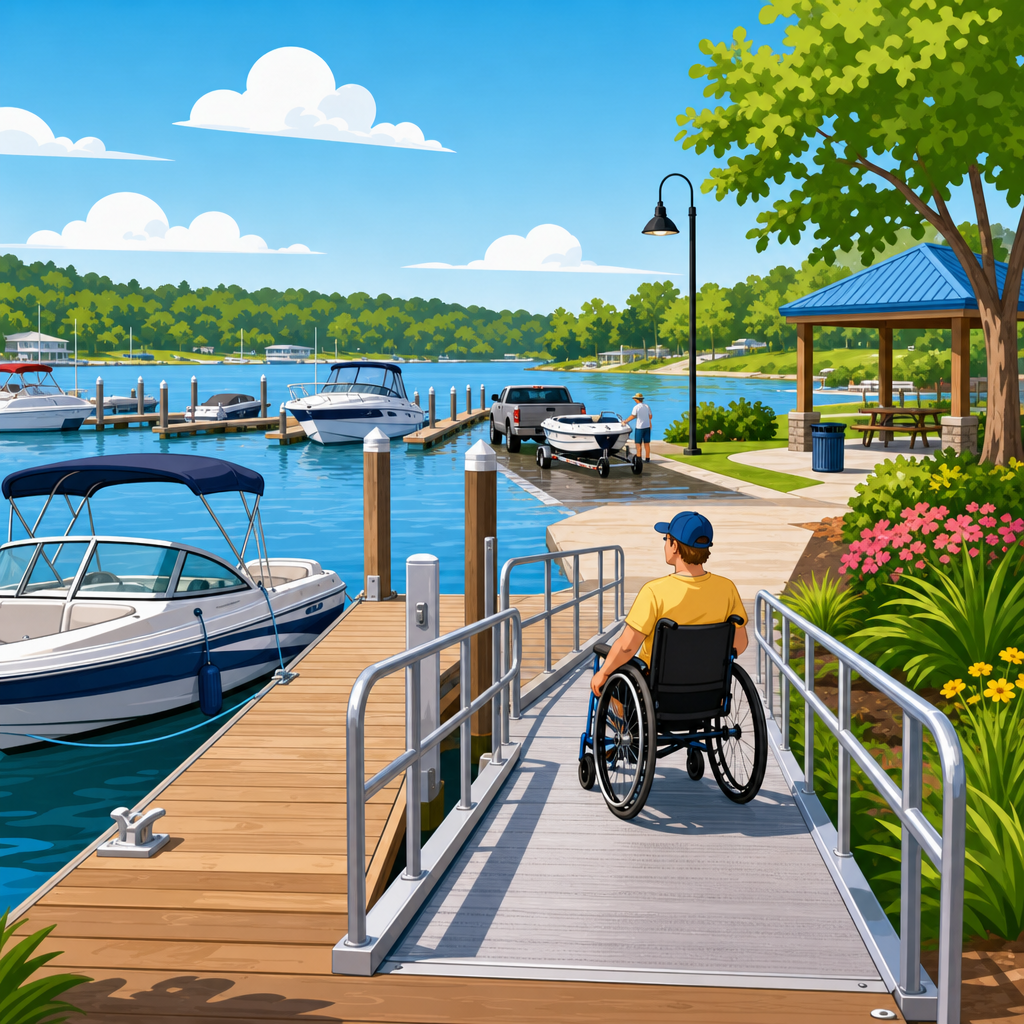
Recreational boating facilities and dock accessibility are governed by a specialized part of ADA Accessibility Standards because marinas, floating piers, gangways, boat slips, boarding piers, and related site amenities operate in changing water conditions that fixed-site rules do not fully address. In practice, Chapter 10 of the recreational provisions sets the baseline for how public and private facilities open to the public must provide accessible routes, boarding opportunities, clear spaces, and usable support elements without ignoring tides, waves, seasonal water levels, and structural limits. I have worked on accessibility reviews where dock operators assumed a standard sidewalk slope rule applied unchanged to floating systems; that mistake leads to costly redesigns because boating facilities are treated differently for legitimate engineering reasons. This matters because inaccessible docks do more than create compliance risk: they exclude users from fishing, paddling, sightseeing, launching, and social participation tied to waterfront life. A useful definition is that a recreational boating facility includes the piers, gangways, slips, boarding structures, and associated components used for recreational craft rather than commercial shipping. Accessibility in this context means a person with mobility, sensory, or balance limitations can approach, enter, move through, and use the facility with substantially equivalent independence and safety. The hub role of this page is to explain the full Chapter 10 framework, show how boating provisions connect to routes, parking, toilet rooms, and signage elsewhere in ADA standards, and clarify where technical exceptions apply. If you manage a marina, design a dock, review plans, or evaluate an existing waterfront, understanding these rules early is the fastest way to avoid noncompliant layouts and to create boating access people can actually use.
What Chapter 10 Covers at Recreational Boating Facilities
Chapter 10 addresses recreation-specific elements that need tailored accessibility criteria, and boating facilities are one of its most frequently misunderstood categories. The boating provisions focus on getting people from the arrival point to the water’s edge and onto usable dock surfaces, then ensuring enough slips and boarding areas are connected by an accessible route. The scope is not limited to the dock itself. In real projects, compliance starts at accessible parking, passenger loading zones, sidewalks, and route transitions from land to gangway. It also includes restrooms, rinsing stations, retail counters, and any clubhouse or harbor office serving the public under other ADA chapters. The boating section works together with the scoping and technical provisions for routes, reach ranges, protruding objects, operable parts, and common site features. That is why a marina can have an accessible gangway yet still fail overall because the route from parking includes stairs or because the fuel dock payment device is mounted too high.
The core boating concepts are straightforward. First, accessible routes must connect accessible boat slips and boarding piers. Second, the number of required accessible slips depends on the total number of slips provided. Third, when gangways are part of the route, slope exceptions recognize variable water levels. Fourth, clear deck space, width, and transitions still matter even when structures float. Fifth, dispersion rules affect where accessible slips are located, especially in large marinas with different dock clusters or boat sizes. The standards do not require every slip to be accessible, but they do require meaningful access rather than token placement at one inconvenient location. Designers should read boating provisions as a system, not a checklist, because route continuity is the issue that most often breaks compliance in the field.
How Many Accessible Boat Slips and Boarding Piers Are Required
The starting question most owners ask is simple: how many slips must be accessible? The answer depends on the total number of boat slips at the facility. ADA standards use a graduated scoping formula so smaller marinas are not overburdened while larger facilities provide more accessible opportunities. The requirement applies to slips, and accessible boarding piers can also satisfy access obligations where those are the facility’s relevant boating elements. Importantly, only slips that are not exempt from the count are included when calculating the number required. The standards also address dispersion among various types of slips where the facility offers different characteristics, such as lengths, boarding configurations, or locations.
| Total Slips at Facility | Minimum Accessible Slips Required |
|---|---|
| 1 to 25 | 1 |
| 26 to 50 | 2 |
| 51 to 100 | 3 |
| 101 to 150 | 4 |
| 151 to 300 | 5 |
| 301 to 400 | 6 |
| 401 to 500 | 7 |
| 501 to 600 | 8 |
| 601 to 700 | 9 |
| 701 to 800 | 10 |
| 801 to 900 | 11 |
| 901 to 1000 | 12 |
| 1001 and over | 12 plus 1 for each 100 over 1000 |
In plan review, I tell clients not to stop at the math. If a 220-slip marina provides sailboat slips on one pier and smaller powerboat slips on another, the accessible slips should reflect the range of boating opportunities unless a documented exception applies. Clustering every accessible slip near the office may be operationally convenient, but it can deny access to boat classes or views available elsewhere. The practical rule is that accessible slips should be on an accessible route and should be dispersed to serve different boating experiences to the extent feasible. This is also where coordination with marina operations matters, because transient slips, rental slips, and seasonal assignments can influence how accessible inventory is actually used.
Accessible Routes, Gangways, and Floating Pier Conditions
The most technical part of dock accessibility is the accessible route to the accessible slips and boarding piers. An accessible route generally must connect all required accessible elements, but boating facilities receive carefully limited exceptions because gangway slope changes with water levels. The standards recognize that a gangway connected to a floating pier cannot maintain the same slope at all times as a fixed land route. Instead of forcing impossible compliance, the rules provide exceptions tied to gangway length and to the total rise caused by fluctuating water levels. This is one of the clearest examples of accessibility standards adapting to real environmental conditions rather than ignoring them.
That flexibility is not a free pass. Gangways still need sufficient clear width, edge protection where required, stable connections, and transition plates that minimize abrupt level changes. The accessible route on the pier itself must also remain usable. A compliant gangway that lands on a narrow dock blocked by cleats, utility pedestals, and hose reels is not functionally accessible. I have seen excellent waterfront engineering undone by bad equipment placement. Utility pedestals should be located so they do not reduce required clear width or create protruding hazards, and route surfaces should remain firm, stable, and slip resistant to the extent possible for marine materials. Designers often choose aluminum framed gangways, composite decking, or treated lumber systems, but material choice must be evaluated for wet traction, joint spacing, maintenance, and warping over time.
Another common question is whether an elevator or mechanical lift can replace a gangway. In some constrained sites, platform lifts may be considered under the general ADA rules, but they are usually a secondary option because marine environments are hard on moving equipment and emergency reliability is critical. A well-designed gangway system with proper length, hinge detailing, float performance, and landing space is typically more robust. Where extraordinary tidal ranges exist, designers should document mean high and low water conditions, seasonal fluctuation data, and structural limits early. That documentation helps explain which exceptions are being used and protects the project during permitting and later audits.
Technical Design Details That Determine Real Usability
People often focus on slope and forget the details that determine whether a dock actually works for someone using a wheelchair, cane, walker, or transfer aid. Clear width is fundamental because marina routes are busy with carts, coolers, fuel hoses, and mooring lines. If the route meets minimum width only on paper but routinely narrows at gate hardware or utilities, users will be forced into dangerous maneuvers over water. Turning space matters too, especially at pier intersections, security gates, and gangway landings. A wheelchair user approaching a latch with no maneuvering clearance may be blocked even though the route technically reaches the gate.
Surface quality is another issue. Boards with excessive gaps can trap small casters, crutch tips, or canes. Uneven settlement at transition plates can create abrupt changes in level that feel minor to ambulatory users but can stop a wheelchair. Cross slope on floating structures also deserves attention; overloaded or poorly balanced docks can list enough to make propulsion difficult. Where benches, fish cleaning stations, rinse fixtures, or power pedestals are provided for public use, operable parts and clear floor space should be checked under the relevant technical provisions. Security features must also be accessible. Card readers, intercoms, and latch hardware should be within reach ranges and operable without tight grasping, pinching, or twisting of the wrist. Good dock accessibility is less about one dramatic feature and more about getting dozens of small dimensions right.
Exemptions, Exceptions, and Common Misreadings
Chapter 10 includes exceptions, but they are narrower than many operators assume. The best-known scoping exclusion concerns slips that are designed for, and can only be used by, vessels without engines, such as canoes, kayaks, and some rowing shells. Those slips are not counted when determining the total number of slips for accessibility scoping. However, that does not automatically eliminate accessibility obligations elsewhere in the launch area. If a facility offers a kayak launch, boarding pier, or route for public use, the surrounding circulation, amenities, and any required accessible boating elements still need review. Another recurring misreading is the idea that floating docks are entirely exempt because they move. They are not. The standards modify route requirements to account for fluctuating water levels, but accessible slips, connections, and usable dock surfaces are still required.
Historic sites, extreme terrain, and existing facilities can raise separate compliance questions under barrier removal or program access analyses, particularly when alterations are phased. Those cases require careful legal and technical review, not assumptions. I also caution clients against relying solely on local building department approval. Some jurisdictions adopt accessibility codes derived from ICC A117.1 or state standards, and those may interact with federal obligations rather than replace them. For public entities, Department of Justice enforcement and program accessibility considerations remain relevant. For private operators, Title III responsibilities still apply. The safest path is to compare the federal standard, state code, and marina operating model before final design.
How Boating Accessibility Connects to the Rest of the Site
A dock can be accessible only if the rest of the facility supports the trip. That means accessible parking located on the shortest practical route, curb ramps aligned with travel paths, and stable surfaces from the lot to the harbor office and onto the pier system. Restrooms and showers are not optional quality upgrades in many marinas; they are core services, and when they exist they must be accessible under the applicable technical standards. The same is true for check-in counters, vending, picnic areas, fishing platforms, and boat launch support spaces. At public waterfront parks, I often see one accessible parking space near the entrance but no continuous route to the transient dock because the sidewalk ends in gravel. That breaks access before the user even reaches the boating elements.
Wayfinding also matters more than many operators realize. Accessible routes should be obvious, not hidden behind service yards or locked side gates. Signage should identify accessible parking, toilet rooms, and where relevant, the route to accessible slips or boarding piers. Staff training is part of accessibility in real life. An accessible transient slip is of limited value if reservation staff do not know it exists, if maintenance stores equipment on it, or if gate attendants cannot explain the accessible route after hours. For this subtopic hub, that broader lesson is important: Chapter 10 boating compliance succeeds when site planning, architecture, marine engineering, and operations are coordinated from the start.
Best Practices for Planning, Auditing, and Upgrading Existing Marinas
The most effective way to improve compliance is to audit the user journey step by step. Start at arrival, confirm accessible parking counts and dimensions, then trace the route to the office, restrooms, gates, gangway, pier, and designated accessible slip. Measure actual clear widths, slopes, thresholds, hardware heights, and turning spaces instead of relying on as-built drawings. In existing marinas, conditions drift. Deck boards are replaced, pedestals are added, and utility lines migrate into circulation space. Annual inspections should include a simple accessibility checklist alongside structural and electrical reviews.
When upgrades are needed, prioritize high-impact fixes. Re-striping parking, lowering an intercom, relocating a pedestal, adding maneuvering clearance at a gate, or replacing a short steep gangway with a longer one can transform usability. For larger capital projects, engage an accessibility specialist and marine engineer together. They should review tidal data, float freeboard, gangway geometry, slip assignment policy, and maintenance practices as one system. The main benefit of doing this well is practical inclusion: more people can boat, visit, launch, and participate without special arrangements. If you oversee a recreational boating facility, use this page as your Chapter 10 hub, then move next into detailed reviews of slips, gangways, launches, and support amenities so accessibility is built into every waterfront decision.
Frequently Asked Questions
What makes recreational boating facilities different from other sites under ADA accessibility rules?
Recreational boating facilities are treated differently because they operate in an environment that constantly changes with water levels, tide movement, seasonal conditions, and dock motion. A marina or boating dock is not like a fixed sidewalk, parking lot, or building entrance where the surface, slope, and connection points stay the same all year. Floating piers rise and fall, gangways can become steeper or flatter depending on the water, and access points may need to accommodate changing operational conditions. Because of that, the ADA Accessibility Standards include specialized recreational provisions, including Chapter 10, to address the real-world challenges of marinas, boat slips, boarding piers, and related facilities.
These rules recognize that boating access must be practical as well as compliant. Instead of applying only standard fixed-site requirements, the standards account for features such as gangway length, accessible routes to docking areas, and the number of slips that must be accessible. They also consider how people with disabilities move through the facility, board vessels, and use associated amenities such as parking, restrooms, fuel docks, harbormaster offices, and picnic or viewing areas. In short, boating facilities are subject to ADA requirements, but those requirements are adapted to the unique operating conditions of water-based environments.
What does an accessible route typically mean at a marina, dock, or boating facility?
An accessible route at a recreational boating facility generally means a usable path that allows people with disabilities to travel from arrival points and site amenities to the boating area itself. Depending on the layout, that route may start at accessible parking, passenger loading zones, public sidewalks, or building entrances, then continue to the marina office, restrooms, docks, gangways, and other features provided to the public. The route must be designed so people using wheelchairs, walkers, canes, or other mobility devices can move through the facility with a reasonable degree of independence and safety.
In boating settings, the accessible route often includes a combination of fixed and floating elements. For example, a person may travel along a stable path on land, cross a transition area, and then use a gangway to reach a floating pier. Because gangways respond to changing water levels, the standards allow some flexibility that would not be typical in a purely land-based project. Even so, the route still needs to be planned carefully, with attention to width, surface condition, transitions, edge protection where required, and connections to the accessible slips or boarding locations that the facility provides.
It is also important to remember that the route is not limited to reaching the water’s edge. Accessibility is broader than simple entry. A compliant boating facility should connect users to the key services and experiences that are open to the public, including check-in points, restrooms, concessions, seating areas, and any other site elements that are part of the boating program. The goal is not merely to get someone near a dock, but to provide meaningful access to the facility as a whole.
Do all boat slips have to be accessible, or only a certain number?
No, not every boat slip is required to be accessible. ADA boating provisions generally require a specified number of accessible slips based on the total number of slips in the facility. This approach is similar to many other accessibility scoping rules: the standards do not require every element to be accessible, but they do require enough accessible features to ensure meaningful opportunity for use. The exact number depends on the total slip count and the applicable scoping criteria in the standards.
The accessible slips that are provided must be connected by an accessible route and designed so users can approach, maneuver, and make use of the boating facility in an equitable way. In practice, that often means selecting slip locations that work with the site’s physical conditions and operational needs while still giving users with disabilities a genuine opportunity to board or disembark. Simply designating a slip as “accessible” without providing the route, clear space, and supporting features needed to reach and use it would not satisfy the purpose of the standards.
Facility operators should also understand that accessibility is not just about counting slips. Distribution, usability, and integration matter. Accessible slips should not be isolated in inconvenient or inferior locations if the facility offers better options to the general public. They should be part of the normal boating experience to the extent feasible. For both public and private facilities open to the public, careful planning at the design stage is the best way to meet the required slip count while also creating practical, user-friendly access.
How do gangways, floating piers, and boarding areas affect compliance?
Gangways, floating piers, and boarding areas are central to compliance because they are often the actual link between land-based accessible features and the water-based use area. A gangway can present one of the biggest design challenges at a marina because its slope changes as water levels rise and fall. ADA recreational provisions recognize this issue and provide criteria that are more tailored to boating environments than standard site-access rules. That flexibility is important, but it does not eliminate the obligation to provide an accessible connection wherever required.
Floating piers also create unique considerations. Because they move with the water, designers must consider stability, connection points, transitions from fixed walkways, and the location of accessible slips or boarding opportunities. The path of travel should allow a person using a mobility device to move onto and along the pier without unnecessary barriers. Likewise, boarding areas should include enough usable space for approach and maneuvering, as well as practical access to the vessel side when that is part of the public boating service being offered.
Compliance in these areas often comes down to balancing technical requirements with real operating conditions. A well-designed facility anticipates changes in tide, weather, maintenance needs, and vessel activity while still preserving accessible use. That is why marinas and boating projects should be evaluated holistically rather than feature by feature. If the parking is accessible but the gangway is unusable, or if the dock can be reached but the boarding area lacks sufficient clear space, the overall experience may still fall short of accessibility expectations.
What other amenities at a recreational boating facility must be considered for accessibility?
Accessibility at a boating facility extends well beyond the docks themselves. If the site includes parking, routes from public transportation, ticketing or registration counters, restrooms, showers, dining areas, retail spaces, fuel stations, picnic areas, fishing or observation platforms, or other amenities open to the public, those features generally must be reviewed under the applicable ADA requirements as well. In many cases, the boating-specific rules work alongside broader accessibility standards for buildings and site elements, meaning compliance requires an integrated view of the property rather than a dock-only analysis.
This broader approach matters because the user experience begins long before someone reaches a slip or boarding pier. A person may need accessible parking, a curb-free route to the marina office, an accessible check-in counter, a restroom they can use comfortably, and a continuous route to the dock. If any one of those components is missing, participation in the boating activity can become difficult or impossible. True accessibility depends on how all of the parts function together.
For owners, operators, designers, and managers, the key takeaway is that boating access should be addressed as part of an overall accessibility strategy. Chapter 10 and related standards provide the framework for boating elements such as piers, gangways, and slips, but those features exist within a larger public environment. Reviewing the full site, understanding which amenities are offered, and making sure users with disabilities can access those amenities in an equivalent and dignified way is the best path toward both compliance and better public service.