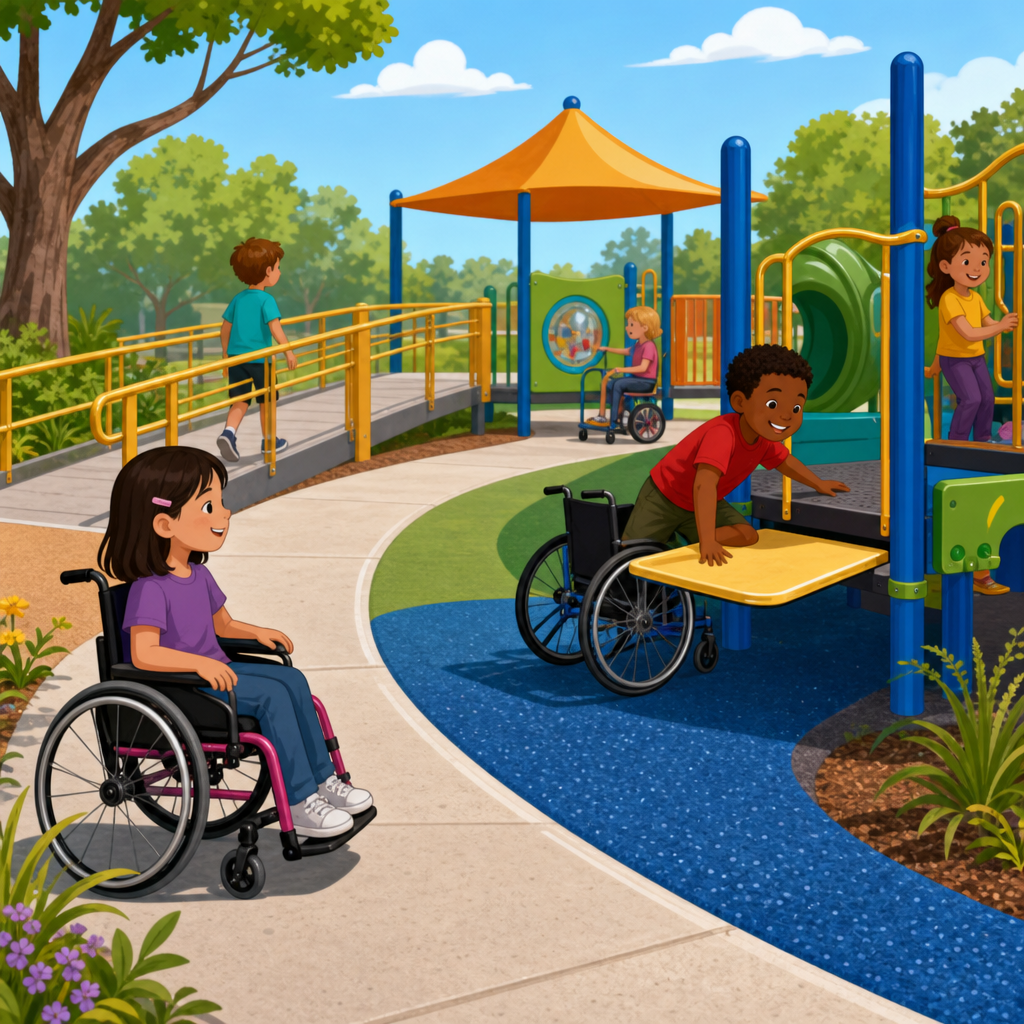
Accessible play areas are not defined by a single ramp or a token adaptive swing; they are planned environments where children with and without disabilities can approach, enter, move through, and use play components with dignity and safety. Under ADA Accessibility Standards, Chapter 10: Recreational Facilities sets the technical foundation for these spaces, and the play area provisions are especially important because they connect civil rights law to everyday childhood experiences. In practice, accessible play areas depend on three linked elements: accessible routes, stable and usable surfacing, and transfer systems that let a child move from a mobility device onto elevated play features. When I assess playgrounds, these are the first issues I examine, because they determine whether a site is meaningfully usable or merely appears compliant from a distance.
An accessible route is the continuous, unobstructed path connecting arrival points, entry points, ground-level play components, and elevated components that must be reached by ramp or transfer system. Surfacing refers to the material under and around equipment, which must meet both accessibility and impact attenuation requirements. Transfer systems are designed sequences of platforms and steps that support a child who can leave a wheelchair or other mobility device and transfer onto a structure. These terms matter because a playground can have inclusive intentions yet still fail if a route is too steep, if loose-fill surfacing shifts under wheels, or if elevated components can only be reached by climbing. This hub article explains how Chapter 10 addresses each issue, where designers and operators commonly make mistakes, and how these requirements connect to the broader goal of equitable recreation.
Playgrounds also matter legally and socially. Schools, parks departments, multifamily developments, childcare centers, museums, and private recreation operators all face obligations when they build or alter play areas covered by accessibility standards. More importantly, accessible play supports physical development, social learning, sensory engagement, and family participation. A parent should not have to stop at the perimeter because a stroller or wheelchair sinks into engineered wood fiber. A child should not be excluded from elevated imaginative play because the only access point is a net climber. Good compliance work produces better user experience. Chapter 10 does not ask owners to remove challenge or adventure from play; it requires a thoughtful distribution of accessible opportunities across the play environment.
What Chapter 10 requires for accessible play areas
Chapter 10 establishes scoping and technical rules for newly designed or altered play areas. The core concept is straightforward: a play area must provide accessible routes to required play components, and the number of components that must be on an accessible route depends on the total number and type of components provided. Ground-level and elevated play components are treated differently because they involve different methods of access. Ground-level components must be connected by an accessible route, while elevated components can be connected by ramps or transfer systems depending on the size and composition of the structure.
The standards do not require every single play feature to be accessible. Instead, they require a minimum number of ground-level play components and elevated play components to be connected so children with disabilities can experience a comparable range of play activities. This is a crucial nuance. Comparable experience means considering different types of play, such as climbing, spinning, sliding, sensory activity, dramatic play, and social interaction. A playground filled with accessible steering wheels at ground level but no meaningful elevated play access may technically struggle and functionally fail. During audits, I look beyond counts and ask whether the accessible components offer equivalent challenge, variety, and social value.
Another important point is that altered play areas trigger accessibility obligations within the scope of the alteration. Replacing surfacing, adding a new composite structure, or substantially reworking circulation can require compliance upgrades. Owners often assume accessibility only applies to brand-new playgrounds, but alterations frequently bring Chapter 10 into play. Because this page serves as a hub for the recreational facilities subtopic, it should be read alongside detailed articles on swimming pools, boating facilities, amusement rides, and sports facilities. Those facilities have their own technical rules, yet the same pattern appears throughout Chapter 10: identify the user journey, connect required elements with an accessible route, and ensure the experience is usable rather than symbolic.
Accessible routes: the backbone of usable playground design
An accessible route in a play area starts before the child reaches the equipment. It should connect parking, public sidewalks, passenger loading zones, school paths, or building entrances to the playground entry. From there, the route must continue into and through the play area, linking required ground-level components and the points where ramps or transfer systems provide access to elevated components. If the route breaks at the edge of the containment border, usability breaks with it. This is one of the most common field problems: the site path is compliant concrete, but access ends at a timber curb containing loose-fill material.
Route design depends on width, slope, cross slope, openings, vertical changes, and edge conditions. A route that looks generous can still fail if cross slope causes wheelchair drift or if transitions at poured-in-place surfacing create wheel-catching lips. Drainage design matters as much as geometry. I have seen otherwise compliant playgrounds become inaccessible after seasonal settlement created puddling at the transfer platform approach. Water, rutting, and displacement can compromise both route integrity and safety. Maintenance teams need to treat accessible routes as operational infrastructure, not just initial construction details.
Accessible routes should also support how children actually play. Children rarely move in a neat linear sequence from one feature to another. They circle, reverse direction, congregate, and move with caregivers and siblings. That means route planning should avoid dead ends, pinch points, and isolated accessible components placed away from the social center of the playground. A ground-level music panel hidden behind a bench row does not create inclusion. The better model is a circulation loop or branching network that lets all children reach high-interest features together. In schools, this is especially important during recess, when congestion can make nominally accessible paths unusable.
| Design issue | Common failure | Better practice |
|---|---|---|
| Entry connection | Accessible sidewalk stops at containment border | Extend route seamlessly into play space with compliant transition |
| Surfacing transition | Lip or rut at poured-in-place edge | Use flush edges and inspect after settlement |
| Circulation | Single narrow spur to one accessible feature | Create looped routes serving multiple high-value components |
| Drainage | Water pooling on route after storms | Coordinate grading, subbase, and drainage early in design |
| Maintenance | No plan to restore displaced surfacing | Adopt inspection schedule and corrective action log |
Surfacing: accessibility and fall protection must work together
Playground surfacing is where accessibility compliance and safety performance meet. The surface must be firm enough and stable enough for mobility devices, yet it must also provide impact attenuation under and around equipment. This dual requirement is why surfacing decisions cannot be reduced to product marketing claims. The recognized benchmark for accessibility performance has long been ASTM F1951, which measures wheelchair work per foot on a surface. Impact attenuation is addressed through standards such as ASTM F1292. A surface that performs well in one dimension but poorly in the other is not a successful solution.
Loose-fill materials such as engineered wood fiber can be compliant when properly installed and maintained, but they are maintenance-intensive. They migrate, compact unevenly, and can be displaced from use zones and route segments. In public parks with limited maintenance staffing, that reality matters. Unitary surfaces such as poured-in-place rubber or bonded rubber systems often provide more consistent access, but they bring different challenges: higher initial cost, susceptibility to wear, heat buildup in direct sun, and potential failure if the base is not properly prepared. Tiles can work, but edge curl, separation, and settlement are recurring issues if drainage and installation quality are poor.
In real projects, surfacing choice should be based on life-cycle performance, climate, maintenance capacity, and expected use patterns. A school district with daily custodial oversight may successfully maintain engineered wood fiber if replenishment and grooming are funded. A neighborhood park with intermittent maintenance may be better served by a high-quality unitary system, even if the upfront budget is tighter. Owners should ask not just whether a product can pass a test in a lab, but whether the installed surface will remain accessible after two summers, one freeze-thaw cycle, and heavy use by scooters, strollers, and wheelchairs. That question prevents expensive retrofits.
Transfer systems and ramp access to elevated play components
Elevated play components are central to many playgrounds because they create views, movement sequences, and social play zones that children seek out. Chapter 10 recognizes that not every elevated structure can or must be ramped in full, so it allows two access strategies: ramps and transfer systems. A ramp provides direct wheeled access and generally offers the highest degree of independence. A transfer system provides a structured way for a child to move from a mobility device onto a platform and then up transfer steps to the elevated route. Deciding between them is not simply a budget decision; it affects who can use the equipment and how independently they can do so.
Transfer systems work best when they are carefully integrated rather than appended to the side of a structure. A proper transfer platform needs usable clear space for approach, a practical transfer height, and transfer steps with dimensions that support movement by children with varying strength and coordination. Handholds, edge protection, and predictable spacing all matter. I often see transfer systems compromised by decorative panels, steering features, or guard elements that intrude into the approach area. When that happens, a technically present transfer point becomes functionally unusable.
Ramps, meanwhile, support broader access and typically improve social inclusion because children using mobility devices can remain with peers on elevated decks and bridges. The tradeoff is space and cost. Ramped systems require longer runs, larger footprints, and careful attention to slope, landings, and edge protection. They also affect the play experience: too many long ramps can consume the structure and reduce the variety of active play elements. Strong playground design often combines both methods, using ramps to reach a meaningful set of elevated components and transfer systems to extend access deeper into the structure. That balanced approach aligns compliance with realistic site constraints and better play value.
Ground-level components, variety, and inclusive play value
Ground-level play components are sometimes treated as the fallback category, but in well-designed playgrounds they are essential, not secondary. Chapter 10 requires a minimum number of ground-level components on an accessible route, and those components must offer different play experiences. Variety is the point. A compliant playground should not satisfy its obligation by clustering several nearly identical sensory panels in one corner while all dynamic play happens overhead. Children need options that involve motion, tactile exploration, social interaction, imagination, and achievable challenge.
Examples of strong ground-level design include accessible spinners with transfer support, play tables sized for seated or standing use, musical elements placed within route-connected gathering spaces, sand or water play with reachable working heights, and imaginative features integrated into the main circulation zone. These choices matter because not all children will use transfer systems or ramps, and many children prefer rich ground-level play regardless of disability status. Inclusive design succeeds when the accessible elements are also desirable to everyone else. That reduces stigma and increases social mixing.
Distribution matters as much as selection. Place ground-level components where children naturally gather, not just along the perimeter. Connect them to shade, seating, and caregiver sight lines. Pair quiet sensory spaces with active zones rather than segregating them at opposite ends of the site. In parks serving neurodiverse users, clear spatial organization, predictable transitions, and refuge spaces can be as important as dimensional compliance. Chapter 10 establishes the legal floor, but thoughtful programming creates a play area that families return to because it works in practice.
Common compliance mistakes in design, construction, and maintenance
Most playground accessibility failures are not caused by ignorance of the law; they result from coordination gaps between designers, manufacturers, installers, and maintenance staff. One frequent mistake is relying too heavily on catalog layouts without verifying how the selected equipment, surfacing, and site grading interact. Another is treating the equipment footprint as the whole project while overlooking the accessible path from parking, restrooms, or school entrances. Accessibility does not begin at the slide; it begins at arrival.
Construction-phase substitutions are another major risk. A specified unitary surface may be replaced with a lower-cost system that lacks equivalent performance, or the base preparation may be simplified in ways that accelerate failure. Field tolerances matter. A small edge lip, a misplaced bollard, or a gate with heavy hardware can undo accessible circulation. I recommend punch-list inspections focused specifically on Chapter 10 items, including route continuity, transfer approach clearances, surfacing performance, and actual usability by children and caregivers using mobility devices.
Maintenance failures can be even more damaging because they accumulate quietly after opening day. Engineered wood fiber compacts and displaces. Rubber surfaces crack. Drain inlets clog. Shade structures change drainage patterns. Replacement parts create protrusions. The best operators use documented inspection schedules, keep manufacturer maintenance guidance on file, and assign responsibility clearly. If a facility manager cannot say who checks route integrity after storms, the playground is not being managed accessibly. This is the same lesson seen across Chapter 10 recreational facilities: compliance is an ongoing operational obligation, not a one-time design event.
How this hub connects to the wider recreational facilities standards
Accessible play areas are one part of Chapter 10, but they illustrate the logic of the entire recreational facilities framework. Swimming pools require accessible means of entry, amusement rides address wheelchair spaces and transfer access, boating facilities focus on pier routes and boarding conditions, and sports facilities address team areas and spectator support spaces. In each setting, the standards ask a similar set of questions: How does a person arrive, where does the accessible route go, what usable experiences must be provided, and where do technical details determine whether access is real?
As a hub page, this article should guide readers deeper into the subtopic. If you are planning a park, campus, resort, or civic recreation site, do not assess the playground in isolation. Review site arrival, parking, toilet rooms, drinking fountains, picnic areas, and path networks alongside the play area. Recreational accessibility works best when facilities are connected into one coherent visitor journey. Start your next review with Chapter 10 and use the play area as the test case: if the route, surfacing, and transfer strategy are right there, the rest of the site planning usually improves as well.
Frequently Asked Questions
What makes a play area truly accessible under ADA standards?
A truly accessible play area is designed as a complete experience, not as a single accessible feature added after the fact. Under ADA Accessibility Standards, especially the provisions in Chapter 10 for recreational facilities, accessibility in play areas means children with disabilities must be able to approach the site, enter the play space, travel along usable routes, and engage with a sufficient range of play components. That includes the ground-level path into the playground, the surfacing beneath and around equipment, the route connecting components, and the design of the equipment itself.
In practical terms, accessibility is about whether a child can move through the space with dignity, safety, and independence to the greatest extent possible. A playground is not considered meaningfully accessible if a child can reach the perimeter but cannot get to the equipment, or if they can reach one isolated feature but are excluded from the rest of the play experience. The ADA standards address this by requiring accessible routes, transfer systems or ramps where appropriate, and a minimum number of elevated and ground-level play components that can be used by children with mobility impairments.
Just as important, a well-designed accessible play area supports inclusive play rather than separation. Children with and without disabilities should be able to use the same environment together. That means planners need to think beyond compliance checklists and consider circulation, social interaction, sensory variety, and usable challenge. When accessibility is integrated from the beginning, the result is a play space that works better for everyone: caregivers using strollers, grandparents with mobility limitations, children with temporary injuries, and kids with sensory, cognitive, or physical disabilities.
Why are accessible routes so important in playground design?
Accessible routes are the backbone of an inclusive play area because they determine whether users can actually get from one part of the space to another. In ADA terms, an accessible route is a continuous, unobstructed path that connects key elements of the site, including the entry, amenities, and required play components. Without that connected route, accessibility breaks down quickly. A child may be able to enter the playground but still be blocked from reaching elevated structures, swings, activity panels, or social gathering areas.
These routes matter because playground use is not static. Children move constantly between equipment, caregivers move alongside them, and social play depends on being able to participate in multiple parts of the environment. If routes are too narrow, too steep, unstable, or interrupted by level changes, they can limit independent movement for wheelchair users and others with mobility challenges. Accessible routes should be planned so they support circulation naturally, rather than forcing users into a single segregated path or a dead-end viewing spot.
Good route design also affects safety and usability. A route should be predictable, firm and stable where required, and wide enough to allow movement without conflict. It should connect not only major play structures but also support spaces such as seating, shade, restrooms where provided, and accessible parking or drop-off areas nearby. In inclusive playground planning, routes are not just technical features; they shape how welcoming the environment feels. A well-connected layout helps ensure children can participate fully instead of watching from the sidelines.
What type of playground surfacing is best for accessibility?
The best surfacing for accessibility is surfacing that remains firm, stable, and slip-resistant while also meeting impact attenuation requirements for fall protection. Under ADA-related play area requirements, the surface along accessible routes and beneath accessible play components must be usable by people with mobility devices. That means the material should support wheelchairs, walkers, and other mobility aids without excessive sinking, shifting, or resistance.
In many cases, unitary surfaces such as poured-in-place rubber or rubber tiles are preferred because they can provide a more consistent and predictable travel surface when properly installed and maintained. Engineered wood fiber can also be used in some settings, but it requires more ongoing maintenance to remain compliant and functional. Loose-fill materials may shift over time, especially in high-use areas, creating barriers that were not present on opening day. For that reason, selection should be based not only on installation cost but also on climate, drainage, expected traffic, maintenance capacity, and long-term performance.
It is also important to remember that no surfacing material is automatically accessible forever. Wear, compaction, displacement, edge failure, and drainage problems can all reduce usability over time. A surface that initially passes accessibility and safety criteria may become difficult to navigate if it is not inspected and maintained routinely. The best approach is to choose a surfacing system that aligns with the site’s maintenance realities and to establish a clear plan for inspection, repair, and replacement. Accessibility depends as much on sustained upkeep as it does on original design.
How do transfer systems help children access elevated play components?
Transfer systems are designed to help children move from a mobility device onto an elevated play structure when a ramped route is not provided or is not feasible for every component. They typically include a transfer platform and transfer steps that allow a child to shift from a wheelchair or other mobility aid onto the structure and then move upward through the equipment. Under ADA play area provisions, transfer systems are one recognized method for providing access to certain elevated play experiences.
These systems are valuable because they expand the range of play opportunities available to children with mobility impairments. Many elevated components are central to the playground experience, and without a transfer option, those features may be effectively off-limits. A properly designed transfer platform should be at a usable height and provide enough space for a child to position themselves and transfer safely. Transfer steps should be spaced and arranged to support movement in a way that is practical and respectful of a child’s abilities.
That said, transfer systems are not a substitute for thoughtful inclusive design. Not every child can use a transfer system independently, and some may not be able to use one at all. That is why many of the best play areas combine transfer access with ramped routes, accessible ground-level activities, and diverse sensory and social play options. The goal is not to assume one method works for all users, but to provide multiple ways to participate. When used appropriately, transfer systems can be an important part of that broader inclusive strategy.
How can designers go beyond minimum compliance to create better inclusive play areas?
Going beyond minimum compliance starts with recognizing that ADA standards establish the legal baseline, not the highest possible standard of inclusion. Compliance is essential, but a playground can technically meet code and still fall short as an inclusive environment if the experience feels limited, isolated, or difficult to use. Designers, schools, municipalities, and owners should use ADA requirements as the starting point and then ask a larger question: can children with different abilities participate in meaningful play together throughout the site?
One way to do that is by offering a wide variety of play experiences at both ground level and elevated levels. Inclusive play areas should support physical, sensory, imaginative, social, and quiet forms of play. That may include accessible spinners, musical elements, tactile panels, shaded retreat spaces, interactive equipment usable from seated or standing positions, and circulation layouts that encourage side-by-side play. It is also helpful to think about caregiver access, sightlines, seating, wayfinding, and the comfort of children who may need lower-stimulation zones.
Maintenance and operations are also part of inclusive design. Even the best layout can fail if routes become blocked, surfacing deteriorates, or transfer points are neglected. Involving disability advocates, occupational therapists, families, and community members during planning can help identify real-world barriers that drawings alone may miss. The strongest accessible play areas are those created with both technical knowledge and lived experience in mind. When design teams move beyond the idea of a token accessible feature and instead plan for dignity, choice, and shared play, they create spaces that serve the whole community far more effectively.