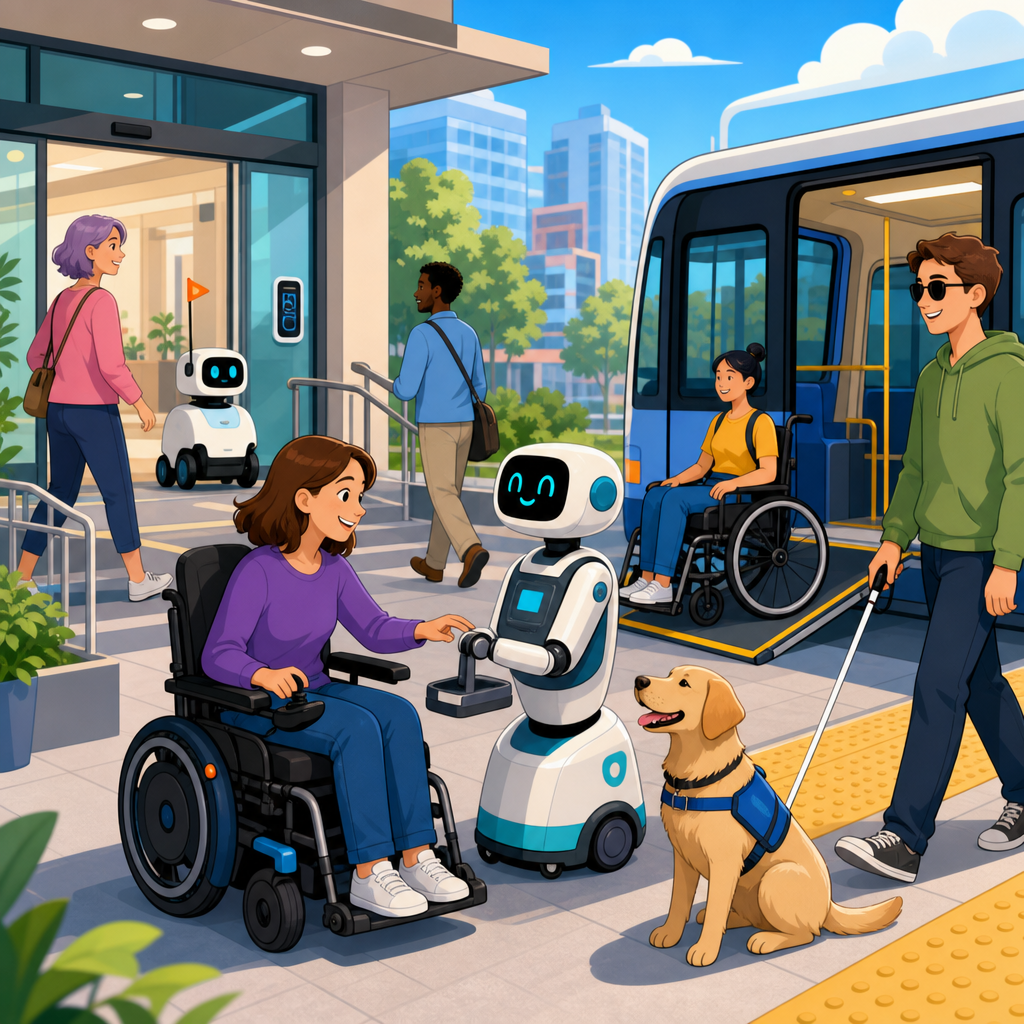
Robotics in accessibility is moving from a niche research field into everyday compliance, design, and service delivery, and that shift is reshaping how organizations think about ADA-related innovation. In this context, accessibility means designing spaces, products, digital systems, and services so people with disabilities can use them effectively, safely, and with dignity. Robotics includes physical robots, powered mobility aids, robotic exoskeletons, autonomous service devices, robotic manipulation systems, and sensor-driven machines that assist with movement, communication, navigation, and daily tasks. ADA-related innovations are developments that help public entities, employers, schools, transportation providers, retailers, healthcare systems, and hospitality operators meet obligations under the Americans with Disabilities Act while improving real-world access.
I have seen this change firsthand in projects where organizations initially viewed accessibility as a checklist issue, then realized robotics could solve stubborn barriers that building retrofits or staffing models alone could not address. A hospital may install autonomous wayfinding robots to help blind and low-vision visitors reach clinics. An airport may test robotic wheelchair attachments that reduce attendant shortages. A warehouse employer may evaluate exoskeletons as a reasonable accommodation for specific lifting tasks. These are not speculative concepts anymore. They are active deployments, pilots, and procurement discussions influenced by ADA expectations, OSHA safety rules, Section 508 digital requirements in certain contexts, and growing consumer demand for inclusive design.
This matters because disability access gaps remain significant across transportation, employment, education, healthcare, and public accommodations. Robotics will not replace ramps, captions, accessible websites, trained staff, or policy compliance. It will, however, become an increasingly important layer in how access is delivered. The central question for future ADA developments is no longer whether robotics belongs in accessibility planning. It is which technologies offer measurable access benefits, what standards will govern them, and how organizations can adopt them without creating new barriers.
Why robotics is becoming central to future ADA developments
Robotics is gaining importance because many access barriers are dynamic rather than static. A compliant doorway does not help if no staff member is available to assist with a transfer. A map kiosk is less useful if a visitor cannot read it, hear it, or physically operate it. A human-centered service model can still fail during staffing shortages, emergencies, or peak traffic. Robots and automated assistive systems can extend accessibility into these operational gaps by providing repeatable, on-demand support.
Three forces are driving adoption. First, sensor costs have fallen while perception systems have improved. Lidar, depth cameras, computer vision, haptic feedback, and speech recognition are now integrated into commercial platforms at prices far below a decade ago. Second, labor constraints are pushing organizations to automate routine support tasks, especially in transportation, logistics, and healthcare. Third, accessibility expectations have broadened. Users increasingly expect independence, not just accommodation after a complaint. That expectation aligns with universal design and with ADA enforcement trends that focus on effective communication, equal access, and practical usability.
In plain terms, robotics becomes valuable when it turns a dependent experience into an independent one. A robotic feeding arm can let a person eat without waiting for assistance. An autonomous navigation device can help a traveler move through a terminal with fewer handoffs. A robotic shelf-reach system in retail can help workers with limited upper-body mobility perform core tasks. The strongest future ADA developments will come from this kind of practical use case, where robotics addresses a specific barrier and produces evidence of improved access.
Current innovation categories shaping the next wave
The robotics landscape in accessibility is broad, but several categories are most relevant to ADA-focused planning. Mobility assistance is one of the most mature. Robotic wheelchairs, stair-climbing mobility devices, powered add-on drives, and exoskeletons are advancing quickly. Companies such as WHILL, Permobil, and Wandercraft have pushed powered mobility and robotic gait systems into clinical and commercial settings. These tools matter for ADA developments because they expand what independent navigation can look like in workplaces, campuses, transit hubs, and public venues.
Wayfinding and navigation robotics are another major category. Autonomous indoor robots can escort users through complex buildings, while wearable navigation systems use cameras, obstacle detection, and audio or haptic cues to support blind or low-vision users. In my experience, this is where organizations often see the fastest operational return because large hospitals, airports, universities, and convention centers already struggle with navigation. Better wayfinding improves access while also reducing missed appointments, staff interruptions, and visitor frustration.
Manipulation and task-assistance robotics are also expanding. Robotic arms mounted on wheelchairs or desks can assist with opening doors, retrieving items, operating switches, or handling objects in workplace and home settings. In employment contexts, these systems could shape future accommodation practice by helping qualified workers perform essential job functions with less dependence on coworkers. Communication support is emerging too, especially through telepresence robots, social robots used in therapy or education, and multimodal interfaces that combine speech, text, gesture, and screen output for users with different communication needs.
| Innovation area | Typical use case | ADA relevance | Key limitation |
|---|---|---|---|
| Robotic mobility aids | Independent travel in public spaces | Improves equal access to facilities and services | Cost, maintenance, insurance coverage |
| Autonomous wayfinding robots | Navigation in hospitals, airports, campuses | Supports effective communication and orientation | Need for accessible interfaces and fallback support |
| Exoskeletons | Assisted standing, walking, or task support | Potential workplace accommodation tool | Safety validation and task-specific suitability |
| Robotic manipulation systems | Reaching, grasping, operating objects | Helps users perform daily living or work tasks | Training time and environmental constraints |
| Service and telepresence robots | Remote participation, customer support | Expands access to meetings, classes, and services | Connectivity, privacy, and usability concerns |
How ADA compliance and robotics intersect in practice
The ADA rarely requires a specific robot, but it often requires an accessible outcome. That distinction is critical. Under Titles I, II, and III, covered employers and public-facing organizations must provide access, reasonable accommodations in employment, and effective communication unless doing so would create an undue hardship or fundamental alteration. Robotics enters the picture when it is the most effective, practical, or scalable way to achieve that outcome.
For employers, the interactive process remains central. A robotic device may be a reasonable accommodation if it enables an employee to perform essential functions safely and effectively. The Equal Employment Opportunity Commission has long emphasized individualized assessment, and robotics fits that framework. An exoskeleton might help one worker with fatigue-related limitations but be inappropriate for another because of balance, heat, or task variability. The legal analysis still turns on essential functions, medical documentation where appropriate, safety, cost, and whether other accommodations would work as well.
For public accommodations and state or local governments, robotics often supports program access and auxiliary aids. A museum could deploy a robotic guide with multilingual speech, captioned display, and tactile interface options. A courthouse might use telepresence systems for remote participation in certain nonconfidential proceedings where physical access is limited. A transit provider may add autonomous boarding assistance or robotic wheelchair movement systems. In each case, the robot is not the compliance endpoint. The endpoint is equal opportunity to participate, receive information, and use the service with comparable independence.
Standards, procurement, and the compliance questions organizations must ask
The next phase of ADA developments will be shaped as much by procurement discipline as by engineering progress. When I review accessibility technology plans, the strongest programs treat robots as regulated operational systems, not gadgets. They ask whether the interface is usable by people with low vision, hearing loss, limited dexterity, cognitive disabilities, or speech differences. They ask how the device performs during network failure, battery loss, crowded conditions, or emergency evacuation. They ask whether data collection introduces privacy or surveillance risks for disabled users who already experience disproportionate scrutiny.
Several standards and frameworks matter. The 2010 ADA Standards for Accessible Design still govern the built environment, and robotics must function within that baseline rather than substitute for it. In digital and interface design, WCAG principles remain highly relevant when a robot includes screens, apps, or voice interfaces. Safety review may involve OSHA obligations in workplaces, FDA pathways for certain medical or rehabilitation robotics, FCC rules for connected devices, and product liability considerations. ISO 13482, covering safety requirements for personal care robots, is especially important because it addresses robots that interact directly with people in nonindustrial environments.
Procurement teams should require accessibility conformance documentation, user testing with disabled participants, maintenance commitments, incident logging, and a clear human-assistance fallback. That last requirement is essential. If an autonomous concierge fails and no accessible alternative exists, the organization may have created a new barrier instead of removing one. Future ADA-related innovation will reward vendors that can document both technical performance and inclusive usability in realistic settings.
Where future trends are heading across major sectors
Healthcare will remain a leading sector because accessibility needs are frequent, varied, and operationally complex. Expect more robotic transfer aids, autonomous delivery devices that reduce hallway congestion, rehabilitation robots that support therapy intensity, and navigation systems for patients with sensory impairments. Hospitals are under pressure to improve patient experience scores and reduce injury risk for staff and patients, so robotics that supports safer movement and clearer navigation has immediate value.
Transportation is likely to become the most visible public proving ground. Airports, rail stations, and paratransit systems are already testing robotic wheelchairs, autonomous escorts, and smarter boarding assistance. The biggest future development here is integration. A traveler will increasingly expect one accessible journey that connects ticketing, navigation, restrooms, boarding, and destination guidance. Robotics can support that journey, but only if systems share data responsibly and present information in multiple accessible formats.
Employment and education will also expand. In workplaces, robotic workstations, collaborative robots, and adaptive manipulation tools may widen access to jobs previously viewed as physically restrictive. In schools and universities, telepresence robots and classroom support devices can improve participation for students with mobility impairments, chronic illness, or immune-related limitations. Retail and hospitality will adopt service robots more slowly, but the pressure is building. Guests increasingly expect accessible check-in, room navigation, menu access, and in-store assistance without delays or awkward dependence on staff discretion.
Risks, limitations, and the policy shifts to watch
Robotics in accessibility is promising, but the risks are real. Cost remains the first obstacle. Advanced mobility systems and manipulation devices can be expensive to purchase, maintain, insure, and repair. Interoperability is another challenge. A robot that works well in a controlled demo may perform poorly in a cluttered lobby, noisy terminal, or older building with inconsistent wireless coverage. Bias in speech and vision systems can also reduce usability for people with accents, atypical speech, service animals, mobility equipment, or nonstandard movement patterns.
There is also a serious policy question: when does assistive automation empower users, and when does it become a substitute for broader accessibility improvements? Organizations must avoid treating robotics as a waiver from structural compliance. A delivery robot does not excuse an inaccessible service counter. A navigation robot does not replace tactile signage, trained staff, or accessible digital maps. The most durable ADA developments will treat robotics as an added access layer, not a shortcut around established design obligations.
Watch for policy activity in four areas over the next several years. First, more detailed procurement guidance for accessible emerging technology. Second, stronger scrutiny of AI-driven decision systems embedded in service robots, especially where speech, identification, or behavior analysis affects access. Third, clearer expectations for disability-inclusive product testing. Fourth, more litigation and settlement language focused on operational accessibility, not just fixed architecture. Those shifts will influence how vendors design products and how organizations evaluate future deployments.
The future of robotics in accessibility will be defined by practical usefulness, not novelty. The strongest ADA-related innovations are the ones that remove a specific barrier, preserve user dignity, and work reliably in real environments. Mobility aids, wayfinding robots, exoskeletons, robotic arms, and telepresence systems already show how automation can expand access across healthcare, transportation, employment, education, and public accommodations. Yet every deployment must still be measured against the same core test: does it provide effective, equitable access without creating new obstacles?
For organizations tracking future trends and predictions in ADA developments, this topic belongs at the center of planning. Robotics will shape accommodation strategies, capital projects, technology procurement, risk management, and service design. The best approach is disciplined rather than futuristic: identify access barriers, evaluate where robotics can help, test with disabled users, document outcomes, and maintain human alternatives. That is how innovation becomes compliance-ready and genuinely useful.
If you are building an accessibility roadmap under updates and developments, use this hub as your starting point. Review your highest-friction access points, examine which robotic tools address them, and connect those findings to policy, procurement, and training decisions. Organizations that start now will be better prepared for the next generation of ADA expectations and better equipped to deliver access that works in everyday life.
Frequently Asked Questions
What does “robotics in accessibility” mean in an ADA-related context?
In an ADA-related context, robotics in accessibility refers to the use of robotic and semi-autonomous technologies to reduce barriers for people with disabilities in physical spaces, workplaces, public accommodations, transportation settings, healthcare environments, and digital service systems. This can include powered mobility devices, robotic exoskeletons, autonomous wayfinding tools, robotic manipulators that help users interact with objects, service robots in customer-facing environments, and smart robotic assistance systems that support communication, navigation, lifting, reaching, or daily tasks. The key point is that these technologies are not just about technical innovation; they are about improving access, independence, safety, usability, and dignity.
From an ADA perspective, robotics becomes relevant when organizations use these systems to help meet accessibility obligations or to improve how people with disabilities access goods, services, programs, and facilities. For example, a robotic door-opening system, an automated reception assistant with accessible speech and visual interfaces, or a robotic inventory retrieval solution in a retail setting may all affect how accessible an environment is in practice. At the same time, robotics must be implemented carefully. A robot does not automatically make a space ADA compliant, and in some cases it can create new barriers if it is poorly designed, hard to operate, incompatible with assistive technology, or unreliable in real-world use.
That is why the current wave of innovation is so important. The field is moving beyond experimental prototypes and into mainstream design and service delivery. Organizations are increasingly evaluating robotics as part of accessibility planning, not as a novelty. The most effective ADA-related robotic innovations are those that are integrated into broader universal design strategies, tested with disabled users, supported by clear policies, and offered in ways that preserve choice rather than force a single mode of access.
What are some of the most important recent ADA-related innovations in accessibility robotics?
Recent innovation has been especially notable in systems that combine robotics with sensors, artificial intelligence, adaptive controls, and user-centered design. One major area is powered mobility and robotic movement support. Advanced wheelchairs, robotic exoskeletons, stair-assist technologies, and smart transfer devices are improving mobility options for users in healthcare, rehabilitation, and community settings. These tools can help individuals navigate environments more safely and can also influence how organizations think about accessible pathways, charging infrastructure, storage space, and emergency planning.
Another important area is robotic assistance in public and commercial spaces. Autonomous service robots are being deployed in airports, hospitals, hotels, universities, and large facilities to guide visitors, carry items, deliver supplies, and support navigation. When designed well, these systems can enhance access by reducing physical strain, simplifying wayfinding, and offering multimodal interaction through voice, touch, visual display, and app-based controls. Similarly, robotic manipulators and smart kiosks are beginning to help users reach products, retrieve materials, or complete transactions that might otherwise be difficult due to limited dexterity, strength, or reach.
There have also been meaningful developments in home and workplace robotics. Robotic arms mounted on wheelchairs, assistive feeding devices, robotic dressing aids, telepresence robots, and collaborative robots in employment settings can help individuals perform tasks more independently. In ADA-related workplace discussions, this matters because employers are increasingly considering robotic systems as part of reasonable accommodation strategies, particularly when they help an employee perform essential job functions safely and effectively. The strongest recent innovations share a common theme: they are becoming more adaptable, more interoperable with assistive technologies, and more responsive to the real needs of disabled users rather than being designed around a one-size-fits-all model.
Can robotics help an organization comply with the ADA?
Robotics can help support ADA compliance, but they should be understood as one tool within a larger accessibility framework rather than a standalone solution. The ADA generally focuses on equal access, effective communication, reasonable modifications, and the removal of barriers where required. A robotic system may help an organization meet those goals by improving navigation, assisting with physical access, expanding communication options, or enabling more inclusive service delivery. For example, a robot that helps transport materials in a healthcare facility could reduce delays for patients with mobility limitations, and a robotic interface that offers both spoken and visual instructions may improve usability for a broader range of people.
However, it is important not to assume that introducing robotics automatically satisfies legal obligations. If the core facility, service, website, or workflow remains inaccessible, adding a robot on top of it may not resolve the underlying issue. In some cases, overreliance on robotics can create separate-but-not-equal experiences, especially if disabled users are funneled into a special process that is slower, less reliable, or more stigmatizing than the standard one. ADA-minded implementation means asking whether the technology provides meaningful, equivalent, and dependable access, and whether users still retain options that fit their needs and preferences.
Organizations should also evaluate maintenance, training, emergency procedures, privacy, safety, and user feedback. A robot that works well during a demonstration but fails during daily operations can undermine access rather than improve it. The most defensible approach is to treat robotics as part of an ongoing accessibility program that includes policy review, barrier assessment, staff training, human support channels, and direct consultation with people with disabilities. In short, robotics can be a powerful compliance-support tool, but only when it is deployed thoughtfully, tested rigorously, and aligned with the ADA’s broader access principles.
What accessibility risks should organizations consider before adopting robots or autonomous service devices?
Organizations should start by recognizing that every accessibility innovation can introduce new barriers if it is not designed and implemented inclusively. One major risk is interface exclusion. If a robot depends only on speech, only on a touchscreen, or only on a mobile app, it may be unusable for people with hearing, vision, speech, cognitive, or dexterity disabilities. Multimodal interaction is essential. Users may need audio prompts, captions, tactile controls, screen-reader-compatible apps, simple instructions, adjustable timing, plain-language options, and ways to summon human assistance without difficulty.
Physical navigation and environmental interaction are also critical concerns. Autonomous devices operating in hallways, lobbies, sidewalks, stores, or workplaces must account for wheelchair turning space, cane detectability, safe stopping distance, speed control, surface changes, crowded conditions, and unpredictable movement patterns. A robot that blocks an accessible route, startles users, or fails to recognize mobility aids, service animals, or nonstandard movement can create serious problems. Similarly, robotic systems that assist with doors, lifts, item retrieval, or transfers must be dependable and fail-safe. If access depends on a robotic device, downtime and error rates become accessibility issues, not just technical issues.
There are also broader concerns involving privacy, bias, and dignity. Vision-based and AI-enabled robots may collect sensitive information, infer disability status, or misinterpret user behavior. Facial recognition, speech recognition, and motion detection tools can perform unevenly across different users, including those with atypical speech, movement, posture, or appearance. Organizations should therefore conduct accessibility impact assessments, usability testing with diverse disabled participants, and policy reviews covering data handling, consent, escalation procedures, and manual alternatives. The goal is not simply to deploy a functioning robot, but to ensure that the system is safe, respectful, equitable, and genuinely useful in everyday use.
How should businesses, schools, healthcare providers, and public entities evaluate ADA-related robotics going forward?
The best starting point is to evaluate robotics as part of a comprehensive accessibility strategy rather than as a separate innovation project. That means asking practical questions early: What barrier is this technology intended to solve? Who benefits from it? Could it unintentionally exclude some users while helping others? Is there a non-robotic design change that would remove the barrier more simply? In many cases, the strongest approach is not replacing accessibility fundamentals with robotics, but combining robotics with universal design, architectural accessibility, digital accessibility, and trained human support.
Decision-makers should involve disabled users throughout planning, procurement, testing, and post-deployment review. Lived experience is indispensable. A device that looks impressive in a vendor demonstration may fail in real environments if it is too complex, too slow, too fragile, or too inconsistent. Organizations should request evidence of usability testing, interoperability with assistive technology, maintenance requirements, emergency override procedures, and accessibility documentation. They should also consider whether staff know how to support users when the system malfunctions or when an individual prefers a different method of access.
Looking ahead, the most successful ADA-related robotics programs will likely be those built on flexibility, transparency, and accountability. Technology is evolving quickly, but the underlying accessibility principles remain stable: equal access, effective use, safety, reliability, dignity, and meaningful choice. Businesses, schools, healthcare systems, and public entities should measure robotic innovation against those principles, not just against novelty or efficiency claims. When robotics is selected carefully and implemented responsibly, it can expand access in powerful ways. When it is adopted without inclusive planning, it can reinforce the very barriers it was supposed to remove.


