Shooting facilities and fishing piers sit in a specialized corner of ADA compliance, yet they raise practical design questions that general accessibility checklists rarely answer. Within Chapter 10 of the 2010 ADA Standards for Accessible Design, recreational facilities receive targeted technical and scoping requirements because recreation spaces must be usable, not merely reachable. In this context, accessible means people with disabilities can approach, enter, operate, and participate with substantially equivalent convenience and dignity. For owners, architects, parks departments, and compliance teams, these rules matter because they affect site planning, route design, deck geometry, rail conditions, clear floor space, and the number of compliant shooting positions or fishing locations required. I have worked through these issues on public park renovations and private club upgrades, and the mistakes are often subtle: a compliant parking area feeding a noncompliant gravel route, a pier with beautiful views but unusable guard heights, or a shooting station sized for standing users only. This hub article explains the Chapter 10 recreational framework, then focuses on the niche rules for shooting facilities and fishing piers while connecting them to adjacent recreation categories that teams often review at the same time. Used correctly, Chapter 10 turns accessibility from a late-stage correction into an early design strategy that protects inclusion, reduces rework, and supports durable public access.
How Chapter 10 Fits Into ADA Accessibility Standards
Chapter 10 is the recreation-specific layer of the 2010 ADA Standards. It does not replace the general requirements in Chapters 1 through 4; it adds specialized scoping and technical criteria for elements such as amusement rides, boating facilities, exercise equipment, golf facilities, miniature golf, play areas, saunas and steam rooms, swimming pools, shooting facilities, and fishing piers and platforms. The practical rule is simple: start with the general accessibility provisions for routes, parking, entrances, toilet rooms, signage, and operable parts, then apply the Chapter 10 provisions that are specific to the recreational use. That sequence prevents a common compliance failure in which a project team studies the niche recreation section but overlooks the basic accessible route requirements leading to it.
For hub planning, Chapter 10 matters because recreational sites are usually distributed environments rather than single rooms. A park may include trails, a fishing pier, picnic areas, a boat launch, and support buildings spread over varied terrain. Accessibility therefore depends on connected systems: accessible parking to site arrival, accessible route to the activity, compliant maneuvering and clear floor spaces at the activity, and supporting amenities such as restrooms and drinking fountains. When I review recreational projects, I map those chains first. If any link fails, the user experience fails even when the activity element itself appears compliant.
Shooting Facilities: What the ADA Requires
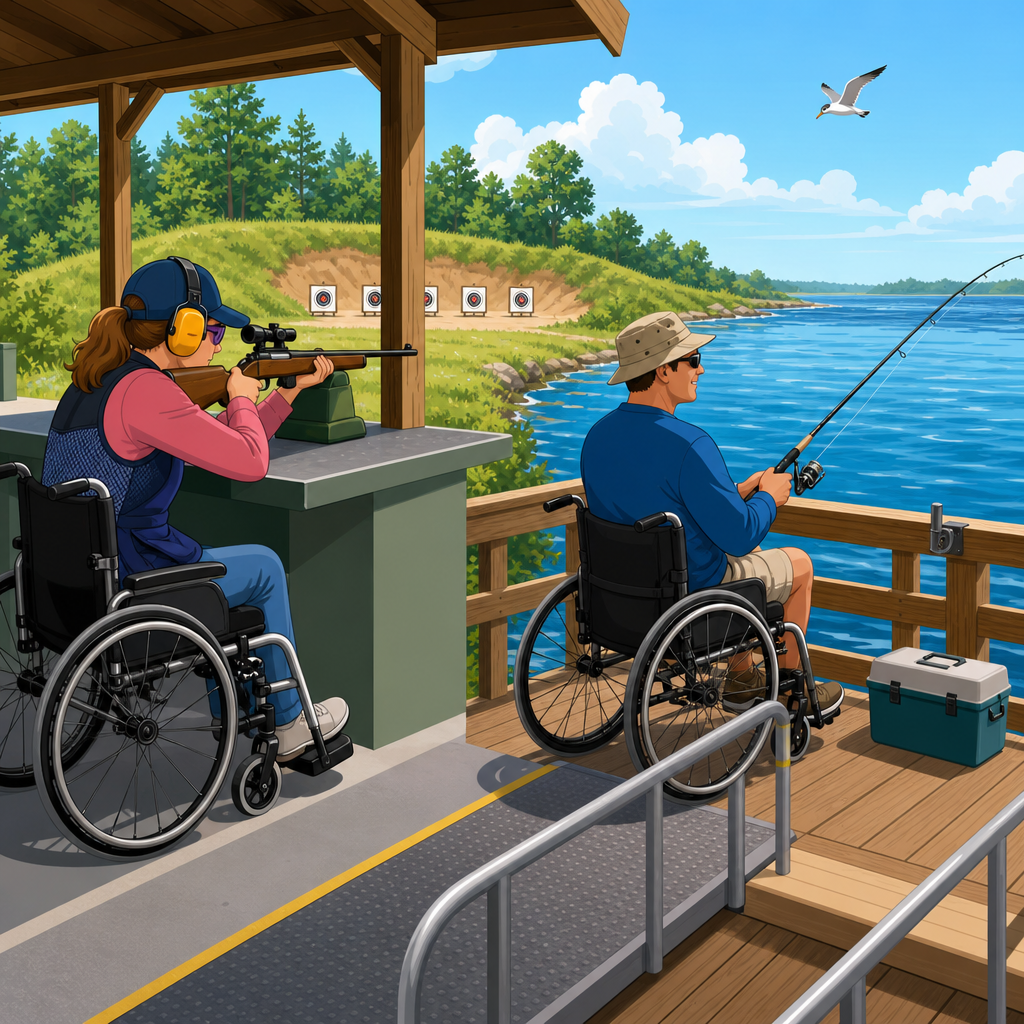
ADA rules for shooting facilities focus on the firing positions themselves and the routes that serve them. Where fixed firing positions are provided at a shooting facility, at least 5 percent, but no fewer than one of each type of firing position provided, must comply. “Type” matters. If a facility has bench positions, standing lanes, trap or skeet stations, and archery stations, the calculation is not done across the whole property as one undifferentiated pool. Each type must be considered so that accessible use is available for the range formats actually offered.
At compliant firing positions, the standards require an accessible route, clear floor or ground space, and turning space. This is where projects often become technical. A lane can be wide enough overall but still fail because fixed benches, partitions, brass deflectors, or equipment shelves remove the required maneuvering area. On outdoor ranges, slope and surface are recurring issues. Crushed stone that shifts under wheels, abrupt level changes at lane thresholds, and muddy transitions from concrete pads to native soil can all defeat usability. The standard expects stable, firm, and slip-resistant surfaces where accessibility is required, and that expectation should guide material selection from the start.
Bench design deserves special attention. A firing position used from a wheelchair must allow a forward or parallel approach as needed, with operable accessories within reach range and without requiring unsafe body positions. In practice, I recommend evaluating tabletop height, knee and toe clearance, side obstructions, and whether protective barriers interfere with aiming or ejection patterns. Facilities also need to think beyond pure dimensional compliance. For example, a bench that technically provides knee clearance but forces a left-handed shooter into an awkward angle is operationally weak. Accessibility works best when the range officer, designer, and user community review prototypes before construction.
Fishing Piers and Platforms: Core ADA Rules
Fishing piers and platforms are regulated because access to water-based recreation should include the act of fishing itself, not just a scenic overlook. The standards require accessible routes to fishing piers and platforms, subject to the same recreation context realities that influence other outdoor facilities. Once on the pier or platform, at least 25 percent of the railings, guards, or handrails must be no higher than 34 inches above the deck or ground surface. That lower segment is essential because typical guard heights can block seated users from casting, viewing the waterline, and landing fish safely.
The 25 percent rule is often misunderstood. It does not mean every edge must be lowered, and it does not eliminate safety requirements imposed by building codes or site conditions. Instead, it requires a meaningful portion of the fishing opportunity to be usable. Designers usually distribute the lowered rail sections across prime fishing zones rather than clustering them in one leftover corner. That approach improves both compliance and equity. If the only lowered rail faces shallow, debris-filled water while standing users access the deeper, stocked side, the facility may meet the letter of the rule but fail the purpose.
Deck geometry is another recurring issue. Clear spaces for wheelchair users must not be squeezed by benches, tackle stations, bait tables, or coin-operated dispensers. On public piers I have audited, the most common mistake is adding amenities after opening day. A portable cooler, storage cabinet, or cleaning station can narrow the circulation path below usable width. Maintenance plans should treat accessible clearances as operational requirements, not just design requirements.
Common Design Pitfalls and Practical Fixes
Most noncompliance in recreational projects comes from coordination failures, not from ignorance of one headline rule. Civil drawings may show an accessible route, while landscape details specify loose gravel. Structural teams may raise a pier rail for safety without preserving the required lowered fishing segment. Range designers may provide one accessible lane but place it on a cross slope that exceeds tolerances after drainage revisions. The cure is disciplined cross-checking at design development, permit set, and post-construction punch stages.
| Issue | Typical Failure | Practical Fix |
|---|---|---|
| Shooting position mix | Only one accessible lane total, regardless of type | Count 5% minimum by each firing position type |
| Range surface | Loose aggregate at accessible stations | Use concrete, asphalt, or bonded stabilized surface |
| Pier rail height | Uniform 42-inch guard around entire deck | Provide at least 25% fishing edge at 34 inches maximum |
| Route continuity | Compliant parking leading to steps or steep ramp | Verify continuous accessible route from arrival to activity |
| Aftermarket amenities | Benches or cabinets reducing maneuvering space | Protect required clearances in operations policy |
Another practical fix is mock-up testing. Before finalizing a shooting bench or lowered rail segment, tape the clearances on site or build a temporary sample. Invite wheelchair users, veterans groups, adaptive sports participants, or local disability advocates to test reach, visibility, turning, and comfort. Those sessions reveal issues no redline set catches, such as whether a pier user can manage tackle while positioned safely away from a wheel stop or whether a range partition blocks a seated shooter’s line of sight.
How These Niche Rules Connect to Other Chapter 10 Facilities
As the hub for the recreational facilities topic, this page should anchor related articles because Chapter 10 works best when understood as a family of use-specific overlays. Boating facilities address accessible boarding piers and boat slips. Swimming pools, wading pools, and spas address accessible means of entry such as lifts and sloped entries. Play areas apply to elevated and ground-level components, transfer systems, and accessible surfacing. Golf facilities address routes connecting holes and accessible teeing grounds. Exercise machines and equipment require clear floor space and route access. Miniature golf addresses accessible playing holes and route continuity. Saunas and steam rooms require turning space and accessible seating. Each area asks the same basic question in a different form: can a person with a disability participate in the core recreational experience, not simply watch from nearby?
That is why sub-pillar content under ADA Accessibility Standards should link these topics intentionally. A parks director renovating a fishing pier may also be planning picnic areas and trails. A private sports club reviewing shooting positions may simultaneously evaluate locker rooms, parking, and outdoor routes. Internal cross-references help users move from niche rules to supporting requirements quickly, which mirrors how compliance reviews happen in real projects.
New Construction, Alterations, and Program Access
The compliance path depends partly on whether the project is new construction, an alteration, or an existing facility evaluated under broader accessibility obligations. New construction must meet the applicable standards in full. Alterations must make the altered area accessible to the maximum extent feasible when full compliance is structurally impracticable because of existing conditions. Public entities also need to think about program access under Title II, which examines whether people with disabilities can access the service, program, or activity when viewed in its entirety. In plain terms, an older park system may not need every single pier to be retrofitted immediately if the fishing program remains accessible overall, but any new or altered pier still triggers current standards.
Private operators under Title III face a different analysis for existing facilities, often framed around barrier removal where readily achievable. That standard is fact-specific and depends on cost, difficulty, and available resources. Still, many straightforward improvements at shooting facilities and fishing piers are relatively achievable: restriping accessible parking, repairing route surfaces, reconfiguring furnishings, adding compliant signage, or lowering a qualifying portion of railing during scheduled maintenance.
Inspection, Documentation, and Ongoing Management
Compliance does not end when the ribbon is cut. Recreational environments wear differently than interior commercial spaces. Sun, salt, freeze-thaw cycles, and heavy public use can change slopes, loosen decking, corrode fasteners, and shift route surfaces. I advise owners to maintain an annual accessibility inspection checklist for Chapter 10 elements and to document findings with dated photographs and repair logs. For fishing piers, inspect rail heights, deck obstructions, surface changes, and route continuity after storms. For shooting facilities, inspect accessible station dimensions, bench stability, surface firmness, and the placement of movable accessories.
Staff training matters as much as hardware. Range staff should know which stations are accessible and keep them available rather than using them for storage or VIP assignments. Park staff should understand that the lowered rail section is not the ideal place for vending machines or waste bins. Good management preserves the usability that the design intended.
Chapter 10 recreational facilities rules are detailed because recreation is hands-on, equipment-driven, and deeply shaped by site conditions. Shooting facilities and fishing piers prove that accessibility is not a generic checklist but a design discipline focused on actual participation. For shooting ranges, the key points are accessible routes, maneuvering space, and compliant firing positions in each type provided. For fishing piers and platforms, the central requirements are route access and usable fishing edges, including railing segments no higher than 34 inches along at least 25 percent of the fishing space. Across both facility types, the biggest risks come from coordination gaps, aftermarket obstructions, and poor maintenance rather than from one dramatic design error.
As a hub within ADA Accessibility Standards, this page should guide readers to the full Chapter 10 landscape while giving them enough practical detail to catch problems early. If you are planning a new recreation project, altering an older facility, or auditing an existing site, review the general ADA provisions first, then apply the recreation-specific rules with drawings, field measurements, and user testing. That process leads to safer, more inclusive facilities and far fewer expensive corrections later. Use this hub as your starting point, then build a project checklist for every recreational element on your site.
Frequently Asked Questions
What makes shooting facilities and fishing piers different from other ADA-covered recreational spaces?
Shooting facilities and fishing piers are different because they are governed by ADA requirements that go beyond the usual questions of parking, routes, and restroom access. Chapter 10 of the 2010 ADA Standards for Accessible Design recognizes that recreational environments have activity-specific barriers, so it applies technical rules aimed at actual participation, not just arrival at the site. In other words, a person with a disability should be able to approach the activity area, enter it where required, use the relevant features, and take part in the experience with a level of independence that is comparable to other users.
At shooting facilities, that often means looking closely at whether people can access firing positions, whether turning space and clear floor space are available, and whether operable elements can be reached and used. At fishing piers and platforms, the analysis frequently centers on route design, edge protection, clear deck space, and fishing station usability. These are practical design issues that generic accessibility checklists often miss because the barriers are tied to the activity itself. A site can have compliant parking and a perfectly acceptable restroom yet still fail to provide meaningful access to the core recreational use.
This is why these facilities are considered niche but important in ADA compliance. Designers, owners, and operators need to evaluate not only how someone gets to the space, but what happens once they are there. If a visitor can reach a pier but cannot fish because the railings block effective use, or can enter a shooting range but cannot use the assigned position, the design may fall short of the ADA’s intent. The standards are structured to address that exact problem.
Do all shooting facilities have to provide accessible firing positions, and what does that usually involve?
In general, shooting facilities covered by the ADA are expected to include accessible firing positions, but the exact obligation depends on the type of facility, the number of firing positions provided, and whether the project is new construction, an alteration, or an existing condition being evaluated under broader program accessibility or barrier removal concepts. The key idea is that accessibility must be integrated into the firing area itself rather than handled as an afterthought. A range is not truly accessible if the only compliant features are outside the actual area where shooting occurs.
Accessible firing positions usually involve a combination of route access and usable space. There must be an accessible route to the position, and the position typically needs sufficient clear floor or ground space for a wheelchair user or other person with a mobility disability to approach and use it. In many cases, designers also need to think about surface stability, maneuvering room, line-of-sight issues, and whether any benches, partitions, or controls interfere with use. If a booth, shelf, or shooting surface is provided, its height and configuration can matter significantly because a person must be able to operate effectively from that position rather than simply occupy it.
It is also important to think beyond the minimum count. Providing only a technically compliant position in an inferior location may create practical inequities. For example, if the accessible firing position has a restricted field of use, poor weather protection, or limited compatibility with the way the range operates, the facility may still create participation barriers. Good ADA planning means making accessible positions part of the normal user experience, distributed and designed in a way that reflects how the range is actually used.
What ADA issues come up most often when designing or evaluating fishing piers and platforms?
Fishing piers and platforms often raise ADA questions that are highly specific to outdoor recreation. One of the biggest is the accessible route itself. It is not enough for a person to get near the pier; the route to and onto the structure must be usable, with attention to slope, width, surface conditions, transitions, and connection points. Because these facilities are frequently exposed to weather and built over or near water, designers also need to consider maintenance, drainage, slip resistance, and material performance over time. Accessibility can be undermined quickly if the route becomes warped, uneven, or obstructed.
Another common issue is whether a person can actually fish once on the pier. Railings and edge protection are important for safety, but they can also block participation if they are not designed thoughtfully. The ADA standards include specialized provisions intended to ensure that at least some fishing locations are usable by people with disabilities. That can involve evaluating railing height, clear space at fishing spots, and whether the design allows effective reach and operation. If every fishing edge is functionally unusable from a seated position, the pier may be reachable but not truly accessible.
Designers should also pay attention to dispersal and experience. If the only usable fishing location is isolated, cramped, or placed in a less desirable area, the pier may technically satisfy a scoping requirement while still delivering a poor user experience. In practice, better solutions integrate accessible fishing opportunities into the broader layout so users with disabilities can choose locations that are comparable to those available to everyone else. This approach aligns more closely with the ADA’s purpose and tends to produce stronger, more defensible designs.
Does ADA compliance for these facilities mean every feature has to be fully accessible in exactly the same way?
No. ADA compliance does not always require every single feature to be made accessible in an identical manner, but it does require sufficient accessible opportunities so that people with disabilities can meaningfully participate in the recreational activity. The standards often use scoping concepts that identify how many elements or spaces must comply, along with technical criteria for how those accessible elements must be designed. This is especially relevant in specialized recreation settings, where layouts, terrain, safety considerations, and equipment types can vary widely.
That said, facility owners should be cautious about interpreting this flexibility too broadly. The ADA does not support token access. If a facility technically provides one accessible option but that option is inconvenient, inferior, or operationally segregated, the design may still present legal and practical risk. The real test is whether users with disabilities can participate with a degree of independence, dignity, and comparability. Accessibility should be built into the program itself, not relegated to a backup option that is rarely usable in practice.
This is particularly important in shooting and fishing contexts because participation depends so heavily on where a person is positioned and what they can physically reach or operate. A facility may not need to duplicate every station or every edge condition exactly, but it should provide accessible choices that are integrated, functional, and realistically usable. Looking at the facility through the lens of actual user experience is often the best way to determine whether the design is meeting the spirit as well as the letter of the standards.
What are the biggest compliance mistakes owners and designers make with shooting facilities and fishing piers?
One of the biggest mistakes is assuming that general ADA familiarity is enough. Many teams know how to check parking counts, restroom layouts, and door clearances, but they do not study the recreation-specific requirements closely enough. As a result, they may create a facility that is accessible around the edges but not at the point of participation. In a shooting range, that might mean no truly usable accessible firing position. On a fishing pier, it might mean railings or deck layouts that prevent effective fishing access despite an otherwise compliant route.
Another common problem is treating accessibility as a last-step review item. By the time construction documents are nearly complete, the geometry of the site, the structural system, and the operational layout may already make compliance difficult or expensive to achieve. Recreation-specific ADA issues should be discussed early, especially when a project involves water access, safety barriers, covered stations, benches, partitions, or specialized user equipment. Early coordination usually produces better results and avoids awkward retrofits.
A third mistake is overlooking maintenance and ongoing operations. Even a well-designed facility can become inaccessible if accessible positions are blocked by movable furnishings, used for storage, poorly signed, or not maintained to the same standard as the rest of the site. For outdoor facilities, surface wear, corrosion, settlement, and weather exposure can create barriers over time. Owners should think of ADA compliance as an ongoing operational obligation, not just a design milestone. Regular review of how people actually use the space is one of the best ways to identify issues before they become complaints or enforcement problems.