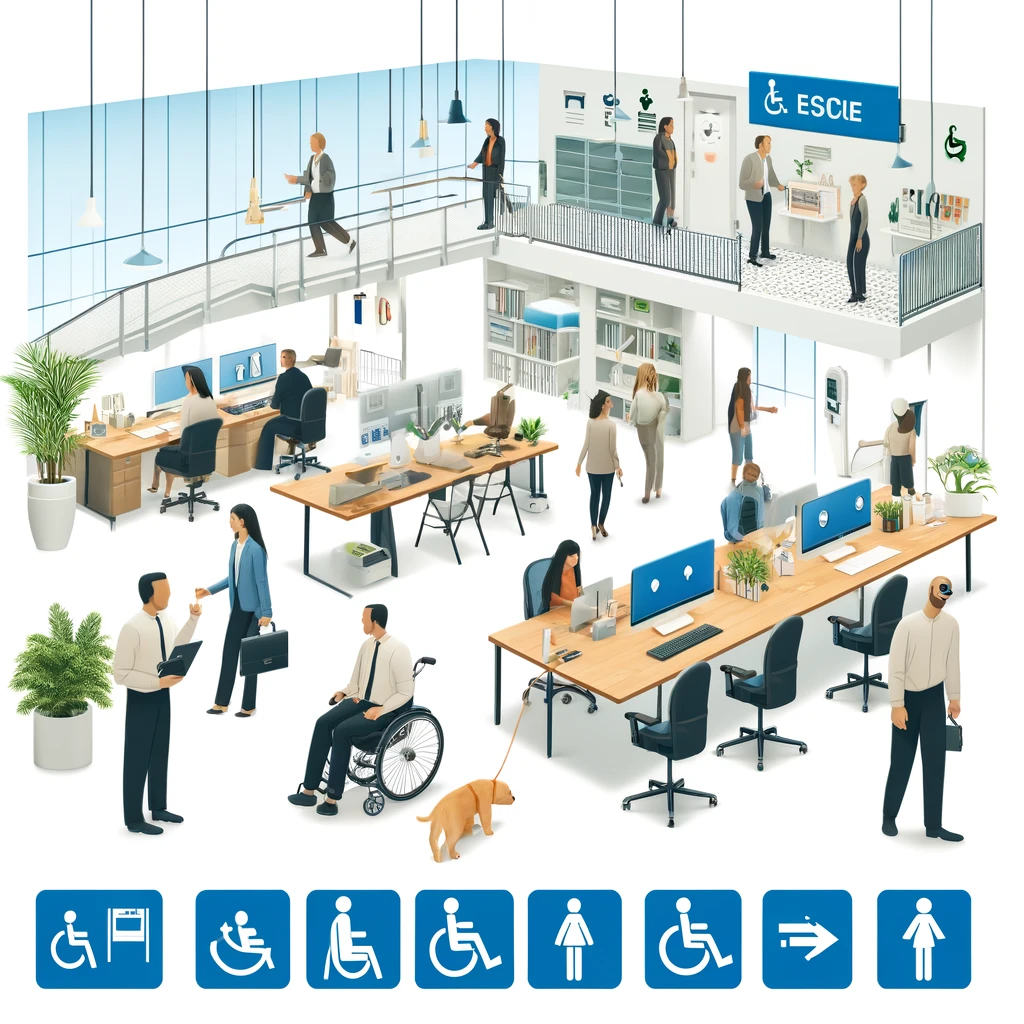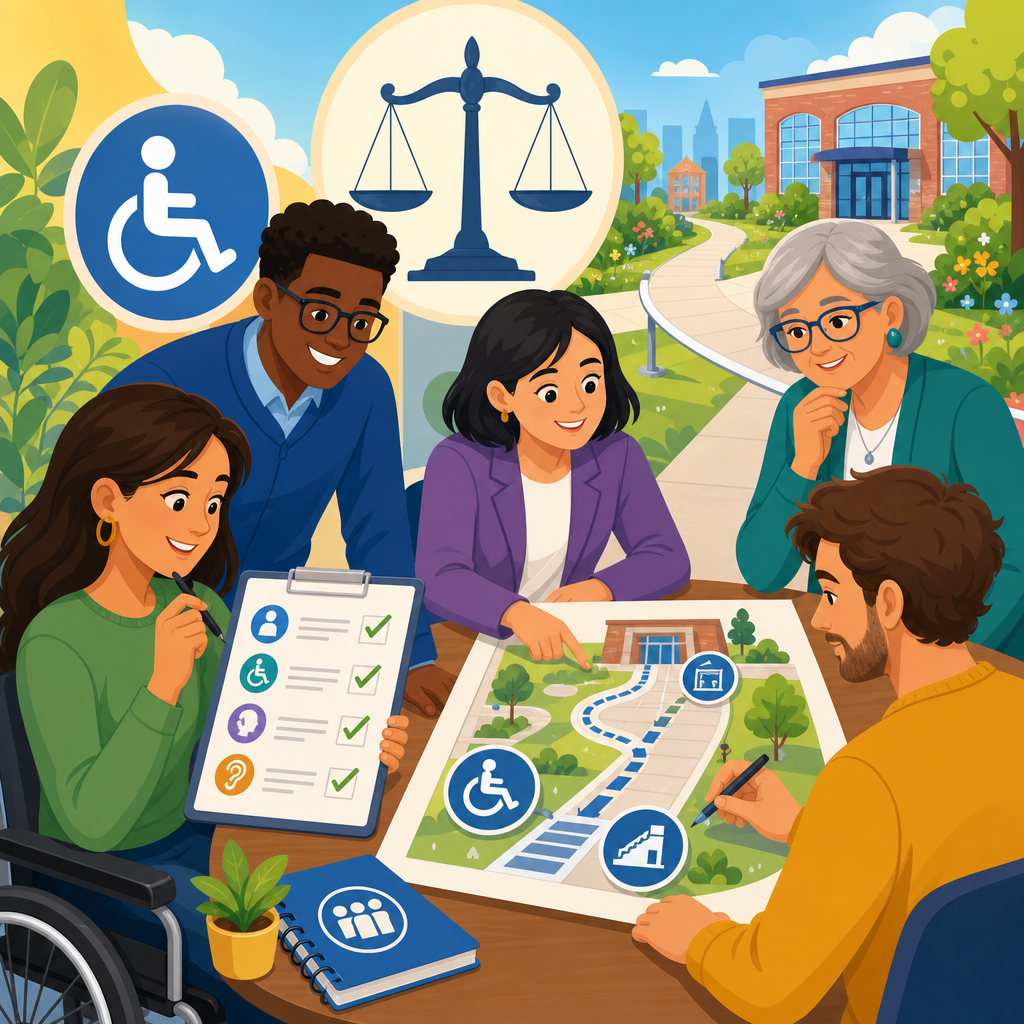
Self-evaluations and transition plans are two of the most practical, and most neglected, ADA governance tools available to public entities and many covered organizations. In my work reviewing accessibility programs, I have seen agencies invest heavily in training, grievance procedures, website fixes, and facility upgrades while skipping the documents that should guide all of that work. The result is predictable: fragmented decisions, inconsistent remediation, weak budgeting, and avoidable legal risk. When leaders ask why their accessibility efforts feel reactive, the answer is usually simple. They have activities, but not governance.
Under the Americans with Disabilities Act, governance means the policies, records, decision rights, and implementation structures that turn broad civil rights obligations into repeatable operational practice. A self-evaluation is the organization’s formal review of current services, policies, practices, communications, and physical assets to identify barriers to equal access. A transition plan is the documented roadmap for removing structural barriers, assigning responsibility, setting priorities, estimating cost, and sequencing capital improvements over time. Together, these tools connect legal requirements to budgeting, procurement, facilities management, digital accessibility, transportation planning, and public service delivery.
This matters because advanced ADA compliance is no longer limited to ramps, parking spaces, and complaint response. Covered entities now operate hybrid service environments that include websites, mobile apps, PDFs, kiosks, online forms, social media, video, emergency communications, contracted programs, and legacy facilities built under different standards. Without a current self-evaluation and a credible transition plan, organizations cannot easily show that they know where barriers exist, how they prioritize fixes, what standards they apply, or who is accountable for progress. For a compliance and implementation program, these documents are the operating system. This hub explains what they are, what they must contain, how they support broader accessibility governance, and which advanced ADA compliance topics connect back to them.
What a self-evaluation actually covers
A self-evaluation is a structured review of how people with disabilities experience an organization’s programs, services, and activities. It is broader than a building survey and more strategic than a one-time audit. In practice, I treat it as a portfolio assessment across four domains: policy, program access, communication access, and physical access. Policy includes rules on service animals, effective communication, reasonable modification, event accessibility, emergency procedures, procurement, and complaint handling. Program access examines whether the service works when considered in its entirety, not whether every room or every facility is perfect. Communication access looks at auxiliary aids and services, plain language, interpreters, captioning, accessible documents, and digital channels. Physical access evaluates routes, entrances, restrooms, counters, parking, signage, recreation areas, and other built environment elements.
For public entities, the requirement traces back to Title II regulations, and the concept still matters because regulators and courts expect organizations to understand their barriers before claiming they are addressing them. A good self-evaluation identifies barriers, records the basis for decisions, and preserves evidence of consultation with interested persons, including individuals with disabilities and disability organizations. It also distinguishes between technical noncompliance and actual program access failure. That distinction is important. A restroom that fails a dimensional requirement may be a compliance issue, but if equivalent accessible restrooms are unavailable where the program is delivered, the issue becomes a program access failure with immediate operational implications.
Advanced programs go further by inventorying digital assets, third-party platforms, leased spaces, temporary events, and specialized services such as paratransit eligibility, emergency sheltering, voting access, and law enforcement communication procedures. They also identify legal standards by asset type, such as the 2010 ADA Standards for Accessible Design for facilities and WCAG-based requirements for web content where applicable. A self-evaluation should not be a static binder. It should be a living governance record that informs procurement language, annual capital planning, remediation backlogs, and staff training priorities.
What makes a transition plan credible
A transition plan turns findings into action. It is not a wish list, and it is not a vague statement that barriers will be removed as funding becomes available. A credible plan identifies physical obstacles in facilities that limit accessibility, describes methods for making facilities accessible, specifies a schedule for taking the steps needed, and names the official responsible for implementation. The strongest plans also include cost ranges, dependencies, interim measures, funding sources, and a rationale for prioritization. When I assess whether a plan will survive scrutiny, I ask three questions: Is the inventory complete enough to support decisions, are priorities tied to actual program risk, and can the organization demonstrate progress quarter by quarter?
Real-world examples show why detail matters. A city may know that several branch libraries have inaccessible entrances, but unless the transition plan states whether the solution is a new ramp, lift, route relocation, or program relocation, facilities staff cannot budget accurately. A county courthouse may have inaccessible witness stands and jury boxes, but if the plan does not identify interim accommodations while renovation design is pending, judges and clerks will improvise. A parks department may have dozens of picnic areas and trails with varying barriers; without a prioritization method based on population served, unique amenities, geographic equity, and cost, money gets spent where projects are easiest rather than where access gains are greatest.
The strongest transition plans align with capital improvement programs and asset management systems. They map barriers to facility IDs, project numbers, estimated fiscal years, and responsible departments. They separate quick operational fixes, such as signage replacement or door pressure adjustment, from major capital projects, such as elevator installation or restroom reconfiguration. They also document when structural changes are unnecessary because program access can be achieved another way, while making clear that alternative methods are not a permanent excuse to ignore high-use barriers.
How these tools anchor advanced ADA compliance topics
As a hub for advanced ADA compliance topics, this page should connect governance documents to the specialized issues that organizations struggle with most. Digital accessibility is one of the clearest examples. Website remediation often happens in a silo, yet the self-evaluation should already identify inaccessible online forms, PDFs, videos, application portals, and vendor software that interfere with access to programs and services. The transition plan then assigns priorities, such as fixing online bill pay before lower-risk archival content, and links them to procurement controls so new systems do not recreate the same barriers.
Effective communication is another connected topic. A compliant program needs procedures for qualified interpreters, CART, captioning, Braille or large-print materials, relay usage, and communication with people who are deafblind or have speech disabilities. Those procedures belong in the self-evaluation because they reveal whether staff know how to obtain aids and services, whether contracts are in place, and whether front-line teams understand response times. If recurring gaps appear, the transition plan should assign corrective actions, including policy revision, training, vendor onboarding, and after-hours protocols.
Transportation, emergency management, housing, recreation, law enforcement, and procurement all fit the same pattern. For example, police communication access often fails because officer training, dispatch scripts, and interpreter protocols are disconnected. Emergency sheltering fails when cots block routes, backup power does not support accessible charging needs, and medical refrigeration procedures exclude disability-related equipment. Procurement fails when contracts omit accessibility conformance requirements, testing rights, remediation obligations, and indemnity language. Each of these advanced topics becomes manageable when leadership uses self-evaluation findings to define the problem and uses the transition plan to assign budget, ownership, and dates.
| Topic | What the self-evaluation should identify | What the transition plan should drive |
|---|---|---|
| Digital services | Barriers in websites, apps, PDFs, forms, kiosks, and vendor tools | Remediation sequencing, procurement controls, testing cycles |
| Facilities | Entrances, routes, restrooms, counters, signage, parking, recreation barriers | Capital projects, interim access measures, cost forecasting |
| Effective communication | Interpreter access, captioning, alternate formats, staff procedure gaps | Contracts, training, service-level expectations, after-hours support |
| Emergency management | Shelter access, alerts, evacuation assistance, backup equipment needs | Revised plans, drills, equipment purchases, mutual aid coordination |
| Procurement | Missing accessibility clauses, weak acceptance testing, inaccessible software | Standard terms, conformance review, governance checkpoints |
Common failures and how mature programs avoid them
The most common failure is treating the self-evaluation as a one-time historical artifact. Many entities completed one decades ago and never updated it after reorganizations, facility changes, outsourced services, or digital expansion. That leaves leaders relying on stale assumptions. Mature programs establish a refresh cycle, usually annual for policies and digital inventories and tied to capital planning for facilities. Another common failure is relying only on technical surveys without assessing how people actually obtain services. A city hall annex may technically comply in several areas while remaining practically inaccessible because the only public meeting room with evening programming has no accessible route from parking after security gates close.
I also see transition plans that list barriers but ignore implementation mechanics. If a plan does not name an owner, expected completion window, interim accommodation, and funding pathway, it is not actionable. Mature programs build governance around a designated ADA coordinator, department liaisons, legal review, procurement review, and quarterly status reporting. They use issue-tracking tools, not spreadsheets alone, for remediation accountability. They engage people with disabilities early, especially when evaluating alternatives such as service relocation, virtual access, or phased renovation, because technical compliance without usability often produces expensive rework.
A final failure is separating accessibility from enterprise risk management. Accessibility findings should influence bond planning, lease negotiations, software acquisition, public communications, and vendor performance reviews. Organizations that do this well make accessibility part of project initiation. Before a website redesign, facility renovation, or transit service change is approved, decision makers review self-evaluation findings and confirm whether the transition plan requires updates. That is how governance prevents recurring defects.
Building and maintaining defensible documentation
Defensible documentation is clear, current, and tied to standards. For facilities, that means identifying the applicable standard, the observed condition, the barrier created, and the proposed corrective method. For digital assets, it means recording the page type, user task affected, severity, test method, and responsible owner. I recommend preserving meeting notes from consultations, photos, audit excerpts, budget assumptions, and reasons for prioritization decisions. If an entity chooses an alternative method for program access instead of immediate structural change, the record should explain why the alternative is effective, who approved it, and when the decision will be revisited.
Named tools and methods help. Facility teams often use asset inventories linked to capital planning software. Digital teams use accessibility testing combinations such as automated scanning, keyboard testing, screen reader checks, and manual review against recognized criteria. Program teams maintain service blueprints for high-risk interactions such as arrests, emergency alerts, courtroom participation, shelter intake, or benefits applications. The point is not to create paperwork for its own sake. The point is to produce a record that shows the organization understands its obligations, has made reasoned decisions, and can prove follow-through.
Documentation also supports internal linking across the broader compliance and implementation program. Grievance procedures, coordinator authority, staff training, accessible procurement, digital remediation standards, and public notice obligations should all point back to findings from the self-evaluation and actions in the transition plan. When those pieces are connected, accessibility stops being a scattered compliance project and becomes a managed operational discipline.
Self-evaluations and transition plans deserve more attention because they solve the problem that derails most accessibility efforts: lack of structure. The self-evaluation tells you where barriers exist across policies, programs, communications, digital services, and facilities. The transition plan tells you what will be fixed, by whom, in what order, with what funding, and on what timeline. Together, they create a defensible, practical framework for advanced ADA compliance topics ranging from web accessibility and procurement to emergency management and capital improvements.
For leaders responsible for compliance and implementation, the benefit is straightforward. Better governance leads to better access, better budgeting, and fewer surprises. It also improves trust with community members because commitments are documented and progress can be measured. If your organization has not updated its self-evaluation recently or cannot produce a detailed transition plan tied to current operations, start there. Review your inventories, consult disabled stakeholders, connect findings to budgets and procurement, and treat these documents as the hub of your accessibility program.
Frequently Asked Questions
What is the difference between an ADA self-evaluation and an ADA transition plan?
An ADA self-evaluation is the diagnostic document. It is the process public entities, and in some cases other covered organizations, use to identify barriers to access across programs, services, activities, policies, communications, digital content, and facilities. It asks the foundational question: where are the accessibility gaps, and how do those gaps affect people with disabilities in practice? A strong self-evaluation does not stop at obvious physical barriers such as inaccessible parking or restrooms. It also examines website accessibility, auxiliary aids and services, effective communication practices, complaint handling, procurement standards, emergency procedures, staff roles, and the policies that shape day-to-day access.
An ADA transition plan is the implementation roadmap that follows the evaluation. Once barriers are identified, the transition plan translates findings into a prioritized schedule for corrective action. It typically identifies what needs to be fixed, who is responsible, what the estimated cost will be, how changes will be sequenced, and when completion is expected. In the facilities context, transition plans are especially associated with structural changes, but as a governance tool they are equally valuable for organizing non-structural remediation, including policy updates, digital accessibility work, training, vendor controls, and communication procedures.
In practical terms, the self-evaluation tells an organization what is wrong and why it matters; the transition plan tells the organization what it is going to do about it. One without the other usually creates problems. If an agency has a transition plan without a current self-evaluation, it may be spending money based on outdated assumptions or incomplete information. If it has a self-evaluation without a transition plan, it may know where barriers exist but have no disciplined way to assign responsibility, budget resources, or show progress. Together, these documents create the structure that turns ADA compliance from a reactive series of fixes into a managed governance function.
Why are self-evaluations and transition plans so often overlooked, even by organizations that are investing in accessibility?
They are often overlooked because they are not as visible as other accessibility efforts. Training sessions, website remediation projects, building upgrades, and revised grievance procedures are easier to point to as evidence of action. By contrast, self-evaluations and transition plans are governance documents. They require inventory work, cross-functional coordination, prioritization, and honest assessment. That can feel slower and less immediately rewarding than fixing an entrance, purchasing software, or launching a compliance initiative.
Another reason is that many organizations treat accessibility as a collection of separate tasks rather than as an enterprise-wide management responsibility. Different departments may handle facilities, information technology, communications, human resources, procurement, and program delivery independently. Without a formal self-evaluation and transition plan, each area makes decisions based on its own priorities, budget pressures, and level of ADA knowledge. The result is fragmented decision-making: one department addresses website issues, another updates policies, another renovates space, but there is no unified record of barriers, no common prioritization method, and no consistent implementation strategy.
There is also a misconception that these documents are old requirements with limited current value. In reality, they remain some of the most practical tools for reducing legal risk and improving operational consistency. They help organizations justify budgets, document decision-making, track remediation, and demonstrate that accessibility work is being handled systematically rather than sporadically. When they are missing, organizations often end up with inconsistent fixes, duplicate spending, and unresolved barriers that persist simply because no one has assigned ownership or established a schedule. In that sense, overlooking them is not a paperwork problem. It is a governance problem.
What should a strong ADA self-evaluation include?
A strong ADA self-evaluation should be broad, evidence-based, and tied to actual operations. At a minimum, it should examine whether people with disabilities can access programs, services, and activities in the same practical way intended by the ADA. That means looking beyond isolated technical defects and evaluating the user experience across physical, digital, and administrative systems. The document should identify barriers, describe where they occur, explain which populations may be affected, and assess the operational significance of each issue.
On the physical side, the self-evaluation should review facilities, routes, entrances, service counters, parking, restrooms, signage, meeting rooms, and other spaces used by the public or employees where relevant. On the digital side, it should assess websites, web applications, online forms, mobile tools, posted documents, multimedia, and procurement practices for technology. On the policy and program side, it should review reasonable modification procedures, effective communication practices, auxiliary aids and services, emergency preparedness, event planning, transportation interfaces, complaint and grievance procedures, and staff training expectations. It should also assess whether accessibility responsibilities are clearly assigned and whether contractors or vendors are being managed in a way that supports compliance.
The best self-evaluations also capture methodology and stakeholder input. They explain how the review was conducted, what standards or criteria were used, which departments participated, and whether individuals with disabilities or advocacy groups were consulted. That matters because a self-evaluation should not be a vague statement of commitment. It should be a credible record of what the organization reviewed and what it found. When done well, it becomes the foundation for prioritization, budgeting, risk analysis, and long-term accessibility planning. It is not just a snapshot of deficiencies; it is the baseline from which meaningful remediation can be measured.
What should an effective ADA transition plan contain to be useful in practice?
An effective ADA transition plan should be specific enough to drive action, not just general enough to signal intent. It should identify each barrier or issue to be addressed, classify it by type and severity, and connect it to a responsible department or owner. It should also establish a realistic timeline, estimated cost where applicable, and the rationale for prioritization. This is what makes the plan operational. Without that level of detail, organizations often have a list of known issues but no accountability structure for resolving them.
A useful transition plan also prioritizes based on impact, risk, and feasibility. Not every issue can be fixed at once, so the plan should explain how decisions are made. Barriers affecting core public services, high-use facilities, critical digital functions, emergency communications, or recurring public interactions should generally receive early attention. The plan should distinguish between short-term actions, such as policy changes or document remediation, and longer-term capital items, such as facility alterations or system replacements. It should also identify interim measures where a complete fix will take time, so access is improved while permanent solutions are being developed.
Just as important, the plan should function as a management tool. That means including mechanisms for status tracking, periodic review, updates when conditions change, and integration with budgeting and capital planning. Accessibility work often fails not because the organization lacked awareness, but because the work was never embedded into ordinary governance processes. A transition plan helps solve that by linking accessibility commitments to project management, procurement, maintenance cycles, and leadership oversight. In practice, the best plans are living documents that support transparency, consistency, and sustained implementation over time.
How do self-evaluations and transition plans help reduce legal risk and improve accessibility outcomes?
They reduce legal risk because they show that the organization is managing accessibility in a deliberate, organized, and documented way. In ADA matters, one of the most damaging facts is often not simply that a barrier existed, but that the organization lacked a coherent process for identifying barriers, prioritizing corrections, and following through. A current self-evaluation demonstrates awareness of existing conditions. A transition plan demonstrates that the organization has moved from awareness to implementation. Together, they help establish that accessibility is being governed rather than ignored.
These documents also improve outcomes because they reduce inconsistency. Without them, remediation tends to occur in response to whoever complains first, whichever department has available funds, or whichever issue is easiest to solve. That reactive pattern usually leaves major barriers untouched and creates uneven access across programs and locations. Self-evaluations and transition plans replace that ad hoc approach with a system: identify barriers comprehensively, assign responsibility clearly, prioritize according to impact, and track completion over time. That leads to smarter spending and more meaningful improvements for users with disabilities.
From an operational standpoint, they strengthen budgeting, procurement, and leadership decision-making. They help agencies and covered organizations forecast costs, align capital improvements with accessibility goals, and avoid repeated spending on piecemeal fixes. They also make it easier to communicate internally about what has been found, what is planned, and what progress has been made. In short, these tools do more than support compliance. They create order, accountability, and continuity in accessibility work. For organizations that want to move beyond fragmented remediation and avoidable exposure, they are not optional extras. They are foundational governance instruments.