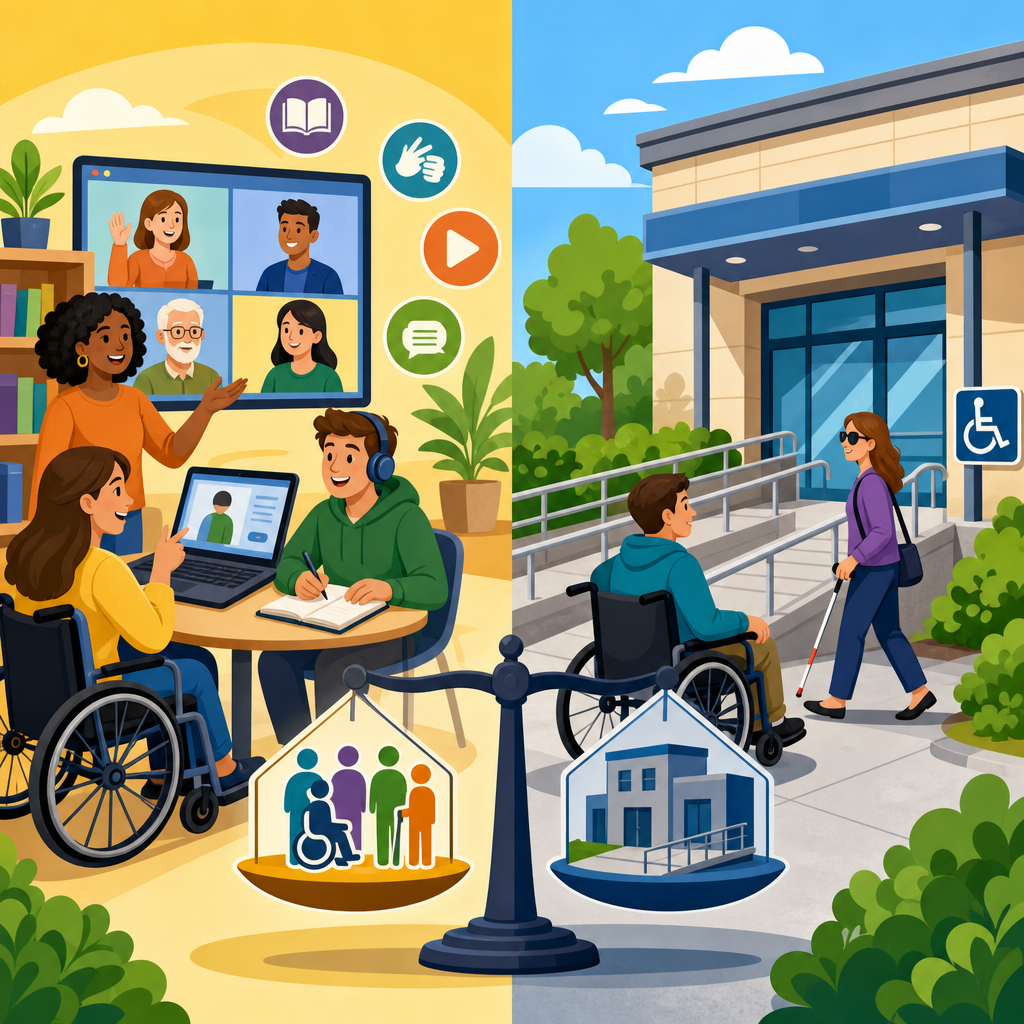
Program accessibility and facility accessibility are often treated as interchangeable, but in ADA compliance they describe different legal duties, different risk profiles, and different implementation strategies. Facility accessibility focuses on the built environment: entrances, routes, restrooms, counters, parking, signage, alarms, and other physical features measured against technical standards. Program accessibility focuses on whether people with disabilities can actually participate in a service, benefit, activity, or government function when viewed in its entirety. That distinction matters because an organization can occupy a building with barriers yet still meet some program obligations through alternative methods, while a beautiful, newly renovated facility can still fail if policies, communication, staffing, or digital workflows block access.
I have seen this confusion create expensive mistakes. Teams invest heavily in ramps, door hardware, and restroom alterations, then discover the bigger compliance gap was how appointments were scheduled, how auxiliary aids were provided, or how services were dispersed across inaccessible locations. The reverse also happens: leadership assumes a service is “accessible enough” because staff will help on request, while obvious architectural barriers continue to violate enforceable standards. For organizations working under the broader umbrella of advanced ADA compliance topics, understanding this distinction is foundational. It affects capital planning, transition planning, grievance procedures, digital accessibility coordination, policy drafting, procurement, and enforcement exposure under Titles II and III.
Program accessibility generally arises most clearly in Title II analysis for state and local governments, where services, programs, and activities must be accessible when viewed in their entirety. Facility accessibility is tied more directly to whether a site or element complies with design standards such as the 2010 ADA Standards for Accessible Design, often alongside the 2010 Standards, UFAS in limited legacy contexts, and related references like ICC A117.1 in building code practice. The concepts overlap, but they are not the same. This hub article explains the distinction, why it matters operationally, how compliance is evaluated, where organizations commonly fail, and which advanced ADA compliance topics should be linked and managed together as part of a mature implementation program.
What program accessibility means in practice
Program accessibility asks a practical question: can a person with a disability obtain the same public service, benefit, or participation opportunity with substantially equivalent effectiveness? Under Title II, public entities do not necessarily have to make every existing facility fully compliant in every detail, but they do need to ensure access to programs, services, and activities when viewed in their entirety. In practice, that means a city may deliver permitting services in one accessible office rather than every satellite office, a county may relocate a hearing to an accessible courtroom, or a parks department may provide accessible registration, communication, and participation options even while older structures are being upgraded over time.
This is not a loophole that excuses barriers. It is a systems-based duty. When I assess program accessibility, I review how the service is actually experienced from beginning to end: awareness, intake, transportation, arrival, wayfinding, communication, participation, payment, complaint handling, and emergency procedures. A program can fail even when the building passes a narrow architectural checklist. For example, a public health clinic may have compliant parking and toilets but still deny meaningful access if interpreters are not arranged promptly, online forms are incompatible with screen readers, or immunization events are routinely held in inaccessible temporary sites. Program accessibility therefore includes policies, staffing, scheduling, digital tools, and communication methods, not just real estate.
What facility accessibility covers and how it is measured
Facility accessibility is the physical side of compliance. It asks whether site features and building elements meet applicable technical and scoping requirements. Common review areas include accessible parking dimensions and signage, exterior routes, door maneuvering clearance, thresholds, ramps, elevators, toilet room layout, grab bar placement, sales and service counters, assembly seating, lodging features, detectable warnings, pool access, and communication elements such as visual alarms. For new construction and alterations, technical compliance is usually mandatory element by element. The analysis is less flexible than program accessibility because design standards are highly specific and measurable.
Real-world consequences are straightforward. If a renovated retail store installs a sales counter at the wrong height, that is not cured by telling customers to use another desk if one exists only occasionally. If a hotel renovation omits required accessible guest rooms, no policy workaround fixes the deficiency. Likewise, if an altered restroom lacks compliant turning space or improperly locates accessories, the violation exists even if staff are helpful. Facility accessibility failures are often visible, documentable, and easy for plaintiffs, consultants, building officials, and the Department of Justice to identify. They also compound operational issues, because staff improvisation is an unreliable substitute for accessible design.
Why the legal distinction changes compliance strategy
The difference between program accessibility and facility accessibility changes how organizations prioritize spending and corrective action. Public entities managing older building portfolios often need a transition plan that sequences structural changes while also using interim methods to maintain access. That might include relocating services, offering home visits, centralizing functions in accessible sites, improving transportation links, or deploying auxiliary aids. Private businesses, especially under Title III, generally have less flexibility because barrier removal, alterations, and new construction obligations are analyzed differently and are not framed around the “viewed in its entirety” concept in the same way.
Misunderstanding this point leads to poor governance. I have seen municipalities spend years debating isolated architectural fixes while failing to map where essential services are inaccessible today. I have also seen private operators cite program alternatives that may help customer service but do not eliminate obligations for accessible routes, restrooms, check-out counters, or lodging features. The right strategy starts with legal classification, then inventory, then risk ranking. You need to know which issues are technical design defects, which are service-delivery failures, which are communication barriers, and which involve overlapping duties. Only then can budgeting, scheduling, and internal accountability match the law.
Common scenarios where organizations get it wrong
The most common failure is assuming that an accessible entrance equals an accessible program. Consider a recreation department offering swim lessons in a building with a ramped entry but no accessible locker rooms, no pool lift, inaccessible registration software, and staff who do not know how to modify instruction for participants with disabilities. The facility may appear partly accessible, yet the program remains inaccessible. Another frequent error is overreliance on ad hoc assistance. Carrying someone up stairs, processing forms in the hallway, or asking a family member to interpret may seem helpful, but those practices often create dignity, safety, confidentiality, and liability problems.
Healthcare settings show the distinction clearly. An exam room may be inside an accessible clinic, but the program fails if there is no accessible medical diagnostic equipment, no transfer support process, and no effective communication for patients who are deaf, blind, or have cognitive disabilities. Higher education provides another example. A campus may renovate selected buildings and still fail if required classes, advising, and student services are routinely scheduled in inaccessible locations or if accommodations are handled inconsistently. Courts and enforcement agencies look beyond isolated fixes and ask whether people with disabilities have equal access in practice.
How to evaluate both types of accessibility together
The strongest compliance programs evaluate facilities and programs in one coordinated framework rather than in separate silos. Start with a service inventory: identify every public-facing program, customer journey, and critical operational function. Then map where each service occurs physically and digitally. Next, perform architectural surveys using the 2010 ADA Standards, state code overlays where applicable, and documented measurement protocols. In parallel, review policies on reasonable modifications, service animals, mobility devices, effective communication, web content, procurement, events, transportation, emergency management, and grievance resolution. Interview frontline staff and test actual transactions, not just spaces.
When I structure these reviews, I rank findings by user impact, legal exposure, frequency, and feasibility. An inaccessible council chamber, emergency shelter intake process, voting location, or hospital registration workflow demands immediate attention because the consequence of exclusion is high. Lower-priority items may still require remediation, but sequencing matters. Documentation also matters. A compliance file should show survey methods, photographs, measurements, policy review notes, complaints, temporary measures, capital estimates, and responsible owners. That record supports transition planning and shows good-faith implementation if a complaint arises.
| Issue | Program Accessibility Lens | Facility Accessibility Lens | Typical Fix |
|---|---|---|---|
| Public meeting held upstairs | Can attendees with disabilities participate equally? | Is there an accessible route, entrance, and seating area? | Relocate meeting immediately; remove route barriers permanently |
| Clinic exam services | Can patients receive equivalent care and communication? | Are exam rooms, scales, and routes physically compliant? | Acquire accessible equipment; train staff; correct room layouts |
| Library registration | Can users enroll online, by phone, or in person accessibly? | Is the service desk, entrance, and restroom compliant? | Fix digital forms and counters; adjust staffing workflow |
| Hotel check-in | Can guests complete the process independently and effectively? | Are parking, lobby routes, counters, and rooms compliant? | Lower counter section; improve reservation process; add room features |
Advanced ADA compliance topics this hub should connect
As a hub under compliance and implementation, this topic should connect several advanced ADA compliance topics because accessibility failures rarely exist in isolation. First, transition plans and self-evaluations are central for public entities. A strong transition plan identifies structural barriers, sets timelines, names responsible officials, and aligns capital projects with service priorities. Second, effective communication is inseparable from program accessibility. Auxiliary aids and services, captioning, qualified interpreters, accessible documents, and website conformance all determine whether a person can use the service even in a compliant building.
Third, policies on reasonable modifications, service animals, other power-driven mobility devices, and nondiscrimination in eligibility criteria directly affect program access. Fourth, digital accessibility must be linked, not treated as a separate web team issue, because appointments, payments, forms, maps, and notices now shape nearly every in-person service. Fifth, accessible procurement matters: if you buy kiosks, exam tables, voting machines, software, furniture, or door hardware without accessibility criteria, you lock in future barriers. Sixth, maintenance of accessible features is an implementation issue too. A compliant route blocked by storage, a broken lift, or a disabled automatic door opener can undo an otherwise sound design. Finally, grievance procedures, complaint data, and internal audits close the loop by turning recurring access problems into documented corrective action.
Implementation lessons for durable compliance
Durable compliance requires governance, not one-time remediation. Assign an ADA coordinator or equivalent lead with authority across facilities, operations, procurement, IT, communications, and training. Create standards for project design reviews so accessibility is checked at schematic design, construction documents, punch list, and post-occupancy, not just after complaints. Pair that with operational standards: interpreter scheduling timelines, accessible event protocols, alternate format production, relocation procedures for inaccessible spaces, and escalation paths when an accessible feature fails. The organizations that improve fastest are the ones that treat accessibility as a managed control environment.
Training must also be role-specific. Facilities staff need technical standards literacy. Frontline staff need to know how to respond to accommodation requests, interact respectfully, and avoid common mistakes such as requiring unnecessary documentation or steering people to inferior alternatives. Procurement teams need accessibility specifications and contract language. Leaders need dashboards showing unresolved barriers, complaint trends, and remediation progress. If you want this hub to support the broader compliance and implementation topic, that is the central message: facility accessibility and program accessibility are distinct, but effective compliance depends on managing them together through policy, design, operations, and accountability.
The critical takeaway is simple: facility accessibility asks whether the place is built correctly, while program accessibility asks whether the service actually works for people with disabilities. Confusing the two creates legal exposure, wasted capital, and preventable exclusion. Treating them as connected but separate duties leads to better audits, better planning, and better outcomes for users.
For public entities, program accessibility often shapes how services must be delivered across older buildings. For private operators, facility accessibility often drives immediate compliance for customer-facing spaces and altered elements. In both settings, communication access, policy design, digital workflows, staff training, and maintenance determine whether compliance holds up in daily operations. That is why advanced ADA compliance topics must be managed as one implementation system rather than a checklist owned by one department.
If you are building a serious compliance program, start by inventorying services, surveying facilities, reviewing policies, and ranking barriers by user impact and legal risk. Then connect this hub to deeper guidance on transition plans, effective communication, digital accessibility, procurement, medical equipment access, event accessibility, and grievance management. That work turns abstract compliance into reliable access people can trust.
Frequently Asked Questions
What is the difference between program accessibility and facility accessibility under the ADA?
Program accessibility and facility accessibility are related, but they are not the same legal concept. Facility accessibility refers to the physical condition of a site or building element. It looks at whether entrances, parking, routes, toilet rooms, service counters, signage, alarms, seating, and similar features comply with applicable accessibility standards. In other words, facility accessibility is about the built environment and whether physical barriers exist.
Program accessibility, by contrast, focuses on whether a person with a disability can actually access and participate in the service, benefit, activity, or program being offered. That analysis is broader than a checklist of architectural features. A program may be accessible through a combination of methods, including policy changes, reassignment of services to accessible locations, auxiliary aids, effective communication, or operational adjustments. The legal question is not limited to whether one room or one entrance meets technical specifications, but whether the program, when viewed in its entirety, is accessible to people with disabilities.
This distinction matters because many organizations mistakenly assume that if a building has some compliant features, then the ADA issue is resolved. It is not. A facility can include accessible design elements yet still fail to provide meaningful access to the actual program. The reverse can also be true in limited circumstances: a program may be delivered in an accessible manner even where an older facility has not been fully altered to current standards, depending on the title of the ADA involved and the nature of the entity’s obligations. The key point is that facility compliance and program access are separate inquiries, and organizations should assess both.
Why is it risky to treat program accessibility and facility accessibility as interchangeable?
Treating the two concepts as interchangeable creates legal and operational blind spots. When an organization focuses only on physical features, it may overlook barriers that prevent real participation. For example, a public meeting may be held in a technically accessible room, but if there is no sign language interpreter, no captioning, inaccessible registration procedures, or no accessible route to the speaker area, individuals with disabilities may still be excluded from the program. In that situation, the organization may have addressed parts of facility accessibility while failing the broader requirement of program accessibility.
The opposite misunderstanding is also risky. Some entities assume they can avoid addressing physical barriers simply by offering an alternative arrangement later or elsewhere. That assumption can be dangerous, especially where new construction, alterations, or specific architectural obligations apply. Technical standards for physical accessibility are enforceable, and relying on informal workarounds does not eliminate duties tied to the built environment.
From a risk-management perspective, confusing these duties often leads to fragmented compliance efforts. Facilities teams may concentrate on measurements and design standards, while program staff assume the building itself resolves access issues. Meanwhile, no one evaluates whether people with disabilities can register, communicate, navigate, participate, and receive benefits in practice. That gap is where complaints, investigations, litigation, and reputational harm often arise. Strong compliance programs treat facility accessibility and program accessibility as complementary, not interchangeable, and assign responsibility for both.
Can a program be accessible even if every part of a facility is not fully ADA compliant?
In some situations, yes, but the answer depends heavily on the type of entity, the age of the facility, whether alterations have occurred, and which ADA rules apply. Program accessibility is often evaluated by looking at the program or service as a whole rather than requiring every existing facility or every room to be fully accessible in identical ways. That means an organization may sometimes satisfy program access obligations by relocating a class, service, hearing, or activity to an accessible area, modifying policies, or using alternative delivery methods that provide equivalent access.
However, this does not mean physical accessibility can be ignored. If a facility has been newly constructed or altered, more specific technical compliance obligations usually apply. Likewise, inaccessible features such as entrances, toilet rooms, parking, service counters, or routes may still create independent compliance problems even if a temporary workaround allows some level of participation. Program accessibility is not a blanket excuse for architectural noncompliance, and an entity should be very cautious about assuming that an alternative arrangement fully resolves the issue.
The practical takeaway is that “accessible in practice” and “technically compliant facility” are related but distinct questions. A sound legal and operational strategy evaluates whether people with disabilities can participate now, while also identifying where physical barriers must be removed, altered, or corrected. Organizations should avoid relying on ad hoc solutions unless they have carefully assessed whether those solutions provide equal access, preserve dignity and independence, and satisfy the specific legal standards that govern the facility.
What are common examples of program accessibility problems that are not just building-design issues?
Many significant access failures arise from policies, procedures, communication practices, and service design rather than from walls, doors, or ramps. One common example is inaccessible communication. A person who is deaf or hard of hearing may be able to enter the building without difficulty, yet still be excluded from a meeting, medical appointment, classroom, or public event if qualified interpreting, captioning, assistive listening systems, or other appropriate auxiliary aids are not provided when needed.
Another frequent issue is inaccessible intake or registration. An organization may have an accessible front entrance but require forms that are not screen-reader compatible, use kiosks without tactile or speech output, or rely on phone-only systems that are difficult for people with speech or hearing disabilities to use. Scheduling procedures, eligibility rules, waitlist practices, and documentation requirements can also create program barriers when they are not designed with disability access in mind.
Staff practices are another major source of program-access problems. Employees may unintentionally deny access by refusing reasonable modifications, mishandling service animal issues, failing to assist with alternate formats, or directing individuals to separate services that are inferior or stigmatizing. Time-sensitive services can create further barriers when an organization says assistance is available “upon request” but has no real process to provide it promptly.
These examples show why program accessibility must be reviewed operationally, not just architecturally. The question is whether a person with a disability can obtain the same benefit, with comparable timeliness, privacy, independence, and effectiveness. If the answer is no, the problem may be a program accessibility failure even when the facility itself appears relatively accessible.
How should an organization evaluate compliance if it wants to address both program accessibility and facility accessibility effectively?
The most effective approach is to conduct two coordinated assessments rather than one narrow review. First, evaluate facility accessibility by examining the built environment against applicable standards and identifying barriers in parking, exterior routes, entrances, interior circulation, restrooms, service areas, alarms, signage, seating, and other physical features. This review should be systematic and documented, especially where alterations, capital planning, or remediation priorities are involved.
Second, evaluate program accessibility from the user’s perspective. Follow the entire experience of a person with a disability: finding information, registering, arriving, communicating with staff, navigating the space, participating in the activity, receiving materials, using restrooms and service points, and resolving problems if they arise. Review policies on reasonable modifications, service animals, auxiliary aids, digital access, emergency procedures, and complaint handling. Interview frontline staff and, where possible, involve people with disabilities in testing or feedback.
It is also important to assign ownership clearly. Facilities, operations, legal, HR, IT, communications, and program leadership all influence accessibility, and compliance gaps often occur where responsibility is diffuse. A written accessibility plan should prioritize immediate barriers, define longer-term capital improvements, establish response procedures for accommodation requests, and include training so staff understand the difference between physical compliance and meaningful program access.
Ultimately, strong compliance is not just about avoiding technical violations. It is about ensuring that people with disabilities can participate fully, safely, effectively, and with dignity. Organizations that understand the distinction between program accessibility and facility accessibility are better positioned to reduce legal exposure, improve service delivery, and create genuinely inclusive experiences.