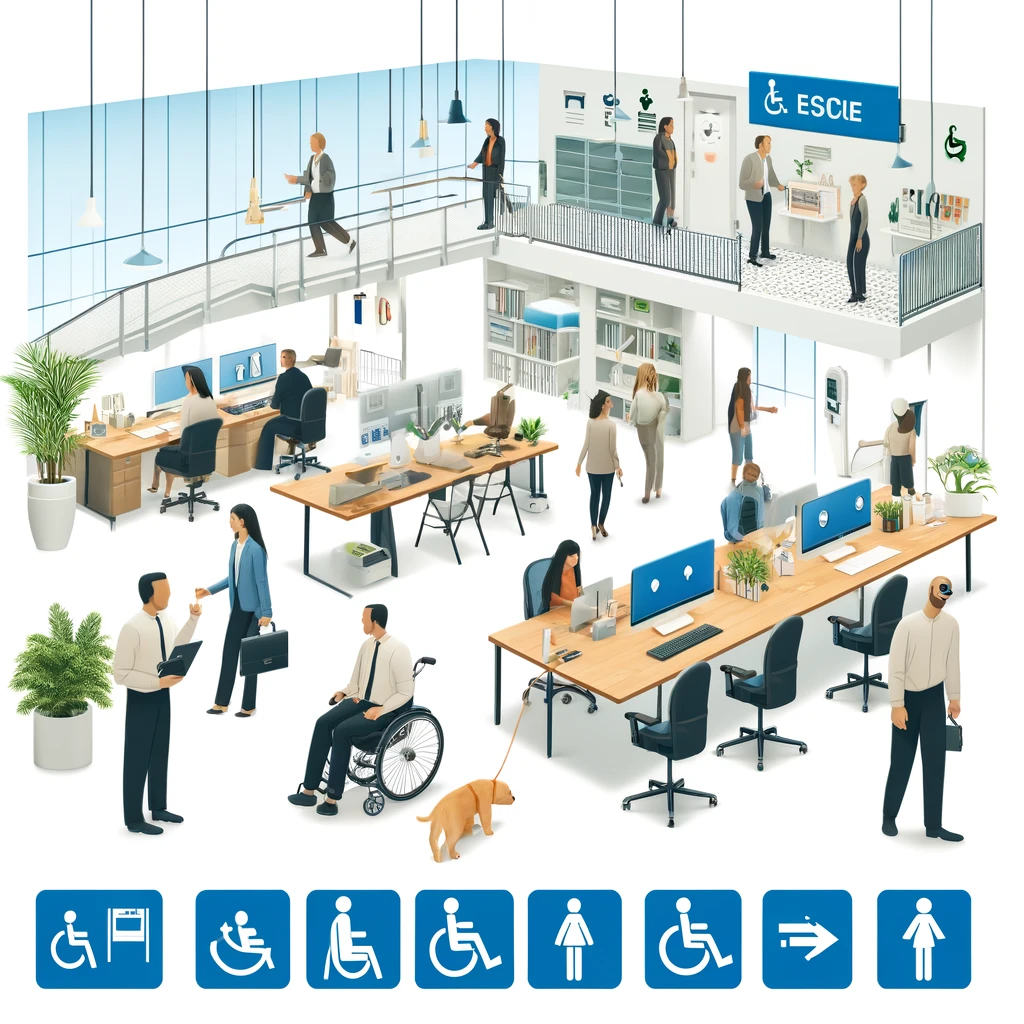
Equivalent facilitation is one of the most misunderstood concepts in advanced ADA compliance. In practice, it does not mean “different but good enough,” and it never authorizes a lower level of access for disabled people. It means using an alternative design, technology, policy, or process that provides substantially equivalent or greater usability, safety, independence, and dignity than the prescriptive requirement it replaces. I have seen organizations treat equivalent facilitation as a shortcut when budgets tighten or legacy systems resist change. That is exactly how new legal, operational, and reputational risk gets created. Used correctly, however, equivalent facilitation is a disciplined compliance strategy that solves real constraints while preserving access.
Under the Americans with Disabilities Act, the concept appears most clearly in the 2010 ADA Standards for Accessible Design, which allow departures from specific technical or scoping requirements where equivalent facilitation is provided. The key idea is outcome, not imitation. If a standard requires one accessible route, communication method, control interface, or service practice, an alternative may be acceptable only when disabled users can obtain the same practical benefit in a comparable way. Comparable is doing heavy work here. A workaround that requires staff intervention, longer wait times, extra disclosures of disability, or reduced privacy is often not equivalent, even if it appears functional on paper.
This matters because modern compliance programs extend beyond ramps, door widths, and restroom clearances. They include kiosks, mobile apps, digital forms, reservation systems, call centers, emergency communications, workplace tools, and hybrid service models that combine physical and digital touchpoints. In each of these environments, teams face constraints: historic buildings, leased spaces, proprietary software, vendor platforms, security controls, and operational realities. Equivalent facilitation can help bridge those gaps, but only when decisions are documented, user-tested, and tied to established standards such as the ADA Standards, WCAG 2.2, Section 508 guidance, and, in some settings, applicable state and local code requirements. This hub explains how to apply equivalent facilitation without creating new risk across advanced ADA compliance topics.
What equivalent facilitation actually requires
The safest way to understand equivalent facilitation is as a burden of proof on the organization proposing the alternative. You must be able to explain what requirement is being addressed, why the standard approach is not being used, what alternative is offered, and how you verified that the alternative delivers equal or better access. In reviews I have led, the strongest decisions begin with a precise compliance map: the citation, the affected user groups, the task being completed, the expected level of independence, and the failure consequences if the alternative does not work. Without that structure, teams tend to approve creative ideas that feel inclusive but collapse under real use.
Three tests are especially useful. First, task completion: can the person finish the same task from start to finish? Second, condition parity: can they do so with similar time, privacy, effort, and reliability? Third, contingency resilience: what happens when staff are busy, the network is down, or the assistive feature fails? A staffed side entrance instead of an accessible main entrance often fails the second and third tests because it depends on employee availability and can stigmatize the user. By contrast, a properly designed visual communication system that supplements an audible announcement may satisfy equivalent facilitation because it improves access for multiple groups without reducing independence.
Equivalent facilitation is also not the same as reasonable modification, auxiliary aids and services, or temporary manual assistance, although these may overlap operationally. A sign saying “ask for help” is rarely a robust equivalent. A policy that requires a disabled customer to call ahead may solve staffing convenience, but it usually imposes unequal conditions. The practical rule is simple: if the alternative shifts friction, delay, or disclosure onto the disabled user, risk is increasing, not decreasing.
Where organizations create new risk
Most failures come from treating equivalent facilitation as an exception rather than a controlled design method. One common mistake is substituting human assistance for accessible design. For example, a touchscreen check-in kiosk without tactile controls, screen-reader support, headphone output, or adjustable timing cannot be made equivalent merely by placing an employee nearby. Staff may help during peak periods, but users lose privacy when entering medical information, and service quality varies with training and turnover. Another mistake is fragmented access. A retailer may make product browsing accessible in its app but route coupon redemption through an inaccessible point-of-sale device. The customer technically can shop, but not on equal terms.
Risk also appears when teams ignore interacting standards. A facility group may solve a physical access issue while creating communication barriers, or a digital team may meet interface criteria while breaking procurement, privacy, or security obligations. I have seen multifactor authentication tools selected for cybersecurity strength alone, only to block screen-reader users and customers without smartphones. The fix was not to waive security; it was to support accessible passkeys, TOTP apps with labeled fields, hardware security keys, and backup verification channels that did not depend solely on vision, hearing, or fine motor control.
| Scenario | Common “Alternative” | Why Risk Increases | Lower-Risk Equivalent Approach |
|---|---|---|---|
| Inaccessible self-service kiosk | Staff member enters data for customer | Loss of privacy, inconsistent availability, slower service | Accessible kiosk interface plus staffed backup for exceptions |
| Historic building entrance barrier | Use side door and ring bell | Segregation, delay, dependency on staff | Integrated accessible route where feasible, equal signage, reliable automated entry |
| Video-only customer support | No captions; offer transcript on request | Delayed access, incomplete communication, extra burden | Live captions, transcript, chat, and voice options by default |
| Mobile app with inaccessible MFA | Call center override after lockout | Account friction, security exposure, long wait times | Accessible authentication choices built into primary flow |
Applying equivalent facilitation in buildings, facilities, and public accommodations
In the built environment, equivalent facilitation must be handled conservatively because many ADA Standards are dimensional and safety-critical. Door maneuvering clearances, turning space, reach ranges, signage, alarms, assembly seating, and toilet room elements are not areas for casual improvisation. Yet complex projects do create legitimate design conflicts. Historic properties are the classic example. When original features cannot be altered without destroying significance, teams may propose alternative routes, lifts, or service configurations. The correct question is not whether any access exists. It is whether the alternative preserves equivalent participation in the same program, with comparable convenience, visibility, and dignity.
Consider a museum in a landmark building where a grand stair connects the primary galleries. Installing a ramp at that location may be structurally impossible, but the museum may still create lower-risk equivalent facilitation by providing an integrated elevator route near the main entrance, synchronized wayfinding, exhibit access on identical schedules, and staff protocols that do not single out wheelchair users. If the elevator opens into a service corridor or requires special escort, the experience is no longer equivalent. Similarly, in restaurants and hotels, dispersal matters. One accessible table hidden at the back is not equivalent to regular patron choice. Accessible guest rooms clustered in one room type or price band also raise risk if they limit inventory and user autonomy.
Maintenance is another overlooked issue. An accessible route that exists only when furniture stays in place, snow is cleared, or automatic doors are repaired is not a stable equivalent. Organizations should treat maintenance logs, inspection intervals, and rapid-response repair processes as part of compliance evidence. DOJ enforcement patterns and settlement agreements repeatedly show that inaccessible conditions are judged not only by design intent but by operational reliability.
Applying equivalent facilitation in websites, apps, and digital services
Digital environments tempt teams to improvise because software changes quickly and formal ADA web regulations remain less prescriptive than building standards. But the risk logic is the same. An alternative interaction can satisfy equivalent facilitation only if it supports the same user goal with comparable independence and efficiency. In web and app work, WCAG 2.2 Level AA is the dominant baseline for evaluating that outcome. If you depart from a standard pattern, you need evidence that your pattern still supports perceivable content, operable controls, understandable flows, and robust compatibility with assistive technologies.
A practical example is drag-and-drop interaction. Some applications use drag-and-drop for scheduling, dashboards, or file organization. That can be acceptable if users also have a fully supported keyboard method, clear focus management, status announcements for screen readers, and error recovery. Without those, saying users can email support to rearrange items is not equivalent. Another example is image-based verification. If a fraud-control tool depends on selecting pictures and offers no accessible alternative that is equally available and secure, risk is immediate. Audio CAPTCHAs alone are often insufficient because they can be unusable in noisy environments and difficult for users with cognitive or hearing-related needs. Better options include risk-based authentication, email links, passkeys, or accessible challenge flows.
Documents, forms, and transactional journeys deserve special attention. A compliant homepage does little if tax forms are untagged PDFs, consent screens trap keyboard focus, or checkout timers expire before users can review content. In implementation, I advise teams to test critical tasks end to end: create an account, recover credentials, apply a discount, upload a file, sign electronically, and get confirmation. Equivalent facilitation fails most often in these high-friction sequences, not on marketing pages.
Governance, documentation, and testing that reduce exposure
The strongest equivalent facilitation decisions are made through governance, not intuition. Start with a written decision record. Identify the applicable requirement, the proposed deviation, the business or technical constraint, the user groups affected, the alternative provided, the standards used to evaluate it, and the sign-off owners from compliance, legal, operations, design, and engineering. This is not bureaucracy for its own sake. When a complaint, audit, procurement review, or demand letter arrives, your organization needs a contemporaneous record showing that access was analyzed methodically rather than improvised after the fact.
Testing should combine expert review and disabled user validation. Automated accessibility scanners such as axe, WAVE, or Accessibility Insights are useful for detecting code-level issues, but they cannot determine whether an alternative delivers equal privacy, timing, or task success. For facilities, measure actual routes, observe peak-time operations, and test alarms, doors, counters, and service procedures. For digital systems, run keyboard-only, screen-reader, zoom, speech input, color contrast, and mobile orientation tests. Include users with varied disabilities because one “accessible” path can work for blind users and fail for people with low vision, limited dexterity, deafness, cognitive disabilities, or photosensitivity.
Vendor management is equally important. Many high-risk failures enter through procurement: kiosks, HR systems, payment terminals, learning platforms, visitor management tools, and telehealth products. Contract language should require conformance evidence, remediation timelines, testing cooperation, indemnity where appropriate, and notice before material interface changes. A VPAT can help start the conversation, but it is not proof of accessibility and definitely not proof of equivalent facilitation. Verification must happen in your implementation context.
Building a hub strategy for advanced ADA compliance topics
As the hub page for advanced ADA compliance topics within compliance and implementation, this article should connect readers to deeper guidance on adjacent issues that commonly intersect with equivalent facilitation. Those issues include accessible procurement, kiosk accessibility, mobile app compliance, reservation systems, PDF remediation, accessible authentication, effective communication, service animal policies, maintenance obligations, historic property constraints, employee accommodations, and complaint response procedures. The reason to organize the topic this way is practical: equivalent facilitation decisions rarely live in one department. They span facilities, digital, legal, customer experience, procurement, and frontline operations.
The main benefit of a hub approach is consistency. Instead of allowing each team to invent its own exceptions, the organization can define shared criteria for when alternatives are acceptable, who approves them, how they are tested, and what evidence must be retained. That lowers risk because recurring patterns become predictable. If your team is implementing a new service, start with the primary standard, use equivalent facilitation only when necessary, test the real user journey, and document why the result is equal or better. Do that consistently, and advanced ADA compliance becomes more than a defensive exercise; it becomes a repeatable implementation discipline. Review your highest-friction journeys now, identify any “ask for help” substitutes, and replace them with access that truly stands on equal terms.
Frequently Asked Questions
What does equivalent facilitation actually mean in ADA compliance?
Equivalent facilitation means meeting the underlying accessibility objective through a different method than the one specifically described in a technical standard, without reducing access. In other words, it is not a loophole, a waiver, or permission to provide a second-tier experience. It is an alternative design, technology, policy, or operational approach that delivers substantially equivalent or greater usability, safety, independence, privacy, and dignity for people with disabilities. That distinction matters because many compliance failures happen when organizations focus on whether the alternative looks innovative or costs less, rather than whether it truly preserves the full value of access.
A useful way to think about equivalent facilitation is to ask what problem the original requirement was intended to solve. If a prescriptive standard exists to ensure a person can enter, navigate, communicate, operate, or participate without unnecessary barriers, then any substitute must accomplish that same result at least as well in real-world conditions. The comparison is not abstract. It should account for actual users, actual settings, and actual consequences. If the alternative introduces delay, dependency on staff, social stigma, avoidable safety concerns, or inferior functionality, it is unlikely to qualify as equivalent facilitation even if it appears technically creative.
This is why “different but good enough” is the wrong standard. ADA access is not satisfied by offering disabled users a workaround that is slower, more complicated, or available only on request. True equivalent facilitation maintains meaningful equality of use. It should enable a person with a disability to accomplish the same task with a similar degree of autonomy and reliability as others, and in some cases the alternative may even outperform the prescriptive option. The legal and practical test is not whether the organization prefers the alternative, but whether the person receiving the accommodation or accessible feature is being served at an equivalent or better level.
When does equivalent facilitation create new risk instead of solving an accessibility problem?
Equivalent facilitation creates new risk when it is treated as a shortcut rather than a carefully validated accessibility strategy. The biggest warning sign is when the proposed alternative shifts burden onto the disabled person. If someone must call ahead, wait for staff assistance, use a separate entrance, accept reduced hours, disclose disability information unnecessarily, or navigate a more complicated process than everyone else, the organization may have replaced one barrier with several new ones. In those cases, the risk is not only legal. It is also operational, reputational, and human.
Another common risk appears when an organization evaluates equivalence too narrowly. For example, a team may compare only whether a user can technically complete a task, while ignoring whether the process is safe, private, intuitive, and dependable. An alternative may seem compliant on paper yet fail in practice because it depends on staffing that is inconsistent, technology that is unreliable, or policies that front-line employees do not understand. A solution is not truly equivalent if it works only under ideal conditions. Accessibility must hold up during busy periods, after hours, during emergencies, and when the specific employee who “knows the workaround” is not available.
New risk also arises when equivalent facilitation is adopted without documentation, testing, or accountability. If there is no record of why the alternative was chosen, what standard it is replacing, how equivalence was evaluated, and how performance will be monitored, the organization is left exposed. It becomes difficult to defend the decision, difficult to train staff, and difficult to detect failure before a complaint or incident occurs. In practice, the safest approach is to assume that every alternative method must be proven, not merely asserted. That means assessing usability across disability groups, verifying reliability, and revisiting the solution over time as technology, user expectations, and site conditions change.
How can you tell whether an alternative provides substantially equivalent access?
The best way to evaluate substantial equivalence is to compare the user experience end to end, not just the visible feature. Start by identifying what the prescriptive requirement is designed to achieve. Then test whether the alternative delivers the same or better result across the factors that matter most: usability, timeliness, safety, independence, dignity, privacy, reliability, and consistency. If the original requirement allows a person to complete a task immediately and privately, an alternative that requires staff intervention or waiting time may fail even if the task can eventually be completed.
A strong evaluation also considers a wide range of users and use cases. Equivalent facilitation should not work only for one disability category while disadvantaging another. It should be assessed by people who understand functional accessibility and, whenever possible, by disabled users themselves. Real-world testing is especially important because many alternatives seem acceptable in theory but break down under ordinary conditions. Lighting, noise, internet connectivity, queue length, weather, maintenance gaps, and employee turnover can all affect whether an alternative remains substantially equivalent in practice.
Documentation is part of the answer as well. Organizations should be able to show what requirement is being replaced, why the alternative was selected, what evidence supports equivalence, what limitations were considered, and what corrective steps will be taken if the solution underperforms. This turns equivalent facilitation from an ad hoc judgment into a defensible compliance decision. If the alternative cannot be explained clearly and supported with evidence, that uncertainty itself is a sign the organization may not have reached true equivalence. The goal is not to justify a deviation after the fact. The goal is to demonstrate, before implementation, that the disabled user is not receiving less.
What are the most common mistakes organizations make when using equivalent facilitation?
The most common mistake is using equivalent facilitation as a justification for not following a clear accessibility requirement when the real motivation is cost, convenience, design preference, or schedule pressure. That is backwards. Equivalent facilitation is not meant to dilute compliance obligations. It is meant to preserve or improve access through a different means. When teams begin with the question, “How can we avoid the standard?” instead of, “How can we achieve equal or better access?” they often produce alternatives that are weaker, harder to maintain, and more likely to fail.
A second major mistake is relying on staff assistance as the default substitute for independent access. Staff can play an important role in accessibility, but human help is rarely equivalent to a feature or process that a person can use independently, on demand, and without explanation. Assistance may introduce delays, inconsistency, loss of privacy, and embarrassment. It can also collapse entirely during peak demand, understaffing, or turnover. If the alternative depends on employees always being present, trained, and responsive, that dependency must be treated as a serious risk factor, not ignored.
Organizations also make the mistake of evaluating alternatives once and then assuming they remain compliant forever. In reality, an equivalent facilitation strategy can deteriorate over time. Software updates break accessibility features. Equipment falls out of calibration. Policies stop being followed. Signage disappears. Contractors change. A process that once worked reasonably well may become unreliable or exclusionary if no one is monitoring performance. That is why governance matters. Equivalent facilitation should include ownership, maintenance procedures, staff training, periodic review, and a mechanism for users to report barriers quickly.
Finally, many teams fail to account for dignity and social experience. Accessibility is not only about whether a task can be completed. It is also about whether the person can participate in a way that respects autonomy and avoids unnecessary separation or stigma. A separate service channel, side entrance, or “special procedure” may be lawful only in very limited circumstances and often signals that the alternative is not truly equivalent. If a non-disabled person receives convenience, speed, privacy, and normalcy while a disabled person receives delay, exposure, or dependence, the organization should assume it has more work to do.
What is the safest way to apply equivalent facilitation without increasing legal, operational, or reputational risk?
The safest approach is disciplined, evidence-based decision making. Begin by identifying the exact prescriptive requirement at issue and the access objective behind it. Then define the proposed alternative in concrete terms: what it is, who will use it, how it will function, what dependencies it has, and what user outcomes it is supposed to achieve. From there, compare the alternative against the original requirement across the full accessibility spectrum, including ease of use, timeliness, safety, privacy, independence, reliability, and dignity. If any of those dimensions are weaker, the organization should hesitate before calling the solution equivalent.
Next, validate the alternative in real conditions. That means involving accessibility specialists, operational stakeholders, and disabled users where possible. Pilot testing is often valuable because it reveals failure points that conference-room discussions miss. The organization should ask practical questions: Will this still work after hours? During emergencies? When internet service is degraded? When the facility is crowded? When the trained staff member is absent? If the answer depends on ideal circumstances, the risk profile is too high. Equivalent facilitation should be resilient, not fragile.
Formal documentation is another key safeguard. Create a written record that explains the rationale, the comparative analysis, the testing performed, the residual risks identified, and the maintenance or training steps required. This not only supports legal defensibility, but also helps operations teams sustain the solution over time. Assign ownership so someone is accountable for monitoring complaints, reviewing effectiveness, and making corrections quickly. A good equivalent facilitation decision is never “set it and forget it.” It is managed like any other critical accessibility control.
Finally, keep the standard high