Ramp slope, rise, and landing rules determine whether an accessible route is safe, legal, and usable for people who rely on wheelchairs, walkers, scooters, canes, and other mobility aids. In the ADA Accessibility Standards, Chapter 4 covers accessible routes, and ramps are one of the most scrutinized elements because small design errors create major barriers. I have reviewed ramp plans, measured built work in the field, and seen the same problems repeatedly: slopes that look gentle but exceed limits, landings shortened by door swings, and cross slopes that force wheelchair users to drift sideways. Understanding the basic terms is the first step. Slope describes steepness, usually expressed as a ratio such as 1:12, meaning one inch of vertical rise for every twelve inches of run. Rise is the total vertical height a ramp segment climbs. A landing is a level area at the top, bottom, or change in direction that allows resting, maneuvering, and door operation. These rules matter because they connect compliance to real movement. A ramp that technically reaches the entrance but requires excessive force, offers no resting space, or funnels a user into a door closer has failed its purpose. Chapter 4 matters beyond standalone ramps, too. It governs the continuity of accessible routes through sites, parking access aisles, curb ramps, building entrances, interior circulation, and level changes. For owners, designers, contractors, and facility managers, mastering these requirements reduces change orders, inspection failures, injury risk, and costly retrofits.
What Chapter 4 Requires for Accessible Routes
Chapter 4 establishes that an accessible route must connect all required accessible spaces and elements. In practice, that means people using mobility devices should be able to move from site arrival points, parking, public sidewalks, transit stops, and passenger loading zones to entrances, then through the building to the spaces everyone else uses. An accessible route can include walking surfaces, doors, ramps, curb ramps excluding stair alternatives, elevators, and platform lifts where permitted. It cannot rely on stairs, abrupt level changes, or paths narrowed by protruding objects and poor door clearances. The route must meet width, passing, turning, slope, cross slope, headroom, surface, and maneuvering requirements as a system, not as isolated parts.
A key practical point is that ramps are only one component of compliant circulation. I often see teams focus on the ramp ratio and miss the route leading to it. If the sidewalk approaching the ramp is too narrow, if a gate latch requires tight grasping and twisting, or if the landing is interrupted by a threshold, the route still fails. The standards are designed this way because users experience the full journey, not a detail on one sheet. For a Chapter 4 hub page, the central principle is continuity: every segment must work together from origin to destination.
Ramp Slope Rules: What 1:12 Really Means
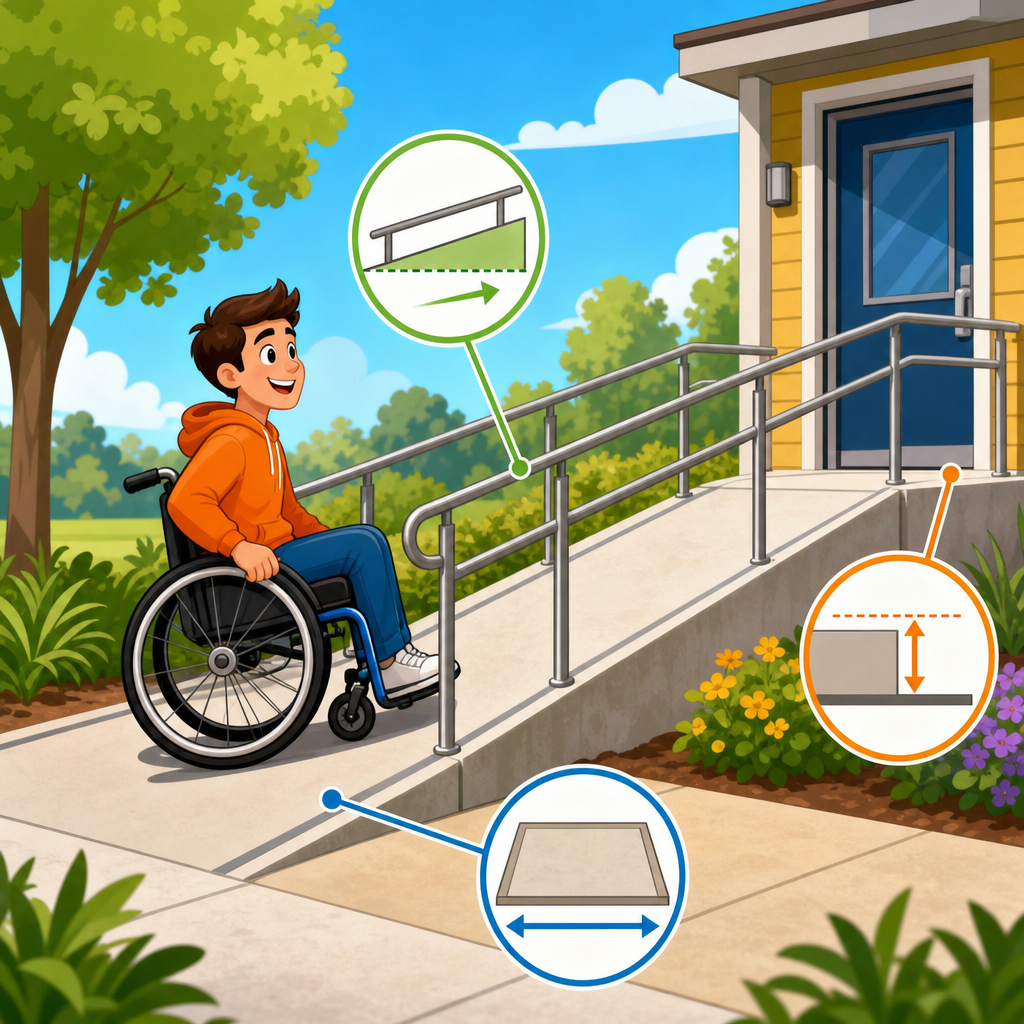
The maximum running slope for a ramp on an accessible route is 1:12. That is the headline rule most people know, but it is often misunderstood in construction. A 1:12 slope means for every inch of vertical rise, you need at least twelve inches of horizontal run. If a ramp rises 30 inches, its run must be at least 30 feet. Steeper than that is not compliant. Gentler is allowed and usually better for usability. Many experienced designers target slightly flatter field conditions, such as around 1:13 or 1:14, because finish tolerances, settlement, or paving variation can push a nominal 1:12 design over the limit after installation.
Cross slope matters just as much. Ramp runs and landings generally cannot exceed a cross slope of 1:48. Excessive cross slope makes drainage easier for the contractor, but it forces wheelchair users to countersteer and increases the chance of rolling sideways. Outdoor projects frequently fail here because crews shape concrete by eye. On renovation work, I always recommend digital levels, smart levels, or calibrated slope meters rather than relying on tape and framing square checks alone. Inspecting only the centerline is not enough; measure both edges and the likely path of travel.
There are limited exceptions elsewhere in the standards for existing site constraints, but as a general rule for new construction and alterations, 1:12 is the governing ramp slope. This is also where route planning becomes strategic. If there is not enough space for a compliant run, the answer is not to steepen the ramp. The correct response is to regrade the site, add switchbacks, relocate the entrance route, or use an elevator or lift where allowed.
Maximum Rise and When Landings Are Required
The maximum rise for any single ramp run is 30 inches. After 30 inches of rise, a level landing is required before the route continues. This rule limits user exertion and creates predictable stopping points. In real projects, the 30 inch limit affects both geometry and sequencing. A total elevation change of 42 inches, for example, cannot be solved with one continuous run, even if enough horizontal distance exists. It needs at least two runs separated by a landing.
Landings are required at the top and bottom of each ramp run, and wherever the ramp changes direction. The standard minimum landing size is typically 60 inches long, and the width must be at least as wide as the ramp run leading to it. Direction changes require enough clear space for turning and alignment. A switchback ramp that technically provides the 60 inch dimensions can still be awkward if handrails, curbs, or door projections pinch the turning movement. This is where field experience matters: users need a stable, level place to pause, reposition, and continue safely, especially on longer outdoor routes exposed to rain, snow, and wind.
Another issue is landing slope. A landing is not merely flatter than the ramp; it must be level within the permitted cross slope and running slope tolerances, generally not steeper than 1:48 in any direction. I have seen crews pour a landing with enough fall to drain water quickly, only to create a surface that causes mobility devices to drift. Drainage must be solved without sacrificing level maneuvering space. Trench drains, careful grading away from the route, and better site water management are usually more reliable solutions.
Required Dimensions, Handrails, and Edge Protection
Clear width is fundamental. A ramp run must provide at least 36 inches clear between handrails where handrails are required. If the route narrows at rail brackets or flares into walls and landscaping, the user still experiences the narrowest point. Handrails are required on both sides of ramp runs with a rise greater than 6 inches. They must be continuous for the full length of the run, with gripping surfaces that meet dimension and clearance rules. In practice, inconsistent extensions, oversized decorative profiles, and interrupted rails at intermediate posts are common noncompliance issues.
Edge protection is required so wheels, crutch tips, and canes do not slip off the ramp. This may be provided with a curb, barrier, or an extended floor or ground surface beyond the rail, depending on configuration. Outdoor concrete ramps often use a 2 inch curb. Open-sided metal ramps may use toe plates or barriers integrated into the guard and rail assembly. The method matters less than the function: prevent drop-off hazards without reducing usable width or creating snag points.
Surface quality also belongs in this discussion. Accessible routes must be stable, firm, and slip resistant in practical performance. The standards do not assign one universal coefficient for every circumstance, but polished stone in a wet exterior approach, loose unit pavers with uneven joints, or patched asphalt with rutting are predictable failures. Good ramp design pairs geometry with maintainable materials. Broom-finished concrete, well-installed asphalt, or textured metal systems can work if joints, drainage, and seasonal maintenance are handled properly.
Doors, Landings, and Maneuvering Space Conflicts
One of the most frequent Chapter 4 mistakes is treating the ramp landing at a door as if it only needs to satisfy ramp geometry. It also has to satisfy door maneuvering clearances. If a door swings onto the required landing, the user needs adequate level space to stop, operate the hardware, and move clear of the swing. A landing that is 60 inches deep but partially consumed by a closer arm, wall return, or gate leaf may not work. This is especially critical at exterior entries with vestibules, security gates, and intercom posts.
I have seen projects pass rough inspection and then fail final review because added features crowded the clearances. A package locker, bollard, card reader pedestal, or planter can ruin an otherwise compliant route. The safest approach is to coordinate the entry sequence early: route width, landing depth, door swing, threshold height, hardware reach range, weather protection, and lighting should be reviewed together. When automatic operators are installed, they help usability, but they do not automatically cure poor landing geometry. The required clear floor space and approach still matter.
| Ramp Element | Core Rule | Common Field Problem | Practical Fix |
|---|---|---|---|
| Running slope | Maximum 1:12 | Finish grading makes ramp steeper than plan | Design slightly flatter and verify after paving |
| Rise per run | Maximum 30 inches | Single run used for total elevation change | Add intermediate landing and second run |
| Landings | Level, minimum 60 inches long | Drainage pitch exceeds allowed slope | Use trench drains and regrade adjacent surfaces |
| Handrails | Both sides when rise exceeds 6 inches | Decorative rails break continuity | Use compliant gripping surfaces and extensions |
| Door interface | Landing must also meet maneuvering clearance | Door swing or hardware blocks clear space | Coordinate door details with ramp layout early |
Curb Ramps, Transitions, and Site Route Connections
Curb ramps are part of the Chapter 4 conversation because they connect pedestrian routes across vehicular edges and grade breaks. Their geometry differs from a long building ramp, but the same logic applies: users need a safe, direct, stable transition. A curb ramp cannot be dropped randomly into a parking lot or angled into traffic without regard to the route alignment. Detectable warning surfaces, landing conditions at the top, side flare treatment, and the connection to the crosswalk all affect usability. The best curb ramp is aligned with the crossing direction and lands the user where they expect to travel, not into the turning path of cars.
Transitions also matter at thresholds, gutters, expansion joints, and changes in material. The standards limit vertical changes in level and require beveled treatment when the change exceeds a small amount. In the field, this is where many accessible routes degrade over time. Sealant failures, settlement at utility cuts, or repaving overlays create lips that were not present at turnover. Facility managers should include route inspections in preventive maintenance, especially after winter freeze-thaw cycles or utility work. Compliance is not a one-time design event; it is an ongoing operational responsibility.
Alterations, Existing Conditions, and Best Practices for Compliance
Existing buildings and sites are where Chapter 4 becomes nuanced. Space constraints, historic fabric, retaining walls, underground utilities, and structural limits can complicate full compliance. Even so, the standards do not permit casual shortcuts. In alterations, the design team should document existing conditions carefully, identify the primary accessible route obligations, and evaluate whether regrading, selective demolition, route relocation, or vertical access equipment can provide compliance more effectively than forcing a compromised ramp into a tight footprint. On several renovation projects, moving the accessible entrance to the same entrance used by most visitors solved multiple issues at once and improved dignity as well as code performance.
Best practice is straightforward. Survey with accurate elevations, not assumptions. Model slopes and landings in detail. Coordinate civil, architectural, structural, and door hardware drawings. Specify field verification before rail fabrication. Require mockups or hold points for critical exterior concrete. Use the 2010 ADA Standards together with applicable building code provisions, including ICC A117.1 where adopted, because local enforcement often references both. For owners managing portfolios, create a route audit checklist that covers width, slope, rise, landing levelness, handrails, edge protection, doors, signage, and maintenance conditions.
Ramp slope, rise, and landing rules are the backbone of a usable accessible route because they translate legal standards into everyday movement. The core requirements are consistent: keep ramp runs no steeper than 1:12, limit each run to 30 inches of rise, provide level landings at top, bottom, and direction changes, maintain proper width, add compliant handrails when required, protect edges, and coordinate every ramp with the doors and paths it serves. Chapter 4 is broader than ramps alone, but ramps are where route continuity is most visible and most likely to break down. Small dimensional errors create real barriers, while careful planning creates independence and safety.
If you are using this page as your hub for Chapter 4: Accessible Routes, treat it as the starting point for every related detail review on site circulation, curb ramps, entrances, doors, level changes, and route maintenance. Measure existing conditions, compare them to the governing standards, and correct problems before they become complaints, failed inspections, or access barriers. A compliant ramp is not just a drawing requirement. It is a reliable path that lets people arrive, enter, and move through a place with confidence.
Frequently Asked Questions
What is the maximum ADA ramp slope, and how is it measured?
The maximum running slope for most accessible ramps is 1:12, which means for every 1 inch of vertical rise, the ramp must provide at least 12 inches of horizontal run. Put another way, that is about 8.33 percent. This is one of the most important ramp rules because it directly affects whether a person using a wheelchair, scooter, walker, or cane can travel the route safely and independently. A ramp that seems only slightly too steep can become exhausting, unstable, or even dangerous in real-world use.
It is also important to understand that slope is measured along the direction of travel, not just by looking at the overall geometry from a distance. In field reviews, a ramp may appear compliant at first glance, but when measured with a digital level or other accurate tool, it can exceed the allowed running slope in one or more segments. That is a common problem with poured concrete and site-built work, especially where transitions were not laid out carefully.
In addition to running slope, cross slope matters. The surface should not tilt excessively from side to side, because side slope can pull wheelchairs off line, create instability for people using canes or walkers, and increase fall risk in wet conditions. Ramp design is not just about one number; it is about the complete travel surface working together as a usable accessible route. Good practice also means checking the bottom transition, the ramp run itself, and the top landing, since many compliance issues occur at those connection points rather than in the middle of the ramp.
How much rise can a ramp have before a landing is required?
A ramp run cannot rise indefinitely. Under ADA ramp criteria, a single run can have a maximum rise of 30 inches before a landing is required. This rule is essential because long uninterrupted ramps can become difficult to navigate, especially for people who self-propel manual wheelchairs or have limited stamina, balance, or lower-body strength. Landings break the route into manageable sections and provide a place to rest, reorient, and safely change direction when needed.
If the total elevation change on a project is greater than 30 inches, the ramp must be divided into multiple runs with level landings between them. Designers sometimes focus on overall length and forget that rise limits apply to each individual run. For example, even if the overall route technically fits on a site, a run that exceeds the rise limit is still noncompliant. In practice, this often happens when someone is trying to save space and stretches the tolerances too far.
The landing is not a decorative extra or a convenience item; it is a required usability feature. A properly sized and level landing gives a wheelchair user room to pause without rolling backward, allows someone using a walker to regain stability, and creates a safer condition at doors, turns, and transitions. When evaluating ramps in the field, it is common to find that the ramp slope itself was considered, but the rise between landings was not carefully verified. That kind of oversight can force an otherwise well-built accessible route out of compliance.
What are the ADA landing requirements for ramps?
Ramp landings must be level, stable, and large enough to serve the movement that occurs there. At a minimum, landings are required at the top and bottom of each ramp run, and intermediate landings are required wherever a run reaches its maximum permitted rise or where the direction of travel changes. In general, a landing must be at least as wide as the ramp serving it and at least 60 inches long. That minimum dimension is critical because it gives users enough room to approach, stop, maneuver, and continue safely.
Where a ramp changes direction, the landing must provide adequate clear space for turning and repositioning. This is especially important for wheelchair and scooter users, who need sufficient room not just to fit, but to maneuver without hitting handrails, walls, curbs, or door swings. Tight switchback configurations are a frequent source of trouble because they may appear workable on paper but feel cramped and awkward in actual use. If a person cannot make the turn smoothly and safely, the landing is not really functioning as intended.
Landings also need to be truly level within allowable tolerances. If a landing has too much slope, it can cause rolling, instability, or difficulty opening doors. This becomes a serious issue at top landings, where a user may need to stop, balance, and operate hardware at the same time. In reviews of built projects, one of the most repeated mistakes is treating the landing as part of the ramp rather than as a separate level area. That often leads to sloped “landings” that are not usable and do not satisfy the purpose of the standard.
Do ramp landings and slopes change when there is a door at the top or bottom?
Yes, doors can make ramp design significantly more complicated. When a door is located at the top or bottom landing, the landing must satisfy both ramp requirements and door maneuvering clearance requirements. That means it is not enough to provide a landing that barely meets the minimum ramp dimensions. The space must also allow a person using a wheelchair, walker, or other mobility aid to approach the door, stop, reach the hardware, open the door, and move through without being forced into an unsafe position on a slope.
This is one of the most common failure points in accessible design. A project may include a compliant-looking ramp run, but the top landing becomes too short once the door swing and maneuvering clearances are taken into account. In the field, that condition often leaves users trying to hold a heavy door while positioned on a slight slope or with too little room to back up and reposition. Even small dimensional errors can make a door-and-ramp combination frustrating or unusable.
The best approach is to evaluate the entire sequence together: approach, landing, door swing, hardware location, and clear floor space. On renovation projects especially, there is often pressure to fit a ramp into a tight footprint, but squeezing the landing near a door usually creates more problems than it solves. If a landing at a door does not provide the needed level maneuvering area, the accessible route may fail in practical use even if some individual measurements appear close to compliant. Good ramp design always considers the user’s real movement, not just isolated dimensions.
What are the most common ramp compliance mistakes in design and construction?
The most common problems are excessive slope, missing or undersized landings, improper cross slope, and bad transitions at the top or bottom of the ramp. These mistakes show up repeatedly because ramps are deceptively simple. On paper, a ramp can look like a straightforward calculation, but in the field, grading, formwork, finish tolerances, adjacent paving, and drainage all affect the final result. A ramp that was intended to meet code can become noncompliant if even one portion is built steeper than planned.
Another frequent issue is failing to account for cumulative tolerances. Contractors may hit the target dimension at one point but lose control of the slope across the full run or at the landing interface. The result is often a bottom flare that is too abrupt, a top landing that is not level enough, or a run that creeps beyond the maximum allowed slope. These are not minor details. Abrupt transitions can stop small front casters on wheelchairs, create trip hazards, and make the route much harder for people with limited balance or strength.
Design coordination problems are also common. Handrails, edge protection, drainage paths, nearby walls, and door clearances all interact with ramp geometry. If these elements are designed separately, the final assembly may not work as an accessible route. That is why careful review during design, layout verification before construction, and field measurement after installation are so important. The most reliable way to avoid ramp problems is to treat slope, rise, landing size, transitions, and user maneuvering as one integrated system. When that happens, the ramp is not only more likely to meet ADA requirements, but also more likely to be safe, legal, and genuinely usable for the people who depend on it.