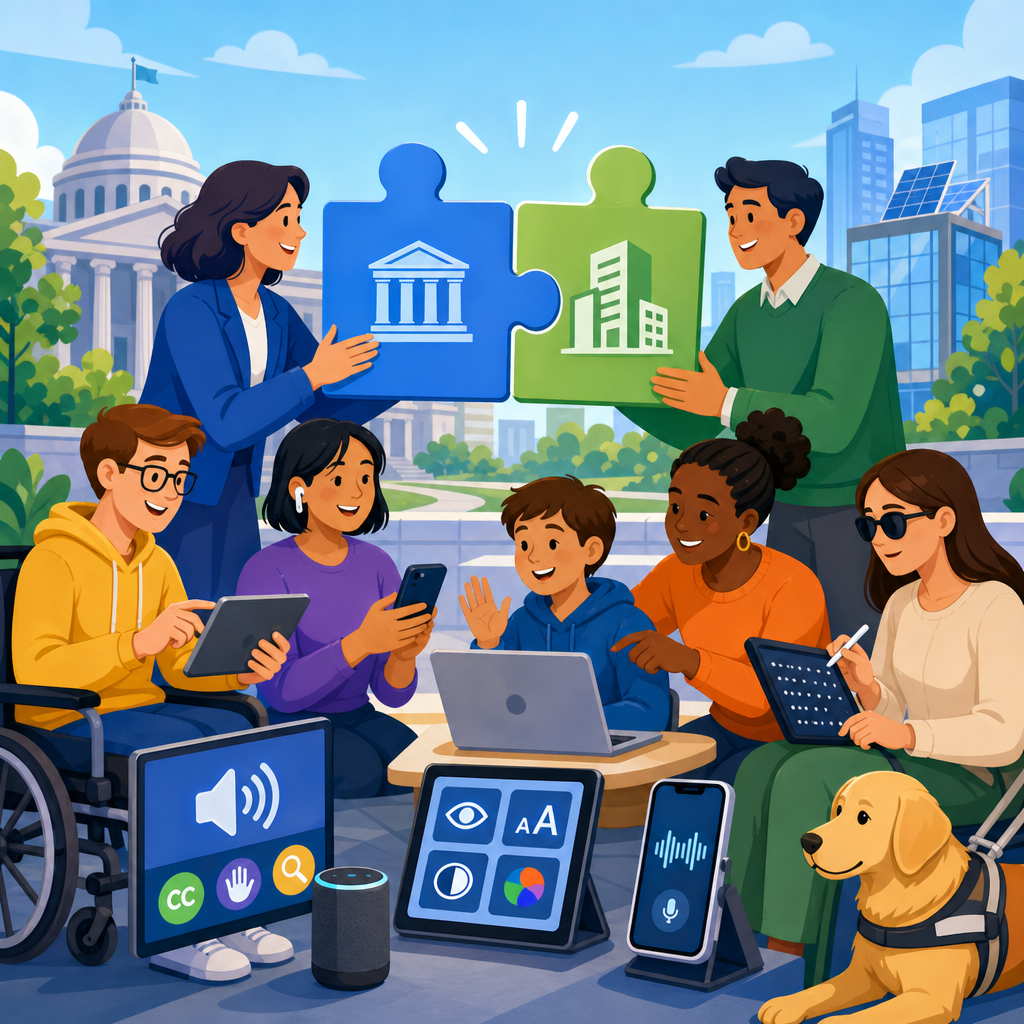
Public-private partnerships are one of the most effective ways to expand accessible technology because they combine public mission, private innovation, and the scale needed to turn promising tools into everyday infrastructure. In the accessibility field, that matters enormously. Accessible technology includes hardware, software, digital services, and built-environment systems designed so people with disabilities can use them independently or with appropriate support. It covers screen readers, captioning tools, hearing access systems, alternative input devices, accessible kiosks, wayfinding apps, AI-powered image descriptions, and inclusive design standards built into mainstream products. I have worked on accessibility programs where excellent prototypes failed simply because procurement, standards, training, and maintenance were treated as separate problems. Partnerships solve that fragmentation by aligning incentives across government agencies, schools, hospitals, transit operators, employers, universities, startups, and major technology vendors.
Promoting advanced technology for accessibility is no longer a niche policy issue. It sits at the intersection of civil rights, public service delivery, digital transformation, and economic participation. Accessibility laws such as the Americans with Disabilities Act, Section 508 in the United States, the European Accessibility Act, and public sector web requirements in many countries establish minimum obligations, but compliance alone does not produce broad adoption. Real progress happens when public institutions create demand, private companies bring research and product capacity, disability organizations shape requirements, and funding models make deployment sustainable. This hub article explains how public-private partnerships work in accessible technology, where they succeed, what models are most useful, and how organizations can structure collaborations that improve access in education, employment, healthcare, transport, and civic life.
What public-private partnerships mean in accessible technology
A public-private partnership in this context is a structured collaboration between government or publicly funded institutions and private sector organizations to develop, buy, implement, or scale accessibility solutions. The public side may include national agencies, city governments, school districts, transit authorities, libraries, public broadcasters, or healthcare systems. The private side may include software firms, device manufacturers, telecom providers, platform companies, systems integrators, and specialist accessibility vendors. In mature partnerships, disability advocacy groups, standards bodies, universities, and community service organizations are also active participants rather than afterthoughts.
The practical purpose of these partnerships is straightforward: reduce barriers faster than any single institution can do alone. Governments have reach, legitimacy, and procurement power. Companies have engineering talent, product roadmaps, distribution channels, and service capacity. Researchers contribute validation, usability testing, and evidence. Disability communities provide lived expertise that prevents expensive design mistakes. When those capabilities are coordinated, advanced technology for accessibility moves from pilot stage to reliable public service. I have seen this clearly in captioning deployments for public meetings, campuswide accessibility programs, and transit information systems where the breakthrough was not the invention itself but the coordinated model for implementation.
Several partnership structures appear repeatedly. One is co-development, where a public need such as accessible voting or classroom accommodation drives product refinement. Another is procurement-led innovation, where accessibility requirements in tenders reshape vendor behavior across an entire market. A third is shared infrastructure, such as statewide captioning contracts, assistive technology lending libraries, or public broadband initiatives that support telehealth access. The strongest collaborations define success in measurable terms: task completion, reduced wait times, higher educational attainment, lower support costs, improved employment outcomes, and independent access for users with different disability profiles.
Why advanced accessibility technology needs partnership models
Advanced accessibility technology often fails when organizations treat it as a standalone tool rather than part of an ecosystem. A school can purchase speech-to-text software, but if devices are outdated, teachers are untrained, privacy terms are unclear, and procurement ignored compatibility with the learning platform, adoption stalls. A city can install accessible kiosks, but if the interface is not maintained, headphone jacks break, and location data is inaccurate, residents stop trusting the system. Partnerships matter because accessibility outcomes depend on interoperability, training, maintenance, user feedback, funding continuity, and policy alignment.
The cost structure also favors collaboration. Many assistive and inclusive technologies involve high upfront research and development costs but lower marginal costs once they scale. Speech recognition, real-time captioning, haptic navigation, computer vision for object recognition, and multilingual text simplification all benefit from large datasets, cloud processing, and integration into mainstream platforms. Public entities can create predictable demand through contracts, grants, tax incentives, challenge programs, and standards. Private firms respond by improving products for broader markets. This is one reason features once considered specialized, such as live captions, voice control, and image descriptions, increasingly appear in consumer operating systems and productivity suites.
There is also a risk management argument. Public institutions need reliability, privacy, auditability, and equitable service delivery. Private companies need clarity on requirements, liability, market size, and deployment conditions. A well-designed partnership allocates these risks explicitly. For example, the public side may require conformance testing against Web Content Accessibility Guidelines, service-level agreements for uptime, and human review for high-stakes AI functions. The vendor may commit to accessibility roadmaps, API access, staff training, and remediation timelines. These are not bureaucratic details; they are the mechanics that determine whether accessible technology works in the real world.
Where partnerships deliver the strongest public value
Education is one of the clearest examples. Public school systems and universities regularly partner with edtech companies, cloud providers, and specialist vendors to deliver captioning, alternative format conversion, accessible learning management systems, and assistive tools for reading, writing, communication, and mobility. When these partnerships are done well, they move from reactive accommodations to inclusive baseline design. A university that negotiates enterprise licenses for note-taking support, screen reader compatibility testing, accessible STEM content, and faculty training creates a better environment for students with disabilities and a smoother digital experience for everyone.
Healthcare is another high-impact area. Telehealth platforms, patient portals, remote monitoring tools, and hospital check-in systems can either widen or narrow disparities. Public health agencies and health systems often depend on private vendors for software, devices, and data infrastructure. The partnership succeeds when accessibility is treated as a clinical access issue, not merely an IT preference. That means video platforms supporting captions and keyboard navigation, portals compatible with screen readers, accessible consent workflows, plain-language content, and multilingual communication support. During rapid telehealth expansion, many providers learned that inaccessible interfaces directly affect missed appointments, medication adherence, and patient safety.
Transport and civic services show the same pattern. Transit authorities increasingly work with mapping companies, mobile app developers, and digital signage vendors to provide step-free routing, audible announcements, tactile interfaces, and real-time disruption alerts. Cities also partner with private firms on accessible parking systems, smart crossings, public information kiosks, and emergency alerts. The value here is independence. A route planner that includes elevator status, sidewalk closures, and platform accessibility does more than improve convenience; it changes whether a person can reliably attend work, school, or medical appointments.
| Sector | Typical partnership focus | Accessibility outcome |
|---|---|---|
| Education | Accessible platforms, captioning, AT licensing, faculty training | Better learning access and lower accommodation delays |
| Healthcare | Telehealth, patient portals, remote monitoring, plain-language design | Safer care access and improved communication |
| Transport | Wayfinding apps, digital signage, alerts, kiosk accessibility | Greater travel independence and confidence |
| Employment | Workplace software, adaptive devices, inclusive recruitment tools | Higher retention and broader hiring pools |
| Civic services | Accessible websites, voting tools, emergency communication | Stronger participation in public life |
Key technologies shaping the accessibility landscape
The hub for advanced technology for accessibility should start with the technologies currently driving the greatest change. Artificial intelligence is prominent, but its value depends on careful implementation. AI can support automatic captioning, speech synthesis, image description, document remediation, sign language research, predictive text, and personalized interfaces. Microsoft, Google, Apple, Adobe, Zoom, and many specialist vendors have expanded accessibility features using machine learning. The benefit is speed and scale. The limitation is accuracy, especially with specialized vocabulary, multilingual content, low-resource accents, complex visuals, and safety-critical communication. In practice, the best partnership models use AI to assist humans, not replace judgment.
Interoperable platforms are equally important. Accessibility technology works better when procurement requires compatibility with assistive technologies and open standards. Screen readers such as JAWS, NVDA, and VoiceOver rely on proper semantic structure and accessible application programming interfaces. Hearing access systems depend on standards for telecoils, Bluetooth Low Energy audio, or Auracast rollout. Digital publications need EPUB accessibility support. Procurement teams that understand these dependencies avoid buying isolated tools that cannot connect with mainstream systems.
Emerging hardware is also expanding what accessibility means. Wearables can support haptic navigation and environmental alerts. Computer vision can identify objects, read text aloud, and guide indoor navigation. Eye tracking and switch access improve communication and computer control for people with complex physical disabilities. Smart home platforms can enable voice, touch, or automated control of lighting, locks, appliances, and reminders. Yet the lesson from deployment work is consistent: advanced devices only become useful public assets when training, support, replacement cycles, and affordability are built into the partnership from the start.
How to build partnerships that actually work
The first requirement is co-design with disabled users from the beginning. Not occasional feedback after launch, but structured involvement in discovery, requirements, testing, and governance. Organizations that skip this step usually optimize for procurement convenience instead of access. A city may specify kiosk brightness and screen size yet forget wheelchair reach ranges, speech output, tactile controls, cognitive load, and multilingual guidance. A school district may buy a reading support platform without evaluating how it performs with dyslexia, low vision, limited bandwidth, or privacy expectations for minors. Co-design reduces these failures early, when they are cheaper to fix.
The second requirement is measurable standards. Contracts should reference recognized criteria such as WCAG for web and mobile content, EN 301 549 for information and communication technology procurement in Europe, and relevant national requirements for telecom, education, healthcare, and broadcasting. Vendors should provide accessibility conformance reports, but buyers should not stop there. Independent testing, user testing with people with disabilities, remediation deadlines, and renewal conditions tied to performance are what make standards meaningful. In my experience, accessibility clauses buried in boilerplate never move delivery teams; milestones and named owners do.
The third requirement is sustainable operations. Many promising pilots collapse because funding covers deployment but not support. Effective partnerships include training for frontline staff, help desk procedures, maintenance budgets, device refresh plans, cybersecurity controls, and data governance. They also define what happens when a feature fails. If automated captions are unavailable during a public meeting, is there a fallback human service? If an accessible document workflow breaks, who resolves it and how quickly? Accessibility resilience is part of service quality, and partnerships should treat it that way.
Common obstacles and how leading organizations address them
The biggest obstacle is fragmented accountability. Accessibility may sit with compliance, procurement, IT, communications, facilities, or disability services, leaving no single owner. Strong partnerships counter this by establishing cross-functional governance with executive sponsorship and user representation. Another barrier is the misconception that accessible technology is inherently expensive. Some solutions do carry added costs, especially specialist hardware and live support services, but inaccessible systems create hidden expenses through retrofits, complaints, legal exposure, duplicate workflows, and exclusion from education or employment. Total cost of ownership usually favors building accessibility in early.
Data and privacy concerns are another challenge, especially when AI or cloud services process speech, health information, or biometric data. Public institutions should insist on clear retention limits, encryption, role-based access, and documented model use. Accessibility cannot come at the cost of basic privacy rights. There is also the issue of uneven digital literacy. A powerful accessibility tool can still fail if users do not know it exists or staff cannot support it. Leading programs solve this with onboarding, peer support, accessible documentation, and ongoing communication rather than one-time announcements.
Finally, market maturity varies. Some domains, such as web accessibility and mainstream captioning, are well established. Others, such as automated sign language translation or advanced indoor navigation, are still evolving and require careful claims evaluation. Public-private partnerships should be ambitious, but they should not treat experimental products as settled solutions. The most credible organizations run phased pilots with independent evaluation, publish lessons learned, and expand only when evidence shows real user benefit.
The strategic path forward for accessible innovation
Public-private partnerships in promoting accessible technology work best when they are treated as long-term capacity building rather than procurement events. The goal is not simply to buy tools for a specific group; it is to build public systems where accessibility is normal, reliable, and continuously improved. That requires policy alignment, clear standards, procurement discipline, co-design, evidence, and operational funding. It also requires recognizing that advanced technology for accessibility is both a specialist field and a mainstream design imperative. Features developed for disabled users routinely improve broader usability, from captions in noisy environments to voice control during hands-free tasks and clear navigation in stressful situations.
For organizations building a technology and accessibility strategy, the practical next step is to map where barriers occur across the user journey, identify which partners control each part of the solution, and set measurable outcomes before selecting tools. Start with high-impact services such as websites, learning platforms, telehealth, transit information, workplace systems, and public communications. Require standards-based accessibility, test with real users, and fund support as seriously as deployment. When public institutions, private innovators, and disability communities share responsibility, accessible technology stops being an exception and becomes part of how modern services are delivered. Use this hub as the foundation for deeper work on AI accessibility, inclusive procurement, assistive technology ecosystems, accessible design systems, and sector-specific implementation.
Frequently Asked Questions
What are public-private partnerships, and why are they important for accessible technology?
Public-private partnerships are collaborative arrangements between government entities, private companies, nonprofit organizations, educational institutions, and sometimes community groups to solve shared problems. In the context of accessible technology, these partnerships matter because no single sector can usually deliver inclusive solutions at the speed, scale, and quality required. Governments often bring policy authority, procurement power, funding, public accountability, and a mandate to serve all residents. Private companies contribute technical expertise, product development capacity, manufacturing, design talent, and the ability to innovate quickly. When these strengths are combined, promising accessibility tools can move beyond pilot programs and become part of everyday infrastructure.
This is especially important in accessibility because the needs being addressed are broad and practical. Accessible technology can include screen readers, captioning tools, speech recognition, hearing assistance systems, accessible kiosks, mobility-supporting devices, inclusive websites, and smart built-environment systems. For people with disabilities, access to these tools is not a luxury feature; it is often the difference between participation and exclusion in education, employment, healthcare, transportation, and civic life. Public-private partnerships help ensure that accessibility is treated as a baseline requirement rather than an optional add-on.
They also improve long-term adoption. A private company may develop an excellent accessibility feature, but without public-sector integration, standards alignment, and equitable distribution, its impact can remain limited. Likewise, a government may set strong accessibility goals, but without industry collaboration, implementation can be slow or outdated. Partnerships close that gap by aligning mission with execution. Done well, they reduce duplication, expand access for underserved communities, lower deployment costs through shared investment, and create more consistent user experiences across public services and private platforms.
How do public-private partnerships help expand access to accessible technology at scale?
One of the biggest advantages of public-private partnerships is scale. Many accessible technologies begin as specialized tools or limited pilot projects. They may work well in a single school district, transit system, workplace, or healthcare network, but scaling them to serve millions of people requires funding, procurement channels, training systems, technical maintenance, and regulatory support. Partnerships allow these pieces to come together in a coordinated way. Governments can establish accessibility requirements, fund deployment, and open access through public systems, while private partners can refine the technology, support implementation, and provide ongoing innovation.
For example, if a city wants to improve accessibility across public transportation, it may work with private technology vendors to deploy real-time audio announcements, tactile interfaces, accessible payment systems, mobile navigation tools, and platform wayfinding supports. The public agency ensures these tools are integrated into service delivery and available across the network, while private firms handle product engineering, interoperability, and updates. This model is often far more effective than leaving agencies to build solutions on their own or expecting the market to deliver equitable access without public direction.
Scale also depends on standardization and repeatability. Public-private partnerships can help create shared technical standards, procurement guidelines, and usability benchmarks that make accessible technology easier to adopt across regions and sectors. Instead of every organization reinventing the wheel, successful models can be replicated in schools, libraries, hospitals, government websites, and community services. That lowers costs and improves consistency for users. Most importantly, it increases the likelihood that accessibility becomes embedded in mainstream systems rather than isolated in niche products.
What makes a public-private partnership successful in the accessibility field?
A successful public-private partnership in accessibility starts with a clear understanding that accessibility is a core design and service objective, not a secondary compliance issue. The strongest partnerships define measurable goals from the beginning, such as improving digital access to government services, increasing the usability of public kiosks, expanding assistive technology in classrooms, or making transportation systems easier to navigate for people with visual, hearing, mobility, cognitive, or speech-related disabilities. Clear goals help partners align investments, timelines, and accountability.
Another essential factor is direct involvement from people with disabilities. Accessibility efforts are most effective when disabled users are included not only as testers, but as decision-makers, advisors, designers, researchers, and evaluators throughout the process. Partnerships that rely only on assumptions often miss practical barriers that emerge in real-world use. By contrast, co-design leads to technologies that are more usable, more relevant, and more likely to be adopted. This is one of the clearest markers of a mature and credible accessibility partnership.
Strong governance also matters. Successful partnerships establish who is responsible for funding, implementation, maintenance, training, data protection, compliance, and user support. They define performance metrics and review outcomes regularly. They also prepare for sustainability beyond the launch phase. Too many accessibility projects begin with enthusiasm but lose momentum because there is no long-term ownership plan. The best partnerships build in procurement continuity, staff training, technical support, and regular updates so the technology remains effective as user needs, regulations, and digital environments evolve.
Finally, trust and transparency are crucial. Public partners must be confident that private vendors are delivering inclusive, secure, and interoperable solutions. Private partners need clarity on regulatory expectations, contract requirements, and user needs. Open communication, transparent testing methods, and honest reporting of results create the conditions for continuous improvement. In accessibility, success is rarely defined by a single product launch; it is defined by durable, everyday access for real people in real settings.
What challenges can arise in public-private partnerships focused on accessible technology?
Although public-private partnerships offer major advantages, they also come with challenges that need careful management. One common issue is misaligned incentives. Public agencies are generally focused on equity, compliance, affordability, and long-term service delivery, while private companies may be driven by product timelines, market competition, and return on investment. These priorities are not necessarily incompatible, but if they are not openly addressed, they can lead to weak implementation, inaccessible design compromises, or solutions that are difficult to sustain after initial funding ends.
Another challenge is the risk of treating accessibility too narrowly. Some partnerships focus only on meeting minimum legal requirements rather than building genuinely inclusive systems. This can result in technology that technically checks a box but remains difficult to use in practice. Accessibility is not one-size-fits-all, and solutions must account for diverse disabilities, multiple languages, different digital literacy levels, and varying contexts of use. A product that works well in a controlled demonstration may fail in crowded transit stations, low-bandwidth environments, public schools, or rural communities if it has not been designed and tested broadly enough.
Procurement and interoperability can also become obstacles. Public institutions often operate with legacy systems, budget constraints, and complex approval processes. Private vendors may offer advanced tools, but integration can be difficult if systems do not communicate well or if contracts do not include accessibility maintenance, updates, and support. Data privacy is another concern, especially when technologies collect personal, biometric, behavioral, or location-based information. Accessibility should never come at the expense of user rights, consent, or security.
The good news is that these challenges are manageable when partnerships are structured thoughtfully. Contracts can include accessibility benchmarks, user-testing requirements, maintenance obligations, training provisions, and transparent reporting. Advisory boards can include disabled stakeholders and independent experts. Pilot programs can be evaluated before full rollout. In other words, the challenge is not whether partnerships can work in accessibility; it is whether they are designed with enough rigor, inclusion, and long-term commitment to serve the people they are meant to support.
How can organizations ensure that public-private partnerships create genuinely inclusive and lasting accessibility outcomes?
Organizations can improve outcomes by treating accessibility as a long-term public interest commitment rather than a short-term technology initiative. That begins with building accessibility into strategy, budgeting, procurement, and evaluation from the start. Instead of asking whether a product can be adjusted later for accessibility, partners should ask how inclusion will shape the design, deployment, training, support, and measurement of success from day one. This shift in mindset leads to better decisions and more sustainable results.
Inclusive participation is central. People with disabilities should be engaged across every phase of the partnership, including planning, research, vendor selection, design review, pilot testing, implementation, and post-launch assessment. Their involvement should be compensated and structurally meaningful, not symbolic. Organizations should also recognize that disability is diverse. Partnerships should consider the needs of people with sensory, mobility, cognitive, developmental, neurological, and mental health-related disabilities, as well as those who use multiple forms of support. A genuinely inclusive approach looks beyond a single user profile and plans for broad usability.
Lasting impact also depends on practical execution. Organizations should establish accessibility standards, require documented testing, provide staff training, and allocate resources for maintenance and upgrades. They should measure outcomes such as usability, adoption rates, service access, user satisfaction, and reduction of barriers, rather than relying solely on compliance checklists. When possible, they should also share lessons learned so successful models can be replicated in other sectors and communities.
Most importantly, organizations should remember that accessible technology is part of social infrastructure. It supports participation in school, work, healthcare, communication, transportation, and community life. Public-private partnerships are most effective when they reflect that broader responsibility. When mission-driven public leadership is combined with private-sector innovation and shaped by the lived experience of disabled people, accessibility moves from isolated intervention to everyday reality. That is the standard organizations should aim for if they want partnerships to deliver meaningful and lasting change.