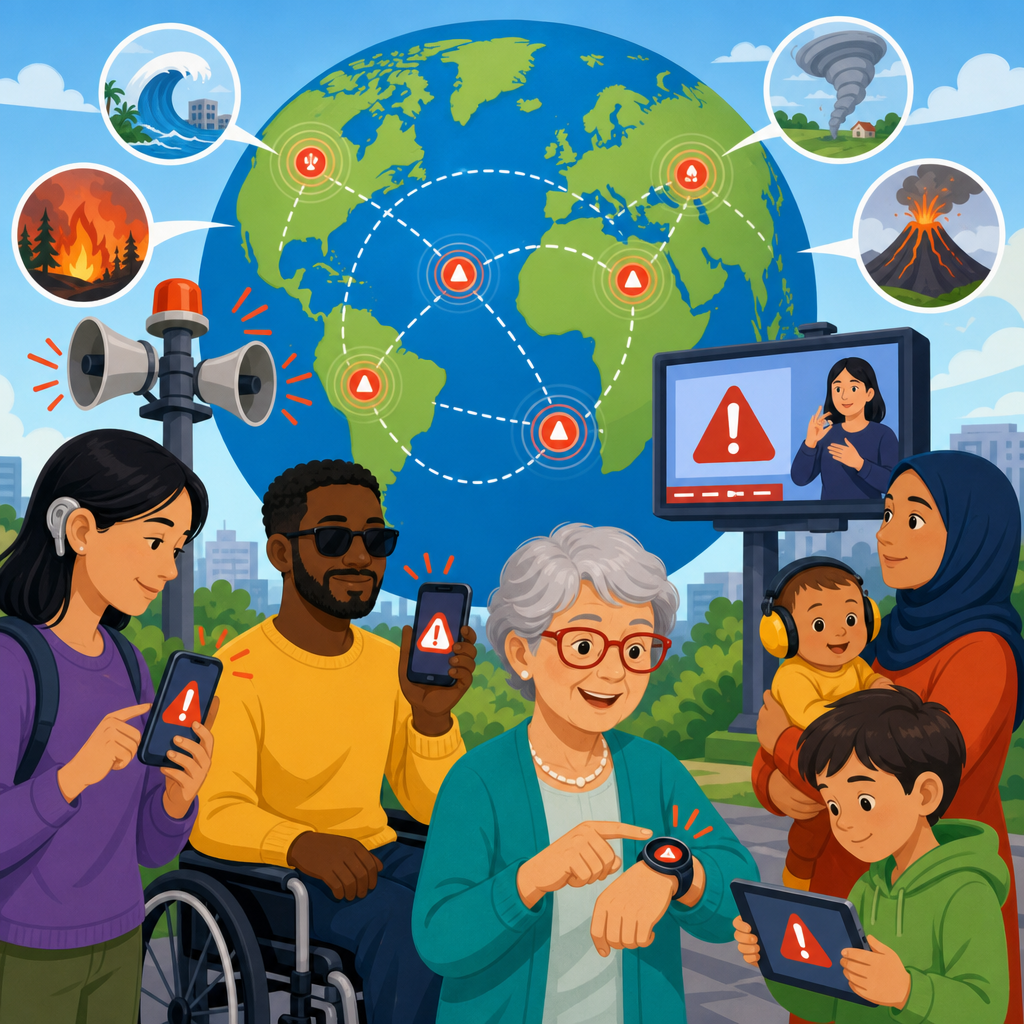
Accessible emergency warnings sit at the intersection of disability rights, public safety, and communications law, and countries regulate them because a warning that cannot be understood in time is not a warning at all. In practice, accessible emergency warnings are official alerts about threats such as hurricanes, floods, wildfires, heatwaves, chemical releases, armed conflict, or missing children that are delivered in formats people with different disabilities can perceive, understand, and act on. That means captions and sign language for Deaf users, audio and screen-reader compatibility for blind users, plain language for people with intellectual or cognitive disabilities, multilingual support for diverse populations, and redundant channels for anyone whose technology, electricity, or connectivity fails. I have worked with accessibility and public-information teams on alerting content, and the consistent lesson is simple: speed matters, but clarity and inclusion determine whether speed saves lives. This topic also anchors broader global views on disability rights because emergency communication reveals how seriously governments treat equal protection under law. A country may endorse inclusion in principle, yet its warning rules expose whether accessibility is funded, enforced, tested, and built into daily operations before a crisis begins.
Globally, regulation is shaped by disability rights treaties, telecom rules, broadcasting standards, civil protection laws, and technical specifications for mobile alerts. The United Nations Convention on the Rights of Persons with Disabilities has been especially influential, particularly Article 9 on accessibility and Article 11 on situations of risk and humanitarian emergencies. Countries translate those obligations differently. Some use binding statutes with explicit accessibility duties for broadcasters and mobile carriers. Others rely on emergency management guidance, procurement standards, or voluntary codes. The strongest systems do three things well: they define who must issue alerts and in which formats, they require testing and accountability, and they recognize that one channel never reaches everyone. As the hub for global views on disability rights in this international perspective series, this article explains how countries regulate accessible emergency warnings, where leading models differ, what standards are commonly used, and what lessons policymakers, advocates, and public agencies can apply when evaluating national systems.
International legal foundations and the rights-based model
The clearest answer to how countries regulate accessible emergency warnings is that they usually begin with disability rights and then operationalize those rights through sector-specific law. The Convention on the Rights of Persons with Disabilities created a global baseline by requiring states to ensure access to information and protection in emergencies on an equal basis with others. That broad commitment is reinforced by the Sendai Framework for Disaster Risk Reduction, which emphasizes inclusive risk communication and the participation of persons with disabilities in disaster planning. In Europe, the European Accessibility Act and the European Electronic Communications Code influence communications accessibility, while the Audiovisual Media Services Directive shapes broadcasting obligations. In the Americas, national constitutional equality guarantees often combine with telecommunications and civil defense law. In Asia-Pacific, countries frequently mix disaster management acts with standards for broadcasters and mobile network operators.
A rights-based model matters because emergency warnings fail in predictable ways when governments regulate them only as technical transmission problems. If the law says an alert must be sent, but does not say it must be accessible, officials may issue a fast text bulletin that a screen reader cannot parse, a television crawl without audio description, or a spoken radio message with no text counterpart for Deaf listeners. Good regulation addresses the full chain: authoring, encoding, transmission, device display, comprehension, and response. It also requires consultation with disabled people’s organizations. In my experience, agencies improve fastest when people who use captions, hearing aids, braille displays, augmentative communication devices, or easy-read formats are included in drills and post-incident reviews. Accessibility is not an add-on feature after the warning goes live; it is a design requirement that shapes message templates, software procurement, vendor contracts, and broadcaster workflows from the start.
National regulatory models: broadcast rules, mobile alerts, and public warning duties
Countries generally regulate accessible emergency warnings through three channels: broadcast obligations, wireless public alerting, and emergency management mandates. The United States is one of the most detailed examples. The Federal Communications Commission regulates the Emergency Alert System and Wireless Emergency Alerts, while the Federal Emergency Management Agency manages the Integrated Public Alert and Warning System. FCC rules require visual and audio presentation of televised emergency information, audible tones, and accessibility features for alerts on mobile devices. Wireless alerts must support attention signals and have standardized categories, and operating systems now allow alerts to be read, enlarged, or spoken through built-in accessibility settings. Yet the United States still illustrates limits: local television weather cut-ins can remain difficult for blind users when maps are described poorly, and county-level alerting quality varies widely.
Japan shows a different model rooted in disaster readiness. National and local governments use J-Alert, cell broadcast, sirens, community loudspeakers, television, and radio. Because earthquakes and tsunamis require immediate action, redundancy is central to regulation and practice. Accessibility is supported through mobile device features, subtitles, multilingual content, and local municipal communication systems, though consistency can differ by prefecture and municipality. The United Kingdom combines emergency planning duties under the Civil Contingencies framework with broadcaster accessibility expectations and the newer Emergency Alerts mobile system. The system can override silent mode in some cases, but regulators and disability advocates continue to examine issues such as message clarity for screen-reader users and support for people who may panic when alarms are unexpected.
Canada, Australia, and New Zealand each use hybrid systems that blend federal guidance with provincial, state, or territorial implementation. Canada’s Alert Ready system distributes alerts through television, radio, and compatible wireless devices, using the Common Alerting Protocol as a technical foundation. Australia’s National Emergency Warning System and Emergency Alert arrangements rely heavily on state authorities, broadcasters, and telecom delivery, with increasing attention to Auslan interpretation, accessible web pages, and bushfire-specific guidance. New Zealand has expanded cell broadcast and emergency management accessibility planning after earthquake experience demonstrated the importance of rapid, trusted communication. In lower-resource settings, regulation may depend more on radio and community networks than smartphone ecosystems, but accessibility principles still apply. Community radio, door-to-door notification, and disability-inclusive local preparedness plans remain essential where digital infrastructure is uneven.
| Country | Primary warning channels | Key accessibility measures | Main regulatory pattern |
|---|---|---|---|
| United States | TV, radio, wireless alerts, IPAWS | Captions, audio access rules, mobile accessibility settings | Detailed telecom and emergency rules with federal oversight |
| Japan | Cell broadcast, J-Alert, TV, radio, speakers | Redundant channels, subtitles, municipal adaptations | Disaster law integrated with national-local warning systems |
| United Kingdom | Mobile alerts, broadcasters, local resilience communications | Accessible message design, broadcast accessibility duties | Emergency planning law plus communications regulation |
| Canada | Alert Ready across TV, radio, wireless | CAP-based distribution, multilingual and accessible public information | Federal standards with provincial implementation |
| Australia | Emergency Alert, broadcasters, state warning apps | Auslan use, accessible websites, hazard-specific templates | State-led operations under national frameworks |
Technical standards that determine whether alerts are actually usable
Regulation only works when it maps onto technical standards. The most important standard in modern public warning is the Common Alerting Protocol, usually called CAP. CAP is an open XML-based format managed through international standardization processes and widely used to structure alert content so one authoritative message can be distributed across many channels. When implemented properly, CAP supports event type, severity, urgency, certainty, geotargeting, multilingual text, and links to audio or additional resources. It helps governments avoid conflicting messages across television, apps, websites, and wireless networks. Cell Broadcast, used in many countries for mobile alerts, is also critical because it can reach all compatible devices in a geographic area without knowing phone numbers and can function under network congestion better than SMS.
Accessibility depends on how those standards are deployed. A CAP feed can contain clear text, but if the receiving platform strips formatting, fails to expose fields to screen readers, or truncates messages badly, users still miss life-saving information. Television accessibility depends on caption encoders, on-screen layout, and live production workflows. Radio remains highly effective for blind users and rural areas, but it must be coordinated with text-based channels for Deaf users. Government websites need WCAG-conformant design, especially during traffic surges when emergency banners, maps, and shelter lists are updated quickly. I have seen agencies discover during exercises that a warning page looked fine visually yet trapped keyboard users or presented evacuation maps with no text equivalent. The lesson is that accessible warning regulation cannot stop at issuance requirements; it must include procurement rules, conformance testing, backup formats, and after-action audits tied to measurable standards.
What inclusive warning content looks like in real emergencies
Accessible emergency warnings are not only about delivery technology; they are about message construction. The best regulations require plain language, clear calls to action, time references, location specificity, and updates as conditions change. A strong alert says what happened, who is affected, what to do now, where to get more information, and when the next update will come. For blind users, this means audio that describes maps and routes instead of saying “see shaded area.” For Deaf users, it means captions that are synchronized and accurate, plus sign language interpretation during longer televised briefings. For people with cognitive disabilities, plain language reduces processing burden: “Leave now using Highway 8 eastbound” is far more useful than “Residents in potentially impacted zones should consider immediate evacuation options.”
Real-world examples show why these details matter. During wildfire seasons in North America and Australia, agencies that issue map-heavy alerts without text descriptions create barriers for blind residents and for anyone receiving low-bandwidth text-only updates. During the COVID-19 pandemic, several countries improved the visibility of sign language interpreters during government briefings, demonstrating how regulation and public pressure can change communication norms quickly. In tsunami-prone regions, countdown language must be simple and immediate because people may have only minutes to respond. Heatwave warnings in Europe increasingly include practical accessibility considerations, such as advice tailored for people using certain medications, wheelchair users in upper-floor apartments, or homebound older adults who rely on support workers. Inclusive content recognizes that disability intersects with age, poverty, language, housing, and digital access, so no single wording strategy reaches everyone equally well.
Enforcement, testing, and the policy gaps that still put people at risk
The difference between a strong law and a life-saving system is enforcement. Countries that regulate accessible emergency warnings effectively do not simply publish guidance; they test systems regularly, investigate failures, and assign responsibility. Regulators can require broadcaster audits, accessibility certifications in government procurement, public complaint mechanisms, and mandatory after-action reports following major incidents. The United States, for example, has seen FCC enforcement around inaccessible televised emergency information and ongoing rule refinements for wireless alerts. In Europe, disability equality bodies and media regulators can influence practice even when emergency warning rules are dispersed across several legal instruments. In countries with decentralized emergency management, uneven local capacity is often the biggest weakness. One city may run accessible drills and maintain translated, screen-reader-friendly templates, while a neighboring district still depends on ad hoc social media posts.
Important policy gaps remain worldwide. Many alert systems still assume smartphone ownership, stable electricity, and literacy under stress. Few countries regulate tactile or haptic options deeply enough, even though vibration patterns and wearables can support people who miss audio alerts. Sign language provision during fast-moving local emergencies remains inconsistent because interpreter staffing and video insertion workflows are not always available twenty-four hours a day. Another gap is trust. Disabled communities may ignore warnings if previous alerts were inaccessible, inaccurate, or impossible to act on due to inaccessible shelters and transport. That is why accessible emergency warnings should be evaluated as part of a larger disability rights system that includes evacuation planning, housing, transport, healthcare continuity, and accessible recovery information. For policymakers building an international perspective on global views on disability rights, the practical benchmark is clear: ask whether disabled people receive the same warning, at the same time, in a format they can use independently, and whether the path to safety is equally accessible.
How countries regulate accessible emergency warnings reveals the real-world meaning of equal protection. The strongest systems combine disability rights law, emergency management duties, telecom and broadcast regulation, and technical standards such as CAP and cell broadcast. They require redundancy, not reliance on one app or one medium. They demand usable content, not just transmitted content. They test with disabled users before disasters, not after failures. They also acknowledge limits: technology can break, local capacity can vary, and message design must evolve as devices, hazards, and demographics change.
As a hub within the international perspective topic and the broader global views on disability rights subtopic, this article points to the core questions every reader should carry into related country studies: Who is legally responsible for accessible alerts, which channels are mandated, what standards govern usability, how is compliance enforced, and are disabled people involved in design and review? Those questions cut through rhetoric and expose whether a warning system is genuinely inclusive. If you are comparing national approaches, start by mapping the legal framework, the delivery channels, and the accountability mechanisms, then examine how disabled people actually receive warnings during real events. That is where effective regulation proves itself, and where disability rights become concrete public safety outcomes.
Frequently Asked Questions
What are accessible emergency warnings, and why do countries regulate them so closely?
Accessible emergency warnings are official public alerts designed so people with different disabilities can receive, understand, and act on urgent information during a crisis. These warnings may cover hurricanes, floods, wildfires, earthquakes, heatwaves, hazardous material releases, armed conflict, terrorist incidents, evacuation orders, shelter-in-place instructions, and child abduction notices. What makes them “accessible” is not simply that they are sent widely, but that they are delivered in formats that work across different sensory, cognitive, and communication needs. That can include text alerts for Deaf or hard of hearing users, audio messages for blind or low-vision users, captions and sign language on television, screen-reader-compatible mobile alerts, plain-language instructions for people with intellectual or cognitive disabilities, multilingual messaging, vibration cues, and repeated dissemination across multiple platforms.
Countries regulate these warnings closely because emergency communication is a matter of life safety, not merely convenience. If an alert reaches only part of the population, governments can fail in their core duty to protect the public. A warning that cannot be perceived in time, cannot be understood, or does not include usable instructions may leave people trapped, injured, or unable to evacuate. Regulators therefore treat accessibility as part of emergency preparedness, broadcasting policy, telecommunications rules, disability law, and sometimes constitutional or human rights obligations.
In many legal systems, the regulatory rationale rests on three overlapping ideas. First, there is the public safety obligation: authorities must warn people about imminent threats quickly and reliably. Second, there is the equality or non-discrimination principle: people with disabilities should not be excluded from emergency systems that others can use. Third, there is the communications infrastructure principle: broadcasters, mobile carriers, internet platforms, and device manufacturers often need technical rules so alerts can actually function across networks and devices. As a result, accessible warning laws are rarely found in just one place. They are usually spread across disability rights statutes, civil protection laws, telecom regulations, broadcasting standards, and emergency management protocols.
How do governments usually structure laws and regulations for accessible emergency alerts?
Most countries regulate accessible emergency warnings through a layered framework rather than a single standalone law. At the top level, there may be a constitutional guarantee, disability rights law, or equality statute requiring public services to be accessible. A second layer often comes from emergency management or civil defense laws that define who can issue alerts, under what circumstances, and through which channels. A third layer typically includes sector-specific communications rules for television, radio, wireless networks, internet-based services, and public warning systems. Together, these layers determine not only whether an alert must be sent, but also whether it must be captioned, audible, screen-reader compatible, multilingual, geotargeted, archived, and repeated.
In practice, regulators often assign responsibilities to several institutions. A national emergency agency may decide when a warning is necessary. A telecommunications regulator may require mobile carriers to support cell broadcast or location-based SMS. A broadcasting authority may require emergency crawls, spoken audio interruptions, captions, and sign language inserts. Accessibility commissions or human rights bodies may oversee compliance with disability standards. Local and regional authorities may also have duties to adapt alerts to local risks, such as tsunamis, volcanic eruptions, extreme heat, or industrial accidents.
Many countries also rely on technical standards and operational guidance to make the law workable. These can include rules on message length, sound patterns, vibration signals, text contrast, plain language, symbol use, compatibility with assistive technologies, and system testing requirements. Some jurisdictions require redundancy, meaning alerts must be available through more than one channel so that failure in one system does not leave people unprotected. Others require regular drills, post-incident reviews, and consultation with disability organizations to identify barriers that may not be obvious to system designers. This kind of structure reflects an important regulatory reality: accessible warning policy is not only about sending a message, but about designing an end-to-end system that works under real emergency conditions.
What accessibility features are most commonly required in emergency warning systems?
The most commonly required features are those that help people perceive, understand, and respond to warnings despite differences in hearing, vision, mobility, cognition, language, or technology access. For television and video-based alerts, common requirements include closed captions, emergency text crawls, audible reading of visual text, and in some cases sign language interpretation. For radio, the emphasis is on clear spoken instructions, repeated messaging, and interruption authority so regular programming can be overridden during a crisis. For mobile alerts, regulators increasingly focus on device-level accessibility, including compatibility with screen readers, large text settings, vibration patterns, and text-based delivery that does not depend solely on audio cues.
Plain language is another major requirement. A technically correct but confusing alert can still be inaccessible. Many regulations and guidelines therefore push agencies to avoid jargon, explain the threat directly, identify the affected area, specify timing, and provide simple action steps such as “Evacuate now,” “Move to higher ground,” or “Stay indoors and close windows.” This is especially important for people with intellectual disabilities, psychosocial disabilities, limited literacy, older adults, tourists, and anyone trying to process information under stress. Some systems also support icons, maps, and standardized hazard labels, though these tools work best when paired with text and audio rather than used alone.
Multichannel delivery is equally important. A well-regulated system often requires warnings to be distributed through mobile alerts, television, radio, sirens, websites, social media, transit signage, and public address systems. No single format reaches everyone. Sirens may alert people outdoors but do not explain what action to take. Mobile alerts may fail where network coverage is weak or devices are off. Television may not reach people traveling. Accessibility rules therefore increasingly favor redundancy and interoperability, so one official message can be pushed through multiple systems quickly and consistently. The strongest frameworks also recognize that accessibility includes timeliness: captions that appear too late, websites that crash, or sign language feeds that begin after key instructions have already passed can make a technically “available” alert effectively useless.
How do disability rights laws influence emergency warning rules around the world?
Disability rights laws are one of the strongest drivers of accessible emergency warning regulation. In many countries, emergency communication is treated as a public service that must be delivered without discrimination. That means governments and, in some cases, private communications providers may have legal duties to ensure disabled people can access the same urgent information as everyone else. These duties often arise under equality legislation, accessibility statutes, public accommodation rules, administrative law principles, or broader human rights protections. International norms have also shaped domestic law, especially the idea that disabled people must have equal access to safety, information, and public services during emergencies and disasters.
These laws influence warning systems in several concrete ways. They can require reasonable accommodations, mandate accessible digital design, prohibit inaccessible broadcasting practices, and support complaints or enforcement actions when public agencies fail to warn disabled communities effectively. They also push regulators to think beyond minimum compliance. For example, a government may technically issue an alert, but if it is presented only as fast-moving on-screen text with no audio, blind users may be excluded. If it is audio-only with no captioning, Deaf users may be excluded. If it uses complex terminology and no clear steps, people with cognitive disabilities may be excluded. Disability rights frameworks help expose these gaps by shifting the question from “Was a warning sent?” to “Could affected people actually use it?”
Just as importantly, disability rights laws often encourage consultation and co-design. Regulators increasingly recognize that accessibility cannot be fully solved by technical assumptions made in offices far from real-world users. Deaf associations, blind advocacy groups, neurodiversity advocates, organizations representing people with intellectual disabilities, and disability-led disaster response networks often provide essential insight into what works in practice. Their involvement can shape everything from message wording to device behavior to evacuation guidance. In stronger legal systems, this participation is not optional goodwill; it is built into rulemaking, procurement, testing, and compliance review. That is one reason accessible warning regulation continues to evolve: disability law has made clear that equal protection in emergencies requires systems designed with disabled people, not merely for them.
What are the biggest challenges countries face when trying to enforce accessible emergency warning standards?
The biggest challenge is that accessible warning compliance depends on many institutions and technologies working together under intense time pressure. A country may have strong laws on paper, but enforcement can break down if emergency agencies use outdated software, broadcasters lack automatic captioning integration, mobile operators have inconsistent technical support, local authorities are underfunded, or public websites are inaccessible during traffic surges. Accessibility is especially hard to enforce when responsibility is fragmented. If one agency drafts the message, another approves it, a telecom provider transmits it, broadcasters adapt it, and local officials issue follow-up instructions, failures can occur at several points and still leave no one clearly accountable.
Another major challenge is the gap between formal compliance and functional accessibility. Systems may pass a technical checklist while still failing users in real emergencies. For example, a message may be screen-reader compatible in theory but too long, too vague, or too delayed to help. Captions may exist but be inaccurate during live events. Sign language interpretation may be available but placed too small on screen to be useful. Rural areas may have weak connectivity. Older devices may not display alerts properly. People who rely on assistive technologies may