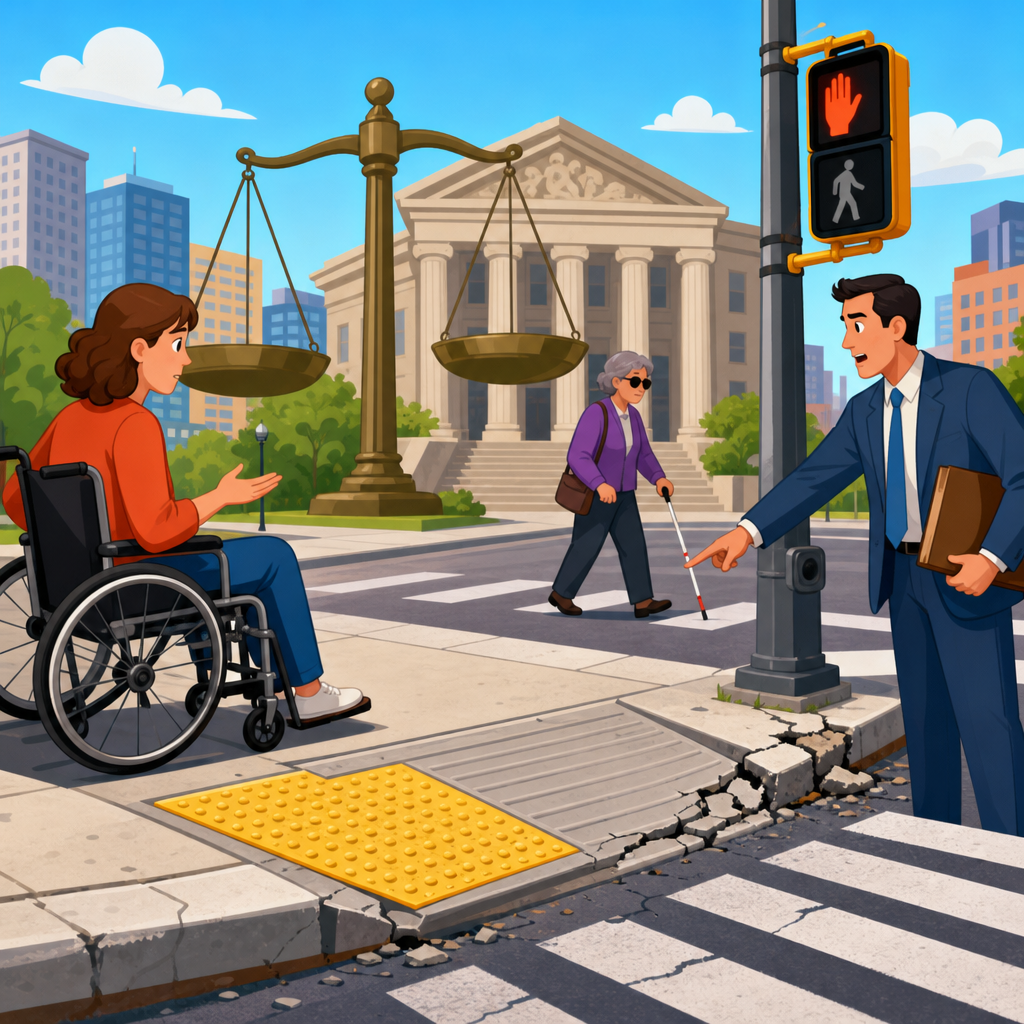
Cities get sued over sidewalks, curb ramps, and pedestrian signals when public rights-of-way exclude disabled people from basic travel, and those cases increasingly shape how streets are designed, funded, and maintained. In practice, “sidewalk accessibility” means more than having a paved path. It includes continuous pedestrian routes, curb ramps aligned with crosswalks, detectable warnings for blind pedestrians, accessible pedestrian signals with audible and vibrotactile features where required, reasonable maintenance, and work-zone routing that does not force wheelchair users into traffic. “State and local lawsuits” refers to claims brought against municipalities, counties, transit agencies, school districts, and related public entities under federal disability law, state civil-rights statutes, state tort law, and local enforcement mechanisms. I have worked with these issues in planning and compliance contexts, and the pattern is consistent: agencies are rarely sued because one corner is imperfect; they are sued because barriers are systemic, long-known, and tied to weak inspection, outdated standards, or capital programs that ignore accessibility.
The legal importance is substantial because sidewalks and crossings are core public infrastructure, not optional amenities. Title II of the Americans with Disabilities Act requires state and local governments to provide meaningful access to services, programs, and activities. Section 504 of the Rehabilitation Act applies when federal funding is involved, which is common in transportation and public works. The U.S. Department of Justice and the Federal Highway Administration have repeatedly treated the public right-of-way as subject to these obligations, and courts have often agreed that inaccessible pedestrian networks can deny equal access to civic life itself. When a resident cannot reach a bus stop, school, courthouse, voting place, or business district because missing curb ramps block the route, the issue is not simply engineering; it is legal exposure. Cities also face parallel negligence claims when broken pavement, ponding, uplift, or snow and debris create foreseeable hazards, though notice rules, immunity doctrines, and damage caps vary by state.
This topic matters now for three reasons. First, much of the pedestrian system in older cities predates modern accessibility requirements, creating a backlog too large for annual maintenance budgets. Second, resurfacing, utility work, and corridor redesign projects trigger obligations to upgrade adjoining pedestrian features, yet many agencies still under-scope those items. Third, litigation has become more data-driven. Plaintiffs use GIS inventories, Street View histories, complaint records, and signal timing sheets to show patterns of exclusion. For public agencies, the lesson is direct: sidewalk and curb-ramp cases are won or lost long before a complaint is filed, in the inventory, transition plan, maintenance logs, design exceptions, and capital improvement process.
The legal theories cities face
Most lawsuits over sidewalks, curb ramps, and signals rest on a small set of legal theories. The first is disability discrimination under Title II of the ADA. Plaintiffs argue that a city’s pedestrian network denies program access because routes are discontinuous, intersections lack compliant curb ramps, or signals cannot be used by blind or low-vision travelers. Program access does not always require every facility to meet current new-construction standards immediately, but it does require access when viewed in its entirety. Courts often examine whether barriers are isolated or widespread, whether officials knew about them, and whether the city has a realistic transition plan with priorities, schedules, and funding. A second theory arises under Section 504, often pleaded alongside ADA claims because transportation and street projects frequently use federal money. The standards are similar, but the funding link can strengthen the record.
A third category involves failure to make required upgrades during alterations. Under longstanding federal rules, when a street is altered, adjacent curb ramps generally must be installed or brought into compliance to the maximum extent feasible. Resurfacing counts in many contexts; routine maintenance usually does not. That distinction has generated major disputes. If a city mills and overlays a corridor but leaves corners without ramps, plaintiffs can argue that the agency altered the roadway while ignoring a clear accessibility trigger. A fourth category includes state-law negligence and premises liability claims. These cases usually focus on trips, falls, wheel snags, or forced street travel caused by defects such as vertical displacement, spalled panels, missing utility covers, or vegetation overgrowth. They are less about equal access and more about breach of a duty to maintain reasonably safe public ways, but they often arise from the same management failures.
What plaintiffs must show, and what cities argue back
Successful plaintiffs usually prove four practical points. They identify a disability recognized by law, show that they were denied meaningful access to a public service or route, connect that denial to a physical or operational barrier, and establish that the public entity knew or should have known. In class actions, they also show common patterns across many locations. Strong complaints include exact intersections, running slopes, cross slopes, landing dimensions, lack of detectable warnings, pushbutton placement outside reach ranges, inaccessible work zones, and signal timing that leaves too little crossing time. Photographs, measurements, mobility-device testimony, and expert reports make the case concrete. For blind plaintiffs, inaccessible pedestrian signals, poor locator tones, and unsafe channelization can be pivotal because a crossing can exist on paper yet remain unusable in practice.
Cities typically respond with several defenses. They may argue no denial of program access exists because alternative routes are available, the barriers are isolated, or remediation is underway. They may invoke sovereign immunity or statutory notice requirements against negligence claims. They often contend that correcting every legacy barrier immediately would impose undue financial and administrative burdens, especially where terrain, drainage, utilities, or historic conditions limit retrofit options. Those defenses are not imaginary; they can matter. But in my experience, they are weakest when the agency lacks a current inventory, cannot explain why known barriers were omitted from recent projects, or has no objective prioritization system. Courts and enforcement agencies tend to distinguish between a city facing a genuine backlog with a documented plan and a city that has normalized noncompliance for decades.
The features that generate the most claims
Some defects appear repeatedly because they block travel at decision points. Missing curb ramps are the classic example. A continuous sidewalk is useless to a wheelchair user if each corner ends in a vertical curb face. Misaligned ramps create another common claim because they direct users into traffic or away from the crosswalk. Excessive cross slope on sidewalks or landings can destabilize wheelchairs and walkers. Ponding at the foot of a ramp can make a crossing effectively inaccessible even when dimensions look acceptable on plans. Detectable warnings matter because blind pedestrians rely on them to locate the street edge. Their absence, incorrect depth, or poor contrast can support claims, particularly after a city has recently rebuilt corners.
Signals generate a different but equally serious set of allegations. Accessible pedestrian signals are not mandatory at every location solely because a signal exists, but when they are required to provide equivalent usability, a city cannot ignore them. Common failures include no audible walk indication where geometry is complex, pushbuttons mounted too far from the curb line, inaccessible approach routes to the buttons, low volume that is masked by traffic, and missing vibrotactile indications. Timing claims also arise when clearance intervals are too short for slower walkers or medians lack refuge. Work zones are another frequent source of liability. Contractors close sidewalks without creating protected temporary routes, forcing pedestrians with disabilities into parking lanes or around long detours. Because cities remain responsible for the public right-of-way, poor contractor control often turns a construction inconvenience into a lawsuit.
| Issue | Typical allegation | Evidence plaintiffs use | Best municipal response |
|---|---|---|---|
| Missing curb ramps | No accessible route across intersections | Intersection inventory, photos, field measurements | Networkwide ramp program tied to paving and signals |
| Noncompliant sidewalk geometry | Excessive cross slope or vertical changes impede mobility devices | Digital levels, survey data, user testimony | Risk-based repair standards and routine inspections |
| Inaccessible pedestrian signals | Blind users cannot independently locate or use crossings | Signal plans, audio recordings, orientation testimony | APS warrants, standardized placement, maintenance logs |
| Work-zone closures | Temporary pedestrian routes are unsafe or nonexistent | TMP sheets, dated photos, inspector notes | Accessible traffic control plans and contractor enforcement |
| Poor alteration practices | Resurfacing occurred without required curb-ramp upgrades | Project records, bid sets, before-and-after imagery | Design checklists and ADA review before advertisement |
How major cases and enforcement actions shape local exposure
Although facts differ by jurisdiction, a few recurring precedents define the landscape. The Ninth Circuit’s decision in Barden v. City of Sacramento is widely cited because it recognized sidewalks as part of a public entity’s services, programs, or activities under Title II. That helped confirm that inaccessible sidewalks are not merely public works defects; they can be civil-rights violations. Another major line of authority grew from disputes over street resurfacing and curb ramps, including litigation and federal enforcement involving large cities such as Los Angeles. Those matters reinforced the principle that roadway alterations trigger curb-ramp obligations and that cities may need comprehensive settlement programs, not one-off fixes. Department of Justice settlement agreements commonly require self-evaluation, inventory, public complaint systems, dedicated funding, and multiyear schedules. Once one city signs such terms, neighboring agencies can no longer claim the compliance model is unclear.
State and local exposure also expands through state statutes that sometimes offer broader remedies than federal law. California’s Unruh Civil Rights Act and Disabled Persons Act, for example, are often discussed alongside ADA compliance because they can increase pressure through damages and fee provisions in certain contexts. Other states rely more heavily on tort systems, municipal notice statutes, and public-duty doctrines. The details vary, but the strategic effect is similar: plaintiffs combine legal pathways to survive dismissal and drive settlement leverage. From the agency side, that means city attorneys cannot treat sidewalk litigation as a narrow engineering issue. Public works, transportation, risk management, procurement, and disability services all need to share data, because the strongest plaintiff narratives usually expose fragmentation inside government.
Why cities lose: systems problems, not isolated defects
When I review troubled programs, the same operational failures appear again and again. The first is the missing or obsolete inventory. Agencies do not know how many corners lack ramps, which sidewalks exceed cross-slope tolerances, or where pushbuttons are inaccessible. Without a defensible baseline, they cannot prioritize, budget, or show progress. The second failure is treating ADA work as separate from paving, signal modernization, utility coordination, and development review. That silo guarantees missed triggers. A corridor gets resurfaced, but the design scope excludes ramps; a signal cabinet is upgraded, but no one checks pushbutton location; a developer rebuilds frontage, but inspection focuses on curb reveal instead of running slope and landing geometry. Plaintiffs notice these misses because they create visible contradictions: a street looks newly improved while remaining unusable.
A third reason cities lose is weak maintenance discipline. Accessibility is not only a capital issue. Tree-root uplift, debris, snow, temporary signs, dining enclosures, and failed APS speakers can eliminate access long after a compliant installation. If complaint systems are slow, undocumented, or inaccessible themselves, the notice record becomes damaging evidence. Fourth, many agencies rely on standards without training the field staff who enforce them. Engineers may know Public Rights-of-Way Accessibility Guidelines concepts, the Manual on Uniform Traffic Control Devices, and PROWAG-informed design details, but inspectors and contractors may not. The result is rework, inconsistent acceptance, and corners that fail on dimensions no one measured before pouring concrete. Lawsuits thrive where standards exist on paper but not in daily practice.
How municipalities reduce lawsuit risk before claims arrive
The most effective prevention strategy is a network-based accessibility program. Start with a complete asset inventory using GIS, mobile collection tools, and standardized condition codes. Include sidewalks, curb ramps, landings, detectable warnings, APS equipment, crossing distances, obstructions, and temporary closure patterns. Then adopt a transition plan that prioritizes high-need corridors: routes to transit, schools, medical facilities, government buildings, and commercial centers, along with locations identified through disability community engagement. A credible plan names milestones, responsible departments, annual funding, and a public reporting cadence. Cities that do this well do not promise instant perfection; they demonstrate disciplined progress and transparent decision-making, which matters in court and in negotiations.
Operational controls are just as important. Every resurfacing, reconstruction, utility permit, and private frontage project should trigger an accessibility review checklist before design approval and again before final acceptance. Standard drawings must reflect current requirements for flare treatment, counter slopes, landing sizes, detectable warning placement, and APS details. Maintenance crews need objective thresholds for patching uplift, replacing broken panels, clearing vegetation, and restoring accessible routes after storms. Work-zone permits should require temporary pedestrian access routes consistent with temporary traffic control guidance, with field enforcement strong enough to stop noncompliant closures the same day. Finally, cities need a complaint system that is easy to use, tracks response times, and feeds the capital program. If five residents report the same inaccessible crossing, that location should not disappear into separate service tickets; it should move onto the agency’s legal-risk dashboard and design queue.
What this hub means for the broader legal and technology frontier
State and local lawsuits over sidewalks, curb ramps, and signals sit at the intersection of civil-rights law, tort exposure, public finance, and street technology. The core rule is simple: if a city controls the pedestrian network, it must treat accessibility as a fundamental service obligation. The cases that reshape practice do not turn on rhetoric; they turn on inventories, alteration triggers, maintenance records, signal details, and whether officials can prove an organized plan to remove barriers. For agencies, the benefit of getting this right is larger than avoiding judgments and attorney fees. Accessible sidewalks and crossings improve transit access, public safety, aging-in-place, and economic participation for everyone using the street.
As the hub for this subtopic, this page sets the framework for deeper articles on resurfacing triggers, APS standards, construction work zones, municipal immunity, and transition-plan design. The immediate takeaway is practical. Audit the network, tie accessibility to every street project, document maintenance, and treat complaints as data, not anecdotes. Cities that build those habits are far less likely to be sued, and far better prepared if they are. If you manage public infrastructure or advise a local agency, use this article as the starting map, then review your own sidewalks, curb ramps, and signals with a litigation lens before a plaintiff does.
Frequently Asked Questions
Why do cities get sued over sidewalks, curb ramps, and pedestrian signals?
Cities are often sued when people with disabilities cannot use public sidewalks and crossings in a safe, continuous, and independent way. Legally, the issue usually centers on whether a city has made its pedestrian network accessible under disability rights laws, including the Americans with Disabilities Act and related regulations that apply to public rights-of-way and public services. A sidewalk system is not considered accessible simply because pavement exists. If there are missing curb ramps, ramps that are too steep, sidewalks blocked by utility poles or broken pavement, crosswalks that do not line up with ramps, or signals that provide no usable information to blind or low-vision pedestrians, the route may effectively exclude people from everyday travel.
These lawsuits typically argue that inaccessible pedestrian infrastructure denies disabled residents equal access to public programs, services, and activities. That matters because sidewalks are how people reach schools, bus stops, parks, government buildings, businesses, medical care, and jobs. In other words, a sidewalk network is not just concrete; it is part of the city’s transportation system and part of civic life. When barriers are widespread or persistent, plaintiffs may claim the city has failed to maintain accessible features, failed to install them during street work, or failed to create a workable plan for removing known barriers. Courts and settlement agreements often push cities to treat accessibility as a systemwide obligation rather than an isolated repair issue.
What sidewalk and crossing problems most commonly trigger these lawsuits?
The most common claims involve barriers that break the continuity of a pedestrian route. Missing curb ramps at intersections are one of the biggest issues, especially where a wheelchair user cannot enter or leave a crosswalk at all. Another frequent problem is curb ramps that technically exist but are built incorrectly, such as ramps with excessive slope, severe cross-slope, lips at the bottom, poor drainage that leaves standing water, or placements that aim pedestrians into traffic instead of into the marked crosswalk. Misalignment is especially important because a ramp that points diagonally into an intersection can create real safety risks for wheelchair users and blind pedestrians.
Lawsuits also commonly focus on damaged or obstructed sidewalks. Uplifted panels, gaps, crumbling surfaces, narrow pinch points, overgrown vegetation, poles in the path, sidewalk café encroachments, and inaccessible transit stop connections can all make a route unusable. For blind and low-vision pedestrians, the absence of detectable warnings at curb ramps is another recurring issue because those warnings help indicate the boundary between sidewalk and street. Pedestrian signals can also become a major legal problem when they do not provide accessible pedestrian signals with audible and vibrotactile information where required, particularly at complex intersections or locations where visual information alone is not enough for safe crossing. The broader pattern in these cases is that accessibility failures are rarely about a single defect; they usually reflect a network that works for some users but not for everyone.
What laws and standards are usually involved when a city is challenged over pedestrian accessibility?
Most of these cases are grounded in Title II of the Americans with Disabilities Act, which applies to state and local governments, and often Section 504 of the Rehabilitation Act when federal funding is involved. These laws require public entities to provide meaningful access to public services and infrastructure. In the sidewalk context, courts and enforcement agencies generally look at whether the city has maintained accessible routes, removed barriers where required, and installed accessible features when making alterations to streets, sidewalks, and intersections. One major trigger is alteration work: when a city resurfaces a road, reconstructs an intersection, or otherwise alters a pedestrian route, accessibility upgrades such as compliant curb ramps are often required as part of that project.
Technical standards also matter. Depending on the project date, funding source, and jurisdiction, agencies may look to ADA Standards, guidance from the U.S. Access Board, transportation regulations, and state or local design criteria. While the legal details can get technical, the practical question is straightforward: can a disabled pedestrian travel continuously and safely through the public right-of-way? That includes route width, slope, surface condition, ramp geometry, detectable warnings, and signal accessibility. In many disputes, the fight is not only over whether a standard exists, but whether the city consistently applied it in planning, construction, inspection, and maintenance. That is why these cases often pull in engineering records, asset inventories, complaint histories, and capital improvement plans, not just legal arguments.
How do these lawsuits change the way cities design, fund, and maintain streets?
These cases often have a much bigger impact than a single damaged corner or missing ramp. Once sued, many cities are forced to inventory barriers across their entire pedestrian system, prioritize corrections, dedicate funding, and adopt timelines for compliance. Settlements and court orders frequently require cities to create transition plans, track requests for accessibility improvements, train staff, revise design manuals, and integrate accessibility into resurfacing and capital projects. That means accessibility stops being treated as an optional add-on and becomes a standard part of how streets are rebuilt and maintained.
The financial impact is also significant. A city may need to spend substantial sums on curb ramp retrofits, signal upgrades, sidewalk repair programs, and data systems to monitor conditions. It may also have to coordinate across departments that previously worked separately, such as public works, traffic engineering, planning, legal, and transit. Over time, these legal pressures can reshape local policy by pushing cities to budget for proactive maintenance instead of waiting for complaints or injuries. They can also influence project sequencing, with higher priority given to routes serving schools, transit, medical districts, and government facilities. In that sense, sidewalk accessibility litigation often functions as a force multiplier: it turns longstanding access problems into binding implementation obligations that affect street design standards for years.
What should a city do to reduce legal risk and make its pedestrian network more accessible?
The most effective approach is to treat accessibility as a systemwide transportation responsibility rather than a reactive claims issue. Cities should start with a current inventory of sidewalks, curb ramps, detectable warnings, transit stop connections, and pedestrian signals, then identify where the network is broken for disabled users. From there, they need a realistic transition plan with clear priorities, deadlines, and funding commitments. High-use corridors, transit routes, school zones, medical areas, and paths to civic facilities should generally be addressed early, especially where barriers completely prevent travel. Routine maintenance matters too: even a properly built sidewalk can become inaccessible if tree roots lift panels, drainage fails, or construction closures create unusable detours.
Cities should also make sure accessibility is embedded in every alteration project. If a street is resurfaced, redesigned, or reconstructed, the pedestrian features connected to that work should be evaluated and upgraded as required, not postponed. Staff training is critical because many legal problems arise from preventable design or inspection errors, such as ramps placed out of alignment or detectable warnings installed incorrectly. Public complaint systems should be easy to use, responsive, and tied to repair tracking. Finally, cities benefit from engaging disability advocates and users directly. People who rely on wheelchairs, white canes, walkers, or accessible signals often identify problems that are easy to miss on paper but obvious in real-world travel. That kind of ongoing input not only reduces legal exposure; it leads to safer, more usable streets for everyone.


