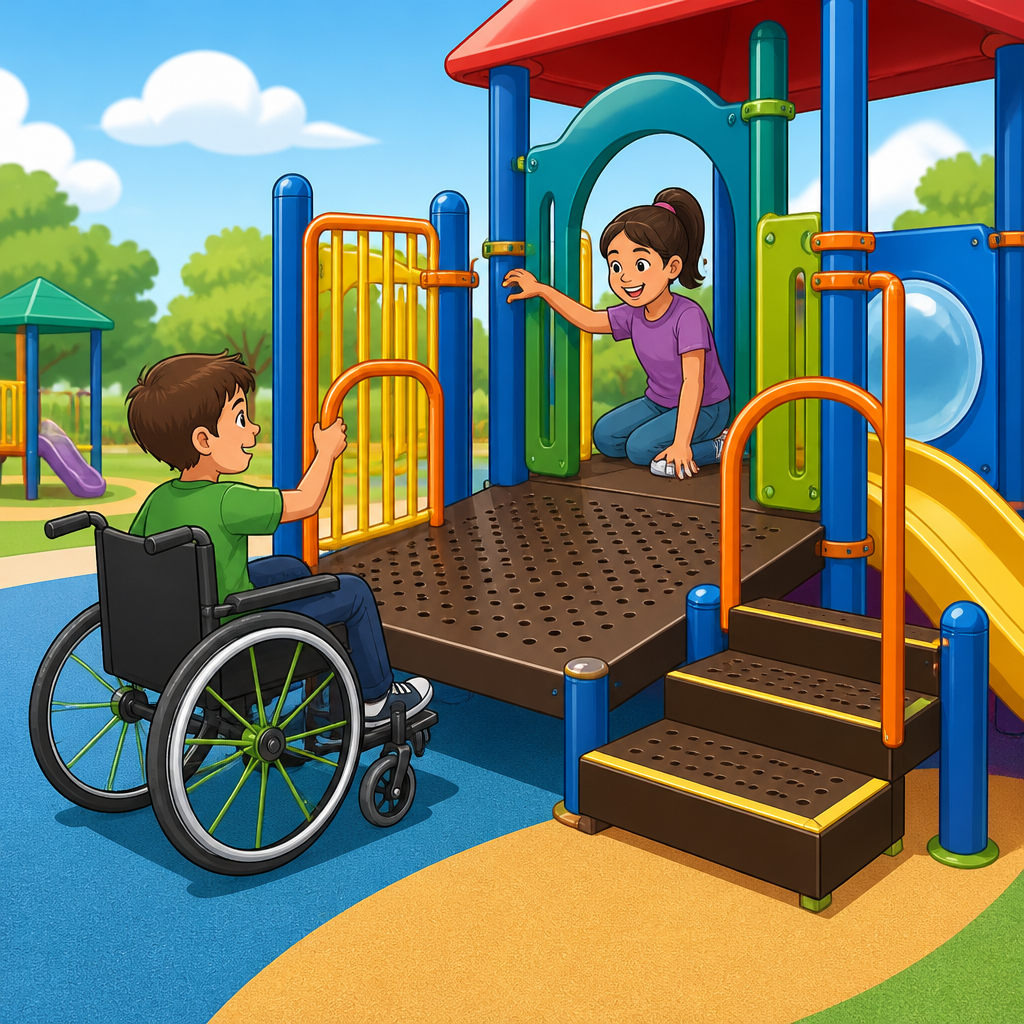
Playground transfer platforms and transfer steps are built features that let children and caregivers move from a wheelchair or other mobility device onto elevated play components when a ramped route is not provided. Within ADA accessibility standards for recreation and sports facilities, these elements matter because they turn access from a general promise into a measurable design requirement. In practice, I have seen the difference a well-designed transfer system makes: a child can leave the edge of the playground and join peers on a deck, in a climber, or at an interactive panel instead of remaining limited to ground-level events. That outcome depends on dimensions, reach ranges, clear space, and usability details being handled correctly from the first site plan through final inspection.
As a hub topic under ADA accessibility standards, recreation and sports facilities includes playgrounds, sports courts, exercise areas, swimming pools, team seating, locker rooms, and routes that connect them. Playgrounds are especially technical because they combine circulation, impact attenuation, supervision, and child development goals with strict scoping and technical criteria. A transfer platform is the landing where a user shifts from mobility device to play structure. Transfer steps are the succeeding levels that help a child move upward through the system. Their design is not interchangeable with stairs, ramps, or decorative ledges. They must support real transfers, not just appear accessible in photos or product brochures.
The reason this subject deserves a dedicated hub article is simple: many compliance failures happen in otherwise attractive playgrounds. Designers may specify accessible surfacing but miss the required transfer height. Installers may place guard components where hand placement is needed. Owners may buy compliant equipment yet connect it with an inaccessible route or maintain surfacing poorly so the approach space no longer works. Understanding dimensions, reach, and usability helps avoid these failures while improving inclusion, independence, and safety. This article explains how transfer systems fit within recreation accessibility standards, what dimensions matter most, how reach affects successful use, and what practical decisions owners, designers, and inspectors should make when evaluating a playground.
How transfer systems fit within playground accessibility requirements
Under the ADA Standards for Accessible Design, playground accessibility is addressed through a combination of scoping provisions and technical criteria. The standards distinguish between ground-level play components and elevated play components, then require accessible routes and specified methods of access. For elevated components, access may be provided by ramps, transfer systems, or a combination of both depending on the size and composition of the playground. In real projects, that means a transfer platform is not an optional amenity added late in design; it is one of the recognized access types used to satisfy required connection to elevated play experiences.
Transfer systems are commonly used where the play structure includes moderate deck heights and where a full ramp system would consume too much area, cost, or fall-zone space. They are frequently seen on composite structures serving ages 5 through 12, though they also appear in areas for younger children. The standards do not treat them as equal in every way to ramps. A ramped route generally offers the highest level of independent access because it accommodates direct wheeled movement onto the elevated deck. A transfer system, by contrast, requires body movement and upper-body support. That limitation matters, but transfer systems still expand usable play opportunities and are often the most practical compliant solution on compact sites.
From an enforcement and planning perspective, playground transfer platforms sit within the larger category of recreation and sports facilities because the same core principles apply across the site: provide an accessible route, maintain required clearances, avoid protruding hazards, and ensure operable features can be used by people with disabilities. The route to the transfer system must connect from site arrival points such as parking, sidewalks, or building entries. If the route breaks down at the playground edge because surfacing is unstable or slopes are excessive, the platform itself cannot cure the problem. Accessibility works as a chain, and the transfer point is only one link.
Required dimensions and technical details that determine compliance
The most important dimensional requirement is transfer height. A compliant transfer platform is typically required to be 11 inches minimum and 18 inches maximum above the play surface. That range is intentional. If the platform is too low, a child transferring from a wheelchair may have to descend awkwardly before climbing up again. If it is too high, the lift becomes difficult or unsafe. I have reviewed installations that missed compliance by just an inch or two, and that small error completely changed usability. Accurate field measurement after surfacing installation is essential because loose-fill or unitary surfacing depths can alter the final height.
The transfer platform must also provide enough area for a stable seated position during the move. Technical criteria commonly require a minimum depth of 14 inches and a minimum width of 24 inches. The clear floor or ground space adjacent to the platform generally needs to support a parallel transfer approach, typically 48 inches by 30 inches minimum, with the long dimension centered on the 24-inch minimum unobstructed side of the platform. Obstructions such as posts, decorative panels, or retaining curbs often interfere with this approach space. On several audits, the equipment itself met catalog dimensions, but added borders or surfacing transitions made the approach unusable in the field.
Transfer steps follow the platform and help a child move to higher levels. These steps are not standard stairs. They are designed around seated or kneeling movement, hand support, and shorter vertical increments. The standards generally limit the height of each transfer step to 8 inches maximum and require a depth of 14 inches minimum. Width matters too because narrow or tapered steps can force unstable body positions. Designers should also review openings, guard elements, and adjacent barriers so the child has secure hand placement without entrapment hazards. CPSC Public Playground Safety Handbook guidance is useful here because code compliance and safety best practice should be evaluated together.
| Element | Common ADA Technical Requirement | Why It Matters in Use |
|---|---|---|
| Transfer platform height | 11 inches minimum, 18 inches maximum | Supports a manageable move from mobility device to platform |
| Platform depth | 14 inches minimum | Creates enough seated area to stabilize during transfer |
| Platform width | 24 inches minimum | Allows side approach and hand repositioning |
| Clear floor/ground space | 30 by 48 inches minimum | Provides the wheelchair approach zone next to platform |
| Transfer step height | 8 inches maximum each | Reduces climbing effort between levels |
| Transfer step depth | 14 inches minimum | Improves stability for seated or kneeling movement |
Another common oversight is assuming manufacturer drawings automatically prove compliance. They do not. Drawings may show nominal dimensions, but field conditions, protective surfacing thickness, slope correction, drainage work, or equipment substitutions can change the installed result. The best practice is to verify dimensions on shop drawings, then inspect after installation using a tape measure, digital level, and a checklist aligned with the standards. Accessibility failures are usually easier and cheaper to fix before the playground opens than after complaints or litigation begin.
Reach ranges, approach, and actual usability for children and caregivers
Dimensions alone do not guarantee usability. Reach and body mechanics determine whether a child can actually use the transfer system. A child approaching in a wheelchair needs enough side clearance to align parallel to the platform, lock wheels if appropriate, place hands securely, and shift weight without hitting posts or rails. The 24-inch unobstructed transfer side is crucial because it creates the working edge for that movement. If designers crowd this side with a steering panel, climber frame, or molded play wall, the nominally compliant platform becomes difficult in practice.
Handholds deserve careful attention. The ADA standards address transfer systems technically, but successful usability often depends on where children can place their hands and forearms during the move. Good playground systems include graspable supports that are close enough to assist balance but not so intrusive that they block the transfer path. I recommend evaluating these supports from the perspective of the child’s likely sequence: approach, pivot, sit, stabilize, and move upward. A support that works for a standing child may be poorly located for a seated transfer. This is where mock-ups and product demonstrations help owners choose equipment that works beyond the checklist.
Reach also affects the play value connected to the platform. If the transfer point leads only to a narrow bridge or one isolated panel, the system may satisfy a minimum requirement yet offer little meaningful participation. Better designs connect transfer systems to multiple elevated activities such as slides, sensory panels, steering stations, or social decks where children can interact with peers. For younger users, shorter distances between transfer platform and first activity reduce fatigue. For caregivers, nearby sightlines and stable surfacing matter because assistance may be needed even when a child is capable of partial independent transfer.
Caregiver usability is often overlooked. The ADA standards focus on accessibility for users with disabilities, but inclusive planning should consider how an adult assists without creating crowding. A transfer system with no nearby standing room, awkward surfacing transitions, or sharp directional changes can make assistance difficult. In community and school playgrounds, I have found that families judge accessibility less by whether one component has a transfer platform and more by whether the whole sequence feels manageable from arrival to play to departure. That broader user experience should guide design reviews.
Materials, surfacing, maintenance, and common failure points
Accessible transfer systems fail most often because of surfacing and maintenance, not because the original concept was wrong. The route to the platform must comply with accessible surface requirements. For public playgrounds, ASTM F1951 is the recognized benchmark for wheelchair accessibility of surface systems, while ASTM F1292 addresses impact attenuation. A surface may perform well on day one and degrade over time. Engineered wood fiber can compact, displace, or rut near the transfer point, increasing effort and reducing approach clearance. Poured-in-place rubber can heave, shrink at seams, or become uneven if the base drains poorly.
Drainage directly affects usability. If water ponds beside a transfer platform, the clear ground space may become slick, soft, or obstructed by sediment. Borders can create trapped low points that collect mulch or washout. On several retrofits, the accessibility solution was not replacing the playground structure but correcting grading, edging, and surfacing transitions so the platform could be approached properly. Maintenance teams need written inspection routines that include measuring surfacing depth, checking settlement, confirming edge stability, and ensuring no repairs create vertical changes that interfere with wheel movement.
Material selection on the platform and steps also matters. Surfaces should provide traction without creating abrasive edges. Metal can become hot in direct sun; some plastics become slick when wet. Fasteners, gaps, and seam lines should be reviewed both for transfer comfort and clothing snag hazards. A technically compliant depth dimension means little if the leading edge is sharply profiled or if the support rail loosens after a season of use. Owners should require maintenance manuals, replacement part schedules, and warranty details from manufacturers as part of procurement, not after problems appear.
Another failure point is poor coordination between accessibility review and playground safety review. For example, adding protective barriers after installation can inadvertently reduce transfer space. Likewise, changing a platform edge to solve a fall concern can alter the transfer height beyond the allowed range. The right process is integrated review involving the landscape architect, playground consultant, contractor, and owner representative. When these parties inspect together, they catch conflicts between compliance, usability, and safety before they become expensive corrections.
Best practices for planning a compliant and inclusive recreation site
Because this article serves as a hub for recreation and sports facilities, it is important to place playground transfer systems within the larger site strategy. Start with the accessible route from parking, passenger loading, public sidewalks, or school entries. Then review site amenities such as seating, shade, drinking fountains, restrooms, and spectator areas. A playground can include a perfect transfer platform and still exclude users if the route from the lot crosses excessive slopes or if there is no accessible family restroom nearby. Recreation accessibility is cumulative, and each element should reinforce the next.
During design, create a compliance matrix listing every ground-level and elevated play component, the required accessible connections, transfer system dimensions, surfacing type, and inspection responsibility. For schools and municipalities, this matrix helps procurement teams compare manufacturers fairly and creates a defensible record if substitutions are proposed. During installation, verify dimensions after final surfacing and before acceptance. During operations, inspect high-use transfer points more frequently than low-touch equipment. These simple management steps consistently reduce accessibility complaints and improve user confidence.
Future subtopic pages in this recreation and sports facilities hub should examine pool lifts and sloped entries, sports court routes and clear spaces, team and player seating, locker and shower accessibility, fishing piers, boating facilities, and exercise equipment access. The same lesson applies across all of them: compliance is not just about owning a certified product; it is about how dimensions, reach, and route conditions work together in the built environment. On playgrounds, transfer platforms and transfer steps are the clearest example of that principle because every inch affects whether a child can join the play experience.
For owners, designers, and facility managers, the key takeaway is straightforward. Measure carefully, verify the approach space, protect reach and hand placement, choose durable surfacing, and maintain the route as diligently as the equipment. When transfer platforms and transfer steps are designed for real use rather than minimum appearance, they support inclusive recreation, reduce compliance risk, and make playgrounds genuinely welcoming. Use this hub as your starting point, then review each related recreation accessibility topic with the same level of detail before your next project moves from concept to construction.
Frequently Asked Questions
What is a playground transfer platform, and how is it different from a transfer step?
A playground transfer platform is an elevated surface designed to help a child move from a wheelchair, walker, or other mobility device onto a play structure when a ramped route is not available. It serves as the first intentional point of access, giving the user a stable place to shift their body weight, reposition, and continue into the play experience. A transfer step, by contrast, is part of the sequence that follows the platform. Transfer steps create a gradual path up or across the structure so the child can continue moving from one level to the next using upper-body strength, caregiver assistance, or a combination of both.
In practical design terms, the platform is the main transfer destination, while the steps support onward movement. That distinction matters because both features have their own dimensional and usability expectations under accessibility standards. A well-designed transfer platform is not just a ledge attached to equipment; it must provide enough room, appropriate height, and usable clear space so that transfer is realistic rather than theoretical. Similarly, transfer steps are not ordinary stairs. They must be arranged to support controlled movement by users who may be scooting, pivoting, or lifting themselves rather than walking in a conventional way.
When designers treat platforms and steps as coordinated parts of one transfer system, the result is much more usable. Children can approach the feature, transfer with less strain, and continue into elevated components with dignity and independence whenever possible. Caregivers also benefit because predictable dimensions and accessible positioning make assistance safer and easier.
Why are transfer platforms and transfer steps important under ADA accessibility standards for playgrounds?
Transfer platforms and transfer steps are important because they turn accessibility into something measurable and functional in playgrounds where a full ramped route is not provided to every elevated play element. Accessibility standards for recreation facilities recognize that elevated play experiences should not be off-limits simply because a ramp is absent. A transfer system offers an alternative means of access, allowing children with mobility limitations to participate in a broader range of play activities.
From a compliance standpoint, these features matter because the standards do not stop at broad statements about inclusion. They establish technical criteria such as height, size, and relationship to accessible routes so that access can be evaluated objectively. That is critical in real projects. Without specific requirements, a platform may look accessible on paper but fail in practice because it is too high, too cramped, or too difficult to approach with a wheelchair. The ADA framework helps prevent that gap between intention and usability.
They also matter from a human standpoint. In real-world playground use, a well-designed transfer system can be the difference between observing play from the sidelines and actually joining friends on the structure. For families and caregivers, that difference is enormous. It supports participation, social inclusion, and more independent play. So while transfer platforms and steps are technical design elements, their real value is that they make elevated play reachable in a concrete, repeatable, and enforceable way.
What dimensions and height considerations make a transfer platform usable?
A usable transfer platform depends heavily on dimensions and height because the child must be able to approach it, position beside it, and move onto it without unreasonable difficulty. In general, the platform must be large enough to support a seated transfer and aligned in a way that allows side or angled movement from a mobility device. If the surface is too small, the user may not have enough room to stabilize themselves after transferring. If it is too high, the lift becomes unsafe or impossible for many children. If it is too low, it may also create awkward body mechanics and reduce the usefulness of the next steps in the sequence.
Height is especially important because transfer is about relativity between the mobility device seat and the platform surface. Designers should think beyond minimum compliance and consider actual user effort. A platform within the accepted accessible range is far more effective when it also reflects the realities of pediatric wheelchair use, body size variation, and caregiver assistance. Surface firmness, edge definition, and surrounding space all affect whether the dimension works in practice. A technically compliant platform can still be frustrating if nearby guardrails, posts, or play panels block body positioning during the transfer.
Another key factor is the clear floor or ground space adjacent to the platform. The user needs enough maneuvering room to approach and align properly. That approach area should be stable and connected to the accessible route so the transfer point is not isolated by surfacing changes or congestion. In short, platform usability is not determined by one number alone. It comes from the relationship among height, surface area, adjacent clearance, and the overall geometry of the play structure.
How do reach and spacing affect the usability of transfer steps after a child gets onto the platform?
Reach and spacing are central to whether transfer steps can actually be used once the child is on the platform. After completing the first transfer, the child may need to use arms, hands, torso control, and sometimes knees or feet to move upward. If the next step is too far away, too high, or awkwardly offset, the sequence can become tiring, unsafe, or completely inaccessible. Good transfer-step design supports short, manageable movements and gives the user a predictable path forward.
Spacing should allow progression with controlled effort rather than requiring large lifts or stretched reaches. Consistency helps a great deal. When each step relates clearly to the next, children can anticipate movement and maintain balance more easily. Handholds and nearby support features can improve usability, but they must be positioned where they actually help rather than interfere. Bars, rails, and panels that are too high, too far back, or too bulky can make movement harder even if they seem helpful during design review.
Reach also involves the placement of the elevated play component at the end of the transfer sequence. The goal is not simply to get onto the platform and stop there; it is to connect the child to meaningful play. That means the final step or landing should place the user within usable reach of the deck, activity, or circulation path beyond. Thoughtful spacing reduces fatigue, increases independence, and makes the transfer route feel like part of the play experience rather than a separate obstacle course.
What design mistakes most often reduce the effectiveness of transfer platforms and steps?
One of the most common mistakes is treating the transfer system as a symbolic accessibility feature instead of a functional one. This often shows up in platforms that technically exist but are too cramped, too high, or poorly located to allow an actual transfer. Another frequent problem is inadequate approach space. If a wheelchair cannot line up next to the platform comfortably, the transfer may be impossible before the child even begins. Designers sometimes focus on the structure itself and overlook how the surrounding route, surfacing, and turning space affect real use.
A second major mistake is poor sequencing between the platform and the transfer steps. Steps that are unevenly spaced, overly steep, or disconnected from hand support can make upward movement far harder than expected. Likewise, obstructions such as guard panels, decorative elements, or protruding hardware can interfere with body movement during transfer. Even small design choices matter here, because users often rely on very precise positioning and leverage to move safely.
Another issue is failing to think about caregivers. Many children will transfer with some assistance, so there must be enough space for an adult to stand, stabilize, and help without blocking the route or creating a hazard. Maintenance is also often underestimated. Worn surfacing, loose components, or slippery finishes can quickly undermine usability. The most effective transfer systems are designed with the whole experience in mind: approach, transfer, step progression, connection to play, supervision, and long-term upkeep. That is what turns compliance into genuine access.