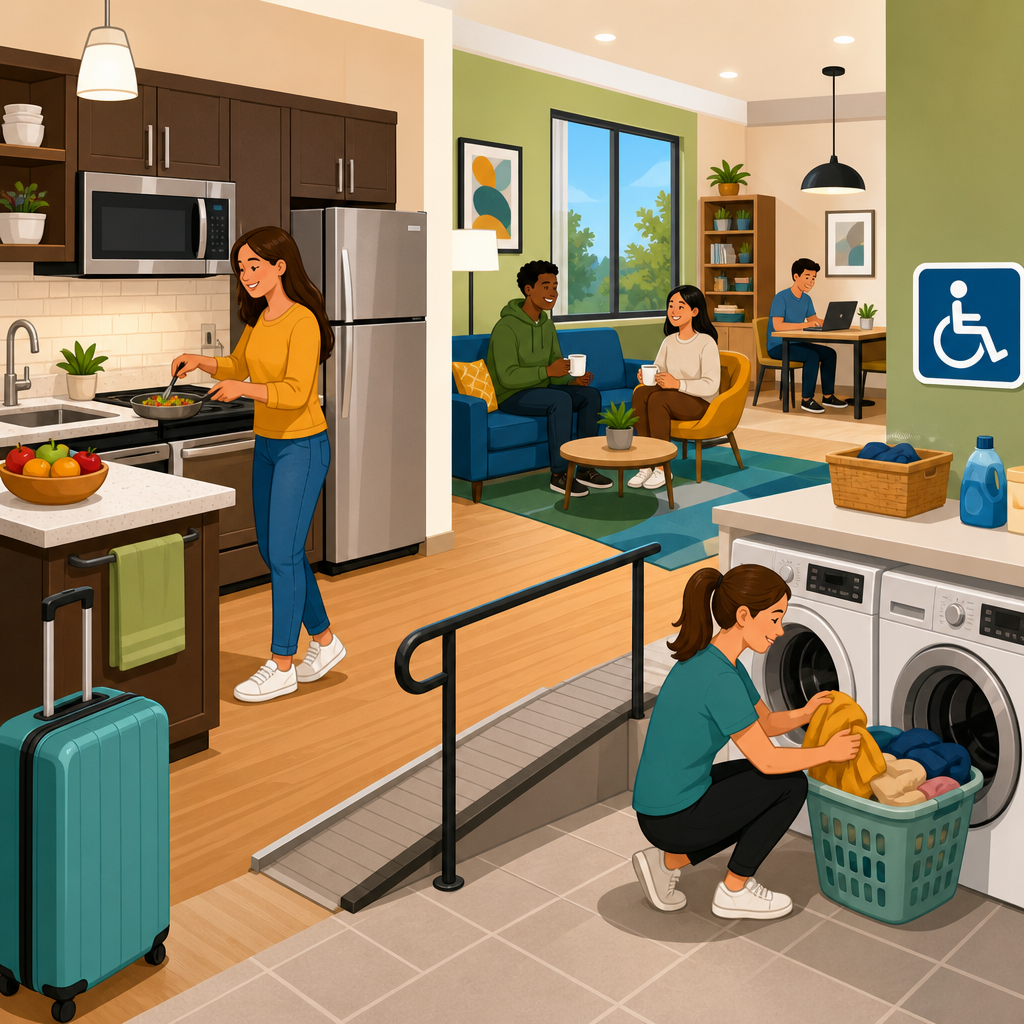
Extended-stay hotels occupy a distinct place in the hotels and lodging market because they are designed for guests who need more than a bed and bathroom. Business travelers on multiweek assignments, families relocating between homes, medical travelers, construction crews, and insurance-displacement guests all rely on properties that support daily living. In practice, that means the three most important features are not decorative lobbies or banquet rooms. They are functional kitchens, dependable laundry, and common area accessibility that allows every guest to use the property with dignity, safety, and reasonable independence.
Within hotels and lodging, an extended-stay hotel generally combines private guest rooms or suites with residential-style amenities. Most properties offer in-room kitchenettes or full kitchens, self-service laundry or valet options, and shared spaces such as breakfast rooms, business centers, fitness rooms, patios, and front-desk areas. The accessibility component matters just as much as the amenities themselves. A kitchen is only useful if countertops, clearances, controls, and storage can be reached. Laundry only helps if machines, pathways, and payment systems can be used by guests with mobility, sensory, or cognitive disabilities. Common areas only meet their purpose when routes, seating, signage, and service counters are accessible.
I have evaluated lodging properties where a room was labeled accessible, yet the laundry room door was too heavy, the ice machine alcove was unusable from a wheelchair, and the breakfast area had no practical turning space during peak hours. Those details shape guest satisfaction more than marketing photos do. They also influence risk, reputation, and compliance. In the United States, design and operations are commonly evaluated against the Americans with Disabilities Act Standards for Accessible Design, while brand standards, state codes, and local building requirements may add further obligations. For operators, owners, and developers, understanding these basics is not optional. It is central to guest experience, revenue protection, and long-stay retention.
This hub article covers the full extended-stay hotels topic within hotels and lodging, with special attention to kitchens, laundry, and common area accessibility. It explains what guests need, how operators should assess a property, what features matter most, and where tradeoffs appear in older buildings, conversions, and new construction. It also points to the wider subtopics that typically sit beneath this hub, including guest room design, wayfinding, maintenance protocols, procurement, and digital booking information. The goal is simple: give decision-makers and researchers a practical framework for evaluating extended-stay lodging in real-world conditions.
What defines an extended-stay hotel in hotels and lodging
An extended-stay hotel is built or operated for guests who remain longer than the average transient hotel visitor. Length of stay varies by market and brand, but the operating model typically assumes stays of five nights, several weeks, or even months. That changes everything from housekeeping schedules to room layouts. Standard hotels optimize for short turnover and compact amenities. Extended-stay properties optimize for routine. Guests need to refrigerate groceries, cook basic meals, wash clothes, unpack supplies, work at a table, and move through the building repeatedly without friction.
The most common formats include economy extended-stay, midscale all-suite, upscale residential-style, and mixed-use aparthotel concepts. Brands such as Residence Inn, Homewood Suites, TownePlace Suites, Hyatt House, Candlewood Suites, and WoodSpring Suites illustrate how the segment spans different price points and service levels. Despite those differences, the same operational question applies: can the property support ordinary living tasks for a diverse guest population? Kitchens, laundry, and common areas answer that question more directly than room décor ever will.
From a hub perspective, this subtopic connects to several essential lodging disciplines. Design teams must think about circulation, appliance specification, and durable finishes. Revenue and marketing teams must describe accessible features accurately online. Housekeeping and engineering must maintain appliances, door hardware, flooring transitions, and clear floor space. Front-desk staff must understand which rooms have roll-in showers, hearing-accessible communication features, lowered counters, or nearby laundry access. In other words, extended-stay accessibility is not a single checklist item. It is a property-wide operating system.
Kitchens: the feature that determines whether a stay actually works
For extended-stay guests, the kitchen is usually the deciding feature. It reduces meal costs, supports dietary restrictions, and makes a room feel livable rather than temporary. A useful extended-stay kitchen usually includes a refrigerator of practical size, microwave, cooktop or range, sink, counter workspace, and storage for utensils and food. Better versions add a dishwasher, adjustable shelving, lever-style faucet controls, task lighting, and outlets positioned where small appliances can be used safely.
Accessibility in kitchen design is highly specific. Guests using mobility devices need clear floor space to approach appliances, turn, and reposition. Reach ranges matter for microwaves, controls, and shelves. Knee and toe clearance under sinks or work surfaces can determine whether meal prep is possible. Controls should be operable without tight grasping, pinching, or twisting. Visual contrast helps guests with low vision locate edges, handles, and controls. Audible appliance signals should be paired with visual indicators where possible. In my assessments, the most common failure is not total absence of equipment; it is partial usability, such as a lowered sink paired with inaccessible overhead storage and a microwave mounted too high to use safely.
Operators should also distinguish between minimum compliance and functional usability. A kitchenette can technically exist while still frustrating a guest every day. Functional design means there is enough landing space near the microwave, enough room to open the refrigerator door fully, and enough maneuvering clearance so a wheelchair user does not have to reverse out of a dead-end alcove. It also means routine safety measures: anti-tip range brackets where applicable, easy-to-read appliance instructions, and ventilation that controls odors without creating hard-to-operate switches or excessive noise.
Laundry design and operations for longer stays
Laundry is one of the highest-value amenities in extended-stay hotels because it directly affects packing, cleanliness, and comfort. Guests on two-week assignments can pack half as much if laundry is dependable. Families traveling with children may need daily access. Medical travelers may need to wash bedding or clothing more frequently. For operators, well-planned laundry reduces linens pressure because guests can handle personal items without relying on housekeeping.
There are three typical models: in-room laundry in premium suites, central guest laundry rooms, and outsourced or valet service layered on top of self-service equipment. Central laundry remains the most common because it balances cost, maintenance, and space efficiency. However, accessibility often breaks down here. I routinely see front-loading machines placed on high pedestals, narrow rooms that block side approach, token systems mounted out of reach, and detergent dispensers positioned above accessible reach ranges. Even when the machines themselves are technically suitable, the route to the room may include heavy fire doors, abrupt thresholds, or clutter from housekeeping carts.
Good laundry access requires more than one compliant machine. It requires an accessible route, readable instructions, convenient seating nearby, and payment methods that do not depend on fine motor precision or a small dim touchscreen. Digital app-based payment can help some guests and exclude others, so the best operations provide options. Signage should identify machine availability clearly, and staff should be prepared to explain hours, detergent sales, and alternative arrangements if a machine is out of order. In long-stay lodging, an unavailable laundry room is not a small inconvenience; it disrupts the guest’s weekly routine.
| Feature | What good practice looks like | Common failure point | Guest impact |
|---|---|---|---|
| Kitchen layout | Clear turning space, reachable controls, usable counter area | Appliances crammed into narrow alcoves | Guest cannot cook safely or independently |
| Laundry room | Accessible route, front-loading machines, reachable payment system | Raised machines, heavy doors, blocked pathways | Guest must seek staff help for routine tasks |
| Common seating | Mixed seating heights and integrated wheelchair spaces | Fixed furniture with no flexible spacing | Guest is separated from companions |
| Service counters | Lowered transaction area with clear communication | Single high counter and poor sightlines | Check-in becomes awkward and slow |
Common area accessibility across the guest journey
Common area accessibility begins before check-in. Parking, passenger loading zones, sidewalk connections, entrance doors, and weather protection all affect whether a guest can enter the property confidently. Once inside, the front desk should support both physical and communication access. A lowered transaction surface is important, but so are good lighting, reduced background noise, hearing-accessible communication options, and staff who know how to provide directions without vague phrases like “right over there.”
Breakfast areas and lounges require especially careful planning because furniture arrangements change. Accessible routes can disappear when operators add promotional displays, luggage carts, or extra chairs during busy periods. Wheelchair spaces should be integrated rather than isolated at the room edge. Tables need usable knee clearance. Buffets should be evaluated for reach range, utensil weight, sneeze guard visibility, and circulation width during peak service. If self-service is not fully usable, staff assistance should be prompt and normalized instead of treated as an exception.
Other common spaces matter too. Fitness rooms need route access, intuitive equipment spacing, and at least some equipment choices that can be used by a wider range of guests. Business centers should include reachable work surfaces and assistive technology compatibility. Outdoor areas such as grills, courtyards, and pet relief zones must be connected by stable, slip-resistant routes. Public restrooms should be located logically and signed clearly. Elevators need visible and audible floor indicators, sufficient cab size, and call buttons placed consistently.
Accessibility also includes wayfinding and cognitive load. Guests who are tired, stressed, jet-lagged, or managing a disability benefit from plain-language signage, logical numbering, uncluttered circulation, and staff explanations that match the building layout. In older converted properties, confusing routes often create as much friction as physical barriers do. A well-run hotel does not force guests to decode the building.
Operational standards, compliance, and staff execution
In hotels and lodging, accessibility succeeds or fails operationally, not just architecturally. A property may open in compliance and drift into poor performance through maintenance gaps and bad habits. Door closers become too strong. Furniture migrates into routes. Laundry rooms become storage areas. Kitchen replacement appliances arrive with different dimensions that erase clear floor space. Online room descriptions become inaccurate after renovations. These are management failures, not design accidents.
Strong operators use recurring audits based on the ADA Standards for Accessible Design, brand standards, preventive maintenance logs, and guest feedback. They train staff to understand the difference between an accessible feature and a preference. If a guest books an accessible suite because they need a roll-in shower and reachable kitchen controls, moving them casually to a standard room is not acceptable service recovery. Reservation systems, front-desk procedures, and housekeeping notes should preserve those requirements accurately from booking through checkout.
Procurement choices also matter. Appliances, door hardware, seating, laundry equipment, and signage should be selected with usability in mind, not just purchase price. When I have worked on renovation reviews, the best value rarely comes from the cheapest fixture. It comes from products that are durable, intuitive, and dimensionally compatible with accessible layouts. Operators should document model numbers, replacement specs, and acceptable tolerances before failures happen. That prevents emergency substitutions that break room usability.
How this hub connects to the wider hotels and lodging subtopic
As a hub for hotels and lodging under industry-specific guides, this page should connect readers to the major supporting articles that make the topic actionable. Those supporting articles typically include accessible guest room types, bathroom layouts, reservation disclosures, public restroom compliance, pool and fitness access, breakfast service design, renovation planning, emergency egress, housekeeping protocols, and digital accessibility for hotel websites. Extended-stay hotels sit at the center of these issues because longer visits expose every operational weakness. A two-night guest may overlook a poor laundry room. A thirty-night guest will not.
The central lesson is that kitchens, laundry, and common area accessibility are not niche concerns. They define whether extended-stay lodging performs its core promise: helping people live temporarily without losing independence or routine. Owners, operators, developers, and travel planners should evaluate these spaces with the same seriousness they apply to occupancy, ADR, and review scores. Walk the route. Test the appliances. Read the signage. Sit at the tables. Use the laundry payment system. Verify online descriptions. Those practical checks reveal what glossy property pages never do.
When extended-stay hotels get these fundamentals right, guest satisfaction rises because ordinary tasks become easy. Staff interventions decrease because spaces work as intended. Risk falls because barriers are identified early. Most important, more travelers can use the property comfortably and confidently. If you manage, design, procure for, or book hotels and lodging, use this article as your starting point and build outward into the connected subtopics that shape a genuinely accessible extended-stay experience.
Frequently Asked Questions
What makes an extended-stay hotel different from a standard hotel when it comes to kitchens, laundry, and common areas?
Extended-stay hotels are built around the needs of guests who are living on-site for days, weeks, or even months, not simply sleeping there overnight. That difference shows up most clearly in the practical amenities. In a standard hotel, a guest may get a mini-fridge, a coffee maker, and access to paid laundry somewhere on the property. In an extended-stay setting, the expectation is much closer to apartment-style functionality: a usable in-room kitchen, reliable laundry access, and common areas that support daily routines rather than occasional convenience.
A true extended-stay kitchen typically includes a larger refrigerator, microwave, cooktop or stovetop, sink, counter space, and storage for groceries and cookware. That setup allows guests to prepare meals consistently, which can significantly reduce food costs and support dietary, religious, or medical needs. Laundry is equally important because long-term guests cannot reasonably depend on packing enough clothing for an entire stay. On-site self-service laundry, ample machine availability, clear hours, and accessible design all make a major difference in quality of life.
Common areas also serve a different purpose in extended-stay properties. Instead of being purely decorative, they often function as spillover living space, informal work space, or places for social connection and routine. Guests may use lounges, outdoor seating areas, fitness rooms, business centers, and breakfast areas repeatedly over a long period, so accessibility, comfort, and ease of use matter more than appearance alone. In short, extended-stay hotels are distinguished by how well they support normal day-to-day living, and kitchens, laundry, and accessible common areas are at the center of that promise.
What should guests look for in an extended-stay hotel kitchen?
The most important thing to verify is whether the kitchen is truly functional for regular meal preparation, not just marketed as a “kitchenette.” That means looking beyond a microwave and mini-fridge. Guests should confirm whether the room includes a full-size or apartment-size refrigerator, a two-burner or full cooktop, a sink, food-prep counter space, and basic storage cabinets or shelving. If a guest plans to stay for several weeks, these details directly affect both comfort and budget.
It is also wise to ask what kitchen equipment is actually included. Some extended-stay hotels provide pots, pans, plates, cups, utensils, cutting boards, and cooking tools in every room, while others provide them only upon request. Knowing this in advance helps guests avoid unnecessary purchases or frustrating first-night workarounds. Guests with specific cooking habits should also ask about freezer space, ventilation, dishwashing options, and whether the cookware setup is suitable for regular use rather than occasional reheating.
Accessibility is another major consideration. Guests with mobility limitations may need to ask about sink clearance, reachable cabinet heights, appliance controls, maneuvering space, and the layout between counters and entry paths. For some travelers, a kitchen that technically exists but is hard to use independently may not meet their needs. The best extended-stay properties understand that kitchen design is not only about features, but also about practical usability. A well-equipped, well-laid-out kitchen can turn a long hotel stay from inconvenient to sustainable.
How important is on-site laundry in an extended-stay hotel?
On-site laundry is one of the most essential services in any extended-stay hotel because it supports the basic rhythm of everyday living. Guests staying for multiple weeks cannot function comfortably without a dependable way to wash clothes, towels, uniforms, workout gear, and bedding-related items. This is especially true for business travelers, medical travelers, families with children, construction and field crews, and anyone relocating between homes. Laundry access is not a luxury in these situations; it is a core operational feature of the property.
When evaluating laundry, guests should look at more than whether machines exist. Important questions include how many washers and dryers are available, whether they are regularly maintained, whether they are coin-operated or app-based, what the operating hours are, and whether peak demand creates long wait times. For longer stays, laundry rooms that are consistently clean, well-lit, ventilated, and easy to access are far more valuable than a nominal laundry offering that is frequently out of service or difficult to use.
Accessibility matters here as well. Guests may need step-free access, wide pathways, front-loading machines positioned at usable heights, seating nearby, readable instructions, and payment systems that do not create barriers. Families may also appreciate laundry rooms located in convenient, visible areas rather than isolated corners of the property. In practical terms, dependable on-site laundry saves time, reduces packing needs, lowers outside laundry costs, and contributes significantly to the overall livability of an extended-stay hotel.
Why does common area accessibility matter so much in extended-stay hotels?
Common area accessibility matters because long-term guests use shared spaces much more frequently and for more purposes than short-term travelers typically do. In an extended-stay environment, the lobby, breakfast area, lounge, patio, fitness room, business center, and outdoor spaces often become part of a guest’s routine. These are places where people work remotely, meet visitors, take a break from their room, eat, make phone calls, watch children, or simply maintain a sense of normalcy during a disruptive life period.
If those areas are hard to reach, crowded, poorly arranged, or not designed with accessibility in mind, the inconvenience compounds over time. Guests may encounter barriers such as heavy doors, narrow furniture layouts, inaccessible seating heights, limited elevator access, steep exterior routes, or poorly marked pathways. For individuals using wheelchairs or walkers, guests with visual impairments, older adults, or anyone carrying laundry, groceries, or work equipment, these design issues can materially affect whether the property is comfortable and usable.
Accessible common areas also support social and emotional well-being. Many extended-stay guests are in transition: moving, working away from home, recovering from treatment, or displaced by insurance claims. Welcoming, easy-to-navigate shared spaces can reduce isolation and stress while giving guests room to function beyond the four walls of their suite. From a property standards perspective, common area accessibility is not only about compliance. It is about making the hotel genuinely livable for a diverse range of long-term guests.
How can guests confirm that an extended-stay hotel will meet their daily living needs before booking?
The best approach is to verify details directly with the property rather than relying only on broad amenity lists on a booking site. Terms like “kitchen,” “laundry available,” and “accessible common areas” can mean very different things from one hotel to another. Guests should call the property and ask specific questions: What appliances are in the room? Is cookware included? How many laundry machines are on-site? Are they available 24 hours? Which common areas are accessible by elevator or step-free route? Are there accessible guest rooms with usable kitchen layouts?
It is also helpful to explain the purpose of the stay. A guest on a six-week work assignment may have different needs than a family displaced during a home repair or a medical traveler staying near a hospital. By describing those needs clearly, guests often get more useful answers from staff about room configurations, floor plans, quieter locations, grocery proximity, parking convenience, and practical limitations that may not appear online. This is especially important when accessibility needs are involved, because photos and generic descriptions rarely tell the whole story.
Reading recent reviews can provide additional context, especially comments about kitchen usability, laundry reliability, cleanliness, and how well shared spaces function during busy periods. Still, direct confirmation remains the most reliable step. For an extended-stay booking, guests are not just choosing a place to sleep. They are choosing a temporary living environment. The more clearly they confirm the details of kitchens, laundry, and common area accessibility before arrival, the more likely the stay will be comfortable, efficient, and genuinely supportive of everyday life.


