The Americans with Disabilities Act (ADA) was landmark legislation passed in 1990, designed to ensure that individuals with disabilities receive the same rights and opportunities as everyone else. The ADA revolutionized access to public spaces, education, employment, and more, setting the stage for a more inclusive society. As we now stand on the cusp of a new revolution marked by artificial intelligence (AI) and automation, it’s important to explore how the ADA remains applicable in this dynamic environment.
From smart technologies in workplaces to AI-driven recruitment processes, automation and AI are transforming the way we live and work. However, while these technologies promise increased efficiency and productivity, they also pose significant challenges and opportunities for individuals with disabilities. How can AI systems be designed to be inclusive? What role does the ADA play in guiding these transformative technologies?
This article aims to provide a comprehensive overview of the Americans with Disabilities Act with a special focus on its implications in the age of AI and automation. We’ll explore the key sections of the ADA, address how AI and automation are impacting these areas, and discuss steps for ensuring that emerging technologies are used to enhance, rather than hinder, accessibility and inclusion.
The ADA: An Overview
The Americans with Disabilities Act is a civil rights law that prohibits discrimination against individuals with disabilities in all areas of public life. This includes jobs, schools, transportation, and all public and private places open to the general public. The ADA ensures that people with disabilities have the same rights and opportunities as everyone else.
The law is divided into five titles:
- Title I: Employment – Prevents discrimination in the workplace and ensures reasonable accommodations.
- Title II: Public Services – Requires state and local governments to provide equal access to services.
- Title III: Public Accommodations – Prevents discrimination in public places like restaurants and stores.
- Title IV: Telecommunications – Mandates accessible telecommunication services.
- Title V: Miscellaneous Provisions – Contains various regulations to ensure the act’s intent is being met.
These titles collectively ensure that the fundamental principle of equality and non-discrimination is upheld. But like any law, the ADA must adapt to new challenges and technologies, and AI and automation are no exception.
AI and Employment: Inclusivity Challenges and Solutions
AI-driven recruitment systems are increasingly being used by employers to streamline hiring processes. These systems often use algorithms to screen resumes, assess candidate suitability, and even conduct initial interviews through AI-powered chatbots. While this can help to eliminate human bias to some extent, it can also inadvertently introduce new forms of discrimination.
For example, if an AI system is trained on data that lacks diversity or incorporates biased assumptions, it can unknowingly exclude qualified candidates with disabilities. Additionally, online application processes may present accessibility challenges if they are not designed with inclusivity in mind.
To align with the ADA, employers must ensure that AI tools are accessible and do not discriminate against candidates with disabilities. This includes:
- Designing AI systems with diverse data sets to minimize bias.
- Implementing regular audits to ensure compliance with ADA requirements.
- Offering alternative application processes for individuals who cannot access digital platforms.
- Providing necessary accommodations during AI-driven interview processes, like allowing assistive technology.
Ultimately, the use of AI in employment must be carefully managed to ensure it enhances rather than undermines accessibility and inclusivity.
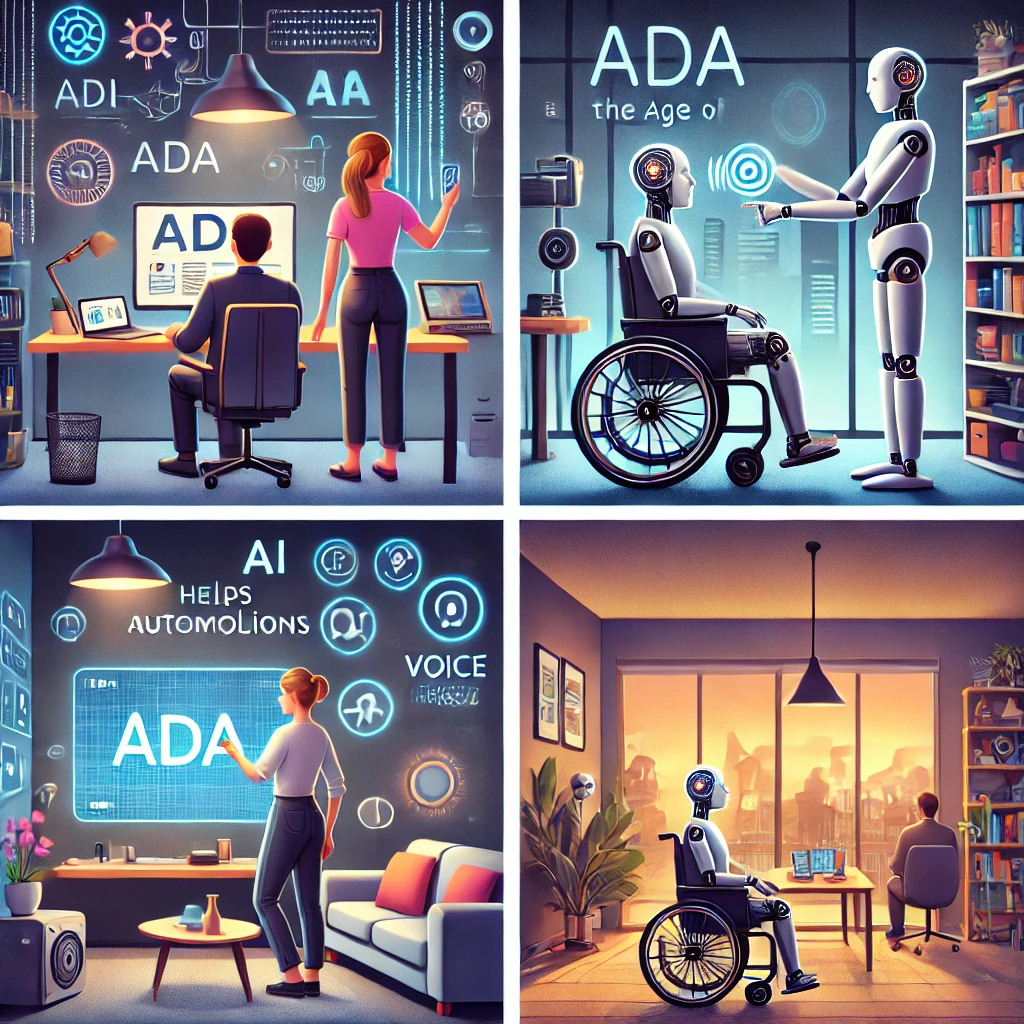
Public Services and Smart Cities: A New Frontier for Accessibility
Smart cities leverage AI and automation to improve urban living, from traffic management to waste collection. However, the incorporation of these technologies must consider the needs of individuals with disabilities to comply with Title II of the ADA.
For instance, AI-powered traffic signals could be programmed to provide longer crossing times for individuals with mobility impairments. Public transport systems could use AI to offer real-time updates and personalized routes for individuals with visual impairments. However, without thoughtful implementation, these technologies risk excluding individuals with disabilities.
To align with the ADA, public services and city planners should:
- Engage with the disability community during the planning phase to identify needs and challenges.
- Ensure that AI-driven public services are fully accessible, providing features like audio descriptions and easy-to-navigate interfaces.
- Implement training for officials and service providers on the use of new technologies in accessible ways.
Smart cities offer a tremendous opportunity to enhance the inclusivity and accessibility of public services, but it requires a committed focus on adhering to ADA principles.
Public Accommodations and AI: Improving Access in Retail and Hospitality
AI technologies are currently revolutionizing the retail and hospitality industries. From AI-driven customer service bots to automated check-ins, these advancements promise to enhance customer experiences. However, it’s imperative that these technologies comply with Title III of the ADA, which ensures accessibility in public accommodations.
Automated kiosks in stores and hotels must be designed to be accessible to individuals with visual, auditory, or mobility impairments. For instance, touchscreens should be compatible with screen readers, and voice-activated services must understand and respond accurately to diverse speech patterns.
Steps to ensure ADA compliance in public accommodations include:
- Conducting accessibility audits for all AI-powered interfaces.
- Providing alternative methods for interaction that do not rely on a single sense (e.g., providing both visual and auditory feedback).
- Engaging with accessibility experts during the design and deployment phases of new technologies.
Retail and hospitality businesses must recognize that accessibility is not just a legal requirement under the ADA but also a valuable aspect of customer service that can enhance overall user experience.
Telecommunications: Ensuring Accessible Communication with AI
Title IV of the ADA focuses on making telecommunications accessible to individuals with disabilities. With the integration of AI, there’s a significant opportunity to enhance accessible communication. Voice recognition systems, automated customer service, and AI-driven content generation must all meet ADA standards for accessibility.
For instance, AI-driven customer service should be capable of understanding and responding to varied speech patterns without bias. Automated transcription services should provide accurate captions for individuals who are deaf or hard of hearing. Similarly, AI can be used to offer real-time text-to-speech and speech-to-text services, making communication more inclusive.
To ensure ADA compliance:
- AI systems must be thoroughly tested for accuracy with inputs from individuals with various disabilities.
- Ensure that all forms of AI-driven communication are accessible and provide multiple modes of interaction.
- Regularly update and train AI systems with new accessibility data and feedback.
Telecommunication companies must maintain a proactive approach to ensure their AI technologies are not only innovative but also inclusive, aligning with the basic principles of the ADA.
Conclusion
The ADA has been a cornerstone of disability rights for over three decades, transforming society by ensuring equal access and opportunities for individuals with disabilities. As we move into an age increasingly defined by AI and automation, it is crucial that these technologies adhere to the principles established by the ADA.
By designing AI systems that are inclusive and accessible from the outset, engaging with the disability community for feedback, and maintaining a commitment to regular accessibility audits, society can harness the power of AI to advance the rights and opportunities of individuals with disabilities.
Ultimately, the challenge is not just to comply with the ADA but to use it as a framework to create a more inclusive and accessible future. As policymakers, technologists, and advocates work together, the principles of the ADA can guide the ethical and inclusive development of AI and automation, ensuring that progress benefits everyone, including individuals with disabilities.
Frequently Asked Questions
1. What is the Americans with Disabilities Act (ADA), and why is it important in the age of AI and automation?
The Americans with Disabilities Act (ADA), enacted in 1990, is a piece of cornerstone civil rights legislation that aims to ensure individuals with disabilities have the same rights and opportunities as everyone else. Its importance cannot be overstated; it has significantly revolutionized access to public spaces, education, employment, public transportation, and telecommunications, leading to a more inclusive society. As we advance into an era heavily influenced by artificial intelligence (AI) and automation, the ADA’s significance remains paramount. In one sense, AI and automation have the potential to facilitate greater inclusion and accessibility through innovative solutions like voice-controlled devices, AI-powered assistants, and automated transportation. Yet, this same technological advancement also presents new risks and challenges regarding accessibility. It’s critical to ensure that AI and automation solutions do not inadvertently create digital barriers or exclude people with disabilities. By continuing to uphold ADA compliance within this rapidly evolving landscape, we can harness the power of AI and automation responsibly, fostering an environment where new technologies empower rather than hinder, providing equitable access and opportunity for all people, regardless of physical or mental ability.
2. How does ADA compliance apply to AI and automated technologies?
ADA compliance is about ensuring accessibility and equal opportunity for individuals with disabilities – principles that become increasingly relevant as AI and automated technologies proliferate in every facet of modern life. When we develop AI and automated systems, ADA compliance requires that these technologies are accessible to all users, including those with disabilities. This means designing user interfaces that are screen reader compatible, ensuring that all visual and audio outputs have text alternatives, and carefully considering how individuals with various types of disabilities will interact with the tool. Furthermore, the output and behavior of AI systems should not be biased or discriminatory against individuals with disabilities. This implies rigorous testing and validation of AI models to ensure fair treatment and representation. Compliance also involves being proactive, rather than reactive, in addressing accessibility, meaning that the inception of a new AI or automated system should include accessibility as a core component, not an afterthought. Training and awareness are crucial elements alongside technical measures, as they ensure everyone involved in the production, implementation, and maintenance of AI technologies understands the importance of accessibility in alignment with ADA standards.
3. What are some examples of ADA compliance concerns with AI technologies?
AI technologies offer incredible prospects, but they also bring specific ADA compliance challenges. One noticeable concern is the potential for bias in AI-driven hiring algorithms, which may unintentionally disadvantage individuals with disabilities. If these algorithms are trained on data sets that do not adequately represent people with disabilities, they could perpetuate existing biases. Moreover, AI-powered customer service and virtual assistant tools need to function seamlessly with assistive technologies like screen readers. If these systems aren’t compatible, individuals who rely on assistive tech could find these services inaccessible. Automated kiosks in public spaces and workplaces also pose compliance issues if they lack accommodations for people with visual or audible impairments. For instance, if a touch screen lacks Braille or audio alternatives, it will not meet accessibility needs. Finally, the rising prevalence of autonomous vehicles brings consideration for ADA compliance to the forefront, particularly in ensuring fully accessible design for individuals using wheelchairs, besides incorporating advanced speech recognition and other assistive technology-friendly features. Addressing these concerns is not merely a compliance mandate but an opportunity to innovate in making AI systems that are inclusive and beneficial for the widest possible audience.
4. How can businesses and organizations ensure their AI solutions are ADA compliant?
Ensuring AI solutions are ADA compliant involves a multi-faceted approach that includes inclusive design, testing, and continuous improvement. Primarily, businesses and organizations should integrate accessibility principles from the early design phases of their AI or automated products. This means involving people with diverse disabilities in the testing and feedback loop processes to identify potential accessibility barriers early. Additionally, it’s crucial to follow established guidelines and standards, such as the Web Content Accessibility Guidelines (WCAG), which can assist in tailoring digital experiences to be more inclusive. Continuous monitoring and updates are essential, as AI and automated technologies evolve rapidly and require adaptation to maintain compliance. Providing training for development teams on ADA requirements and accessibility best practices ensures everyone involved understands the significance of creating inclusive systems. Furthermore, engaging with accessibility experts can provide valuable insights and strategies for maintaining compliance. With the right approach, businesses and organizations can ensure that their AI technologies are not only compliant but also enhance accessibility for users with disabilities, offering transformative benefits across diverse communities.
5. What role can AI play in enhancing ADA compliance and accessibility in the future?
AI has great potential to elevate ADA compliance and accessibility by providing innovative solutions to long-standing challenges faced by individuals with disabilities. For instance, AI-powered speech recognition and natural language processing can create more intuitive voice-controlled interfaces, making digital resources more accessible to users with physical or visual impairments. Machine learning algorithms can help personalize accessibility settings by learning individual user preferences and automatically adjusting interfaces to their needs, improving user experience across various platforms and devices. Real-time translation services can enhance communication for the hearing impaired, while AI can assist in developing more accurate and responsive screen readers for the visually impaired. Importantly, by processing large sets of data, AI can identify patterns that suggest which accessibility features are most critical, allowing developers to focus their efforts effectively. With responsible development and adherence to ADA principles, AI can indeed transform accessibility, turning technological barriers into supportive tools that facilitate inclusivity and equal opportunity. Looking ahead, AI can play a crucial role in building a future where technologies enhance human potential and provide universal accessibility for all individuals, regardless of their abilities.