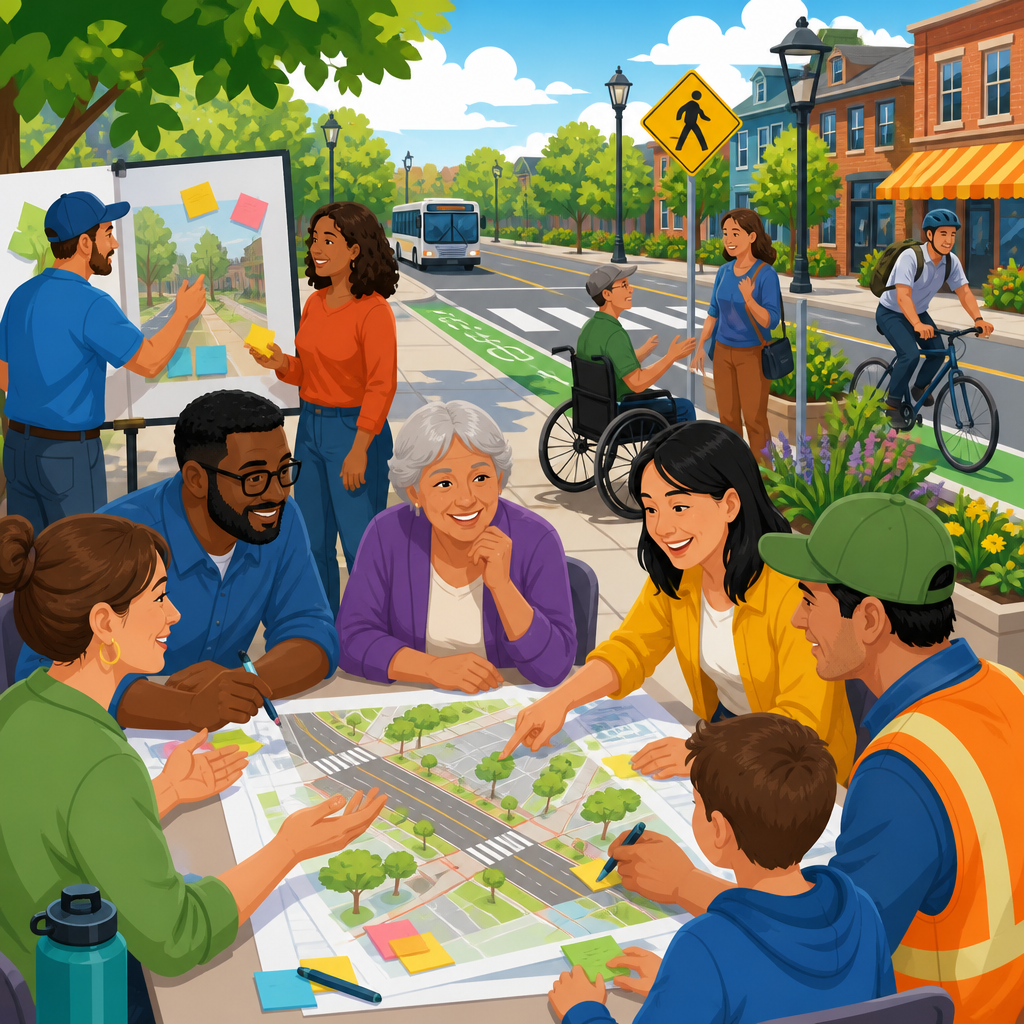
Community engagement tactics for public right-of-way projects determine whether a sidewalk upgrade, curb ramp retrofit, transit stop improvement, or streetscape reconstruction is accepted as a community asset or opposed as a disruptive mandate. In this context, public right-of-way projects include sidewalks, shared-use paths, street crossings, on-street parking interfaces, pedestrian signals, and transit boarding areas located within public streets and easements. Community engagement means the structured process of informing, listening to, and collaborating with residents, businesses, disability advocates, maintenance staff, transportation agencies, and elected officials throughout planning, design, construction, and post-construction evaluation. Advanced ADA support goes beyond minimum legal compliance by integrating accessibility expertise early, validating designs with people who have disabilities, and resolving barriers before they become claims, delays, or unsafe built conditions.
This topic matters because right-of-way work affects daily life at the most local level. A single missing detectable warning, excessive cross slope, inaccessible temporary route, or poorly placed utility pole can limit travel for wheelchair users, blind pedestrians, older adults, parents with strollers, and transit riders. I have seen technically compliant plans fail in public meetings because agencies treated outreach as a notice requirement instead of a design input system. I have also seen modest projects gain broad support when teams mapped stakeholders early, used plain language, documented tradeoffs, and returned with revised drawings that clearly reflected community feedback. For agencies building a durable Resources and Support program, this hub explains the methods, standards, and decision practices that connect community engagement and advanced ADA support into one repeatable delivery approach.
Start with an engagement framework tied to project decisions
Effective outreach begins by identifying which decisions the public can influence and when those decisions are still open. For public right-of-way projects, the most consequential engagement windows usually occur during existing conditions assessment, concept development, preliminary design, maintenance of traffic planning, and construction sequencing. If outreach starts after geometric design is fixed, the public can comment but cannot meaningfully shape outcomes. A better approach is to publish a decision calendar that shows when the team will define pedestrian routes, crossing locations, curb ramp layouts, accessible pedestrian signal needs, driveway treatments, bus stop interfaces, and temporary pedestrian access routes. This makes engagement credible because people can see how their input connects to design choices.
Teams should classify stakeholders by lived experience and operational responsibility, not only by geography. Residents with mobility impairments, blind or low-vision travelers, paratransit users, school administrators, downtown merchants, emergency responders, maintenance crews, and utility owners each experience different barriers and constraints. On one corridor improvement program I supported, maintenance staff identified recurring ponding at a crossing where the public had focused on signal timing. Addressing drainage and timing together prevented a future accessibility failure. That is the core lesson: engagement is not a public relations layer; it is a data collection method that improves design quality, risk control, and long-term usability.
Center accessibility standards without reducing the conversation to compliance
Advanced ADA support requires teams to know the governing accessibility framework and also understand where judgment is still required. Agencies commonly rely on the 2010 ADA Standards for Accessible Design for facilities covered by the ADA, Section 504 obligations for recipients of federal funding, MUTCD requirements for traffic control devices, and the Public Rights-of-Way Accessibility Guidelines as a technical benchmark for sidewalks, curb ramps, blended transitions, pedestrian street crossings, on-street parking, and transit stop connections. Even when a jurisdiction has its own standards, project teams should cross-check local details against these recognized references. Community members rarely ask for standards by name, but they quickly recognize when a route feels unsafe, confusing, steep, or incomplete.
The most productive engagement translates technical criteria into observable conditions. Instead of asking whether the public supports “ADA improvements,” ask whether people can travel continuously from parking or transit to a destination without steps, abrupt level changes, inaccessible pushbuttons, blocked sidewalks, or missing detectable warnings. Instead of discussing only running slope and cross slope, explain how steep side slopes can tip a wheelchair or direct a cane user off path. This framing improves meeting quality because participants respond to real travel tasks, not abstract code language. It also helps agencies explain tradeoffs when strict ideal dimensions are constrained by historic buildings, drainage systems, utilities, or narrow right-of-way. Compliance remains nonnegotiable, but understanding lived experience leads to better design choices within those constraints.
Use multiple outreach channels and remove participation barriers
Public right-of-way projects serve everyone, so outreach cannot rely on a single evening meeting or a project website with PDFs. Agencies should combine in-person pop-ups, accessible virtual briefings, intercept interviews at transit stops, mailed notices, translated fact sheets, text-message updates, and small-group sessions with disability organizations. Every channel must be accessible. That means captioned videos, alt text for graphics, screen-reader-friendly documents, high-contrast maps, plain-language summaries, and meeting venues on accessible routes with functioning restrooms and hearing assistance. If interpreters are needed, schedule them proactively rather than waiting for a late request. These details are not extras; they shape who participates and whose knowledge enters the project record.
Removing barriers also means compensating people for expertise when appropriate. Disability advocates and community-based organizations are often asked to review plans, test routes, and educate agencies without support. Stipends, travel reimbursement, child care, and flexible meeting times increase participation and improve feedback quality. I have found that a ninety-minute field walk with local wheelchair users and blind pedestrians can reveal more actionable issues than weeks of generalized comments. Participants point out utility covers in clear space, channelization that funnels pedestrians into conflict zones, and crossing alignments that look acceptable on plan sheets but fail under real orientation conditions. Good outreach tools gather that evidence in a structured format so it can be traced into design revisions and construction notes.
Build a field-based ADA review process into engagement
The strongest community engagement for right-of-way work happens on site. Plans matter, but accessibility barriers become obvious when teams walk or roll the corridor with users who encounter those conditions daily. A field-based ADA review should include route continuity checks, surface condition documentation, crossing distance measurements, curb ramp orientation review, pushbutton reach and locator tone assessment where applicable, transit stop boarding and alighting evaluation, and temporary route planning for construction phases. Photos should be geolocated and tied to issue categories so the design team can resolve them systematically rather than anecdotally.
Field reviews are especially valuable at complex interfaces: skewed intersections, slip lanes, channelized right turns, constrained downtown corners, older neighborhoods with narrow parkways, and corridors with frequent driveways. At these locations, a small drafting decision can create a major accessibility consequence. For example, shifting a curb ramp a few feet may improve drainage but worsen alignment across a wide crossing. Extending a bus pad may create accessible boarding but pinch the through pedestrian zone unless utility relocations are coordinated. Agencies should document these conflicts in an issue log that records the constraint, applicable standard, community concern, options considered, and final decision. That record becomes essential during review, construction, and future audits.
Turn public input into design actions and transparent tradeoffs
Community trust depends less on how many comments are collected than on how clearly comments change the project. Every public right-of-way project should maintain a comment-to-action matrix that converts public input into discrete responses: accepted and incorporated, accepted for future phase, not feasible due to a defined constraint, or outside project scope. The explanation must be specific. Saying “not feasible” is inadequate. Saying “not feasible because the requested midblock crossing fails sight distance, conflicts with a signalized intersection 180 feet away, and would require major drainage reconstruction beyond current funding” is useful and defensible. Precision reduces frustration and shows respect.
Tradeoffs should also be visualized early. Residents may support wider sidewalks until they see parking removal. Businesses may support loading changes until they understand curbside time restrictions. Disability advocates may support shorter crossing distances but raise concern if curb extensions alter paratransit boarding. These are not contradictions; they are normal competing needs in limited right-of-way. Project teams should evaluate options against consistent criteria, including accessibility benefit, safety performance, maintenance burden, right-of-way impact, utility conflict, cost, and construction complexity.
| Decision Area | Community Question | Technical Check | Typical Tradeoff |
|---|---|---|---|
| Curb ramp location | Does the crossing line feel direct and understandable? | Landing, slope, flare, and detectable warning layout | Drainage and utility conflicts |
| Sidewalk widening | Can two wheelchair users pass comfortably? | Clear width, cross slope, obstruction offset | Parking or landscape reduction |
| Transit stop upgrade | Can riders board safely from a stable surface? | Boarding area dimensions and route connection | Shelter placement and driveway spacing |
| Temporary pedestrian route | Can people travel through construction without detours they cannot use? | Accessible route continuity and work zone protection | Contractor staging efficiency |
Plan construction communication and temporary access as core engagement tasks
Many agencies do thoughtful design outreach and then lose public confidence during construction. For pedestrians, especially people with disabilities, the work zone is often the project. Temporary access must therefore be treated as a major community engagement topic, not a contractor afterthought. Construction communication should tell people what route will close, when it will close, what accessible detour will be available, how long the condition will last, and who can fix problems in real time. The standard for success is practical usability, not merely signage installed on paper according to a traffic control sheet.
Temporary pedestrian access routes should be reviewed in the field before each phase shift. I recommend involving inspectors, the contractor superintendent, agency accessibility staff, and at least one local stakeholder group where feasible. Frequent failures include excessive detour distance, gravel or uneven surfaces, gaps at temporary ramps, signs placed in the pedestrian path, and inaccessible crossings at the detour terminus. Agencies that publish hotline numbers and respond within hours build trust quickly because users see that barriers will be corrected. This is also where advanced ADA support protects schedule and liability. A preventable temporary access complaint can escalate into formal grievances, redesign, and stop-work disruption. A proactive inspection and communication protocol is cheaper and safer.
Measure outcomes, support future articles, and build an internal knowledge hub
As the hub page within Resources and Support, this article should guide readers toward a repeatable knowledge system rather than a one-time outreach checklist. The best programs measure outcomes before, during, and after project delivery. Useful indicators include number and diversity of participants, percentage of materials provided in accessible formats, response time to accessibility complaints, documented design changes driven by public input, post-construction barrier findings, and maintenance issues reported within the first year. Agencies can pair these metrics with crash data, near-miss observations, transit boarding feedback, and walk audit results to understand whether engagement actually improved the corridor.
This hub also supports deeper companion content. Readers typically need focused guidance on ADA transition planning, curb ramp design review, accessible temporary traffic control, public meeting accessibility, transit stop compliance, and post-construction audits. Internal links to those subtopics strengthen the resource structure and help teams find detailed procedures when they move from policy to implementation. The hub’s role is to connect the full workflow: stakeholder mapping, standards review, field assessment, concept testing, documentation, construction communication, and performance measurement. When these pieces are coordinated, community engagement stops being episodic and becomes part of asset management, capital planning, and risk reduction across the public right-of-way program.
Community engagement tactics for public right-of-way projects work best when agencies treat accessibility, transparency, and field verification as inseparable. The central lesson is simple: people who use the corridor every day hold operational knowledge that drawings alone cannot provide, and that knowledge is essential for sidewalks, crossings, transit stops, and temporary routes that are truly usable. Strong programs define decision points early, invite affected users through accessible channels, test conditions in the field, translate comments into documented actions, and maintain communication through construction and beyond.
Advanced ADA support strengthens every stage of that process. It reduces the risk of noncompliant details, improves public trust, helps teams explain tradeoffs honestly, and creates a clearer record for design review, funding discussions, and future maintenance. For a Resources and Support hub, the main benefit is continuity: staff, consultants, advocates, and decision-makers can work from the same framework instead of reinventing outreach on each project. Review your current engagement process against the practices outlined here, identify the gaps that most affect accessibility, and use this hub as the starting point for a more reliable right-of-way program.
Frequently Asked Questions
1. Why is community engagement so important for public right-of-way projects?
Community engagement is critical because public right-of-way projects directly affect how people move through daily life. Sidewalk upgrades, curb ramp retrofits, transit stop improvements, street crossings, pedestrian signals, shared-use paths, and parking interfaces are not abstract infrastructure elements to residents, business owners, transit riders, or people with disabilities. They shape whether a trip feels safe, convenient, dignified, and predictable. When agencies engage early and meaningfully, they gain practical insight into local travel patterns, accessibility barriers, freight needs, school routes, business operations, and neighborhood concerns that may not appear in plans, traffic counts, or design standards alone.
Strong engagement also reduces resistance. Opposition often emerges not because a community rejects safety or accessibility improvements, but because people feel surprised, unheard, or uncertain about construction impacts, parking changes, loading access, traffic operations, or long-term maintenance. By explaining project goals in plain language, showing tradeoffs transparently, and creating real opportunities for feedback, agencies build trust and improve project legitimacy. This is especially important in public right-of-way work, where even relatively small design changes can alter curb access, walking routes, crossing distances, transit operations, and property frontage conditions.
Engagement also improves compliance and long-term outcomes. Projects that incorporate lived experience are more likely to serve older adults, wheelchair users, parents with strollers, limited-English-proficiency residents, cyclists, transit-dependent users, and people traveling at off-peak hours. In short, community engagement is not a public relations exercise. It is a core project delivery function that helps agencies identify needs accurately, avoid avoidable conflicts, strengthen design decisions, and deliver improvements that communities recognize as assets rather than disruptions.
2. When should agencies start community engagement for a sidewalk, crossing, or transit stop project?
Agencies should begin engagement as early as possible, ideally before key project assumptions are fixed. A common mistake is waiting until a preferred design is already developed and then asking the public to “comment” on details that feel predetermined. That approach often creates frustration because stakeholders sense that major decisions about layout, access, parking, crossing locations, or construction staging have already been made. Early engagement allows the project team to understand existing problems, local priorities, and sensitive conditions before design choices become difficult or costly to change.
For public right-of-way projects, the best practice is to treat engagement as a phased process rather than a single meeting. In the earliest phase, agencies should focus on listening: identifying walking barriers, unsafe crossings, ADA access issues, business loading concerns, school travel patterns, bus stop deficiencies, maintenance problems, and neighborhood history. In the concept phase, teams should return with options, explain tradeoffs clearly, and show how community feedback has influenced the alternatives. During final design, engagement should shift toward confirming details such as driveway transitions, temporary pedestrian routes, transit stop relocations, signage, and access during construction. During construction, communication becomes even more important because residents and businesses need timely updates about schedule changes, detours, noise, utility work, and temporary closures.
Starting early does more than improve optics. It gives agencies time to reach underrepresented stakeholders, translate materials, coordinate with disability advocates, and refine designs based on real-world feedback. It also helps manage expectations by distinguishing what is fixed by regulation, funding, or engineering constraints from what remains open for public input. The earlier that distinction is communicated, the more productive the process becomes.
3. What are the most effective community engagement tactics for public right-of-way projects?
The most effective tactics are multi-channel, accessible, and tailored to how people actually experience the corridor. Traditional public meetings still have value, but on their own they are rarely enough. Many people affected by a project cannot attend evening meetings because of work schedules, caregiving responsibilities, mobility limitations, language barriers, or lack of transportation. For that reason, successful agencies combine methods such as pop-up outreach at transit stops or libraries, corridor walk audits, online surveys, stakeholder interviews, small group workshops, business visits, school-based outreach, open houses, and on-site visual displays that allow people to react to the project in context.
Visual communication is especially important. Public right-of-way design can be technical, and terms like curb return radius, detectable warnings, clear width, boarding and alighting area, drainage grade, or signal phasing may be unfamiliar to the public. Agencies should use maps, before-and-after renderings, cross-sections, simple diagrams, and photographs to explain conditions and options. Temporary demonstrations or pilot installations can also be effective when feasible, because they allow people to experience changes such as crossing modifications, curbside reallocation, or transit boarding adjustments before a permanent decision is made.
Another highly effective tactic is targeted stakeholder engagement. A corridor may serve residents, merchants, school communities, paratransit users, delivery drivers, bus riders, and people with low vision in very different ways. Rather than asking one broad audience to represent everyone, agencies should proactively engage groups with specific operational or accessibility needs. This includes disability organizations, senior centers, tenant associations, freight or delivery stakeholders, and transit riders who rely on the corridor daily. The strongest engagement programs do not just collect comments; they document themes, respond to recurring concerns, and demonstrate how the feedback informed design decisions. That feedback loop is what turns outreach into credible engagement.
4. How can project teams make community engagement more inclusive and accessible?
Inclusive engagement begins with the assumption that the standard outreach toolkit will miss important voices unless it is intentionally expanded. For public right-of-way projects, accessibility is not only a design objective; it must also shape the engagement process itself. That means selecting ADA-accessible meeting locations, providing accessible digital content, offering materials in multiple languages, using interpreters when needed, and ensuring that presentations, surveys, and comment tools are understandable to people without technical backgrounds. If a project affects pedestrians, transit users, and people with disabilities, the engagement strategy should be built around their participation, not added as an afterthought.
Timing and location matter as much as format. Meetings held only during business hours or at distant civic buildings often exclude the people most affected by a corridor project. More inclusive approaches bring engagement to where people already are: near transit stops, schools, community centers, senior housing, faith institutions, neighborhood events, and commercial districts. Project teams should also provide multiple ways to participate, including in-person, online, written, and one-on-one options. Some participants are comfortable speaking in public; others provide more candid and useful feedback through short interviews, translated surveys, or direct conversations with trusted community partners.
True inclusivity also requires attention to who has historically been overlooked. In right-of-way projects, that may include wheelchair users navigating broken sidewalks, visually impaired pedestrians dealing with unclear crossings, renters who rely on transit, workers on nontraditional schedules, or small businesses worried about customer access during construction. Agencies should partner with local organizations that already have relationships with these groups and compensate outreach partners when appropriate. Most importantly, inclusion must extend beyond invitation to influence. People are more likely to engage when they see that their concerns are reflected in meeting summaries, design revisions, construction planning, and final decisions.
5. How should agencies handle public concerns, opposition, and conflicting feedback during right-of-way projects?
Public concerns and conflicting feedback are normal in right-of-way projects because the corridor often has to serve many competing functions within limited space. A sidewalk widening may affect parking. A curb ramp upgrade may alter drainage or driveway geometry. A transit stop improvement may change curb use, loading patterns, or traffic operations. The right response is not to dismiss concerns or promise that every request can be accommodated. Instead, agencies should acknowledge tradeoffs openly, explain decision criteria clearly, and show that all feedback is being evaluated within a consistent framework that includes safety, accessibility, operations, equity, cost, and regulatory requirements.
One of the most effective ways to manage opposition is to separate values from solutions. People may express concern about losing parking, but the underlying issue may be business visibility, customer convenience, or delivery access. Residents may object to crossing changes, but the core concern may be vehicle delay, emergency access, or unfamiliarity with the new configuration. By identifying the underlying interest, project teams often find better mitigation strategies, such as adjusting loading zones, refining construction phasing, improving wayfinding, preserving key access points, or enhancing communication around how the design functions. This approach keeps the conversation focused on problem-solving rather than positional conflict.
Agencies should also document and communicate how decisions are made. Meeting summaries, frequently asked questions, response matrices, and updated design exhibits help demonstrate that comments are not disappearing into a void. When a requested change cannot be made, the explanation should be specific and respectful, not generic. If a feature is required for ADA access, pedestrian safety, or transit operations, say so plainly. If there is flexibility, show what options remain. During construction, opposition often intensifies when communication drops off, so regular updates are essential. Ultimately, conflict is not a sign that engagement has failed. In many cases, it is evidence that the public understands the stakes. The goal is to manage disagreement transparently and constructively so the final project better serves the full range of users who depend on the public right-of-way.


