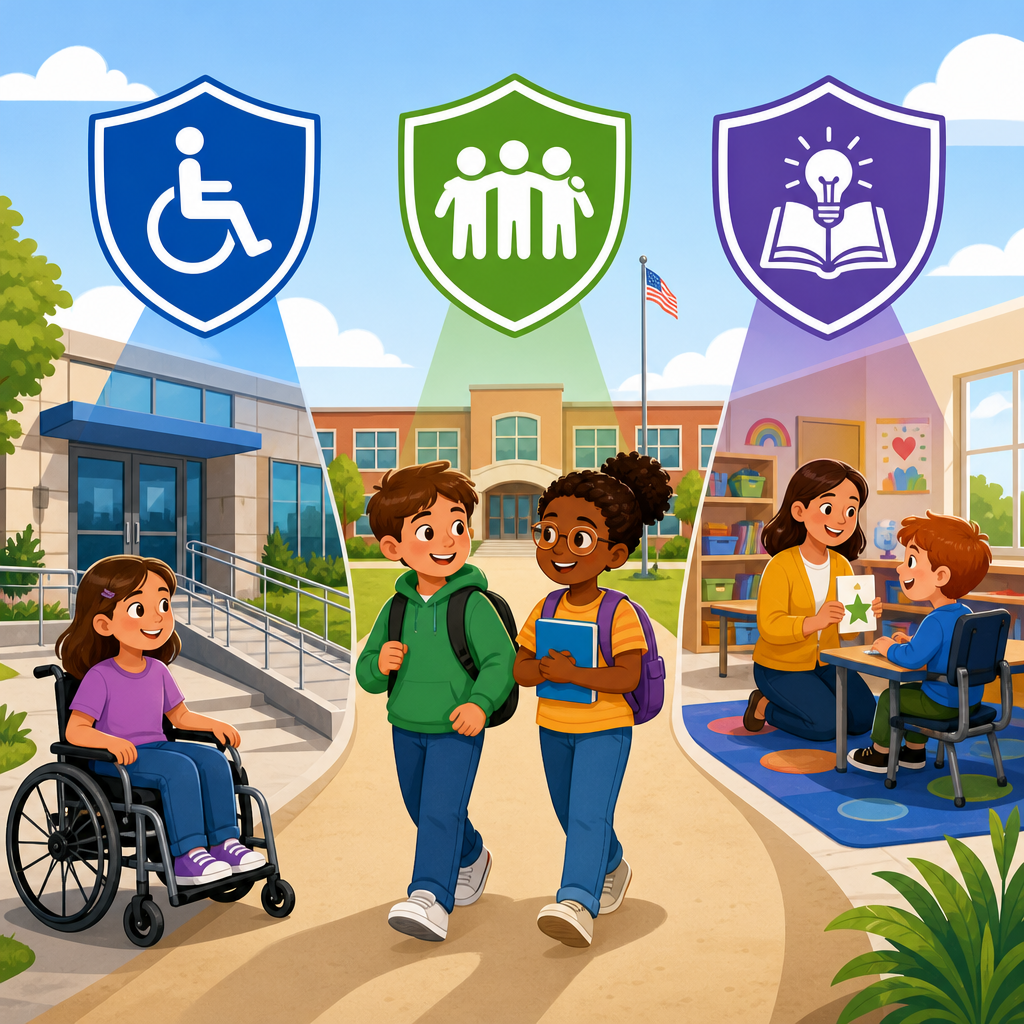
Families often hear three names when a child needs support at school: the Americans with Disabilities Act, Section 504, and the Individuals with Disabilities Education Act. These laws overlap, but they are not interchangeable, and confusion about them can delay evaluations, services, accommodations, or dispute resolution. I have worked with parents, school teams, and advocates who used the wrong framework at the wrong time, such as requesting a 504 plan when a child needed specialized instruction under IDEA, or assuming IDEA was the only path when an accessibility barrier on a field trip was really an ADA issue. A clear comparison matters because eligibility, school duties, remedies, and parent rights differ in meaningful ways.
At a practical level, these laws answer different questions. ADA asks whether a school or program is giving a student with a disability equal access and freedom from discrimination. Section 504 asks whether a federally funded school is providing equal opportunity through accommodations and related aids and services. IDEA asks whether an eligible child needs special education and related services to receive a free appropriate public education, usually called FAPE. Those are related protections, but they trigger different procedures, documentation, and enforcement routes.
Understanding the differences also matters beyond the classroom. Education and family rights often connect to discipline, testing, transportation, athletics, nursing services, extracurriculars, transition planning, parent participation, records, and complaint options. This article serves as a hub for that broader area by mapping where each law fits, when one law is enough, when multiple laws apply at the same time, and what families should look for in common school scenarios. The goal is simple: help you identify which law protects a student, when it applies, and what to ask for next.
What each law does and who it covers
The ADA is a civil rights law that prohibits disability discrimination by public entities under Title II and by many private schools and testing organizations under Title III. In school settings, it focuses on equal access, reasonable modifications, effective communication, and barrier removal where required. A student does not need special education eligibility to be protected. If a child uses a wheelchair and the auditorium stage has no accessible route, the ADA issue is direct access. If a deaf parent needs an interpreter for an IEP meeting, the ADA can also be part of the solution because communication access extends to parents in school interactions.
Section 504 is part of the Rehabilitation Act of 1973 and applies to recipients of federal financial assistance, including nearly all public school districts and many colleges. Its disability definition is broad: a physical or mental impairment that substantially limits one or more major life activities, a record of such an impairment, or being regarded as having one. Major life activities include learning, reading, concentrating, thinking, communicating, walking, seeing, hearing, eating, sleeping, and major bodily functions. In schools, Section 504 commonly results in a written 504 plan listing accommodations, supports, health provisions, and access measures.
IDEA is an education funding statute with detailed procedural rights. It covers children who fit within specific disability categories and, because of that disability, need special education. That second requirement is critical. A diagnosis alone does not create IDEA eligibility. The child must need specially designed instruction, meaning instruction adapted in content, methodology, or delivery to address unique needs. IDEA also includes related services such as speech-language therapy, occupational therapy, counseling, transportation, and nursing services when required for educational access.
In practice, many students are covered by more than one law. A student with dyslexia may qualify under IDEA as a child with a specific learning disability and also be protected by ADA and Section 504 from discrimination. A student with diabetes may not need special education but can still receive a 504 plan for blood glucose monitoring, snacks, bathroom access, and exam flexibility. A student using a service animal may rely on ADA access rules whether or not the student has an IEP or 504 plan. The laws stack; they do not cancel each other out.
How eligibility differs in real school situations
The simplest way to distinguish eligibility is this: ADA and Section 504 protect a broad group of students with disabilities, while IDEA protects a narrower group whose disabilities require special education. Schools often blur that line, especially with attention-deficit/hyperactivity disorder, anxiety, autism, chronic illness, and learning disorders. I have seen teams tell parents, “Your child is passing classes, so IDEA does not apply.” That is incomplete. Grades matter, but they are not the whole analysis. If a student is making progress only because of intensive support, tutoring, or parent intervention, the school must look deeper.
Consider ADHD. A student who can learn grade-level content but needs preferential seating, movement breaks, extended time, and assignment chunking may fit well under Section 504. Another student with ADHD may need explicit executive-function instruction, behavioral intervention, and modified teaching methods throughout the day. That student may qualify under IDEA, often under Other Health Impairment, because the child needs specialized instruction, not just accommodations.
Consider anxiety. A student with panic attacks may need a safe pass, modified attendance response, counseling check-ins, and testing in a reduced-distraction room. That can be a strong 504 case. But if school avoidance has become so severe that the student needs specially designed instruction, a therapeutic placement discussion, or a home-hospital plan with educational services, IDEA may become the proper framework. The legal trigger is educational need, not simply the diagnostic label.
Temporary impairments create another frequent question. A short-term injury can qualify under Section 504 if it is sufficiently severe and substantially limiting, depending on duration and impact. A broken leg that prevents a student from accessing upper-floor classrooms may require elevator access, schedule changes, or homebound supports. IDEA generally does not cover temporary conditions unless they fit a qualifying category and create a need for special education. This is one reason families should not assume every disability-related school issue starts with an IEP request.
FAPE, accommodations, and specialized instruction
All three laws can affect what a school must provide, but the substance of the obligation is different. Under IDEA, FAPE means special education and related services delivered under an individualized education program, at public expense, meeting state standards, and reasonably calculated to enable appropriate progress in light of the child’s circumstances, the standard the Supreme Court explained in Endrew F. v. Douglas County School District in 2017. That decision rejected minimal progress as enough. Schools must aim higher than trivial advancement.
Under Section 504, FAPE means regular or special education and related aids and services designed to meet the individual educational needs of students with disabilities as adequately as the needs of nondisabled students are met. In plain terms, Section 504 is usually about equal access and equal opportunity. The tools are often accommodations: extra time, captioned media, behavior supports, health plans, note-taking access, or modified attendance practices tied to disability.
ADA does not usually produce an IEP-style plan, but it can require reasonable modifications, auxiliary aids, accessible technology, and policy changes. If a district portal is not screen-reader compatible, that is an ADA access problem. If a school refuses to let a student with Crohn’s disease carry water or use unrestricted bathroom access, ADA and Section 504 concerns are obvious. If a robotics club meets in an inaccessible room, the student’s right to participate is not optional simply because the activity is extracurricular.
| Law | Main purpose | Who qualifies | Typical school support | Common examples |
|---|---|---|---|---|
| ADA | Prevent disability discrimination and ensure access | Students with disabilities broadly defined; public schools and many private entities covered | Reasonable modifications, effective communication, accessible facilities and programs | Interpreter access, wheelchair access, accessible website, service animal participation |
| Section 504 | Equal opportunity in federally funded programs | Students with impairments substantially limiting major life activities | 504 plan, accommodations, related aids and services, health supports | Extended time, diabetes care plan, reduced-distraction testing, attendance flexibility |
| IDEA | Provide special education and related services | Students in a listed disability category who need special education | IEP, specialized instruction, measurable goals, related services, placement decisions | Reading intervention for dyslexia, speech therapy, OT, behavior services, transition planning |
Evaluation, child find, and how schools must respond
Public schools have child find duties under both IDEA and Section 504. That means they must identify, locate, and evaluate students who may have disabilities and need services. A parent request can start the process, but schools cannot wait for a formal letter if they already suspect a disability. Repeated suspensions, chronic absenteeism linked to health issues, failing reading scores, or escalating behavior can all trigger a duty to consider evaluation.
The evaluation process under IDEA is generally more formal and comprehensive. Schools must use a variety of assessment tools, avoid relying on a single measure, assess in all suspected areas of disability, and use technically sound instruments. Timelines vary by state, but federal regulations create structure around consent, eligibility meetings, reevaluations, and independent educational evaluations in some circumstances. IDEA also requires parent participation and prior written notice when the school proposes or refuses action.
Section 504 also requires evaluation before significant changes in placement and before initial provision of services, but procedures are often less standardized district to district. That flexibility can help when a student needs support quickly, yet it can also create inconsistency. I have seen districts use strong multidisciplinary review for 504 eligibility and others rely on a thin checklist. Parents should ask what data the team reviewed: attendance, grades, teacher observations, medical documentation, standardized scores, behavior records, and input from outside providers.
A common mistake is treating a doctor’s note as the final word. Medical input matters, especially for conditions like epilepsy, asthma, diabetes, migraine, or long COVID, but schools do not have to adopt every requested accommodation automatically. At the same time, schools cannot dismiss medical evidence without reasoned analysis. The best decisions connect clinical information to school functioning. If a neurologist documents fatigue and attention loss after seizures, the team should discuss scheduling, rest breaks, test timing, and safety procedures in concrete terms.
Discipline, behavior, and placement protections
Discipline is one of the clearest examples of why the legal framework matters. Under IDEA, students have strong procedural protections when removals become significant. A manifestation determination review is required in certain situations to decide whether the conduct was caused by, or had a direct and substantial relationship to, the disability, or resulted from the school’s failure to implement the IEP. If the behavior is a manifestation, the school cannot simply proceed as if the student were nondisabled, with limited exceptions such as weapons, drugs, or serious bodily injury.
Section 504 has parallel protections against discriminatory discipline. A student on a 504 plan cannot be suspended or expelled in a way that ignores the link between behavior and disability. Yet schools and families sometimes overlook these safeguards because 504 procedures are less familiar than IEP procedures. For a student with autism, trauma-related disability, or ADHD, behavior incidents should lead the team to examine whether accommodations were followed, whether staff were trained, and whether a functional behavioral assessment is needed.
Placement rules differ too. IDEA includes the least restrictive environment requirement, meaning the student should be educated with nondisabled peers to the maximum extent appropriate, with removal from the regular setting only when education there cannot be achieved satisfactorily even with supplementary aids and services. Section 504 and ADA also favor integration and equal opportunity, but IDEA gives the most detailed system for deciding placement across service levels.
Behavior support is a practical dividing line. If a student merely needs a calm-down pass and seating away from triggers, Section 504 may be enough. If the student needs explicit social skills instruction, a behavior intervention plan tied to measurable goals, staff consultation, and frequent data collection, IDEA is often the stronger fit. The school’s obligation grows as the educational impact becomes more intensive and instructional.
Testing, activities, health needs, and transition years
Students do not leave their rights at the classroom door. State testing, college entrance exams, sports, field trips, transportation, medication administration, and graduation planning all fall within this landscape. For testing, schools may provide accommodations like extended time, breaks, large print, text-to-speech, or a scribe, but the documentation path varies. Classroom accommodations under an IEP or 504 plan can support requests to testing agencies, yet those agencies may ask for current evidence showing functional need and a history of use.
Extracurricular access is another common source of disputes. A student with a mobility impairment must have an equal chance to join clubs, attend events, and travel on school-sponsored trips. A student with food allergies may need allergen planning on overnight travel. A student with diabetes may need trained staff at athletics practices. These are not extras. They are part of meaningful access to the full school program.
Health conditions often fit Section 504 particularly well. Asthma, severe allergies, migraine, sickle cell disease, POTS, and gastrointestinal disorders may require individualized health plans, attendance flexibility, hydration access, elevator use, or symptom-triggered rest periods. But if frequent absences create a need for specially designed instruction, IDEA may enter the picture. The right law can change as a child’s condition changes.
Transition is where family rights become future-focused. Under IDEA, transition planning must begin no later than age sixteen under federal law, and earlier in some states. Strong plans address postsecondary education, employment, independent living, course of study, and needed services. Section 504 and ADA remain critically important after high school because colleges generally do not provide IDEA services. Students move from an entitlement model in K–12 to a civil rights access model in higher education, which makes self-advocacy and documentation especially important.
How parents can decide what to request next
Start with the student’s actual barrier. If the main problem is access, discrimination, or a policy that does not account for disability, think ADA and Section 504. If the student needs teaching that is different, more intensive, or specially designed to address disability-related needs, think IDEA. If both are true, request evaluation broadly and let the data guide the team. Put requests in writing, describe the educational impact, attach outside records if relevant, and ask the school to explain any refusal in writing.
Keep records that show pattern and impact: report cards, emails, attendance, nurse logs, behavior reports, outside evaluations, work samples, and examples of unfinished or missing work. Ask precise questions. What major life activity is limited? What data show the child does or does not need specialized instruction? What accommodations were tried, and were they implemented consistently? If discipline is involved, ask whether the conduct may be disability-related and whether evaluation is now warranted. Good advocacy is specific, chronological, and evidence-based.
ADA, Section 504, and IDEA are strongest when families understand the distinct promise of each law. ADA protects equal access and freedom from disability discrimination across school programs and activities. Section 504 secures accommodations, related aids, and equal educational opportunity for students whose impairments substantially limit major life activities. IDEA goes further for eligible students who need special education, providing an enforceable IEP, related services, procedural safeguards, and transition planning. Many students are covered by more than one law, but the right starting point depends on whether the student needs access, accommodations, specialized instruction, or all three.
For families navigating education and family rights, the biggest benefit of knowing these differences is speed. When you match the problem to the correct legal framework, schools are more likely to evaluate accurately, write an appropriate plan, and avoid preventable conflict. Review your child’s current barriers, compare them to the standards in this guide, and make your next request in writing. If the fit is still unclear, ask for a multidisciplinary meeting and start building the record that protects your student.
Frequently Asked Questions
What is the main difference between ADA, Section 504, and IDEA in a school setting?
The simplest way to understand these three laws is to focus on what each one is designed to do. The Americans with Disabilities Act, or ADA, is a broad civil rights law that prohibits disability discrimination in public life, including public schools and many private schools. Its purpose is access and equal opportunity. Section 504 is also a civil rights law, but it applies specifically to programs and entities that receive federal funding, including most public schools. In schools, Section 504 is commonly the framework used to provide accommodations and related aids so a student with a disability can access education in a way that is comparable to nondisabled peers. IDEA, the Individuals with Disabilities Education Act, is different because it is an education law. It does not just prohibit discrimination. It creates an affirmative obligation for school districts to identify, evaluate, and serve eligible students who need special education and related services.
That distinction matters in real life. If a student has a disability but can make effective progress in the general education curriculum with accommodations such as extended time, preferential seating, nurse access, behavior supports, or modified attendance procedures, Section 504 may be the correct framework. If a student needs specialized instruction because the disability affects learning, communication, behavior, or another area in a way that cannot be addressed through accommodations alone, IDEA may be the better fit. ADA often operates in the background as a broader anti-discrimination protection and can be especially important in matters involving physical access, extracurricular activities, communication access, policies, and retaliation.
There is overlap, but they are not interchangeable. A student who qualifies under IDEA is also generally protected from disability discrimination under Section 504 and the ADA. However, not every student protected by Section 504 or the ADA qualifies for special education under IDEA. Families often lose time when they ask only for a 504 plan when the real issue is the need for specialized instruction, or when they seek an IEP for a student who needs accommodations but not special education. Knowing the core purpose of each law helps families ask for the right kind of support at the right time.
When should a parent request a 504 plan, and when should they ask for an IDEA evaluation instead?
A 504 plan is usually the right request when a student has a physical or mental impairment that substantially limits one or more major life activities, but the student does not appear to need specialized instruction. Major life activities can include learning, reading, concentrating, thinking, communicating, walking, breathing, regulating bodily functions, and many others. In practice, a 504 plan is often appropriate for students with conditions such as diabetes, epilepsy, anxiety, ADHD, severe allergies, temporary medical restrictions, or other disabilities that affect school access but may not require a specially designed academic program. The goal is to remove barriers and provide meaningful access to school through accommodations, supports, and services.
An IDEA evaluation should be requested when a parent suspects that the child may have a disability and may need special education. That second part is critical. IDEA is not triggered simply because a child has a diagnosis. The question is whether the disability is affecting educational performance in a way that requires specially designed instruction. Examples include a student with dyslexia who needs structured literacy instruction, a student with autism who needs direct instruction in communication and social skills, or a student with emotional or behavioral needs that interfere with learning and require individualized educational programming. If accommodations alone are not enough, a 504 plan may be too limited.
Parents do not need to choose perfectly before asking for help, but they should be clear about their concerns. If a child is struggling academically, behaviorally, socially, functionally, or with attendance because of a suspected disability, it is often wise to make a written request for a comprehensive special education evaluation under IDEA. If the school concludes that the child does not qualify for IDEA but still has a disability that substantially limits a major life activity, the school should then consider eligibility under Section 504. In many cases, the most practical approach is to describe the child’s needs in detail, provide medical or outside information if available, and ask the school to evaluate under all applicable frameworks rather than limiting the request too narrowly at the outset.
Can a student have protections under more than one of these laws at the same time?
Yes. In fact, that is very common. These laws overlap, and a student may be protected by all three, depending on the situation. A student with an IEP under IDEA is also generally protected by Section 504 and the ADA because the student has a disability and attends a school setting covered by those laws. That means the student not only has the right to special education and related services under IDEA, but also has broader protections against discrimination, exclusion, and unequal treatment under the civil rights laws.
This overlap becomes important in situations that do not fit neatly into one category. For example, IDEA may govern specialized instruction, speech therapy, occupational therapy, behavior intervention planning, and annual IEP goals. Section 504 and the ADA may become especially important when the issue involves access to field trips, athletics, after-school clubs, transportation, building accessibility, health services, communication access, or school policies that unintentionally discriminate against a student with a disability. A school cannot avoid its civil rights obligations simply because a student already has an IEP.
It is also important to know that students who do not qualify for IDEA may still have significant rights under Section 504 and the ADA. A child with a medical condition, mental health condition, concussion history, or episodic impairment may not need special education but may still need accommodations and equal access protections. Families should think of IDEA as the law for students who need special education, and Section 504 and the ADA as the broader anti-discrimination protections that may apply whether or not the student has an IEP. Understanding the overlap helps parents and school teams avoid the mistake of assuming that one law replaces the others.
How do schools decide whether a student qualifies for an IEP under IDEA or only for accommodations under Section 504?
Eligibility under IDEA and Section 504 involves different legal standards, which is why two students with the same diagnosis may qualify under different frameworks. Under IDEA, the school must determine whether the student meets the criteria for one of the recognized disability categories and, because of that disability, needs special education and related services. The phrase “needs special education” is the key dividing line. A diagnosis alone is not enough. The evaluation team looks at data such as academic performance, standardized testing, classroom functioning, behavior, communication, developmental history, teacher input, parent concerns, attendance, and outside evaluations. If the student requires specially designed instruction to make appropriate educational progress, IDEA may apply.
Section 504 uses a broader disability definition. The question is whether the student has a physical or mental impairment that substantially limits a major life activity. The student does not need to fit into an IDEA category, and the student does not need to require specialized instruction. If the disability substantially limits learning, concentrating, reading, thinking, communicating, or another major life activity, the student may be eligible for protections and accommodations under Section 504. That is why students with ADHD, anxiety, chronic health conditions, or temporary impairments sometimes receive 504 plans even when they are performing at grade level academically.
Families should also understand that good grades do not automatically rule out eligibility under either law. A student may be working far harder than peers, experiencing severe anxiety, missing school due to a health condition, or relying on informal supports that are not consistently provided. Likewise, a student may have academic struggles that stem from factors other than disability, which is why proper evaluation matters. If the school refuses an evaluation or dismisses concerns based only on report card grades, parents should ask for the decision and reasons in writing, request the evaluation formally, and provide specific examples showing how the disability affects school functioning. Eligibility decisions must be based on data and legal standards, not assumptions.
What should a family do if the school uses the wrong framework or denies needed support?
First, put concerns in writing and be specific. Many problems become harder to fix when conversations stay informal. A parent should describe the child’s disability-related needs, explain what is happening at school, identify the impact on learning or access, and clearly state what is being requested, such as a Section 504 evaluation, an IDEA evaluation, a meeting, compensatory services, or revised accommodations. Written communication creates a timeline and often helps the school respond more carefully. It is also helpful to attach outside evaluations, medical documentation, attendance records, disciplinary records, work samples, and examples of how the current plan is not meeting the student’s needs.
Second, match the request to the problem. If the student is being denied equal access, excluded from activities, or refused accommodations because of disability, Section 504 and the ADA may be the strongest tools. If the student is not making meaningful educational progress and needs specialized instruction, IDEA is likely the correct framework. A common mistake is focusing only on a diagnosis or only on the label of a plan rather than on what the student actually needs. Families should ask: Does my child need access supports, specialized instruction, or both? That question often clarifies the next step.
Third, use the procedural safeguards available under the applicable law. Under IDEA, parents have rights relating to prior written notice, evaluations, independent educational evaluations in some circumstances,