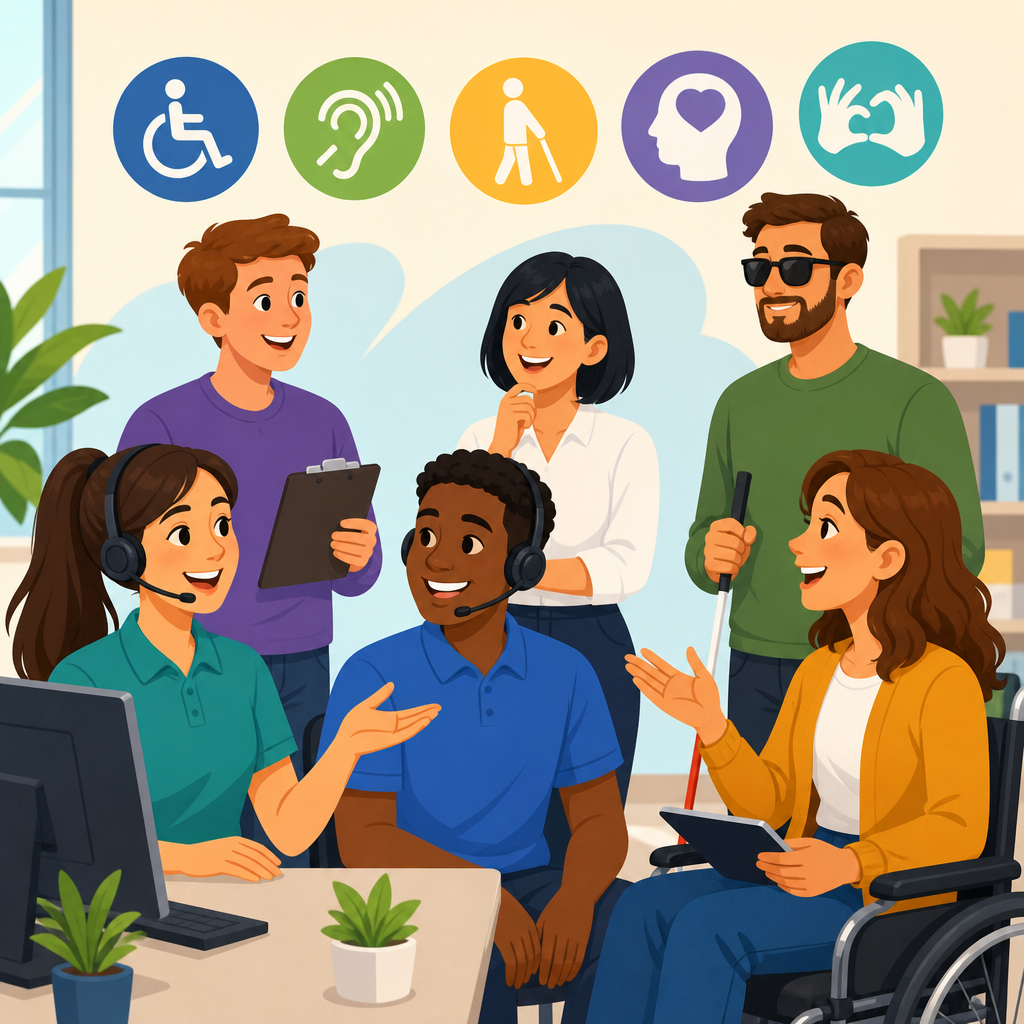
ADA training topics every customer service team needs start with one reality: accessibility is not a side issue handled only by legal or facilities staff. In daily operations, customer service teams are the front line for questions, complaints, accommodations, and trust. When a person with a disability calls, chats, emails, visits a location, or uses a self-service portal, the quality of that interaction determines whether the organization is genuinely accessible. That is why customer service ADA training must cover both awareness and implementation, giving employees practical skills they can use immediately.
The Americans with Disabilities Act, or ADA, is the primary civil rights law in the United States that prohibits discrimination based on disability. For customer-facing teams, the most relevant concepts usually include effective communication, equal access to goods and services, reasonable modifications to policies, and respectful interaction. Depending on the organization, related obligations may also arise under Section 504 of the Rehabilitation Act, state accessibility laws, web accessibility expectations shaped by the Web Content Accessibility Guidelines, and industry-specific standards. In practice, most service failures happen not because staff intend harm, but because they were never taught what access looks like in common situations.
I have seen this firsthand in training sessions with service teams that believed they were doing the right thing while still creating barriers. A representative might speak to a companion instead of the customer, insist on a doctor’s note when none is required, or refuse to read a form aloud because “that is not our process.” Small errors like these can quickly become exclusion, complaints, lost revenue, and legal exposure. Well-designed ADA awareness and implementation training closes that gap by translating rules into habits, scripts, escalation paths, and service standards that employees can follow under pressure.
As a hub article under Resources and Support, this guide maps the essential ADA training topics every customer service team needs. It defines the core knowledge areas, explains why each topic matters, and shows how teams can support ADA awareness and implementation across phone support, in-person service, email, chat, websites, mobile apps, and printed materials. Used well, it also acts as a roadmap for deeper internal guides on service animals, digital accessibility, accommodation requests, complaint handling, and manager responsibilities.
Foundational ADA awareness every team member should learn
The first training topic is a shared baseline understanding of disability rights and respectful service. Customer service staff do not need to become lawyers, but they do need clear, accurate working knowledge. Training should explain that disability can be visible or invisible, permanent or episodic, physical, sensory, cognitive, intellectual, or mental health related. Employees should know that access is about removing barriers, not making assumptions about what a person can do. This foundation reduces the most common source of service breakdowns: treating disability as unusual instead of planning for it as a normal part of serving the public.
Language and etiquette belong in this core module. Teams should practice person-first and identity-first language with flexibility, understanding that individual preference matters. The bigger rule is simple: speak directly to the customer, ask before assisting, and never touch mobility devices, service animals, or personal equipment without permission. For example, if a customer who is blind enters a branch, the correct approach is not to grab their arm. Staff should introduce themselves, ask whether assistance is wanted, and describe the environment clearly. If a Deaf customer communicates by writing or speech reading, staff should face them, avoid covering their mouth, and confirm key information in writing when needed.
Training should also address disability bias. Teams often underestimate how much tone, impatience, or skepticism affects accessibility. A customer with a speech disability may need extra time. A customer with autism may be overwhelmed by noise or abrupt changes. A person with PTSD may react strongly to crowded waiting areas or security procedures. Service quality improves when staff are taught to slow down, use plain language, avoid patronizing behavior, and focus on solving the access need rather than judging whether it seems legitimate.
Reasonable modifications, effective communication, and accessible channels
The next major topic is what the ADA requires in service delivery: reasonable modifications to policies, practices, and procedures, plus effective communication. In customer service, this means staff must recognize when a standard process creates a barrier and know how to adjust it without compromising safety or fundamentally altering the service. A common example is allowing a customer to complete a transaction in a quieter area, extending time limits for forms or appointments, or accepting information in an alternative format when a portal is inaccessible. Training should give concrete examples because abstract principles are hard to apply in the moment.
Effective communication deserves its own emphasis. Organizations must communicate with people with disabilities as effectively as they do with others, which can require auxiliary aids and services. Depending on context, that may include qualified sign language interpreters, real-time captioning, large print, accessible PDFs, screen-reader-compatible web forms, or staff reading written content aloud. In my experience, teams fail here when they improvise instead of following a defined process. Representatives should know what aids are available, how to request them quickly, who approves costs, and how to document the interaction. Customers should not have to educate the organization each time they need access.
Because modern service is omnichannel, ADA training must cover digital and physical touchpoints together. A customer may discover a problem on a website, then call support, then visit a location. If those channels are inconsistent, the burden falls on the customer. Teams should understand basic digital accessibility concepts such as keyboard navigation, alt text, captioned video, color contrast, accessible forms, and compatibility with screen readers like JAWS, NVDA, and VoiceOver. They do not need to remediate code themselves, but they do need to spot likely barriers, gather useful details, and route issues to the right owner without delay.
| Training topic | What staff should know | Practical example |
|---|---|---|
| Reasonable modifications | How to adjust standard procedures when they block access | Offering curbside assistance when a service counter is not reachable |
| Effective communication | Which aids and services are available and how to arrange them | Scheduling CART captioning for a public workshop |
| Digital accessibility intake | How to recognize and document web or app barriers | Reporting an unlabeled checkout button that fails with a screen reader |
| Alternative formats | How to provide information in usable formats promptly | Emailing a tagged PDF and mailing large-print instructions |
Alternative formats are another frequent blind spot. Billing notices, consent forms, product instructions, and support articles may all need to be provided in formats customers can use. Training should explain what large print means in practice, why image-only PDFs fail, and when plain language versions help customers with cognitive disabilities. Teams should also know that speed matters. An accessible format delivered after the deadline is often equivalent to no access at all.
Service animals, mobility access, and in-person interactions
In-person service requires a separate training block because front-desk and retail issues often trigger conflict. Service animal rules are one of the most misunderstood areas. Staff should know that a service animal under the ADA is generally a dog trained to do work or perform tasks for a person with a disability. In limited cases, miniature horses may also require assessment. Employees may ask only two questions when the need is not obvious: whether the animal is required because of a disability and what work or task the animal has been trained to perform. They should not demand documentation, ask about the person’s diagnosis, or require the dog to demonstrate its task.
Mobility access training should go beyond ramps. Teams need awareness of door width, clear floor space, reach ranges, seating options, counter height, and route obstructions caused by temporary displays, delivery boxes, or stanchions. I have seen locations pass a formal accessibility review and still create daily barriers because staff stored supplies in accessible routes or moved furniture without considering wheelchair turning space. Customer service managers should include routine access checks in opening and closing procedures, not just rely on annual audits.
Queue management and emergency procedures matter too. A customer using a scooter may need a different waiting arrangement. Someone with a sensory disability may need a lower-stimulation space. During evacuations or alarms, staff must know how to communicate clearly and avoid separating people from mobility devices, interpreters, or service animals. These details belong in ADA training because real accessibility depends on operational discipline, not just policy statements.
Handling accommodation requests, complaints, and escalations
Another essential topic is how to receive and resolve accommodation requests. Many requests come informally: “Can you email that in large print?” “I need more time to complete this form.” “Your kiosk is not usable with my screen reader.” Training should teach employees to recognize these as access requests even when the customer never says “ADA” or “reasonable modification.” Frontline staff should know which requests they can fulfill immediately, which require manager review, and what response times apply. The best programs use simple decision trees, standardized documentation, and escalation contacts in operations, digital, facilities, and legal.
Complaint handling deserves special attention because defensive responses create avoidable risk. When customers report barriers, staff should thank them, gather facts, apologize for the access problem without arguing, and state the next step. For example, if a captioning failure disrupted a webinar, the right response is to offer a recording with corrected captions, provide any key materials in accessible format, and route the root cause for review. The wrong response is to debate whether the customer was truly disadvantaged. Complaint data is one of the strongest sources for improving ADA implementation because it shows where systems fail repeatedly.
Managers need a higher-level module on documentation and pattern analysis. They should track issue type, channel, time to resolution, repeat barriers, and corrective action. If multiple customers report inaccessible PDFs, that is not an isolated service case; it is a content governance problem. If a store receives recurring complaints about blocked aisles, that points to merchandising or staffing practices. ADA awareness is important, but implementation only improves when organizations convert incidents into process change.
Building a sustainable ADA support program
The strongest customer service ADA training is not a one-time course. It is part of a support system that includes policy updates, job aids, quality assurance, and leadership accountability. New hires need baseline instruction, while experienced staff need refreshers tied to real scenarios. Supervisors should review calls, chats, and in-person interactions for accessibility performance just as they review accuracy and courtesy. Knowledge bases should contain approved scripts for accommodation requests, service animal questions, interpreter scheduling, and accessible document fulfillment. When training lives separately from operations, consistency breaks down quickly.
Teams also need clear partnerships across departments. Customer service cannot resolve digital accessibility bugs without product or IT. It cannot fix inaccessible forms without content owners. It cannot secure interpreters or CART providers without procurement processes. That is why this Resources and Support hub should connect ADA awareness to implementation workflows, including vendor management, procurement language, event planning checklists, and website governance. Standards such as WCAG 2.2, plain language guidance from federal agencies, and structured complaint resolution procedures give teams a common reference point and reduce improvisation.
The goal is not perfection in every interaction. The goal is competence, consistency, and prompt correction when barriers appear. Customer service teams that understand ADA training topics can welcome more customers, reduce friction, improve resolution times, and protect organizational trust. Start by auditing your current training against the topics in this hub: foundational awareness, respectful communication, reasonable modifications, digital accessibility, service animals, mobility access, accommodation handling, complaint resolution, and management oversight. Then build or refresh the supporting articles, playbooks, and escalation paths that turn awareness into reliable action. Accessibility improves when teams practice it every day.
Frequently Asked Questions
Why is ADA training especially important for customer service teams?
ADA training is especially important for customer service teams because they are often the first and most frequent point of contact for people with disabilities. While many organizations think of accessibility as something handled by compliance officers, HR, facilities, or legal teams, the real customer experience happens in everyday interactions. A phone conversation, a live chat session, an email exchange, an in-person visit, or a self-service support process can either remove barriers or create them. Customer service staff shape whether a customer feels respected, heard, and able to access the same services as everyone else.
Well-designed ADA training helps teams understand that accessibility is not only about avoiding complaints or legal risk. It is about communication, consistency, and service quality. Employees need practical guidance on how to respond when someone requests an accommodation, uses assistive technology, needs more time, or communicates in a way that differs from what staff expect. Without training, even well-meaning employees may interrupt, make assumptions, use unclear language, or apply policies too rigidly. Those mistakes can damage trust quickly.
Strong training also gives teams confidence. Instead of feeling uncertain or afraid of saying the wrong thing, staff learn how to ask respectful questions, focus on the customer’s stated needs, and find solutions that align with both accessibility principles and company procedures. In that sense, ADA training improves more than compliance. It strengthens customer loyalty, reduces friction, supports inclusive service, and helps organizations deliver a better experience across every channel.
What ADA training topics should every customer service team cover?
Every customer service team should be trained on a core set of ADA-related topics that connect legal expectations with real-world service situations. One essential topic is disability awareness, including the fact that disabilities may be visible or non-visible, permanent or temporary, and varied in how they affect communication, mobility, sensory access, cognition, or stamina. Teams should understand that there is no single “correct” way a person with a disability will communicate or request help.
Another foundational topic is respectful communication. Staff should learn person-first or identity-first language preferences, avoid assumptions, speak directly to the customer rather than a companion or interpreter, and ask only questions that are relevant to providing service. Training should also cover how to offer assistance appropriately without becoming patronizing or intrusive. This is a practical skill, not just a sensitivity topic, because communication habits directly affect whether a customer can access support effectively.
Accommodation handling is another critical area. Teams need clear instruction on what to do when a customer asks for a modification, alternate format, communication support, extra time, or another adjustment that allows equal access. That includes understanding internal escalation paths, documentation rules, timing expectations, and what front-line employees are empowered to do immediately. In addition, teams should be trained on digital accessibility basics, such as how screen readers, captions, keyboard navigation, and accessible documents affect customers using websites, support portals, email attachments, and chat tools.
Customer service ADA training should also include service animal etiquette, physical access awareness for in-person environments, de-escalation strategies when a customer is frustrated by an accessibility barrier, and scenario-based practice. The most effective programs move beyond definitions and include examples tied to actual workflows: answering phones through relay services, supporting a customer who cannot use a touchscreen kiosk, providing accessible follow-up materials, or responding when a policy unintentionally creates a barrier. These are the topics that make training useful in day-to-day operations.
How should customer service staff respond when a customer requests an accommodation?
When a customer requests an accommodation, the best response is calm, respectful, and solution-focused. Staff should start by listening carefully and acknowledging the request without defensiveness. In many cases, the customer is simply explaining what they need in order to access a service, complete a transaction, or communicate effectively. That request should not be treated as an inconvenience or an exception to “normal” service. It should be treated as part of serving the customer well.
Employees should focus on the functional need rather than making assumptions about the person’s condition. A good approach is to clarify what barrier the customer is encountering and what adjustment would help. Front-line teams do not usually need detailed medical information, and they should avoid asking unnecessary personal questions. Instead, they should determine whether the accommodation can be provided immediately, whether another format or method would work, or whether the request needs to be escalated according to company policy.
Training should teach staff how to distinguish between common service adjustments they can handle directly and more complex requests that require management, accessibility specialists, or another department. For example, reading information aloud, providing written follow-up, extending response time when appropriate, or moving to a more accessible communication channel may be simple front-line actions. Other situations, such as coordinating auxiliary aids or adjusting a formal process, may require additional support. The key is that the customer should not be left feeling dismissed or bounced around without ownership.
Clear follow-through matters just as much as the initial response. Staff should explain what will happen next, when the customer can expect an update, and who is responsible for the next step. If the requested accommodation cannot be provided in exactly the way requested, teams should be prepared to explore effective alternatives rather than simply saying no. Good ADA training helps employees understand that the goal is meaningful access, and that a thoughtful, timely, respectful response can prevent frustration and build trust even in complex situations.
Does ADA training for customer service include digital accessibility and online support channels?
Yes, it should. Modern customer service happens across websites, chat platforms, mobile apps, help centers, email systems, virtual appointment tools, online forms, and self-service portals. If ADA training focuses only on in-person interactions, it misses a major part of how customers actually engage with organizations. For many people with disabilities, digital access is not secondary. It is the primary path to information, transactions, and support.
Customer service teams should understand basic digital accessibility concepts so they can recognize barriers and respond appropriately. That includes awareness of how screen readers are used, why captions and transcripts matter, how keyboard-only navigation affects customers, why PDFs and attachments need to be accessible, and how color contrast, link labels, and timed sessions can create problems. Even if support staff are not designing the technology themselves, they are often the ones hearing directly from customers when something is unusable.
Training should also address channel flexibility. If a customer cannot complete a task through an online form, use a chatbot, read a document attachment, or navigate a portal, staff need to know what accessible alternatives are available. They should be able to shift smoothly to another support method, document the digital barrier, and route the issue to the right internal team for correction. This makes customer service a critical feedback loop for continuous accessibility improvement.
In practical terms, digital accessibility training helps teams avoid unhelpful responses like “just try another browser” or “ask someone to help you.” Instead, employees learn how to troubleshoot respectfully, offer alternate communication methods, and identify whether the issue may involve an accessibility failure rather than general user error. For organizations that want truly inclusive service, digital accessibility belongs at the center of ADA training, not at the edges.
How often should customer service teams receive ADA training, and what makes it effective?
ADA training should not be treated as a one-time event during onboarding. Customer service teams should receive foundational training when they start, followed by regular refreshers, updates tied to policy or technology changes, and coaching based on real customer scenarios. Annual training is a common baseline, but teams that handle high volumes of public interaction often benefit from more frequent reinforcement. Accessibility issues evolve as digital tools change, service models expand, and organizations identify new barriers in practice.
The most effective ADA training is practical, role-specific, and interactive. General legal overviews have value, but front-line employees need examples that reflect their actual work. That means using situations such as handling relay calls, assisting customers who use communication devices, responding to requests for documents in alternate formats, managing long wait times that disproportionately affect some customers, or troubleshooting inaccessible online tasks. Scenario-based learning helps employees build judgment and confidence in ways that a policy memo cannot.
Effective training also depends on clear internal systems. Staff need to know who to contact, what authority they have, how to document issues, when to escalate, and what resources are available. If employees are trained in principles but not in process, they may still struggle to help customers consistently. Organizations should support training with scripts, quick-reference guides, accessible knowledge base content, and leadership reinforcement so accessibility expectations are embedded in daily operations.
Finally, the best ADA training is measured, updated, and informed by feedback. Customer complaints, support transcripts, employee questions, digital accessibility reports, and frontline observations can all reveal where more training is needed. When organizations treat ADA training as an ongoing service-quality priority rather than a box to check, customer service teams become better equipped to deliver respectful, accessible, and consistent support to every customer.


