ADA training for maintenance teams is what turns accessibility from a one-time installation milestone into a daily operational standard. In facilities of every size, accessible features only help people when those features are working, unobstructed, and used as intended. A compliant automatic door that is switched off, a restroom grab bar that has loosened, or a tactile exit sign hidden behind stored supplies can create barriers just as real as missing features. That is why maintenance staff sit at the center of practical accessibility.
In this context, ADA refers to the Americans with Disabilities Act and the built-environment requirements commonly applied through the 2010 ADA Standards for Accessible Design, often alongside state codes, the International Building Code, ICC A117.1, and, for housing or federally funded settings, other overlapping rules. Maintenance teams need role-based education because their work is not the same as design review, legal interpretation, or front-desk customer service. They inspect, adjust, replace, document, and respond. Their decisions affect door force, route width, fixture placement, elevator reliability, signage visibility, and the operability of alarms, lifts, and controls.
I have seen facilities spend heavily on renovations, then lose most of the practical benefit within a year because routine work orders unintentionally degraded accessibility. A trash receptacle migrated into a clear floor space. Weatherstripping increased opening resistance. New soap dispensers projected into circulation paths. None of those issues looked dramatic in isolation, yet together they made the site harder to use and more legally exposed. Good ADA training for maintenance teams prevents that drift. It gives technicians a repeatable way to recognize accessible elements, test performance, prioritize repairs, and avoid creating new barriers during ordinary upkeep. For organizations managing schools, hospitals, offices, retail properties, multifamily communities, transit facilities, and public buildings, this training belongs in the core compliance program, not on the margins.
This hub explains how to build that program. It covers what maintenance staff must know, how role-based education should be structured, which tasks deserve the most attention, where documentation matters, and how this training connects to inspections, capital planning, work order systems, and vendor oversight. If your goal is keeping accessible features operable every day, maintenance training is the operating system.
What ADA training for maintenance teams should cover
Effective ADA training for maintenance teams starts with a simple rule: technicians do not need to memorize every line of every code, but they do need to recognize accessible elements, understand the performance intent behind them, and know when to stop and escalate. In practice, the curriculum should focus on accessible routes, doors and hardware, parking and exterior paths, ramps and handrails, restrooms, signage, alarms and communication features, elevators and platform lifts, service counters, drinking fountains, and common obstructions created by furniture, storage, landscaping, snow removal, or temporary repairs.
Training should define key field concepts in plain language. An accessible route is the continuous unobstructed path connecting arrival points, entrances, rooms, and amenities. Clear width is the usable opening or passage space that cannot be reduced by protruding objects or stored items. Clear floor space is the maneuvering area a wheelchair user needs at doors, fixtures, controls, and equipment. Operable parts are controls or hardware that must be reachable and usable without tight grasping, pinching, or twisting of the wrist. When technicians understand these concepts, they make better decisions before a complaint ever happens.
Teams also need to know the difference between condition issues and design issues. A sagging closer, burned-out audible/visual notification appliance, or broken lift call button is a maintenance issue. A restroom laid out without enough turning space may be a design or alteration issue requiring facilities leadership, design professionals, or counsel. Without that distinction, technicians either attempt the wrong fix or leave obvious barriers unaddressed because they assume accessibility is someone else’s department.
Role-based education: different jobs, different training depth
Not everyone on the maintenance side needs the same level of ADA training. A strong program assigns depth by role. Custodial staff should be trained to preserve accessible routes, keep signage visible, maintain floor surfaces, and report damaged features immediately. General maintenance technicians need broader skill: testing doors, checking mounting heights after replacements, preserving toilet room clearances, and verifying that replacement hardware does not reduce usability. Supervisors need enough knowledge to triage findings, approve compliant substitutions, review preventive maintenance schedules, and coordinate with risk, compliance, and project teams. Facilities directors need dashboard-level understanding tied to budgets, policies, recordkeeping, and escalation.
This role-based approach works because accessibility failures often occur at handoff points. For example, a custodian notices that a paper towel dispenser cover is broken and asks maintenance to replace the unit. If the technician installs a different model without checking projection limits or reach range, a simple swap can create a new barrier. If the supervisor reviewing stock standards has not set approved accessible products, the error becomes systemic across a portfolio. Training each role at the right level closes those gaps.
For large organizations, I recommend separate learning paths for in-house technicians, site managers, call-center dispatchers, and contractors. Dispatchers influence outcomes because the language they use in work orders affects priority. “Door hard to open” should trigger a same-day accessibility check, not a low-priority comfort request. Contractors need orientation because many barrier issues arise during painting, flooring, millwork, signage replacement, and site work performed by third parties who are not thinking about daily accessibility performance.
High-risk maintenance tasks that most often affect accessibility
Some tasks deserve special emphasis because they generate the highest frequency of accessibility failures. Door maintenance is at the top of the list. Technicians should know how closers, latches, gasketing, thresholds, power operators, hold-opens, and access-control devices interact. A well-intended adjustment to improve security or energy performance can make a door unusable. Automatic door sensors that drift out of calibration, delayed action settings that are too short, and paddle actuators mounted inconsistently are common field problems.
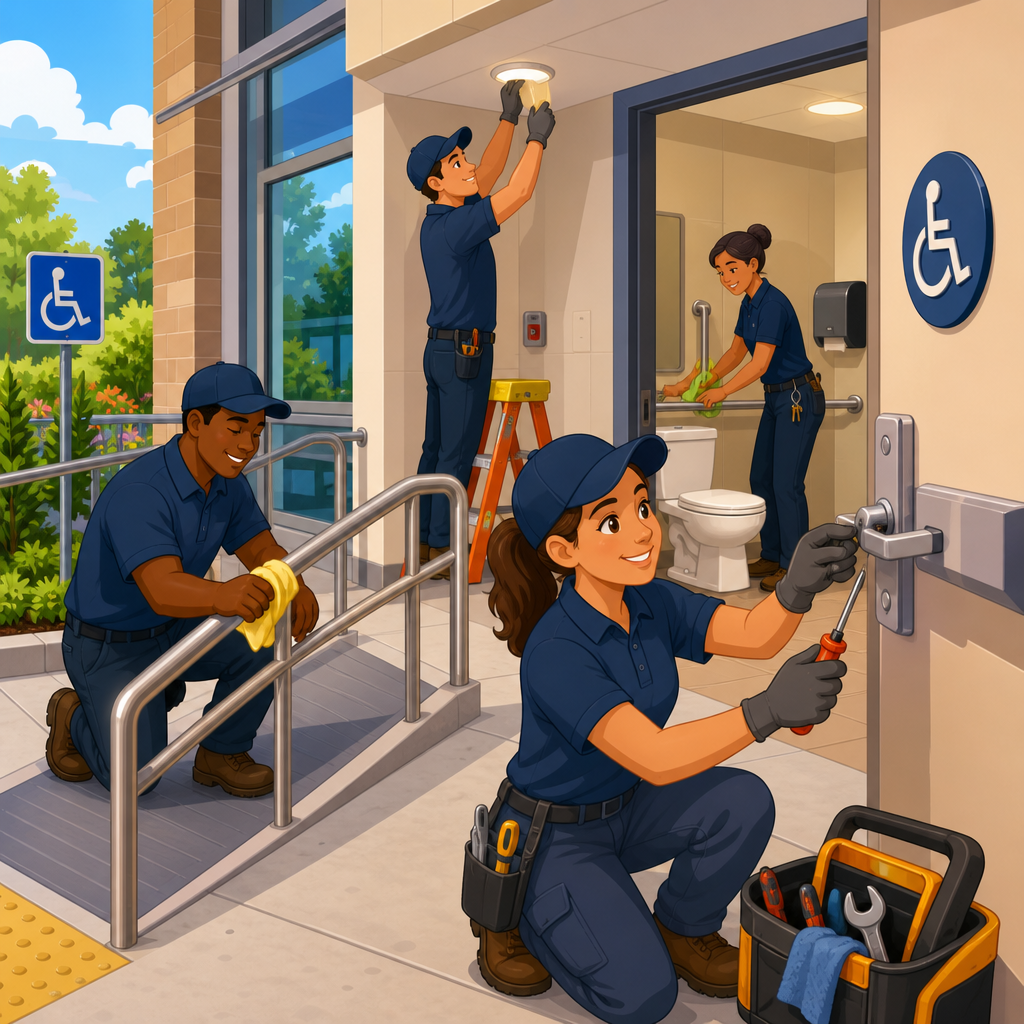
Restrooms are another high-risk area because they combine plumbing, partitions, accessories, signage, and janitorial practices. Maintenance teams must preserve grab bar stability, flush control operability, lavatory knee clearance, insulated pipes, mirror placement, and turning space. Even when construction was initially compliant, everyday changes can cause failure: waste bins placed beside toilets, mop storage in transfer space, aftermarket shelves above grab bars, or replacement dispensers mounted too high.
Exterior conditions create equal risk. Accessible parking loses function when striping fades, signs go missing, slopes settle, curb ramps crack, or snow piles block access aisles. Landscaping crews can narrow sidewalks with overgrowth. Pavers heave. Temporary cones meant to reserve areas for deliveries can end up blocking the only accessible route to an entrance. Maintenance training must connect seasonal operations, groundskeeping, and emergency response to accessibility outcomes.
| Task area | Common failure | Why it matters | Best training focus |
|---|---|---|---|
| Doors | Opening force too high or operator disabled | Users cannot enter independently | Adjustment limits, testing, escalation |
| Restrooms | Clearances blocked by bins or carts | Fixtures become unusable | Daily checks, layout discipline |
| Parking | Missing signs or blocked access aisles | Safe vehicle transfer is lost | Site inspections, winter procedures |
| Signage | Tactile signs removed during repainting | Wayfinding and identification fail | Replacement standards, punch lists |
| Alarms and lifts | Inoperable devices left pending | Safety and equal access are compromised | Critical response times, vendor follow-up |
How to train teams to inspect, document, and respond
The strongest ADA maintenance programs teach a repeatable field method rather than isolated facts. I use a four-part sequence: identify, test, document, act. Identify the accessible feature and the expected user need. Test whether it performs under normal conditions. Document what was observed, including measurements where relevant and photographs when allowed. Then act by correcting the issue or escalating it with a clear priority and owner.
Inspections should be built into routine rounds instead of treated as annual events. Daily or weekly checks can cover entrances, routes, restrooms, elevators, and parking. Monthly preventive maintenance can address doors, operators, alarms, and lifts. Quarterly reviews can sample signage, counters, site furnishings, and recurring trouble spots. Digital work order systems such as CMMS platforms are useful only when accessibility tags, asset categories, and priority codes are configured intentionally. Otherwise, accessibility defects disappear into generic maintenance backlogs.
Documentation matters for both operations and risk management. A good record shows the date, location, issue, temporary mitigation, permanent fix, parts used, and completion time. If a part is on order for a lift or power door operator, the file should show what interim accommodation was arranged and who was notified. This is not paperwork for its own sake. It proves the organization had a functioning process, and it helps supervisors detect patterns, such as one entrance repeatedly failing because the closer specified for that windy façade was never appropriate.
Embedding accessibility into preventive maintenance and vendor management
Maintenance training works best when it is supported by systems. Preventive maintenance checklists should explicitly include accessible features instead of assuming technicians will remember them. Door PMs should call for checking closing speed, latch action, activation devices, safety sensors, thresholds, and maneuvering areas. Restroom PMs should include grab bar tightness, hardware operability, dispenser placement, and floor condition. Exterior PMs should cover accessible parking signs, striping visibility, route continuity, and drainage that could create cross-slope or icing hazards.
Approved product standards are equally important. If storerooms stock inaccessible knobs, wrong-height signs, or dispenser models that protrude excessively, technicians will install barriers under deadline pressure. Facilities leaders should maintain approved lists for hardware, faucets, controls, signage, and common accessories, with dimensions and installation notes tied to accessibility requirements. This is one of the most practical ways to reduce recurring errors across multiple sites.
Vendor management deserves direct attention in any hub on training and role-based education. Elevator contractors, door companies, painters, flooring installers, millworkers, landscapers, and snow vendors all touch accessible features. Contracts should require protection of accessible routes, restoration of signage, equivalent temporary access during outages, and prompt notice when compliant replacement is not possible. Site staff should never assume a specialty vendor is handling accessibility correctly. They should verify it.
Building a culture where accessibility stays visible
The final step is cultural, not technical. Maintenance teams keep accessible features operable every day when leadership treats accessibility like safety, uptime, and life-cycle stewardship. Training should be part of onboarding, annual refreshers, supervisor coaching, and post-incident review. Short toolbox talks work well: one week on door clearances, another on restroom accessories, another on winter route management. Real photos from your buildings are better than generic slides because technicians remember the exact corridor, entrance, or toilet room where a problem occurred.
It also helps to connect accessibility to dignity and customer experience, not only compliance exposure. When a patient cannot enter a clinic independently or an employee cannot reach a breakroom sink after a renovation, the barrier is personal and immediate. Maintenance teams respond well when expectations are concrete: do not block clear floor space, do not substitute unapproved hardware, test before closing the ticket, and escalate design conflicts early. Clear rules produce reliable habits.
For a sub-pillar hub under compliance and implementation, the main takeaway is straightforward: training and role-based education are the mechanism that keeps accessibility alive after construction ends. Your related resources should go deeper into inspections, restroom maintenance, door operator testing, vendor controls, documentation practices, and supervisor accountability. Start by mapping roles, defining high-risk tasks, updating PM checklists, and training staff with site-specific examples. Then audit results, retrain where failures recur, and make accessibility part of everyday maintenance management. That is how accessible features remain operable, defensible, and useful to the people who rely on them.
Frequently Asked Questions
Why is ADA training important for maintenance teams if accessible features were already installed correctly?
Proper installation is only the beginning of accessibility, not the finish line. ADA training helps maintenance teams understand that accessible features must remain usable every day, not just pass inspection on opening day or after a renovation. An automatic door, accessible restroom, ramp, elevator communication feature, tactile sign, or grab bar can all become barriers if they are turned off, damaged, blocked, loosened, or altered during routine operations. Maintenance staff are often the first people to notice these issues, and they are usually the ones best positioned to correct them quickly.
Training also builds practical awareness. Team members learn what features are essential to access, what common problems make them noncompliant or unsafe, and why small oversights can have a major impact on real people. For example, changing the closer tension on a door, storing equipment in front of a clear floor space, or delaying a repair to an accessible restroom fixture can prevent someone from independently using the facility. ADA training gives maintenance personnel the knowledge to identify these risks before they affect occupants, visitors, customers, patients, students, or employees.
Just as important, training helps create consistency. Without clear instruction, accessibility checks may depend on individual judgment and be handled unevenly across shifts, buildings, or departments. With training in place, maintenance teams can follow standard procedures for inspections, work orders, preventive maintenance, and escalation. That turns accessibility from a one-time design requirement into an ongoing operational responsibility, which is exactly what keeps accessible features operable in the real world.
What accessible features should maintenance teams inspect regularly?
Maintenance teams should routinely inspect any feature that affects a person’s ability to enter, move through, use, and exit the facility safely and independently. This includes exterior accessible routes, curb ramps, sidewalks, parking spaces, access aisles, signage, doors, thresholds, ramps, handrails, elevators, restroom elements, service counters, alarms, and emergency egress components. Training should teach staff not only what these features are, but also what “working properly” actually looks like in day-to-day conditions.
Entrances are a major priority. Automatic doors should activate correctly, stay on during operating hours, and not be blocked by mats, displays, carts, or seasonal decorations. Manual doors should open with appropriate force and close properly without becoming difficult to use. Thresholds, hardware, and maneuvering clearances should remain intact. In restrooms, maintenance teams should inspect grab bars for stability, ensure accessible stalls are not being used for storage, verify toilet and sink fixtures are functioning, and check that soap dispensers, hand dryers, mirrors, and paper towel units remain available and reachable.
Wayfinding and life safety features matter too. Tactile and Braille signs should remain visible and securely mounted. Exit routes should be free of obstructions, and areas of refuge, emergency communication systems, and alarms should function as intended. Parking areas should be checked to make sure accessible spaces and access aisles remain properly marked, visible, and unobstructed. Elevators and lifts require special attention because downtime can completely eliminate access to essential spaces.
Training should emphasize that inspection is not limited to wear and tear. Temporary conditions can create accessibility barriers just as easily as permanent damage. Wet floor signs placed in narrow corridors, maintenance carts left in accessible routes, snow piled in access aisles, or supplies stored beneath accessible sinks can all interfere with usability. Effective ADA training teaches teams to look at the full user experience, not just the physical hardware.
How often should maintenance teams check accessible features and document their findings?
The right schedule depends on the type of facility, how heavily it is used, and which accessible features are most critical, but the core principle is simple: checks should be frequent enough to catch problems before they become ongoing barriers. High-use features such as entrances, automatic doors, accessible restrooms, elevators, and parking access should often be reviewed daily or as part of routine rounds. Other items may be inspected weekly, monthly, or as part of preventive maintenance programs, but they should still be included in a consistent documented process.
Documentation is just as important as the inspection itself. Maintenance teams should record what was checked, when it was checked, what condition it was in, and what action was taken if an issue was found. This creates accountability, supports quicker follow-up, and helps identify recurring problems such as door operators frequently being shut off, grab bars loosening over time, or signage repeatedly becoming blocked. Clear records also make it easier for facility leaders to allocate budget, prioritize repairs, and show that accessibility is being actively managed rather than handled only when complaints arise.
Work order systems should flag accessibility-related issues as a priority category whenever possible. If a repair cannot be made immediately, teams should know how to document temporary measures, communicate limitations to management, and arrange prompt corrective action. For example, if an accessible restroom fixture is out of service, there should be a clear process for identifying the issue, responding quickly, and minimizing disruption to users. Training should connect documentation to real operational outcomes: faster repairs, fewer missed barriers, and a stronger culture of accessibility.
Regular review of inspection logs can also improve long-term performance. Supervisors can use the data to refine checklists, adjust schedules, and target additional training where repeated errors appear. Over time, documentation turns ADA maintenance from a reactive task into a measurable, preventive program.
What are the most common accessibility mistakes maintenance teams make during everyday operations?
Many accessibility failures happen through ordinary daily routines rather than major construction mistakes. One of the most common problems is obstruction. Staff may temporarily place ladders, carts, trash bins, floor signs, supplies, or furniture in accessible routes without realizing they are blocking clear passage or maneuvering space. Accessible restroom stalls are sometimes used for storage because they have more room, and tactile signs can become hidden behind decorations, equipment, or stacked materials. These may seem like minor conveniences internally, but they can make a space unusable for the people who rely on those features.
Another frequent issue is allowing accessible hardware or systems to remain in poor working order. Automatic doors may be turned off and not switched back on. Door closers may be adjusted in ways that make doors too heavy to open. Grab bars, toilet seats, faucets, or dispensers may loosen over time and not be repaired promptly. Elevators, lifts, and call buttons may be treated as routine maintenance items rather than urgent access issues. ADA training helps teams understand that when these features stop working, access stops working too.
Maintenance and cleaning practices can also unintentionally create barriers. Thick mats can interfere with mobility devices, wax buildup can affect traction, and cleaning equipment left in corridors can reduce required clear width. Exterior maintenance can create problems as well, including snow or debris in accessible parking spaces, access aisles, ramps, or curb ramps. Paint crews may cover markings, and landscaping may narrow routes if not properly controlled.
A final common mistake is assuming accessibility is someone else’s job. In practice, maintenance teams play a central role because they are constantly interacting with the building’s physical environment. Training helps replace that assumption with clear responsibility. When staff understand how everyday decisions affect accessibility, they are far more likely to protect operability, report issues quickly, and avoid actions that unintentionally create barriers.
What should ADA training for maintenance teams include to be truly effective?
Effective ADA training should combine legal awareness, practical field application, and clear operational procedures. Maintenance staff do not need abstract theory alone; they need concrete guidance on what to inspect, what common failures look like, how to respond, and when to escalate issues. A strong training program usually begins with the basic purpose of accessibility requirements: ensuring people with disabilities can use the facility safely, independently, and with dignity. From there, the training should connect that purpose to the specific features found in the building or campus.
Hands-on examples are especially important. Teams should review actual entrances, restrooms, parking areas, signage, routes, alarms, elevators, and service areas in the facility and discuss what can go wrong in each location. They should learn how to recognize blocked clearances, malfunctioning operators, unstable grab bars, missing signage, worn striping, and temporary obstructions. Training should also cover preventive maintenance expectations, including scheduled checks, testing methods, documentation standards, and response time priorities for accessibility-related repairs.
Just as critical, the training should define responsibilities. Staff should know who handles immediate fixes, who submits or approves work orders, how urgent issues are communicated, and what to do when a barrier cannot be corrected right away. This makes accessibility part of normal operations rather than an informal extra task. If vendors, custodial teams, security, or event staff affect the same spaces, the training should address coordination so one group does not undo the efforts of another.
Finally, the best ADA training is ongoing. Buildings change, staff turns over, equipment ages, and everyday habits drift. Refresher sessions, updated checklists, supervisor follow-through, and periodic site reviews help keep the training active. When maintenance teams are taught not only what compliance requires but why day-to-day operability matters, they become one of the strongest lines of defense against preventable accessibility barriers.