ADA compliance for banks and financial institutions is no longer a narrow legal concern; it is a core operational requirement that affects branches, websites, mobile apps, ATMs, call centers, documents, and customer trust. The Americans with Disabilities Act, or ADA, is the federal civil rights law that prohibits discrimination against people with disabilities in places of public accommodation, employment, transportation, and state and local government services. For banks, credit unions, mortgage lenders, insurers, and fintech companies with customer-facing services, ADA obligations intersect with other rules, including Section 504 of the Rehabilitation Act, Fair Housing Act requirements in lending contexts, and accessibility expectations shaped by the Web Content Accessibility Guidelines, commonly called WCAG. In practice, ADA compliance means ensuring that a customer who is blind, deaf, has limited mobility, uses assistive technology, or has a cognitive disability can access financial products and services with substantially equivalent ease, privacy, and independence. I have worked with institutions that thought accessibility meant only adding a wheelchair ramp, then discovered their PDF statements were unreadable by screen readers and their online account opening flow could not be completed by keyboard. That gap matters because financial access is essential to daily life: depositing paychecks, paying bills, applying for credit, disputing fraud, and understanding fees. When access fails, the result is not just inconvenience; it can mean missed payments, denied opportunities, privacy risks, and legal exposure. Strong ADA compliance reduces litigation risk, improves customer experience, supports inclusive growth, and aligns with the service standards regulators increasingly expect.
What ADA compliance means in banking operations
For financial institutions, ADA compliance is best understood as an enterprise-wide accessibility program rather than a one-time facilities checklist. Title III of the ADA applies to many customer-facing private businesses, including banks and lenders, while Title I governs employment practices. State-chartered entities and programs involving public institutions may also trigger additional accessibility duties. The practical question most executives ask is simple: what must be accessible? The answer is every core customer touchpoint. Physical branches need accessible parking, routes, entrances, counters, restrooms, and signage consistent with the 2010 ADA Standards for Accessible Design. Self-service technologies, especially ATMs and interactive kiosks, need features such as speech output, tactilely discernible controls, privacy protections, and reachable operable parts. Digital banking platforms must support screen readers, keyboard navigation, color contrast, meaningful labels, captions, and predictable forms behavior.
Accessibility also extends to communications. If a customer receives disclosures, statements, adverse action notices, loan terms, or fraud alerts in a format they cannot use, the institution has not delivered equal access. In audits I have led, the highest-risk failures often appeared in routine workflows: inaccessible CAPTCHA during login, unlabeled buttons in mobile check deposit, image-based PDFs for account agreements, and video explainers without captions. These are common because teams treat accessibility as a design preference instead of a functional requirement. A stronger approach is to map each product journey, identify barriers by disability type, and test whether the task can be completed independently. If a customer must call for help simply because the digital path is inaccessible, compliance is already compromised.
Digital accessibility: websites, apps, PDFs, and online banking
Most ADA complaints against financial institutions now involve digital properties, and for good reason: online banking is the primary branch for many customers. Although the ADA does not name a single technical web standard, courts, settlements, and Department of Justice positions frequently point organizations toward WCAG 2.1 Level AA as the benchmark that demonstrates accessible design and development. That standard is not abstract. It requires text alternatives for non-text content, sufficient color contrast, keyboard operability, resizable text, clear focus indicators, error identification, compatible code structure, and adaptable content that works with assistive technologies such as JAWS, NVDA, VoiceOver, and TalkBack.
In banking environments, digital accessibility has specialized implications. Forms must announce labels and instructions correctly because customers enter sensitive information, legal attestations, and identity details. Timeouts need warnings and extension options because customers using screen readers or alternative input may need more time. Authentication flows must be accessible without reducing security; for example, one-time passcodes should work across channels, and biometric options should not be the sole method of access. PDFs remain a persistent problem. Monthly statements, mortgage disclosures, and fee schedules are often generated from legacy systems as untagged image files. A visually perfect statement can still be unusable if it lacks heading structure, reading order, table markup, and selectable text. The fix is to build accessibility into document generation, not just remediate files manually after complaints.
Mobile apps need equal scrutiny. Native controls can improve accessibility when developers use them correctly, but custom widgets often break screen reader announcements and gesture navigation. During one mobile banking review, we found the transfer confirmation screen read only “button, button, image,” leaving users uncertain whether money had moved. That is not a minor usability flaw; it is a transactional risk. Institutions should combine automated scanning tools such as axe, WAVE, Accessibility Insights, and Siteimprove with manual testing by specialists and disabled users. Automation catches only a portion of issues. Reliable compliance requires code review, assistive technology testing, and regression checks integrated into release cycles.
Physical accessibility in branches, ATMs, and customer service environments
Branch accessibility still matters because many customers rely on in-person service for complex transactions, notarization, safe deposit access, trust services, and problem resolution. The branch should provide an accessible route from parking or public sidewalks, doors with appropriate maneuvering clearance, service counters at usable heights, and waiting areas that accommodate mobility devices. Temporary barriers count too. I have seen compliant entrances effectively become inaccessible because promotional displays narrowed the path of travel or queue stanchions blocked turning space. Facilities teams need recurring inspections, not just construction sign-off.
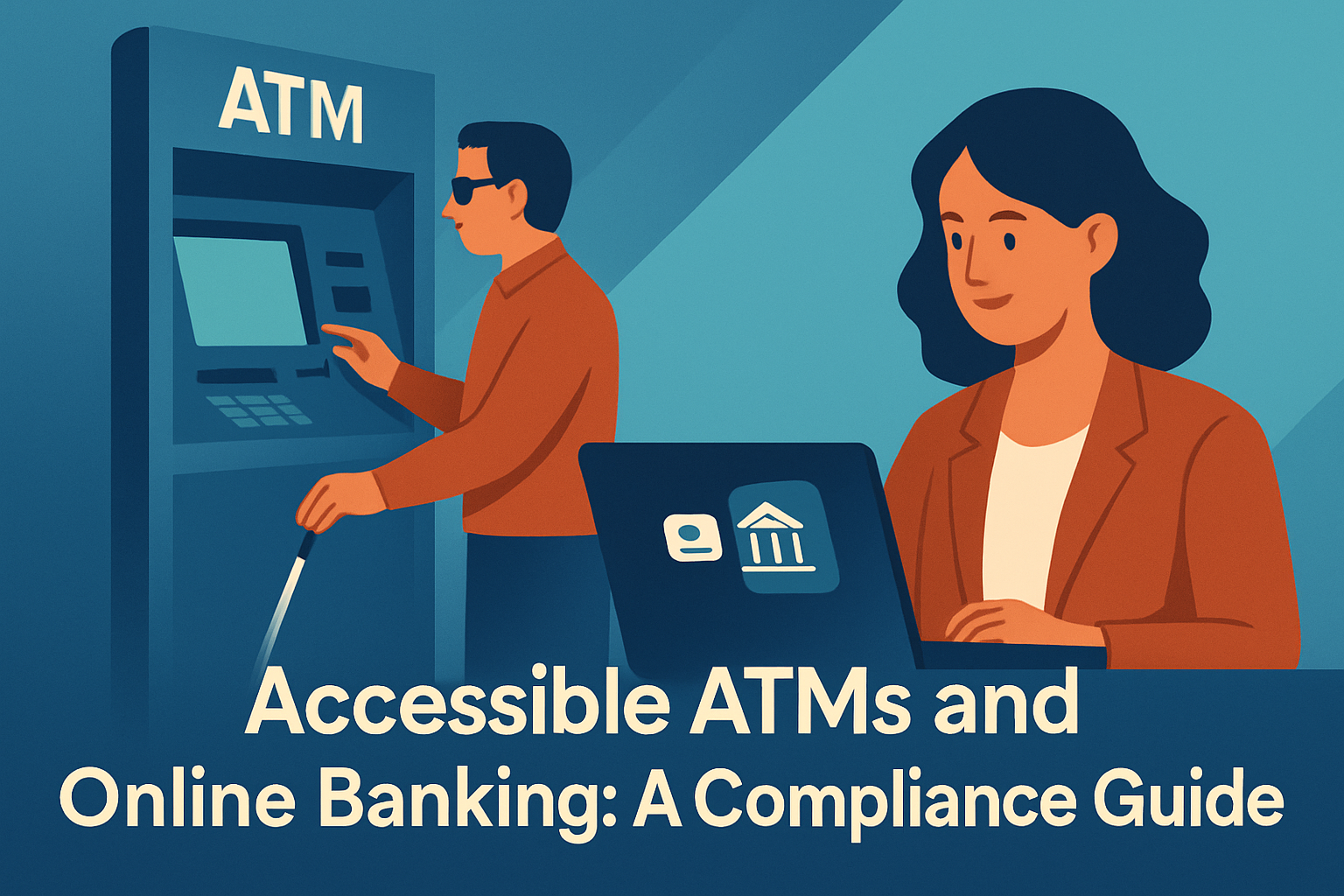
ATMs deserve particular attention because they combine physical and digital accessibility requirements. ADA standards address reach ranges, tactile controls, privacy, and speech output. In real deployments, banks also need to consider glare, ambient noise, headphone jack durability, software updates that disrupt spoken prompts, and maintenance procedures when accessible features fail. An out-of-service speech function is still an access failure. Drive-up ATMs can create additional complexity for customers with mobility limitations or those using adapted vehicles. Accessible design should be validated in the actual environment, not just against manufacturer specifications.
Customer service channels beyond the branch are part of the accessibility landscape. Telephone systems should support relay services, provide clear menu structures, and avoid voice-only bottlenecks that exclude deaf or speech-disabled customers. Video banking platforms need captioning and keyboard access. Appointment systems must not force online-only booking if the interface is inaccessible. When institutions centralize service into digital and contact center models, they must ensure every channel preserves privacy, independence, and equivalent service quality.
Governance, risk management, and vendor accountability
The most effective financial institutions treat ADA compliance as a governance discipline tied to enterprise risk, not a side project owned only by facilities or marketing. Accessibility should have executive sponsorship, board visibility through risk reporting, and clear ownership across digital, operations, compliance, procurement, and human resources. A durable program starts with policy: define the standard, usually WCAG 2.1 AA or newer where practical, identify covered assets, require testing, and establish remediation timelines. Then build controls into the lifecycle. Procurement contracts should require accessibility conformance reports, often in the form of a VPAT based on the Voluntary Product Accessibility Template, but teams should never accept a vendor VPAT at face value. Validate claims through demonstrations and testing because many are incomplete or outdated.
Internal governance also means maintaining an inventory of customer-facing assets, prioritizing high-risk journeys, and documenting decisions. If a bank launches a new chatbot, mortgage portal, or account opening kiosk, accessibility review should occur during design, development, quality assurance, and pre-production approval. Complaint data is a valuable risk signal. Repeated issues around statement formats, inaccessible alerts, or ATM audio failures point to systemic gaps that deserve root-cause analysis. Training matters as well. Designers need to understand contrast and focus order, developers need semantic coding practices, content teams need plain-language and heading discipline, and frontline staff need accommodation protocols.
| Area | Common banking risk | Recommended control |
|---|---|---|
| Website and app | Inaccessible login, forms, and navigation | WCAG-based design standards, manual assistive tech testing, release gates |
| PDF documents | Statements and disclosures unreadable by screen readers | Tagged templates, accessible document generation, sample audits |
| ATMs and kiosks | Broken speech output or unreachable controls | Field inspections, maintenance SLAs, post-update validation |
| Vendors | Third-party tools fail accessibility requirements | Contract clauses, VPAT review, independent verification |
| Customer support | Relay users or caption users receive inferior service | Staff training, channel testing, documented accommodation procedures |
From a legal defense perspective, documented governance helps, but it does not replace actual accessibility. Regulators and plaintiffs look for outcomes customers can experience, not policy binders that sit unused. The strongest programs pair formal controls with measurable results: defect rates, remediation aging, accessible document coverage, and satisfaction feedback from disabled customers.
How banks can implement and sustain compliance
A practical compliance roadmap begins with a baseline assessment across facilities, digital channels, documents, and service processes. Start with high-impact journeys: account opening, login, balance review, transfers, card controls, bill pay, fraud reporting, loan applications, and statement access. For each journey, test against recognized standards and real user tasks. Prioritize remediation by customer harm and legal risk. An inaccessible marketing page matters, but an inaccessible authentication or payment workflow matters more. Establish a remediation backlog with owners, deadlines, and severity ratings.
Next, embed accessibility into change management. Design systems should include accessible components for buttons, modals, form fields, alerts, and tables so teams do not recreate errors in every release. CI/CD pipelines can run automated accessibility checks, but those checks should be complemented by manual review before major launches. Content governance is equally important. If teams can upload PDFs, videos, or promotions without accessibility review, new barriers will appear faster than old ones are fixed. For institutions with large legacy estates, phased modernization is realistic, but temporary alternatives must provide equivalent access in the meantime.
Customer feedback loops close the gap between compliance theory and lived experience. Publish an accessibility statement with contact methods that actually work, respond quickly to reported barriers, and treat those reports as operational intelligence. I have seen simple fixes build significant trust: offering statements in accessible digital formats by default, adding skip links to online banking, or repairing ATM audio outages within defined service windows. The business case is straightforward. Accessible services reach more customers, reduce abandonment, improve SEO through cleaner structure, and lower expensive complaint escalation. For banks and financial institutions, ADA compliance is ultimately about dependable access to money, credit, and information. Make accessibility part of governance, procurement, design, testing, and frontline service, and the institution becomes safer, more usable, and more credible for everyone. Start with an honest audit, fix the highest-risk barriers first, and treat accessibility as a permanent standard rather than a special project.
Frequently Asked Questions
What does ADA compliance mean for banks and financial institutions?
ADA compliance for banks and financial institutions means providing equal access to banking products, services, and facilities for people with disabilities. In practice, this extends far beyond wheelchair ramps or accessible teller counters. It includes physical branches, ATMs, websites, mobile banking apps, PDFs and account documents, telephone support systems, online forms, appointment scheduling tools, and any other customer-facing service channel. Because banks serve the public in highly regulated, essential ways, accessibility must be treated as a core part of operations rather than an afterthought.
For financial institutions, ADA obligations often overlap with digital accessibility expectations under recognized standards such as the Web Content Accessibility Guidelines, or WCAG. While the ADA itself does not list a technical checklist for websites and apps, regulators, courts, and settlement agreements frequently look to WCAG as the benchmark for whether digital services are accessible. That means customers should be able to navigate online banking with a keyboard, use screen readers to review balances and statements, complete applications without inaccessible forms, understand content with clear labels and error messaging, and access videos or audio content with captions or transcripts where needed.
Just as important, ADA compliance is about consistency and usability. A bank may have an accessible website but still create barriers if its loan documents are unreadable by assistive technology, its call center cannot effectively communicate with deaf or hard-of-hearing customers, or its ATM network lacks speech output or tactile controls. In other words, compliance requires a full-channel review of how customers interact with the institution from start to finish. Done well, accessibility improves service quality, reduces legal risk, supports brand trust, and helps ensure that all customers can manage their finances independently and with dignity.
Which parts of a bank’s operations are most commonly affected by ADA accessibility requirements?
The areas most commonly affected are physical locations, digital platforms, self-service technology, customer communications, and support channels. At the branch level, this includes entrances, parking, service counters, waiting areas, restrooms, signage, and paths of travel. Customers with mobility, vision, hearing, or cognitive disabilities must be able to enter, move through, and use branch services without unnecessary barriers. For example, an accessible entrance is not enough if key service counters are too high, signature pads are poorly positioned, or wayfinding signage is difficult to read.
Digital banking is one of the biggest ADA risk areas because it touches nearly every customer interaction. Public websites, online banking portals, mobile apps, mortgage and loan application systems, rate calculators, chat tools, and account-opening workflows all need to be accessible. Common problems include missing alternative text on images, unlabeled form fields, poor color contrast, inaccessible document downloads, keyboard traps, time limits without accommodation, and authentication steps that are difficult for customers using assistive technology. If a customer cannot independently check a balance, transfer funds, apply for a credit card, or review disclosures online, the institution may be creating a significant accessibility barrier.
ATMs and kiosks are another high-priority area. Accessibility here may include tactilely discernible controls, audio guidance for blind or low-vision users, appropriately placed screens and input devices, and sufficient clear floor space for wheelchair users. Banks also need to consider call centers, video banking, secure messaging, mailed and electronic statements, and marketing communications. A financial institution can undermine compliance if accessible branches exist but customer service phone systems are difficult to navigate, alternative formats are unavailable, or fraud alerts and other urgent notices cannot be understood by people using screen readers or relay services. The key point is that accessibility must be built into every major service touchpoint, not confined to a single department.
How can banks make their websites, mobile apps, and online banking platforms ADA compliant?
The most effective approach is to build accessibility into design, development, testing, and governance from the beginning. For websites and apps, banks typically work toward WCAG conformance, usually at the AA level, because that standard addresses many of the barriers people with disabilities encounter online. This includes making all functionality available by keyboard, ensuring screen readers can accurately interpret content, maintaining sufficient color contrast, using clear headings and labels, providing meaningful link text, and designing forms with accessible instructions and error handling. Because banking workflows often involve sensitive transactions, accessibility must be considered at every step, including login, multi-factor authentication, statements, transfers, bill pay, loan applications, and dispute processes.
Mobile accessibility deserves special attention because many customers now rely on banking apps as their primary channel. An accessible app should support built-in assistive technologies such as VoiceOver and TalkBack, allow scalable text, use logical focus order, and avoid interactions that depend only on gestures, color, or timing. Features such as mobile check deposit, card controls, budgeting tools, and alerts should all be tested by real users of assistive technology, not just reviewed in automated scans. Automated tools are helpful for identifying obvious technical issues, but they cannot fully evaluate user experience, transaction flow, or whether content is understandable and operable in realistic conditions.
To sustain compliance, banks need documented processes. That usually means adopting an accessibility policy, assigning responsibility across teams, training designers and developers, including accessibility requirements in procurement, and conducting regular audits and remediation. Third-party vendors also matter, especially when institutions rely on external platforms for account opening, loan servicing, chat support, or document delivery. If a vendor tool is inaccessible, the bank may still face the customer complaint. Strong governance, periodic testing, and prompt remediation help financial institutions move from reactive fixes to a mature accessibility program that supports compliance and customer trust over time.
What are the risks of ADA noncompliance for banks and financial institutions?
The risks are legal, financial, operational, and reputational. From a legal standpoint, banks may face complaints, demand letters, investigations, settlements, or lawsuits if customers with disabilities cannot access branches, digital platforms, or core services. Even when a case does not proceed to trial, responding to claims can consume significant internal time and legal expense. In addition, accessibility issues may attract scrutiny from regulators or advocacy groups, particularly when barriers affect essential services such as account access, payments, lending, or fraud response.
The financial impact goes beyond attorney fees or remediation costs. Inaccessible systems can increase call center volume, prolong service times, create transaction abandonment, and require manual workarounds that are expensive to maintain. For example, if online account applications are not accessible, customers may be forced into branch or phone channels, raising servicing costs and reducing conversion rates. Similarly, inaccessible statements or alerts can lead to misunderstandings, delayed action, disputes, and a poorer overall customer experience. What may begin as a compliance issue can quickly become a broader efficiency and revenue problem.
There is also a substantial trust and brand dimension. Banking depends on confidence, reliability, and ease of use. When customers encounter barriers accessing funds, understanding disclosures, or managing accounts independently, the institution may appear indifferent, outdated, or exclusionary. That can damage loyalty not only among people with disabilities, but also among families, caregivers, employers, and communities who value inclusive service. In a competitive market, accessibility is increasingly viewed as part of customer experience excellence. Banks that fail to prioritize it risk being seen as both legally vulnerable and operationally out of step.
What should a bank do first if it wants to improve ADA compliance across branches, ATMs, and digital services?
The best first step is to conduct a comprehensive accessibility assessment that covers all major service channels. Many institutions assume their biggest exposure is one website or one branch, when in reality the more serious issue is fragmented accessibility across multiple systems and locations. A useful assessment should review physical facilities, ATMs, public websites, online banking, mobile apps, customer documents, call center workflows, and third-party platforms. The goal is to identify where customers with disabilities may face barriers, rank those issues by risk and impact, and create a practical remediation roadmap.
After the assessment, banks should establish a clear governance structure. That means naming responsible stakeholders, setting accessibility standards, documenting policies, and building accessibility into procurement, project management, and quality assurance. Accessibility should not sit only with legal or compliance teams. Operations, IT, digital product, facilities, marketing, HR, and customer service all play a role. Staff training is essential, especially for teams that publish content, design interfaces, configure ATMs, manage branches, or communicate directly with customers. Without training and ownership, the same barriers tend to reappear after initial fixes are made.
It is also important to prioritize improvements that have the greatest customer impact. Fixing high-traffic digital tasks, inaccessible authentication flows, key branch barriers, and ATM usability issues often produces immediate benefits. At the same time, banks should create a longer-term program that includes ongoing testing, feedback channels, and periodic reviews as technology and services change. Accessibility is not a one-time project. New product launches, software updates, branch renovations, and vendor integrations can all introduce fresh barriers if accessibility is not embedded into routine decision-making. Institutions that take a proactive, organization-wide approach are in the strongest position to reduce risk, serve customers effectively, and maintain compliance over time.