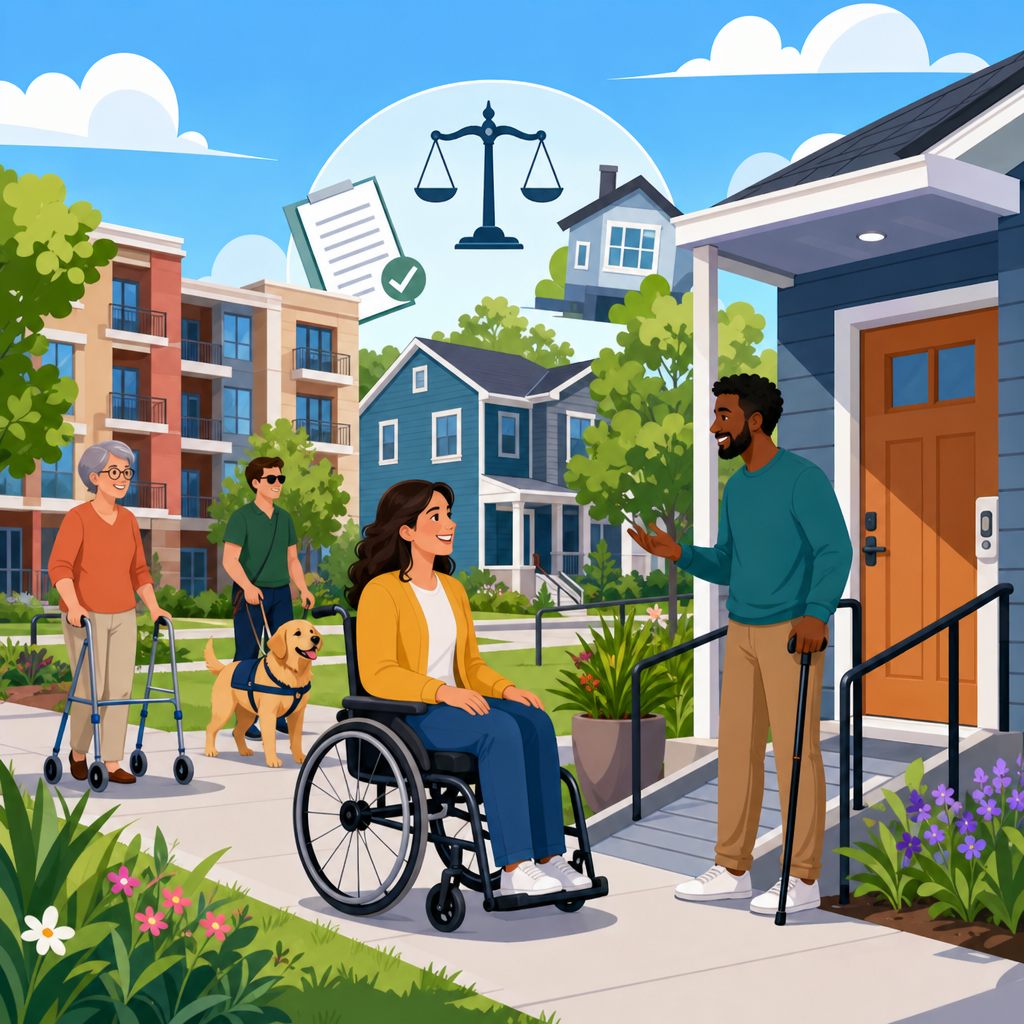
Advanced technology for accessibility is reshaping housing policy, property operations, and tenant rights at the same time that the Americans with Disabilities Act, the Fair Housing Act, and state accessibility rules are being interpreted in new ways. In practice, housing professionals now have to understand not only ramps, door widths, and reasonable accommodations, but also smart-home controls, app-based leasing systems, video intercoms, AI-driven maintenance tools, and digital communication platforms. I have worked with multifamily owners, accessibility consultants, and digital product teams long enough to see a clear pattern: the legal risk no longer sits only in the built environment. It also sits in software, procurement, and day-to-day operational choices.
For readers tracking ADA and housing changes, one point matters immediately: the ADA does not regulate all housing in the same way. Purely residential units are often governed primarily by the Fair Housing Act, while public accommodations within housing communities, leasing offices, shelters, student housing, and state or local government housing programs can trigger ADA obligations. Section 504 of the Rehabilitation Act adds another layer for federally funded programs. Recent legal and policy changes matter because they are tightening expectations around equal access across physical spaces and digital systems. As housing becomes more technology-dependent, accessibility failures increasingly show up in websites, kiosks, portals, smart locks, emergency alerts, and virtual tours. This article serves as the hub for advanced technology for accessibility, explaining the legal baseline, the latest policy direction, and the practical tools housing providers should evaluate now.
How ADA and housing rules now intersect with advanced technology
The biggest shift in recent years is that accessibility in housing is no longer treated as a construction-only issue. Regulators, courts, and advocates increasingly look at the full resident journey: searching for housing online, requesting accommodations, entering the property, controlling home features, receiving emergency information, and communicating with management. In projects I have reviewed, the highest-risk failures often appeared in ordinary systems that teams assumed were neutral, such as online application forms that did not work with screen readers, package lockers without tactile controls, or visitor management tablets mounted too high for wheelchair users.
Legally, this matters because equal access depends on function, not just intent. A leasing office open to the public can be covered under Title III of the ADA. Public housing agencies and local housing authorities may have Title II obligations. Affordable housing receiving federal funds may also fall under Section 504, which carries detailed accessibility and program access duties. The Fair Housing Act remains central for design and construction requirements in covered multifamily dwellings and for reasonable accommodations and reasonable modifications. The operational reality is that a single property may implicate multiple statutes at once, especially when it combines residential units, public-facing amenities, digital services, and government funding.
Technology has expanded what accessible housing can mean. Voice assistants can help residents with mobility impairments control lighting, thermostats, blinds, and door hardware. Video relay integration can improve communication for deaf residents. App-based maintenance systems can document accommodation requests more reliably than scattered email chains. Remote monitoring can support aging in place when deployed with consent and privacy safeguards. Yet each of these tools can also create new exclusion if they are rolled out without alternatives, user testing, or clear vendor accountability. The current policy environment pushes housing providers toward a simple principle: if technology becomes part of housing access, that technology must itself be accessible.
Recent legal and policy changes housing providers need to track
Several developments have changed how accessibility should be managed in housing. First, the Department of Justice has continued to reinforce digital accessibility expectations for state and local government services, including web and mobile content. Even where a housing provider is not directly covered by the latest government-specific digital rules, those standards influence expectations across the market because they point to WCAG 2.1 Level AA as the practical benchmark. Second, the Department of Housing and Urban Development has maintained pressure on reasonable accommodation compliance, effective communication, and accessible design, especially in enforcement actions involving public housing, subsidized housing, and housing-related services.
Third, courts have shown less patience for arguments that digital barriers are outside accessibility law when the online tool is integral to access. In the housing context, that can include online waiting lists, payment portals, virtual leasing tours, and application workflows. Fourth, state and local laws increasingly go beyond federal minimums. California’s Unruh Civil Rights Act, state building codes, local human rights ordinances, and procurement rules can produce stricter outcomes than federal law alone. I regularly advise clients that federal compliance is the floor, not the full strategy.
Policy guidance has also matured around service animals, assistance animals, and communication access. That affects technology because documentation systems, resident portals, and staff workflows need to process these requests without unnecessary barriers. Another major change is emergency communication planning. Wildfire, hurricane, flood, and heat-event preparedness now require accessible alerting methods, captioned video, multilingual messaging, and non-audio alternatives. Smart building systems can help, but only if they are configured to reach people with different sensory and cognitive needs.
| Area | What changed | Practical housing impact |
|---|---|---|
| Digital access | WCAG-based expectations became the common benchmark | Websites, apps, portals, and kiosks need accessibility testing |
| Program access | Stronger scrutiny on public and federally assisted housing operations | Policies, forms, and communication methods must be equally usable |
| Reasonable accommodations | Enforcement remains active and documentation practices are examined closely | Staff need clear workflows, faster responses, and audit trails |
| Emergency communication | Greater focus on inclusive alerts during climate and disaster events | Buildings need multimodal notifications and accessible evacuation information |
| Smart housing technology | Accessibility concerns now extend to IoT devices and resident-facing platforms | Procurement must evaluate interfaces, controls, and alternatives |
Advanced technology for accessibility in housing: what works now
Advanced technology for accessibility is most effective when it solves a clearly defined barrier. For mobility access, power door operators with low-force activation, Bluetooth-enabled door entry with tactile backups, adjustable-height video intercoms, and smart thermostats with voice and switch control can materially improve independence. For blind and low-vision residents, accessible wayfinding apps, high-contrast touchscreens, screen-reader compatible resident portals, and audible elevator interfaces can reduce daily friction. For deaf and hard-of-hearing residents, visual alert systems, real-time captioning for virtual meetings, text-based concierge systems, and video relay compatible service desks are often more important than flashy automation.
Cognitive accessibility is also gaining overdue attention. Simplified resident apps, plain-language lease summaries, guided maintenance request forms, and reminder systems with consistent iconography can help residents with intellectual, developmental, or neurological disabilities. In senior housing and supportive housing, passive monitoring systems, fall detection, medication reminders, and telehealth integrations may support safety, but these tools require careful consent practices and human oversight. A system that helps one resident can overwhelm another, so personalization is essential.
The best deployments I have seen share four traits. They offer multiple input methods, such as touch, voice, keyboard, and physical controls. They maintain a non-digital fallback so residents are not locked out by app failure, dead batteries, or poor connectivity. They are tested by actual users with disabilities before rollout. And they are documented in procurement contracts, service-level agreements, and maintenance plans. Accessibility is not a feature you buy once; it is an operating commitment sustained through updates, replacements, staff training, and resident feedback.
Named tools and standards help teams move from aspiration to execution. WCAG 2.1 AA remains the leading benchmark for websites and apps. For physical and digital product design, teams often use usability testing with assistive technologies such as JAWS, NVDA, VoiceOver, TalkBack, Dragon, switch devices, and refreshable braille displays. In buildings, ANSI references, model codes, and manufacturer conformance statements are useful, but they do not replace field testing. If a smart lock technically complies with a specification yet cannot be operated by a resident with limited dexterity, the operational outcome is still failure.
Common compliance gaps in multifamily, affordable, and public housing
Across property portfolios, the same problems appear repeatedly. Websites post floor plans as inaccessible image files. Leasing chat tools time out too quickly for screen-reader users. Self-service kiosks have no headphone jack, tactile keypad, or privacy mode. Video tours lack captions and audio description. Resident apps send critical notices only through push notifications without accessible email or SMS alternatives. Smart package rooms assume everyone can use a touch interface or scan a QR code. None of these failures are hypothetical; they surface constantly in audits, resident complaints, and demand letters.
Affordable housing and public housing face additional complexity because application and recertification processes are document-heavy and deadline-driven. If forms are inaccessible, the barrier is not minor; it can block entry to housing or jeopardize continued eligibility. Waiting list systems, identity verification tools, and online grievance processes deserve the same scrutiny as unit design. I have also seen emergency maintenance lines fail deaf residents because voice calls were treated as the only urgent channel. Effective communication must be built into every service path.
Another gap is procurement. Housing teams often buy proptech products based on cost, aesthetics, or integration features without asking for accessibility conformance reports, keyboard navigation support, captioning capability, color contrast data, or testing evidence. When accessibility review happens after implementation, retrofits are slower and more expensive. Vendor contracts should require remediation timelines, indemnity where appropriate, update notices, and compatibility with assistive technology. If a critical housing function depends on a vendor platform, accessibility should be treated as a core performance requirement, not a courtesy add-on.
How to build an accessibility strategy that survives legal scrutiny
A defensible strategy starts with an inventory. List every resident-facing and applicant-facing touchpoint: website, mobile app, leasing office, call center, intercom, amenity reservation system, parking access, emergency alerts, smart-home controls, and maintenance workflows. Then map which legal regimes apply to each one. This exercise usually reveals hidden exposure, especially in mixed-use communities and publicly funded programs. The next step is testing. Automated scans can identify some digital issues, but manual testing by specialists and users with disabilities is what uncovers broken workflows.
Governance matters as much as design. Assign ownership across legal, operations, IT, facilities, and procurement. Establish a reasonable accommodation process with defined response times, escalation rules, and standardized documentation. Train leasing staff, maintenance teams, and call center agents on communication access, assistance animal rules, and alternatives when technology fails. Keep records. In every enforcement matter I have touched, documentation made the difference between a manageable correction plan and a credibility problem.
Budget planning should separate immediate remediation from long-term modernization. Some fixes are fast, such as captioning videos, adjusting color contrast, or adding text alternatives. Others require capital planning, such as replacing inaccessible entry systems or redesigning common-area controls. Measure progress through repeat audits, complaint trends, completion times, and resident satisfaction. Housing providers that treat accessibility as continuous quality management, rather than one-time compliance, are better positioned for both legal defense and resident retention.
Why this hub matters for technology and accessibility going forward
ADA and housing compliance now depends on understanding advanced technology for accessibility as a core housing issue, not a niche specialty. The built environment still matters, but the resident experience increasingly runs through software, connected devices, and digital communication channels. Recent legal and policy changes point in one direction: if housing providers use technology to market, lease, manage, secure, or service homes, they must make those systems accessible and provide effective alternatives when needed.
The practical lesson is straightforward. Start with the legal framework, but do not stop there. Audit the full resident journey. Procure accessible technology from the beginning. Test with disabled users in real conditions. Document accommodation processes and emergency communication plans. Review vendor contracts. Update training. When these steps are integrated, accessibility stops being a reactive burden and becomes a better operating model for everyone, including older adults, families, and residents using temporary workarounds during injury or illness.
Use this hub as the starting point for deeper work across smart-home controls, accessible websites and portals, inclusive emergency alerts, assistive communication tools, accessible proptech procurement, and digital reasonable accommodation workflows. Housing law is evolving, but the operational standard is already clear: equal access must extend across both physical and digital housing systems. Review your properties, platforms, and policies now, then prioritize the upgrades that remove the most serious barriers first.
Frequently Asked Questions
How are recent legal and policy changes affecting ADA and Fair Housing Act compliance in residential housing?
Recent legal and policy developments are making residential accessibility compliance more complex and more technology-focused. One of the biggest shifts is that housing providers can no longer think about accessibility only in terms of physical design features such as ramps, grab bars, accessible parking, and usable door widths. Regulators, courts, and state agencies are increasingly looking at the full housing experience, including how tenants search for units, submit applications, communicate with management, access amenities, receive notices, and use building technology. That means compliance questions now extend into websites, online leasing portals, resident apps, keyless entry systems, package rooms, smart thermostats, video intercoms, and AI-supported maintenance platforms.
It is also important to understand that the ADA and the Fair Housing Act do not operate in exactly the same way. In many housing settings, the Fair Housing Act is the primary federal law governing disability-related rights in residential dwellings, including reasonable accommodations and reasonable modifications. The ADA often applies to public-facing areas, leasing offices, shelters, student housing in some contexts, and mixed-use environments with public accommodations. On top of that, Section 504 may apply if federal financial assistance is involved, and state or local accessibility laws may impose standards that go beyond federal minimums. Recent policy changes and enforcement trends are emphasizing this overlap, which means owners, developers, and managers need a coordinated compliance strategy rather than a checklist built around only one law.
Another major development is stronger attention to equal access in digital systems. If a prospective tenant must use an app or web portal to request a tour, pay fees, sign documents, or submit maintenance requests, accessibility barriers in that system can create legal risk just as surely as a set of stairs at the front entrance can. Housing providers are being pushed to evaluate whether digital tools work with screen readers, offer captioning or transcripts for video content, provide keyboard navigation, avoid color-only cues, and include accessible alternatives when biometric or smartphone-based features exclude some users. In practical terms, recent changes are expanding the definition of what operational accessibility looks like and requiring providers to address both the built environment and the digital one.
What is the difference between a reasonable accommodation and a reasonable modification, and has that changed in light of new technology?
A reasonable accommodation is a change in rules, policies, practices, or services that allows a person with a disability to use and enjoy housing on an equal basis. A reasonable modification is a structural or physical change to a unit or common area. That core distinction has not changed, but emerging technology is blurring the line in ways that matter for landlords, property managers, and residents. For example, allowing a tenant to communicate by email instead of phone, permitting a support person to assist with a digital lease portal, or adjusting how notices are delivered may be accommodations. Installing a visual alert system, adaptive smart-home controls, or accessible hardware may be treated as modifications depending on the circumstances and who is responsible for the installation and cost.
What has changed is the range of requests that housing professionals should expect. In the past, a typical accommodation request might involve an assigned parking space near a unit, an exception to a no-pets rule for an assistance animal, or extra time to complete paperwork. Those requests still matter, but now providers may also receive requests related to app accessibility, alternative formats for digital notices, accessible video intercom access, permission to use voice-controlled devices, exceptions to smartphone-only entry systems, or changes to automated communication tools that are not usable by a tenant with a sensory, cognitive, or mobility disability. These requests should be evaluated through the same legal framework used for more traditional accommodations: whether the request is disability-related, whether it is necessary for equal use and enjoyment, and whether granting it would be reasonable rather than creating an undue financial or administrative burden or fundamentally altering the provider’s operations.
The safest approach is not to assume that newer technology requests are outside the scope of disability law. Courts and enforcement agencies generally focus on functional access rather than whether a requested change fits an old category. Housing providers should engage in an individualized, interactive process, avoid reflexive denials, and document how they assess alternatives. A request for a non-digital payment method, a staffed access option in place of an app-only system, or a compatible communication method for a deaf or blind resident may be every bit as legally significant as a request for a physical ramp. Technology does not replace accommodation duties; it often creates new ones.
Do housing providers have to make digital platforms like leasing portals, resident apps, and video intercom systems accessible?
In many situations, yes. Even when a statute or regulation does not spell out every technical requirement for every digital housing tool, the legal trend is clearly moving toward requiring meaningful accessibility in the digital systems that tenants and applicants must use. If a housing provider relies on online platforms for core services such as applications, screening disclosures, rent payment, maintenance requests, package notifications, amenity reservations, or entry control, those systems can become part of the accessibility analysis under federal and state law. A platform that blocks access for people who use assistive technology may expose the provider to fair housing complaints, disability discrimination claims, or state consumer and civil rights claims.
Video intercoms and smart entry systems are especially important because they affect basic access to the home. If a visitor management or unit entry system works only through visual prompts, app-based gestures, facial recognition, or smartphone notifications, it may exclude residents with visual, hearing, dexterity, speech, or cognitive disabilities. Likewise, if notices are delivered only through a mobile app and there is no accessible web version, paper alternative, or human assistance option, that can create a barrier to equal participation. Housing providers should not assume that the technology vendor bears all responsibility. Owners and managers can still face liability if they adopt inaccessible systems without evaluating how residents with disabilities will use them.
From a risk management perspective, providers should build accessibility into procurement, implementation, and daily operations. That means asking vendors for accessibility documentation, testing platforms with assistive technologies, identifying alternative access methods before launch, training staff to respond quickly to digital-access problems, and creating backup procedures for any system failure or accessibility gap. It also means recognizing that accessibility is ongoing, not a one-time purchase decision. Software updates, new app features, and AI-driven tools can introduce fresh barriers over time. A provider that treats digital accessibility as part of housing operations, rather than as a niche IT issue, is better positioned to meet legal expectations and serve residents effectively.
How are AI tools and automated decision-making changing disability rights issues in housing?
AI and automated systems are changing housing operations quickly, and they raise a new set of disability-related compliance concerns. Property managers are increasingly using automated chat tools, screening systems, maintenance triage platforms, fraud detection software, lease enforcement tools, and communication workflows. These systems can improve speed and consistency, but they can also create barriers when they are not designed or monitored with accessibility and discrimination risks in mind. A chatbot that cannot handle screen-reader navigation, a screening model that penalizes disability-related income patterns, or an automated maintenance system that ignores nonstandard communication needs can all create legal exposure.
The central legal issue is that automation does not excuse a housing provider from fair housing duties. If an AI-enabled system effectively denies equal access, screens out applicants with disabilities, or interferes with reasonable accommodations, the provider may still be responsible. For example, if a resident needs extra time to respond to a lease compliance notice because of a disability, an automated enforcement system should not continue escalating the matter without human review. If a maintenance platform requires photos, voice recordings, or app interactions that some residents cannot provide, an accessible alternative needs to exist. If identity verification relies on facial recognition or smartphone authentication that does not work for a particular tenant, there must be another secure path to access services.
Best practice is to treat AI as a tool that requires oversight, not as an independent decision-maker. Housing providers should review automated workflows for disparate impact and accessibility barriers, preserve clear paths for human intervention, and ensure staff know when to pause automation to address accommodation requests. Contracts with vendors should address accessibility, data governance, and the provider’s ability to modify workflows when disability issues arise. In the current legal climate, the question is not only whether AI increases efficiency, but whether it preserves equal housing opportunity and meaningful access for people with disabilities.
What should landlords, property managers, and housing developers do now to reduce legal risk and improve accessibility under evolving rules?
The most effective next step is to move from reactive compliance to a full accessibility governance strategy. That starts with understanding which laws apply to the property or portfolio, including the Fair Housing Act, the ADA where relevant, Section 504 if federal funding is involved, and any state or local accessibility requirements. From there, providers should conduct a combined review of physical accessibility, communication practices, and digital systems. It is no longer enough to inspect only parking slopes and doorway clearances. Providers should also examine whether websites, leasing workflows, smart devices, intercoms, notices, self-service kiosks, payment systems, and resident apps are usable by people with a broad range of disabilities.
Training is equally important. Front-line staff often create legal risk not because they intend to discriminate, but because they do not recognize an accommodation request, do not know how to respond to a digital access complaint, or assume that a vendor-controlled technology problem is